A bedroom can look calm the moment you walk in. Lie down, and the same room turns busy: boxes crowd the top of the wardrobe, the ceiling light glares straight into your eyes and a laundry basket stands right at gaze height. What makes a bedroom look calm standing up and busy lying in bed? Nothing in the room moved. Only the eye height changed. This page measures one flat in Haarlem, takes four readings from the pillow and names three faults, with fixes that begin with nothing to buy. One costly repair that backfires closes the page. Treat every figure as this bedroom’s and take your own.
Why Does a Bedroom Look Calm Standing Up but Busy Lying Down?
Eye height decides what a room shows. Standing, your eyes sit near 160 cm. Lying on one pillow they sit near 75 cm, a figure assumed for this page. The wall opposite the bed stands 270 cm away in both cases, which keeps the angles easy to work out. A 200 cm wardrobe top rises 8° above level when you stand and 25° when you lie, while the ceiling edge at 250 cm climbs from 18° to 33°.
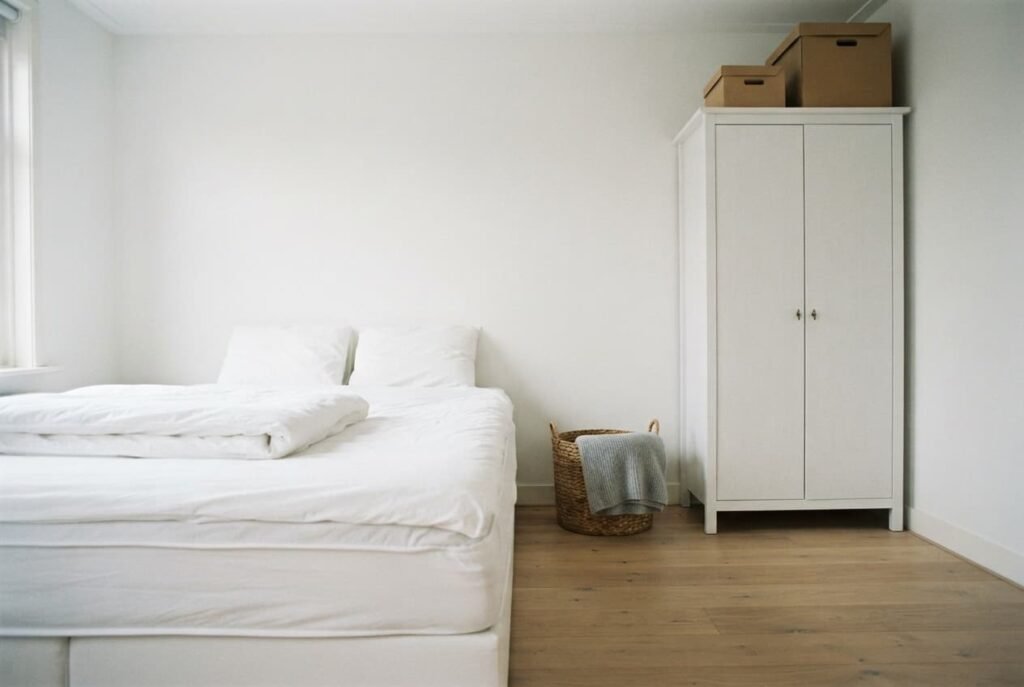
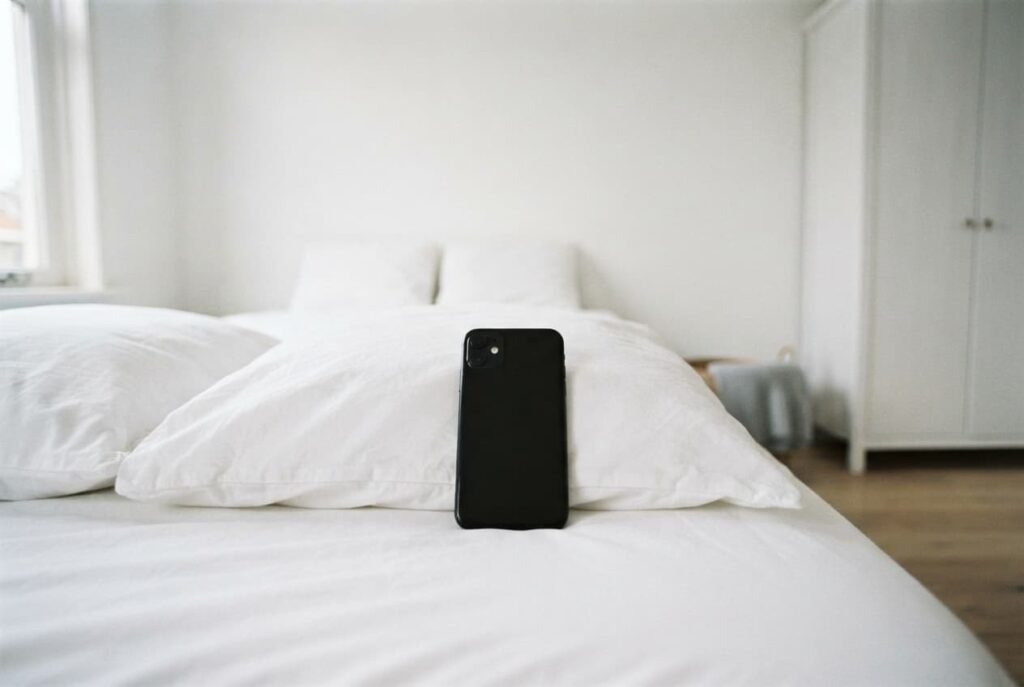
Those upper bands are where the eyes rest when you look along the bed, and they hold the parts of a bedroom that nobody tidies, because they aren’t visible when you stand. Here two boxes lift the wardrobe to 230 cm. A cool white bulb hangs in the ceiling. On the floor beyond the mattress stands a laundry basket with a throw folded over its rim, rising to 80 cm. A phone held at pillow height shows the same bands and makes a fair stand-in for your eyes. Owners usually tidy the floor and the bedside tables, the surfaces that show from standing height, and the view from the pillow stays exactly as it was.
Tidy what the pillow can see.
Four Readings to Take From the Pillow
Lie down on your usual pillows and hold a phone at about 75 cm, which copies your eye position. Then take four readings in order.
1. Ceiling gap: measure from the highest object to the ceiling. Here 250 − 230 = 20 cm, and under about 40 cm the top reads as a squeeze. Miss.
2. Bulb match: compare the colour rating, written in kelvins as K, printed on the ceiling bulb with the rating on the bedside lamps. Here it’s 4000 K against 2700 K, a gap of 1300 K, and a gap over about 500 K shows as two colours. Miss.
3. Foot pile: note anything that rises above the mattress beyond your feet. Here the basket and throw reach 80 cm and span 60 cm, about 18° of your view from 190 cm away. Miss.
4. Object count: photograph the view and count the separate objects above 120 cm. Here there are seven, and more than five tends to read as busy. Miss.
Two misses are plenty. Any pair can make a bedroom look calm standing up and busy lying down, and this one misses all four.
Three Faults Behind a Bedroom That Looks Calm Standing Up
Each fault below can make a bedroom look calm standing up and busy lying down by itself. Test them separately, then stop when the readings turn.
The wardrobe top crowds the ceiling. Two boxes of different heights, 30 cm wide apiece, sit on the 150 cm top, one at either edge, 20 cm under the plaster. From 75 cm up they read as uneven steps in a jagged skyline. Free: take both boxes down, which leaves the top at 200 cm, with a ceiling gap of 50 cm. Rearrange: if they must stay, push them into the corner furthest from the bed’s midline, flush with the wall, which shortens the visible run from 150 to 60 cm. Two flat storage drawers, 15 cm high, for the space beneath the bed are the purchase. The catch is the bed frame, which must clear that height. Slide a ruler under it before you order.
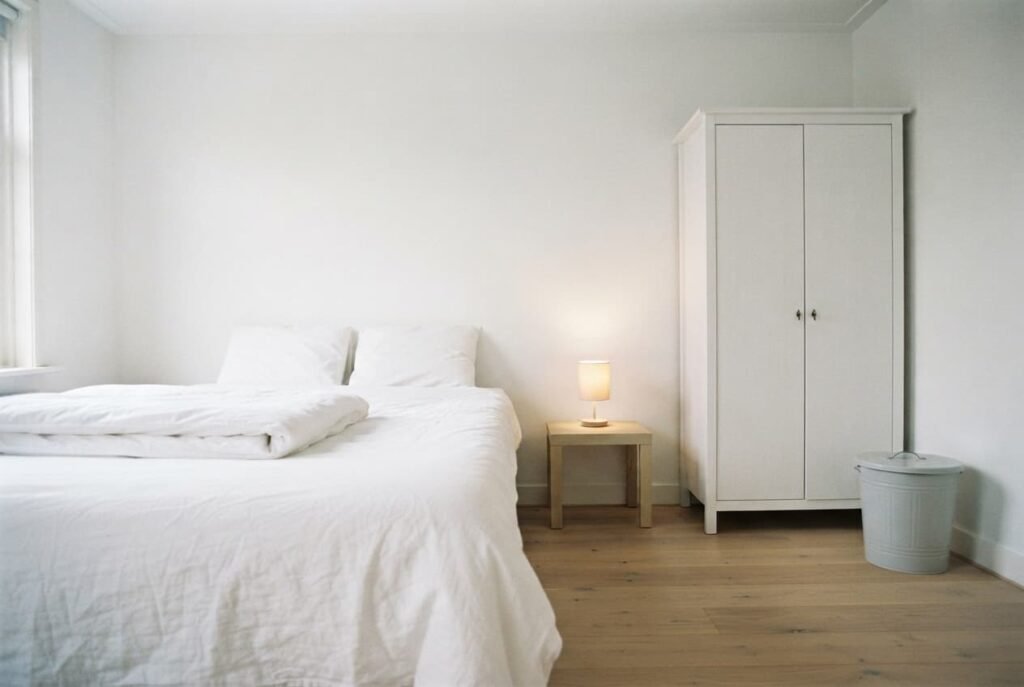
The ceiling light outshines everything else. A 4000 K bulb gives the ceiling a blue-white glow, while the lamps at 2700 K glow amber, and lying down you face both at once. Free: from dusk onward, keep the ceiling fitting dark and use only the bedside lamps. Rearrange: carry a 2700 K bulb from a spare lamp into the ceiling holder if the caps match. Buying a new 2700 K bulb for the ceiling is the purchase. The colour gap then falls from 1300 K to zero. Some fittings won’t take more than one cap type. A glance at the old bulb saves a wasted trip.
A pile sits right on the horizon. The basket and throw rise 25 cm above the mattress, and from 190 cm away they fill 18° of the view at gaze height. The eye lands on them before anything else. Free: carry both out for the night and bring them back in the morning. Rearrange: move the basket 90 cm off the centre line, beside the wardrobe, where it drops out of the zone you look at. A lidded bin 45 cm high in a pale tone is the purchase, since its closed top hides whatever sits inside. The only trap is a lid that doesn’t stay shut.
How to Test a Bedroom Before You Move Anything
Nothing makes a bedroom look calm standing up and busy lying down like a rearrangement judged only from the door. Lie on the bed first and photograph the view with the phone at pillow height, then repeat after each change so the pictures show what each move achieved.
Keep 40 cm free above the tallest object. Read the colour rating on a bulb’s packaging before you buy, and keep it no more than 500 K away from the lamps you already own. A bulb that matches in the shop can still look different at home. Shade and wall both tint the light that reaches you. Check the room again in winter, when the lamps burn for longer each evening and the fitting carries more of the view.
Lie down again after every change.
The Repair That Isn’t Worth Trying
Many owners reach for a darker ceiling to push the glare away, and it seldom works. A dark surround makes the bulb look brighter by comparison. The glow you meant to hide becomes the sharpest thing in view. Dark paint also absorbs light from the lamps, which pushes you toward a stronger ceiling bulb. That raises the contrast again. A rented flat must repaint the ceiling before you leave. The work is then done twice for nothing, and a weekend vanishes.
A heavy curtain across the whole wall behaves similarly. It buries the wardrobe top, yet it adds a large dark mass at exactly the height of the gaze, and its folds create new edges where the eye stops. Neither move touches the readings that failed.
Tonight, lie down with the phone at pillow height and run the four readings. Most bedrooms improve with two free moves: the boxes off the top and the pile out of the view. A week later, repeat the photograph from the same pillow with the same phone angle. Should a reading still miss, adjust that single item. Everything else can stay put. Keep the first photograph in your phone, because comparing the two shows how far the view has moved. A gain like that fades from memory once the room looks right, and the pictures don’t. Nothing else needs touching.
Questions and Answers
Why does a room look different when you lie down?
Lying puts your eyes about 75 cm above the floor instead of 160 cm, which lifts the wardrobe top and the ceiling into the zone where the eyes rest, along with the light fitting. Those areas aren’t tidied often, which is why a calm room can look busy from the pillow.
What is the quickest thing to try tonight?
Take anything off the top of the wardrobe, move the basket away from the mattress, and keep the ceiling fitting dark so only the bedside lamps burn. Ten minutes is enough. Nothing needs buying or drilling. Lie down afterwards and photograph the view to compare with the first picture.
Do I need to repaint or replace the wardrobe?
No. All three fixes work on what stands on the wardrobe, what sits beyond the mattress and the bulb overhead. That leaves the wardrobe and the walls exactly as they are. Most bedrooms need nothing beyond a bulb or a lidded bin, and painting is optional.