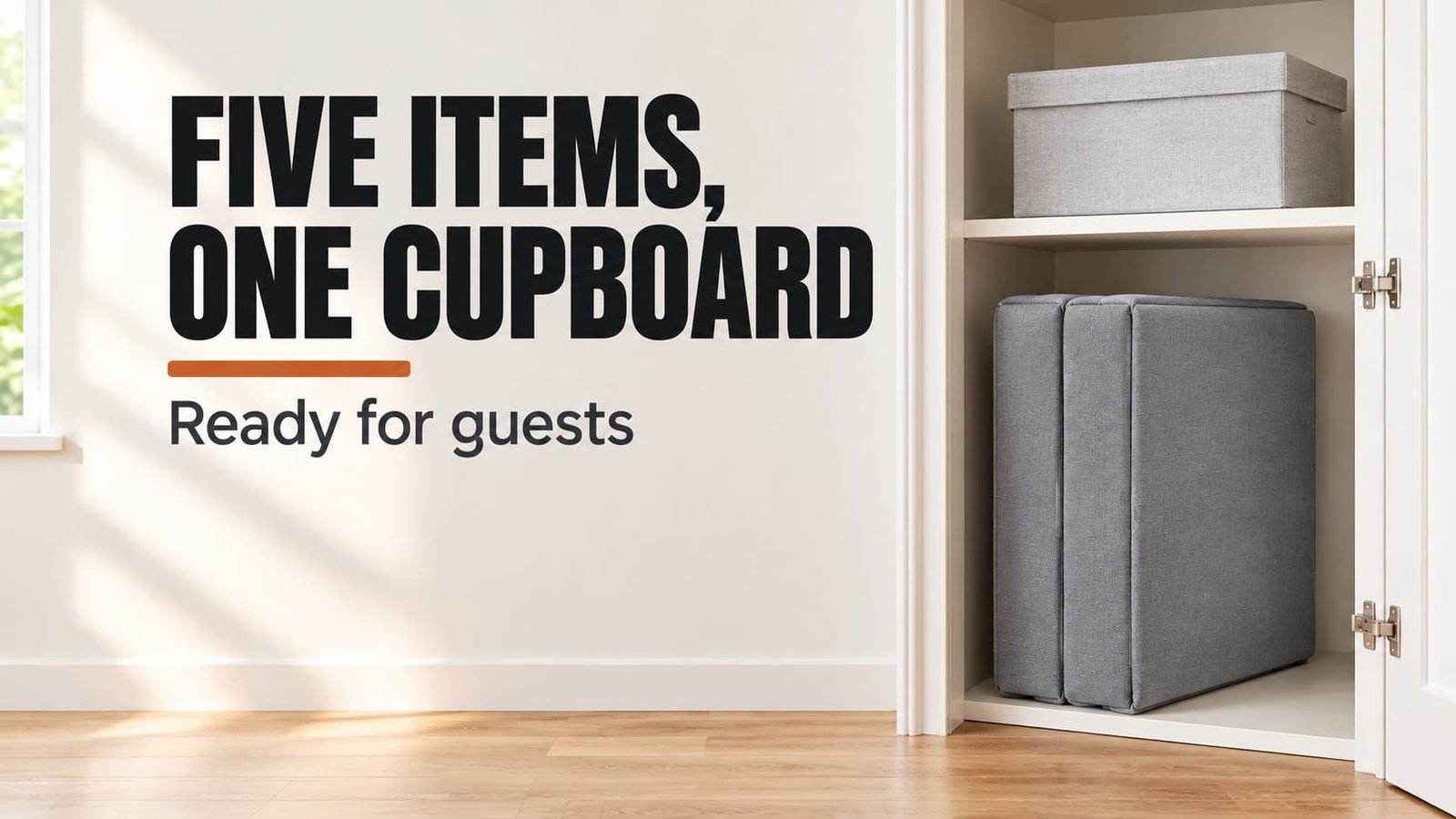
Being ready for overnight guests in a one-bedroom flat takes five purchases and one rule: plan around the guest’s night and let every other choice follow. Our sample flat is in Groningen. It has a clear strip of living-room floor measuring 240 by 140 cm and a hallway cupboard 90 cm across and 70 cm front to back. Treat the figures as samples and measure your own rooms before you shop. Items are ranked by how much harm a bad choice would do to a visit, and a firm skip list closes the article. No spare room is needed.
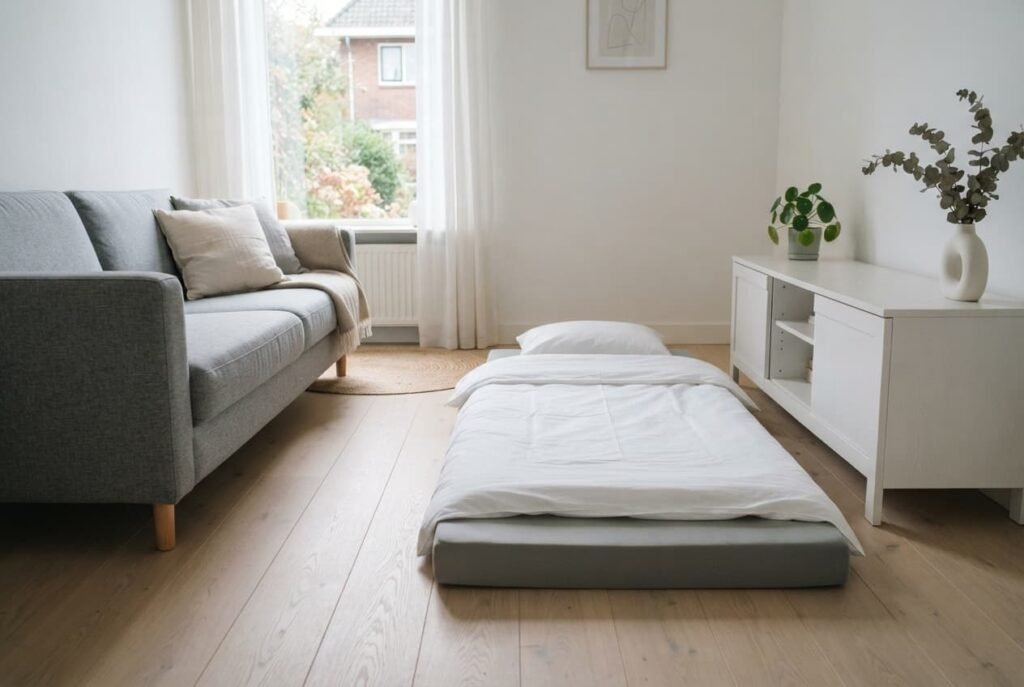
Why Being Ready for Overnight Guests Starts With the Floor
A guest corner has to appear for one evening and vanish afterwards. That sets the two limits every purchase must meet: how much floor it covers while it’s out, and how much shelf it takes while it’s away.
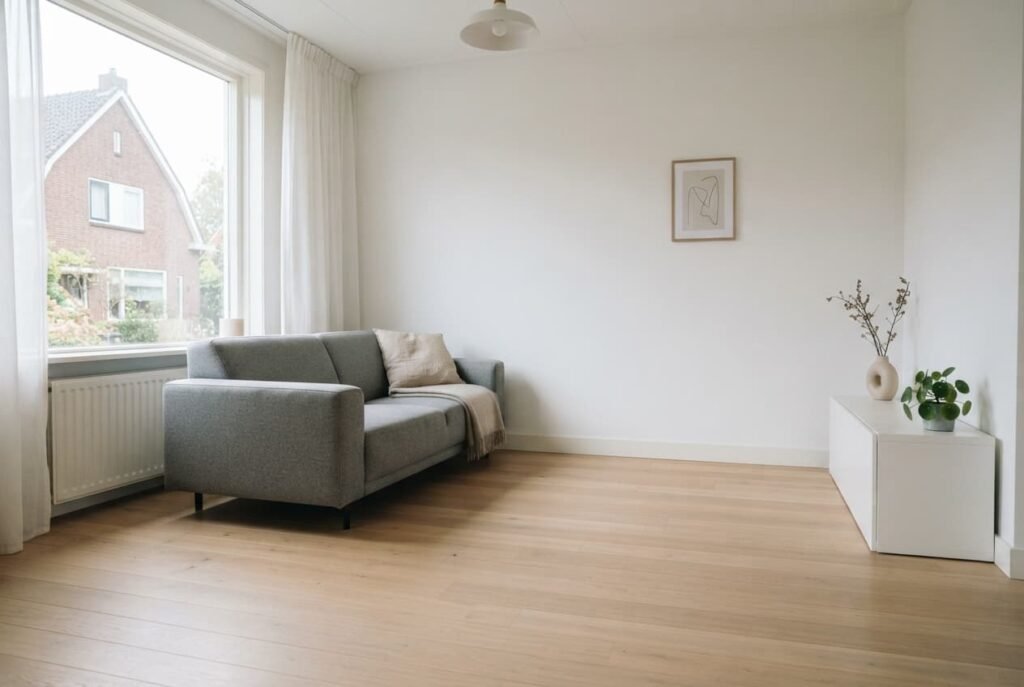
Floor comes first, and it’s easy to count. The strip offers 240 × 140 = 33,600 cm². A mattress of 80 × 190 cm covers 15,200 cm², which is 45% of it. A luggage stand of 60 × 45 cm adds 2,700 cm², and together they take 53%. The remaining 15,700 cm² is where people actually walk and set down a glass.
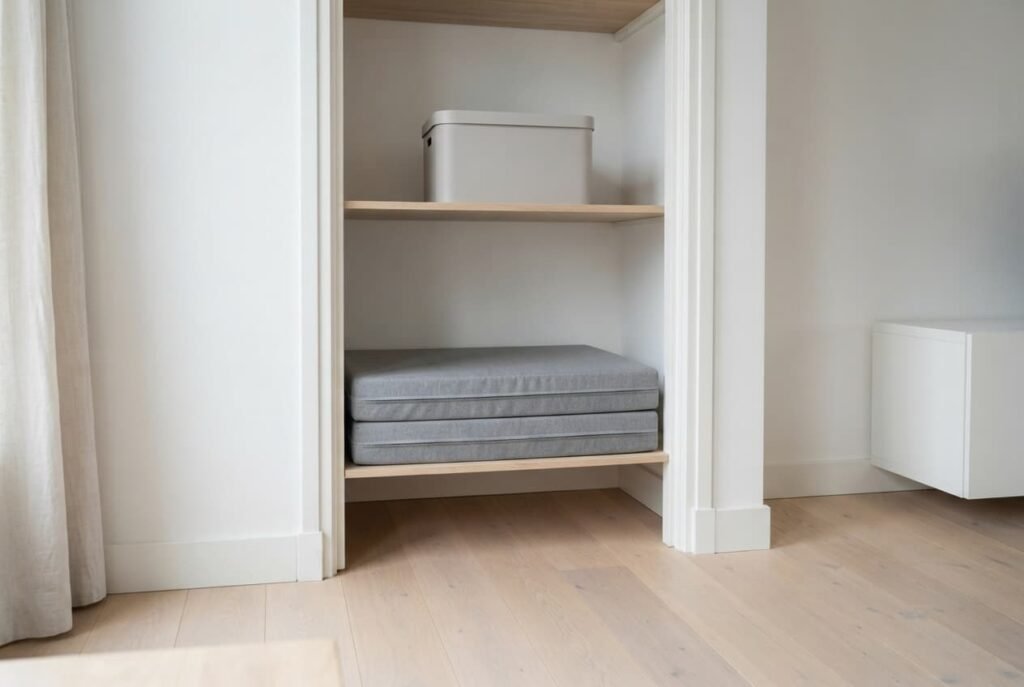
Now the shelf. The cupboard offers two shelves, 45 cm apart, each measuring 90 by 70 cm. Everything below must fold into that space. In practice, the kit must vanish into one cupboard between visits. A piece that can’t, such as a rigid bed frame, stays in the room all year and takes the living room with it.
Weight matters too. You’ll lift this kit out of a cupboard and back each time. A pair of 12 kg loads is manageable, and a single 25 kg one isn’t.
Five Purchases in Order for the Guest Corner
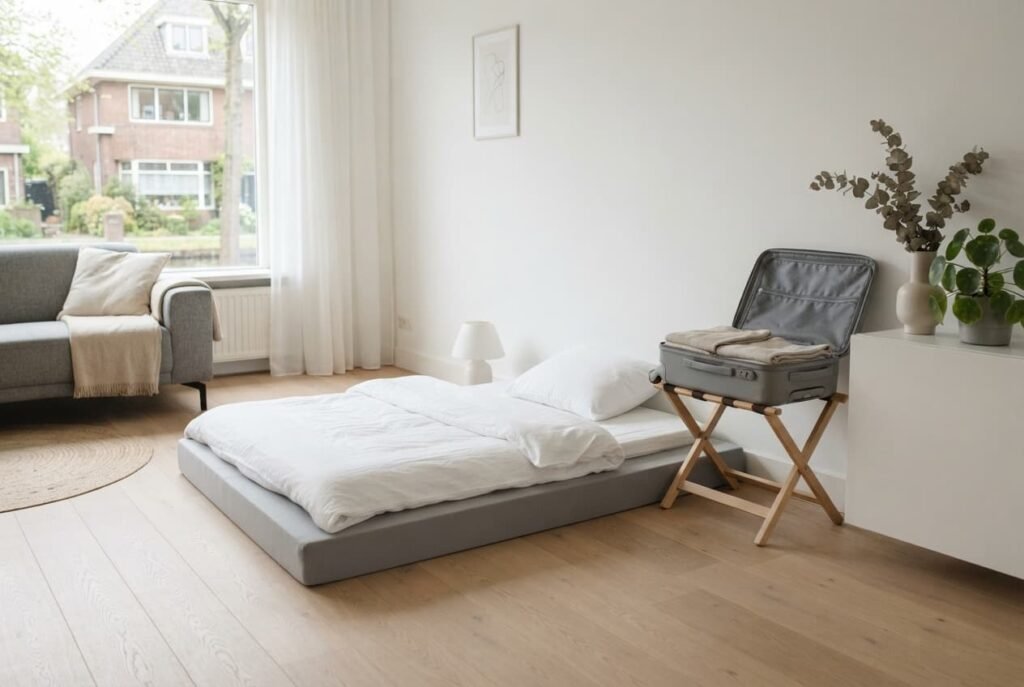
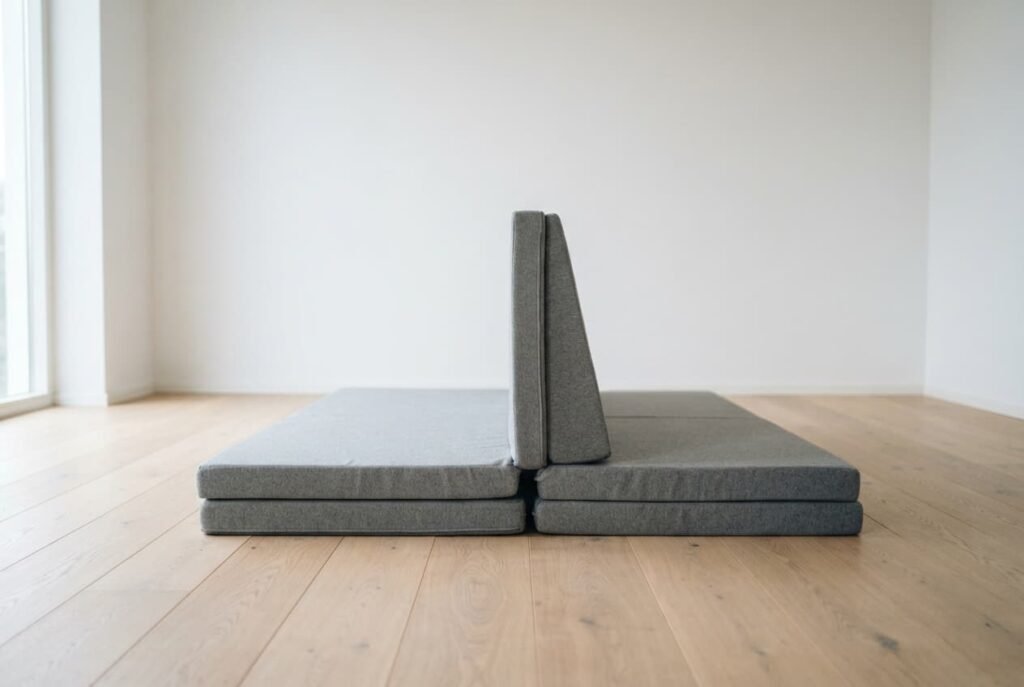
1. A tri-fold foam mattress of 80 by 190 by 12 cm. It leads the list because it carries the whole night, and no later purchase can make up for a poor one. It folds into three panels of 63 cm, and the folded block measures 80 by 64 by 36 cm, which slides onto the lower shelf and leaves 9 cm of headroom. Tier: BUY ONCE, since dense foam decides its working life and a zip-off cover keeps it clean. Weak point: a panel thinner than 8 cm, where a hip reaches the floor.
2. A bedding set made up of a fitted sheet for 80 by 190 cm, a duvet of 1.4 by 2 m and one pillow. The duvet hangs (1.4 m − 0.8 m) ÷ 2 = 30 cm over each side. Tier: BUY CHEAP. Six nights a year barely wear bedding, and a hot wash renews it. Weak point: a sheet with elastic only at the corners, which creeps loose when the mattress shifts.
3. A luggage stand, 60 × 45 cm open and 50 cm high. A suitcase on the floor needs the same 60 × 45 cm patch plus room to kneel, and on the stand it opens at seat height. Tier: BUY CHEAP. The frame holds nothing heavier than a case. Weak point: no cross-brace, which lets a 15 kg case rack sideways.
4. A reading lamp whose switch sits on a 1.8 m cord. The mattress lies 12 cm off the floor. The lamp therefore sits low, and its switch must reach the pillow. Tier: BUY CHEAP, as no part of a lamp carries a load. Weak point: a switch on the lamp head, which sits out of reach.
5. A lidded box measuring 70 by 55 by 30 cm, for the bedding. It holds 115 litres. Folded in four, the duvet takes about 49 litres. The pillow adds 20 and the sheet 3. That makes 72 litres, or 62% of the box. Tier: BUY CHEAP; plain plastic does the job. Weak point: a lid that bows under a stacked blanket and lets in dust.
Five items finish the kit that keeps a one-bedroom flat ready for overnight guests, and one cupboard holds it.
Why the Mattress Is the Item to Drop a Tier
The mattress is the biggest ask on the list, and that invites the closest scrutiny. Being ready for overnight guests doesn’t mean owning the best foam. A foam block built to last for ten years of nightly use is overbuilt for six nights a year. Over ten years that’s about 60 nights, and a 10 cm mattress of medium foam does the same job.
The thinner choice also fits better. At 10 cm, the folded block measures 80 × 64 × 30 cm, which leaves 15 cm under the upper shelf instead of 9. The extra 6 cm lets the block slide in and out without scraping the shelf above, and a thinner mattress is also about a sixth lighter to lift.
Keep a check on firmness. Push a fist down into the centre of the foam: if you feel the floor through it, it’s too thin. Heavier guests need the thicker block. Choose 12 cm only if friends of that build visit regularly.
Spend what you save on the bedding, because that’s the part guests touch. A mattress that feels firm under a soft, clean sheet is judged kindly.
Order and Timing: Getting Ready for Overnight Visitors
Spread the work over three weeks. A tidy flat is ready for overnight guests because each item arrives with time to be tested.
In week one the mattress comes, and you unfold it on the strip and lie on it for ten minutes yourself. Check the panel creases and the cover zip. Week two covers the bedding, which goes through a hot wash before its first use.
Week three brings the last pieces. Set everything up as if guests were due that evening, and time it. Unfolding the mattress takes roughly a minute, and making the bed adds four. If the lamp cord doesn’t reach the pillow, change its place now.
Fold it all away and put the box on the upper shelf. A kit that goes back in one go is a kit you’ll bring out again. Write the date of the dry run on the box lid, since a note there tells you in a year what you last checked.
Nothing in this plan needs longer than three weeks.
What to Skip
Skip a sofa bed, because the flat already has a sofa and a bed, and a third frame costs floor all year. Skip an inflatable bed as well. A pump and a repair patch come with the bed, and slow deflation overnight turns a kind gesture into a poor one. Leave out spare cushions, since guests can use the sofa’s own. A second duvet isn’t needed until two visitors stay at once, and a guest wardrobe adds no storage you don’t already have. Towels can come from the bathroom shelf on the day. Skip a guest-only set of toiletries too; a small basket of your own spares, restocked after each visit, does the same job. The five items take 53% of the strip when out and one cupboard when away.
Let the first real visit show what’s missing. If a guest asks for the same thing twice, that request describes a sixth item better than any list could. Until then the five pieces carry each visit, and the flat returns to its normal shape the morning after. Keep a note of what was used and what was missed, and review it after the second visit. Resist filling the strip with extras, because empty floor is part of what makes a guest feel welcome.
Questions and Answers
How many pieces do I really need?
Two groups will do for one visit: the mattress with its bedding, and a lamp plus a luggage stand. The box only helps with storage. If your guest brings a roll mat and a bedroll, only the lamp matters, with the stand optional. Add the rest after a first stay.
When should I buy them before the first guests arrive?
Order the mattress three weeks ahead so you can test it, and wash the bedding a week before. The lamp and stand can arrive at the last minute, because they need no testing. Leave a day free for the dry run, when you set everything out once and time it.
How can I judge a folding mattress in a shop?
Unfold one panel and push a fist down into its centre. If your knuckles meet the floor, it’s too thin. Check that the cover zip runs smoothly all the way round, and that the panel creases lie flat. A mattress that keeps its shape after a few seconds under your weight will last.