Last weekend the new worktop went in, and now the kitchen looks off whenever the light comes on. The top seems to sit against the old kitchen cupboards like a visitor from another house, though nothing is broken. Only three faults produce that look, and a tape measure settles which in a single evening. The top is sound and every door still closes, which tells you the trouble is purely visual. We’ll work in a rental kitchen of 240 × 300 cm in Utrecht. The cupboards are cream, and the run of grey top measures 240 cm. All figures are rounded samples. Substitute your own numbers.
Why a New Worktop Looks Wrong Against the Old Kitchen Cupboards
Set against the old kitchen cupboards, a worktop gets weighed in three ways at the same moment. Your eye judges how heavy the edge is. It also judges how pale the surface is and what colour of light lands on it. A new top seldom misses on all three, though a single miss is enough to make the old fronts look tired.
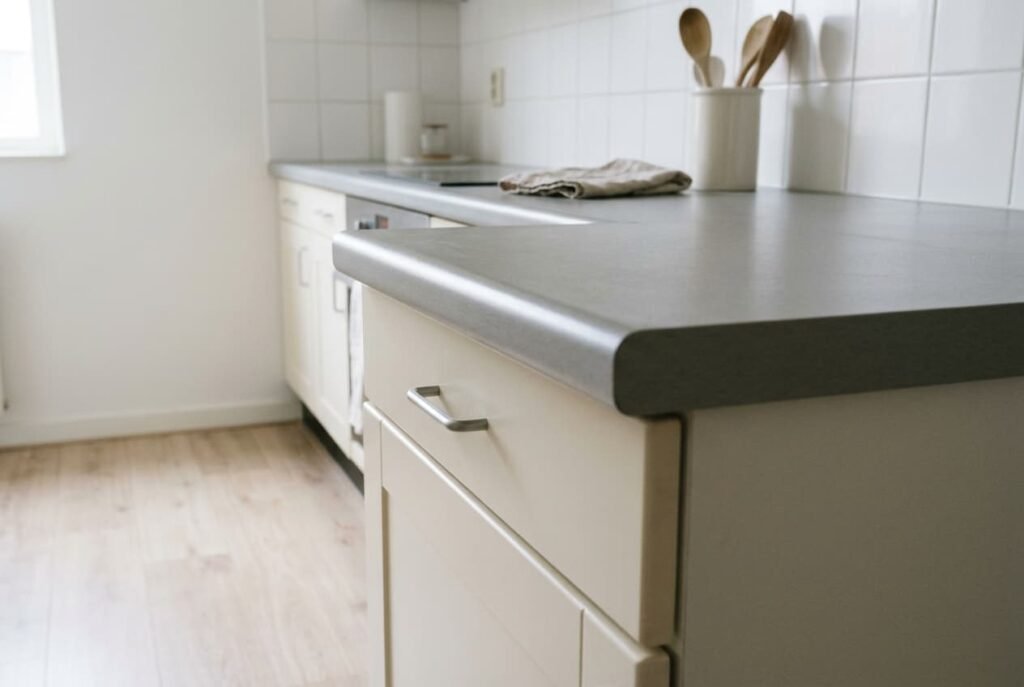
Take the edge first. The new top is 4 cm thick with a 4 cm overhang, while the old one was 2.5 cm thick with a 2 cm overhang. A deep overhang throws a shadow, and the shadow becomes part of the edge. The new stripe therefore measures 7 cm above an 18 cm drawer front, which is 39% of its height, whereas the old stripe was 4 cm, or 22%. Tone is the second gap: cream doors reflect 72% of the light arriving, while the grey top reflects 38%, a difference of 34 points.
Many owners conclude that the cupboards must be replaced. The doors are rarely at fault, since each of those gaps can be narrowed without touching a hinge, and fresh doors would meet the same top in the same light.
Five Checks From the Doorway at Dusk
At dusk, stand 300 cm from the worktop by the door, with the lamps on that you normally use. Each check produces a number.
1. Narrow your eyes until detail blurs. If the top still reads as a heavy band, add the edge to its shadow and divide by the drawer height. A result over 30% flags the proportion.
2. Lay a plain white sheet against a door, then against the top. If the two look far apart in brightness, expect a gap of 30 points or more.
3. Read what the bulbs say on their base. About 4,000 K is a cool white that dulls cream, and 2,700 K is a warm white that keeps it.
4. Notice where your gaze lands as you enter. If it runs along the slab and halts at its end, the run has become the focal point.
5. Take a photo and shrink it to stamp size. Whatever still stands out at that scale is the fault.
Ours fails the first two checks and the fourth.
Three Faults Behind a Worktop That Clashes With the Old Cupboards in the Kitchen
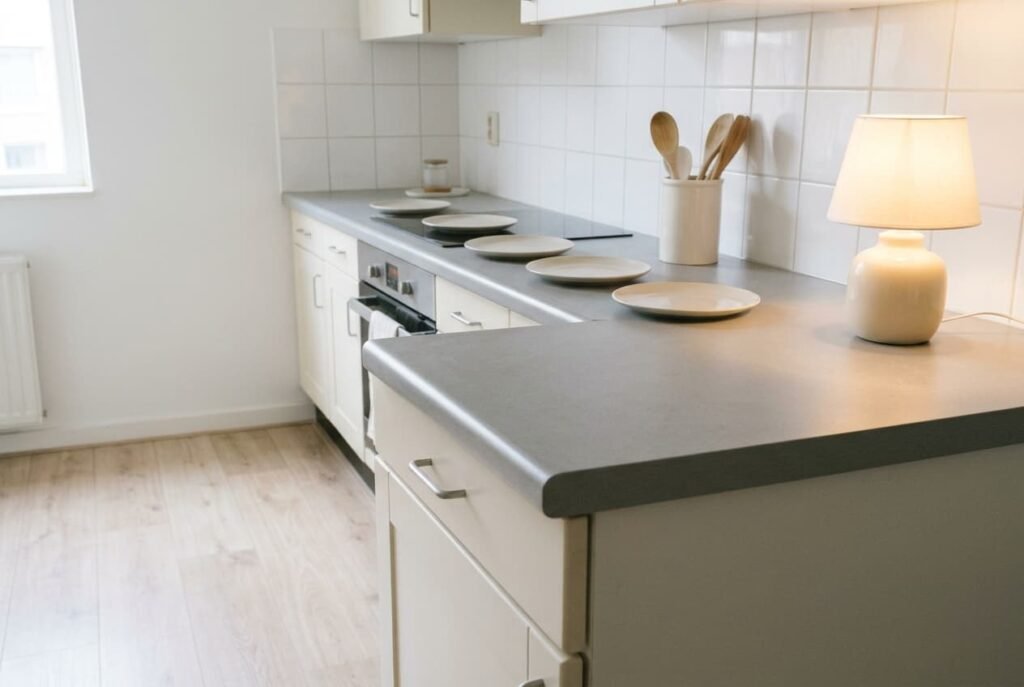
“The edge looks like a heavy slab.” Scale causes this: the 7 cm band against an 18 cm drawer front gives 39%, where the old top gave 22%. Free: take a lamp from another room and turn it towards the front edge, from above. The shadow shrinks and the band drops to about 5 cm, or 28%. Rearrange: lean a tall board or a row of jars against the upstand at the far end to break the long line. Buy: a joiner can bevel the edge, trimming the visible face to 2.5 cm and bringing the band close to the old 4 cm, for half a day of labour. It only works when the top is thick enough to cut. Measure again at dusk afterwards: a band under 30% of the drawer height means the fault is gone.
“The top is a dull grey next to warm doors.” Tone and lighting cause this. The 34-point gap is real, and cool bulbs widen it. Free: in the evening use the warm table lamp alone and leave the overhead off. Rearrange: carry the door tone along the top with four pale objects spaced 60 cm apart. A plate and a bread bin will do. Buy: bulbs of 2,700 K cost very little. The 34 points remain, because only repainting the doors would close them. To test the lamp, hold a white sheet against a door under it: the sheet should look cream, not grey.
“My eye slides along the slab to its last metre.” Placement causes this. An unbroken 240 cm run is the longest uninterrupted line the doorway view offers, and it finishes at the fridge, which gives the gaze nowhere else to stop. Free: move the kettle and the chopping board to that end so that something anchors it. Rearrange: put a stool or a plant on the open side, 30 cm from the edge. Buy: a narrow shelf or a small pendant above the middle of the run offers the gaze a second resting place. The fridge sets the limit, because it can’t move. Stand in the doorway again afterwards. If your gaze now pauses at the shelf before reaching the end, the fix has worked.
What to Settle Before the Next Worktop Is Ordered
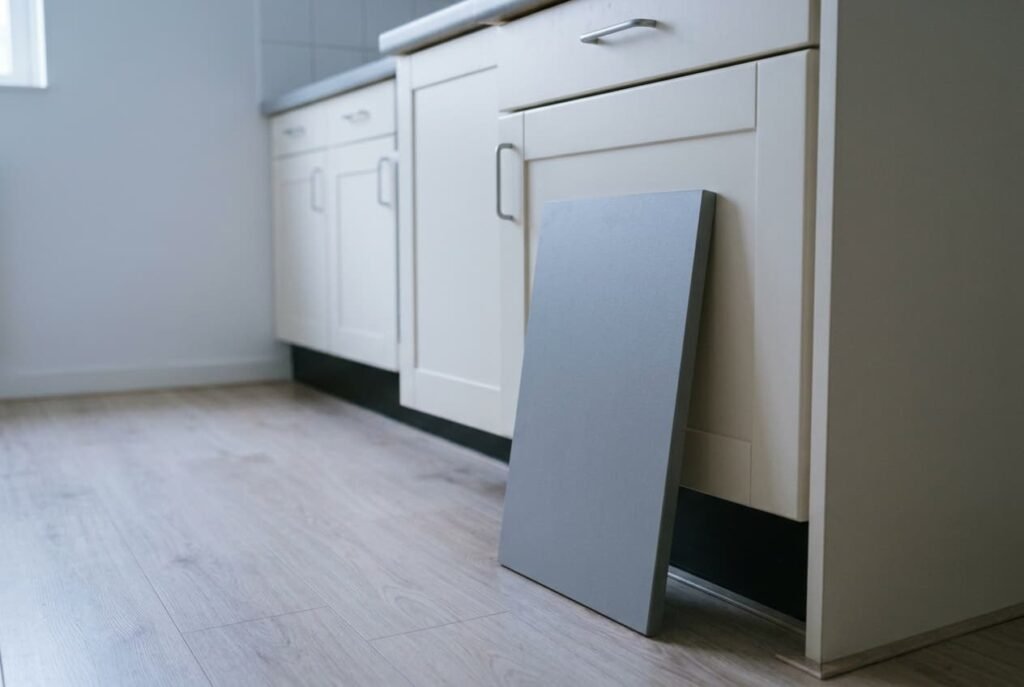
Prevention costs less than any repair. Ask for a sample big enough to hold against the old kitchen cupboards, then look at it at dusk in the spot where it will lie, since showroom lights tell you little. Measure the edge of the old top and hold it beside the new one. A move from 2.5 cm to 4 cm is a 60% jump, and that alone changes the proportion. If the maker prints a reflectance figure, keep the gap to the doors under 30 points.
Plan the end of the run too. A top that finishes against a tall unit gives your gaze somewhere to rest, whereas one that ends in open air offers nothing.
Photograph the old kitchen before the work starts.
The Fix That Isn’t Worth Doing
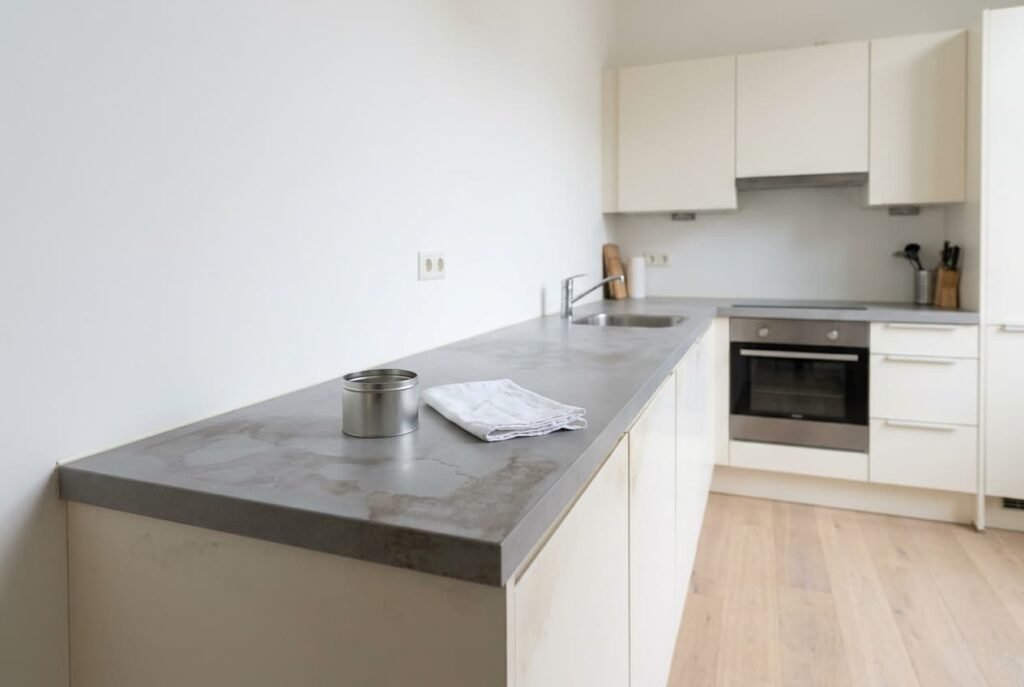
Staining or tinting the new top to match the doors looks like the lowest-cost answer, and it rarely works. A factory finish doesn’t accept colour evenly. The result comes out blotchy, and the protective layer is damaged along the way. The tone gap moves by a few points while the surface gets worse.
Most makers also withdraw their guarantee once the finish is altered. A 240 cm run needs several coats, which means days of drying and a strong smell in a small kitchen. If the colour is still wrong, there’s no way back, because the original finish is gone. The top will still look wrong against the old kitchen cupboards, only more expensively.
Put the effort into light and placement instead. A bulb swap takes minutes, and a rearranged shelf takes one evening.
A worktop that looks wrong beside old cupboards is nearly always wrong for a reason you can measure. Start with the edge proportion, since a 39% stripe is the most visible fault. Compare the tone gap next and the focal run after that. Photograph the wall after each change, because a thumbnail reveals what a weary eye lets pass. If you only make one change, light the front edge with a spare lamp, at no cost. It cuts the stripe from 39% to 28%. The rest can follow whenever the budget allows, and the photographs also help if a landlord asks what changed.
Questions Readers Keep Asking
What is the most common cause?
The edge. A top that’s 1.5 cm thicker than the old one, with a deeper overhang, adds a band of shadow the doors never had. Measure that stripe and divide it by the drawer height. Anything above 30% is the first suspect, and it’s the quickest to check with a ruler.
Is there a quick fix that costs nothing?
Yes. Turn a spare lamp towards the front edge from above and the shadow shrinks. In our kitchen that cuts the stripe from 39% to 28% within a minute, with nothing to buy. If the grey still looks cold, switch off the cool overhead bulbs for the evening.
Can this be fixed without replacing the cupboards?
Almost always. Each fault has a low-cost cure, such as an angled lamp, and a joiner can bevel the edge if you want a lasting result. Replace the doors only if they’re damaged for another reason, since new ones would meet the same top.