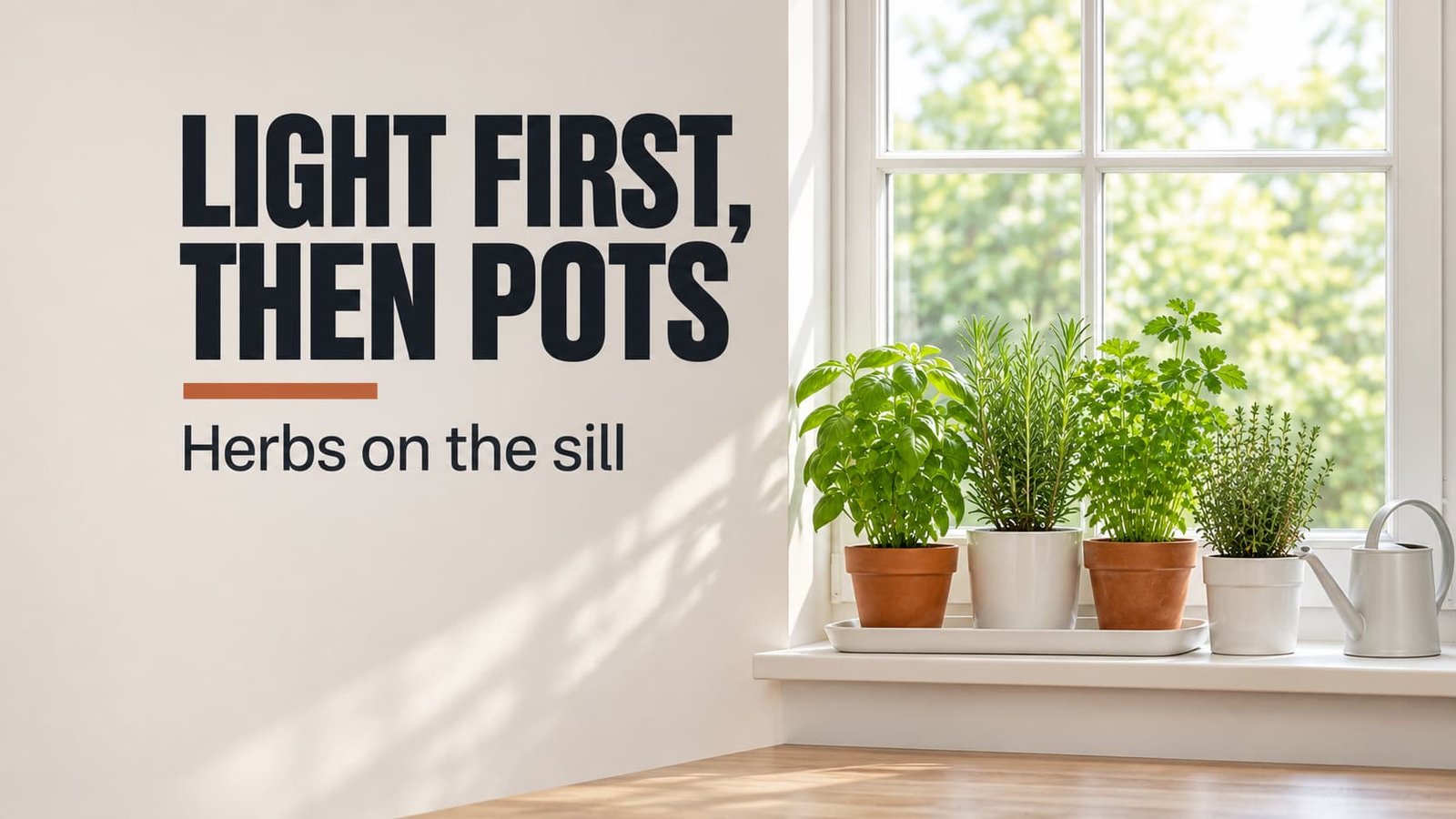
A kitchen windowsill herb garden fails for two plain reasons: the plants get too little light and the roots get too much water. Both problems are easy to prevent when you buy in the right order. Our sample kitchen is in Utrecht, with a sill 110 cm by 20 cm, and five purchases fit on it. These figures are samples. Check each one against your own sill before shopping. The order follows how much a wrong pick costs, and a brief list of what to leave out ends it. You don’t need everything on day one, and you’ll see why below.
Why Herbs on a Kitchen Windowsill Start With Light and Heat
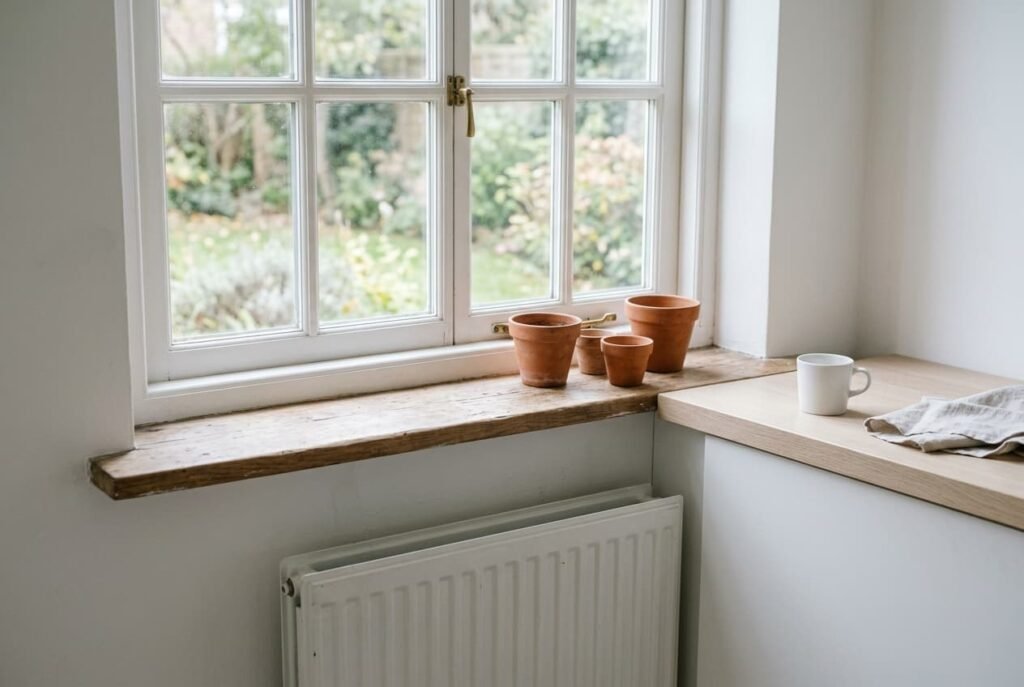
Light and heat set the terms for a kitchen windowsill herb garden before any purchase does. Herbs grow slowly, and most of them want several hours of direct sun each day. Dutch daylight lasts roughly 8 hours in midwinter and roughly 16 in midsummer. The sill that feeds basil in June therefore barely keeps it alive in January. A window facing south or south-west gives the most light, whereas a north-facing one suits only chives and parsley, and even those grow slowly.
Check what sits under the sill, too. Many Dutch flats put a radiator beneath the kitchen window, and the warm air it sends upward dries compost fast. Rest a flat hand on the sill for a minute. If it’s warm, expect to water more often. Keep leaf tips off the glass on frosty nights, because a leaf pressed to frosty glass can be nipped.
Those facts set the buying order: drainage comes first and the plants come last. A pot without a hole drowns the roots within a week. Without a tray, the first watering lands on the sill itself. Weak compost slows growth for months, yet you won’t see it until spring.
Kitchen Windowsill Herb Garden: Five Purchases in Order
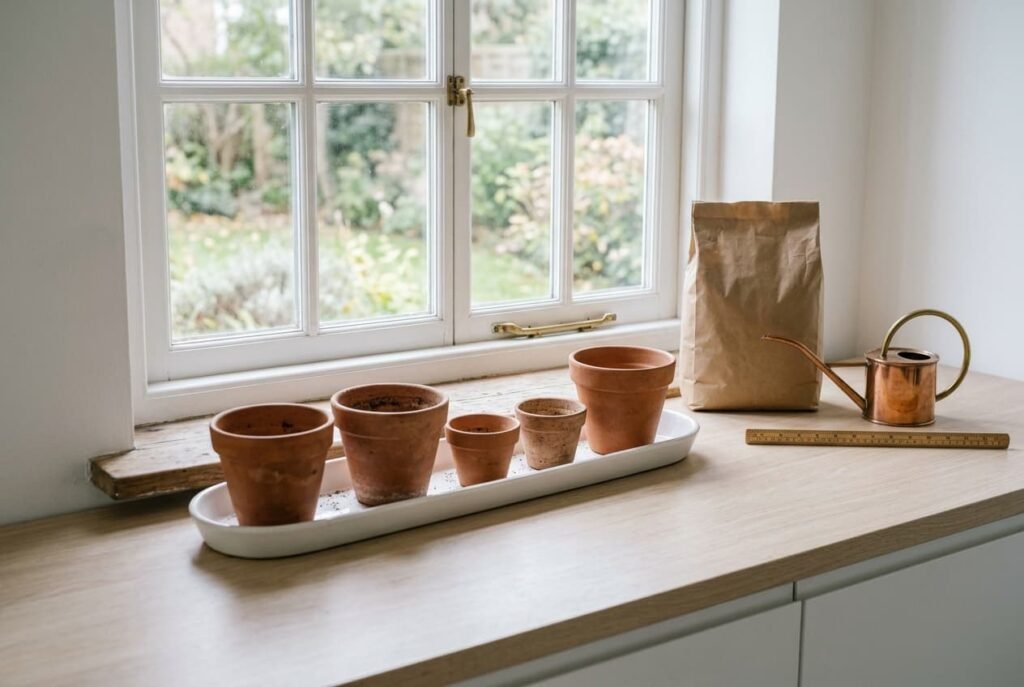
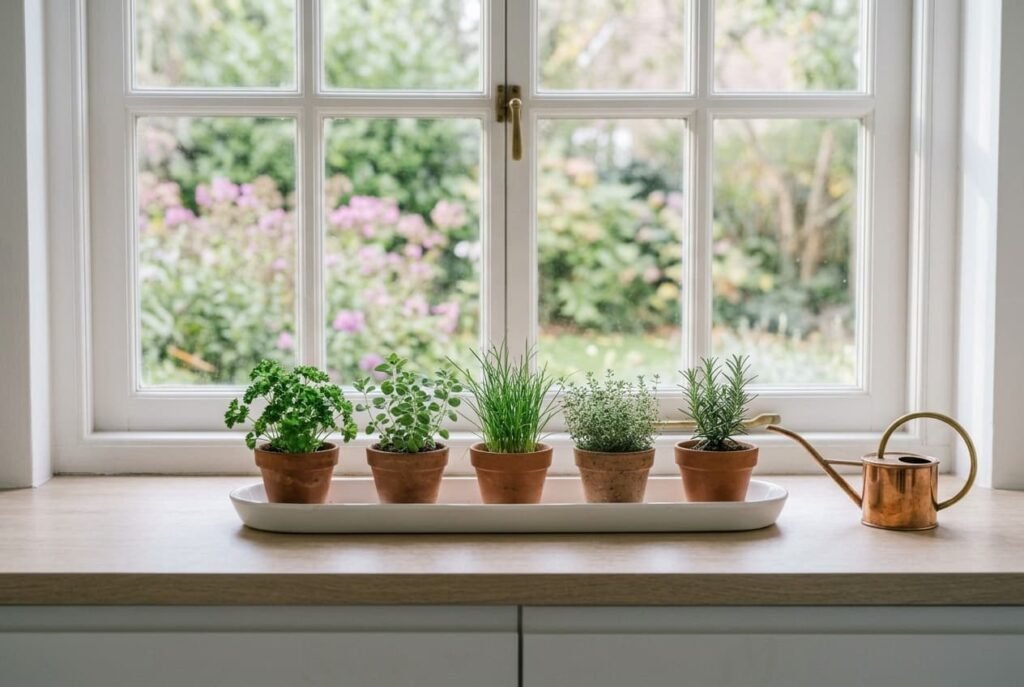
The sill offers 110 × 20 = 2,200 cm². The tray below covers 75 × 16 = 1,200 cm², which is 55% of it. That leaves 35 cm at one end for the window handle.
1. Five pots with drainage holes, each 12 cm across the rim and 11 cm tall. Drainage decides whether a root lives, because standing water leaves it no air. Each pot takes about 0.8 litre of compost. Tier: MID. A thick wall of fired clay or stout glaze evens out wet and dry swings. Fault to watch for: no hole at all, or a glazed base whose hole is sealed by a lip.
2. A waterproof tray, 75 × 16 cm, with a 1.5 cm rim. Five pots of 12 cm plus four gaps of 3 cm span 72 cm, which fits. The rim holds 75 × 16 × 1.5 = 1,800 cm³, or 1.8 litres, and a full round of watering is 0.75 litre. Tier: BUY CHEAP; trays have nothing that can fail. Fault to watch for: a thin base that bows under about 6 kg of wet pots, or a rim under 1 cm that lets water creep over.
3. A 10-litre bag of peat-free multipurpose compost. Five pots take about 4 litres, which leaves 6 for repotting. Tier: MID, because the texture sets how fast water drains. Fault to watch for: dust-fine or sodden compost. Squeeze a handful; it should crumble and not set like clay.
4. A 1-litre watering can with a long, narrow spout. One fill covers the 0.75 litre round. Tier: BUY CHEAP, since any plain body does the job. Fault to watch for: a short, wide spout that floods the pot and pushes compost out.
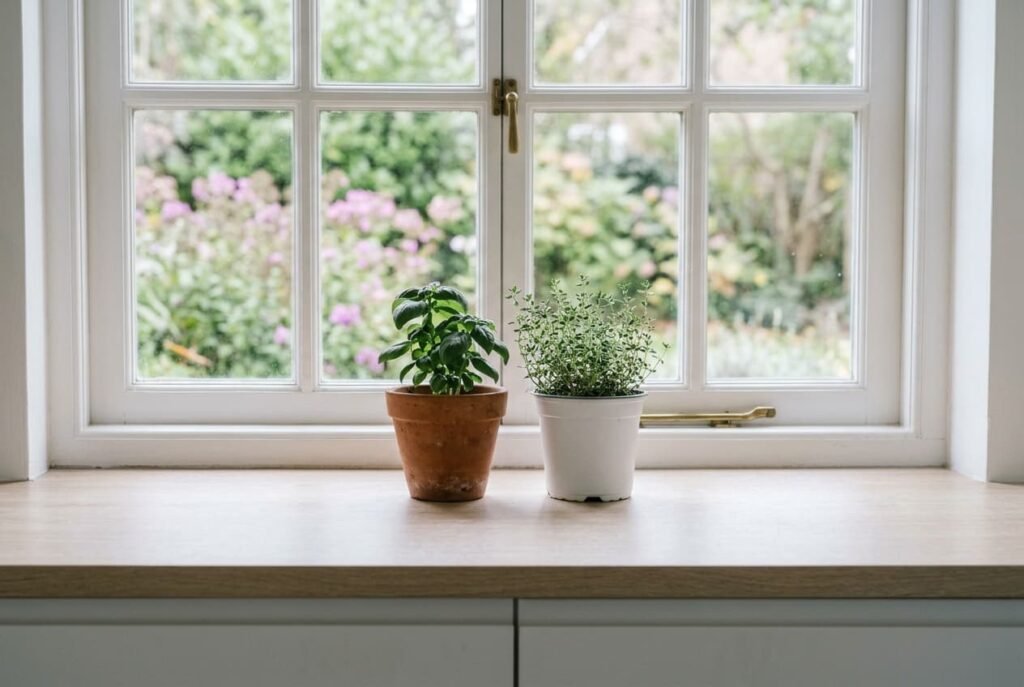
5. Five young herb plants. Basil and thyme want the most sun. Chives and parsley cope with less. Mint spreads by runners and therefore gets a pot of its own. Tier: BUY CHEAP. A herb plant lasts only a season or two. Fault to watch for: pale stretched stems, or roots already poking from the drainage hole.
Bought in this order, the set is ready to plant on the same afternoon.
Why the Pots Are the Item to Drop a Tier
Item one asks for the most, which earns it the hardest look. Clay loses water through its whole wall, which suits thyme. Above a radiator, though, the same wall dries basil and parsley far too fast. A plastic pot with holes holds moisture longer, and the plants arrive in one anyway.
The arithmetic agrees. A nursery pot is about 10.5 cm across. Five of them plus four 3 cm gaps need 5 × 10.5 + 12 = 64.5 cm. A tray of 65 × 16 cm covers an area of 1,040 cm² that is 47% of the sill, against 55% before.
Keep each plant in its own pot for now, stand the pots in the tray and water as usual. When you see roots at the drainage hole, move the plant to a pot one size up. Save one clay pot for thyme, which likes a drier root zone, if you want something handsome on a kitchen windowsill herb garden. Choose clay for everything only if your sill stays cool or you often forget to water, because clay forgives a late drink.
A plastic pot costs nothing extra when it arrives with the plant.
Order and Timing: Four Weeks to a Working Sill
Take it in four weekly steps. The first week is for the pots and tray, with the can beside them and no plants yet. Fill the pots with compost and set the tray out. Then watch the sill, noting where the sun lands in the morning and again in the afternoon.
The plants arrive in week two. Put basil and thyme on the brightest end. Chives and parsley go beside them, and mint takes the dimmest spot. Give each pot 150 millilitres, which is the 0.75 litre round divided by five, and empty the tray an hour later.
Week three sets a routine. Press a fingertip into the compost to your first knuckle and wait until it feels dry there. Week four is for cutting: pinch the top pair of leaves off the basil so it bushes out, and trim the chives to 3 cm above the compost.
Every step answers a problem you can see, which is why the garden rewards patience. Stop buying once the sill works.
What to Skip
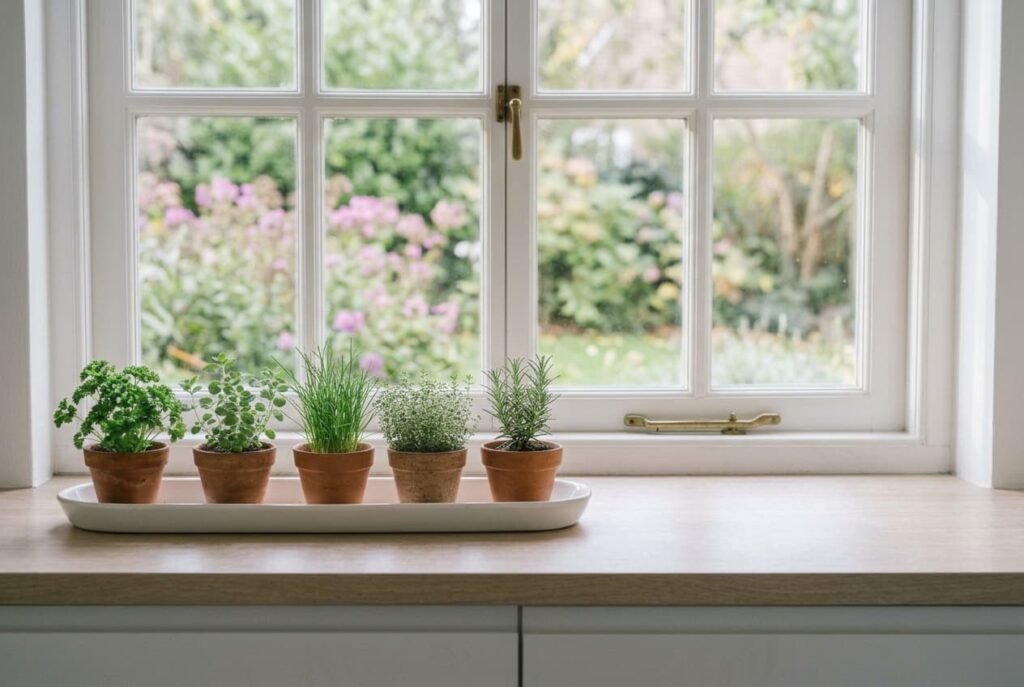
Skip a plug-in grow light for now, because the sill’s own light is plenty from spring to early autumn. Winter is the exception, and you can judge that after you’ve watched one. Hold off on plant food as well. Fresh compost carries nutrients for about the first month, and extra feed makes weak, leggy growth. Self-watering pots are a trap for herbs, since they keep the roots wet. A moisture meter adds little when your finger does the same job. Seed kits with tiny pots look neat, yet sowing a dozen herbs at once leaves a crowd you can’t thin. Every extra pot on a kitchen windowsill herb garden takes sill from the window handle, and a handle you can’t reach turns the whole corner into a nuisance.
The five items take 55% of the sill and solve one problem each, which makes the order weigh more than the item total. Further purchases can wait until the sill has run for a month. If a gap remains by then, you’ll know what the missing piece must do, and that guides a purchase better than any list. Resist the urge to fill every centimetre, because bare sill is room for the plants to grow.
Questions Readers Keep Asking
How many pots do I really need?
The full list is five, yet three will start you off. Chives and parsley share a tray happily, and basil joins them. Add thyme and mint once you’ve learned how fast your compost dries. A half-empty tray costs you nothing, and nobody needs every pot in the first week.
Which should I buy first if I can only afford one?
The pots with holes, or a tray if you own pots already. Drainage alters every watering you do, which no other item manages. Pick a tray with a rim of at least 1.5 cm. A weak tray lets water reach the sill. A poor compost only slows growth.
How can I judge a young plant in the shop?
Turn the pot over and look at the holes. A few pale roots are fine, but a dense mat means the plant has outgrown its pot. Check the stems too: they should be short and green, with leaves close together. Leggy, pale growth means the plant grew in too little light.