A knitting corner beside the sofa works only when you can see every stitch without craning forward. Our corner is a strip of wall 85 cm long that reaches 65 cm into a Rotterdam living room, and five purchases fit there. All sizes are samples; check each figure against your own wall before buying. Keeping the set this small leaves the walkway beside the sofa open. The order below is the one that wastes the least money. Each item has a tier and a typical flaw to look for, and a short skip list closes the guide.
Why a Knitting Corner Beside the Sofa Starts With Light
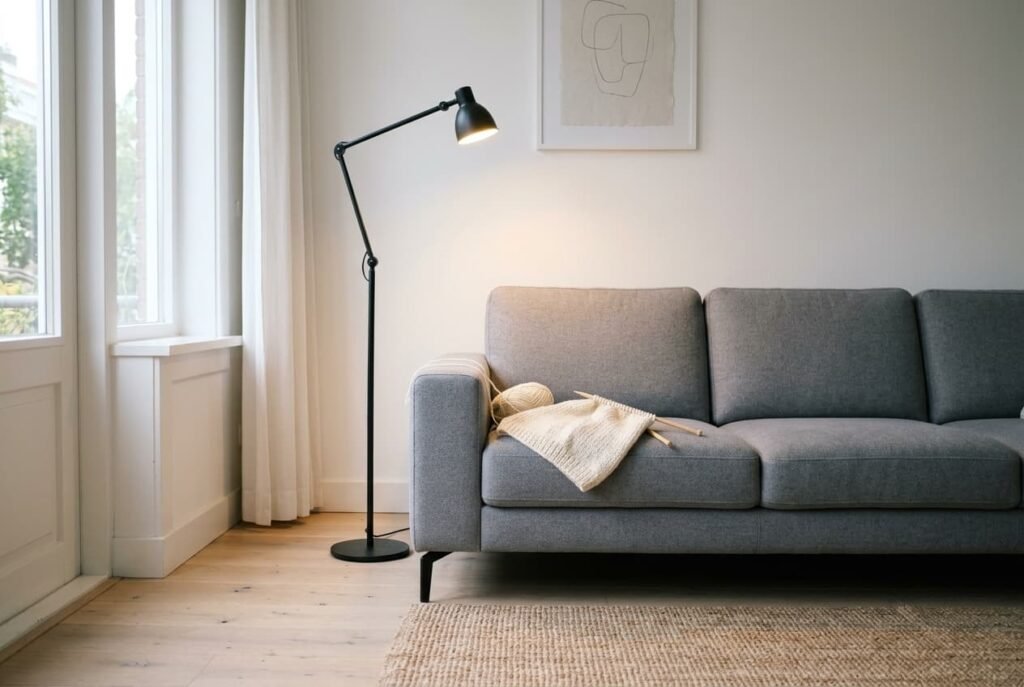
Knitting is close work. Your eyes sit about 35 cm from the stitches for a whole evening, and dark yarn returns very little of the light that falls on it. Light from the front puts your hands between the lamp and the work, and their shadow lands right on the stitches. Move the light to one side and a little behind the hand holding the working needle. The shadow then falls away from the work.
Consider rows worked in navy yarn. Navy gives back only a modest part of the light it receives, and a lamp that suits cream yarn can leave those rows in murk. For a right-handed knitter the lamp should stand at the sofa’s left end, beside the seat, 30 to 40 cm from the shoulder and slightly behind it. A left-handed knitter mirrors that position.
The sofa gives you a seat and an arm. It doesn’t give a firm lap or a spot to rest a project between rows. The order is simple: lamp, then surface, then storage. That ranking follows the cost of each mistake. A weak lamp slows every row you knit. A missing surface only spoils the pauses. Poor storage costs you nothing until the evening ends and the yarn is on the floor.
Knitting Corner Beside the Sofa: Five Purchases in Order
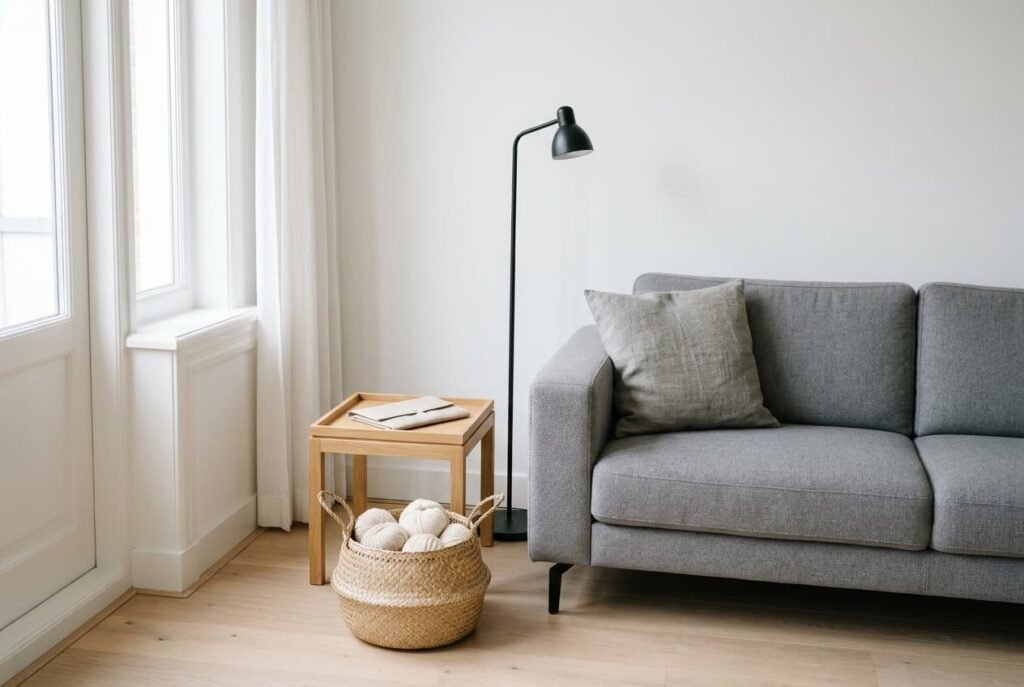
The strip covers 85 × 65 = 5,525 cm² of floor. The five items below use 625 + 1,600 + 962 = 3,187 cm² of it, which is 58%, leaving the remainder free as a route past them.
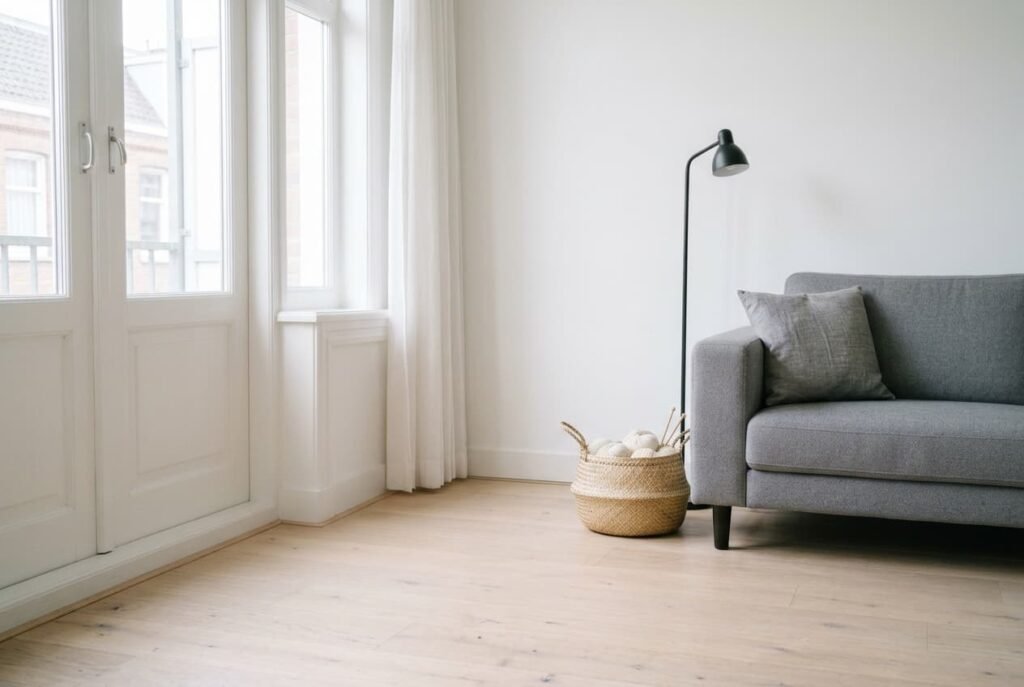
1. A standing lamp with a bendable arm, 140 cm tall, on a base 25 cm across. Light decides every row, and the arm lets you hold the shade over your shoulder. Aim for roughly 800 lumens from a warm-white bulb; treat that as a sample figure. Tier: BUY ONCE. A heavy base and firm joints last for decades. Fault to look for: an arm that sinks within a week, which means the joints have no friction washers.
2. A side table, 40 × 40 cm and 60 cm tall, with a raised rim. It stands level with a typical sofa arm. Tier: MID. Braced legs stay steady under a loaded bag. Fault to look for: a flat top with no rim, which lets needles roll off, or legs with no brace that wobble when you reach.
3. A basket with a smooth inside and a diameter of 35 cm. The walls rise 30 cm. A 50 g ball of yarn is about 9 cm across, which lets the 962 cm² floor hold ten balls with room to spare. Tier: BUY CHEAP. A basket carries no load. Fault to look for: a rough weave that snags the fibre. Run a hand around the inside before you buy.
4. A needle case that opens to 40 × 20 cm. Straight needles run to 35 cm, which is why the case must be longer than that. Tier: BUY CHEAP. Fabric and stitching are all it needs. Fault to look for: loose slots that let needles slide out when you tip the case.
5. A firm cushion, 40 × 40 cm, for the small of your back. A sofa seat is often 55 to 60 cm deep, which pulls you into a slouch. Tier: MID, because a firm filling holds its shape where a soft one flattens early. Fault to look for: a filling that bunches into one corner after a few washes.
Buy them in that sequence and a knitting corner beside the sofa works from the first week.
Why the Side Table Is the Item to Drop a Tier
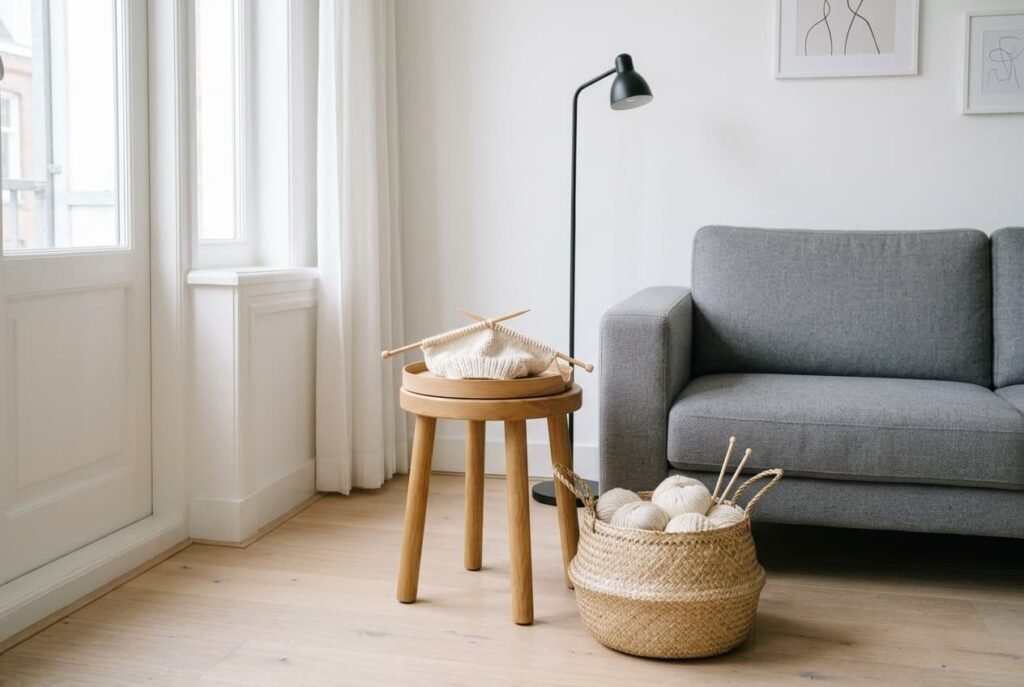
Of the five, the side table asks for the least. A project bag weighs about 1 kg, and the table has two jobs: to hold the work at arm height and to stop needles rolling. A tray with a lip on a stool does both. Many flats already own a stool or a nesting table.
The numbers favour it. A round stool 35 cm across takes about 962 cm² of floor, against 1,600 cm² for the square table. That saves 638 cm². The five items then use 3,187 − 638 = 2,549 cm², or 46% of the strip, and the route past them widens.
Test the stool before you commit. Its top should be at least 35 cm wide, enough for a bag plus a cup. Its height should land between 55 and 65 cm. It mustn’t rock when you press one edge with a flat hand.
A tray with a 2 cm lip handles the rolling needles.
Retain the table only when no stool is available to borrow. Moving it from MID to a borrowed stool changes nothing about how the corner works. It frees money for the lamp and the cushion instead.
Order and Timing: Three Weeks to a Working Corner
Spread the buying over three weeks and let each week prove the one before it. Week one is for the lamp alone. Use what you already own for everything else, knit for half an hour, and ask yourself whether every stitch is visible without leaning forward. If it is, the lamp has done its job.
Week two brings the cushion and the basket. The cushion corrects how you sit, and the basket lifts the yarn off the floor and away from passing feet. Notice whether you’re still leaning forward when the evening ends.
Week three is for the needle case, and for a decision about the table. By then you know how you use the corner, and that’s what makes the last choices easy.
A knitting corner beside the sofa rewards patience, because each purchase fixes a problem you can already feel. Stop buying once the corner works. It’s often after the cushion.
What to Skip
Skip any wall rack for yarn, because drilling a rented wall invites a dispute over the deposit. The floor basket serves equally well. Hold off on a ball winder until you buy yarn in hanks, as most balls arrive wound. A chair made only for knitting adds little, since the sofa with a cushion gives the same support. Magnifying lamps are for those whose eyes need them, because a good ordinary lamp solves most seeing problems. A second basket for projects in progress isn’t needed either: one half-made sleeve rests above the yarn in the first. Every extra piece in a knitting corner beside the sofa takes floor from the walkway, and a walkway you can’t use soon makes the corner annoying.
Five pieces are the whole list, and they use 58% of the strip. Each one solves a single problem you can feel in the first evening, which makes sequence count for more than the total. Anything beyond them is decoration, and it can wait while you test the corner for four weeks. If a piece still looks missing after that, you’ll know exactly what it should do, and that’s a far better guide to a purchase than any list.
Questions Readers Keep Asking
How many pieces do I really need?
Five is the full list, but the lamp plus the basket is enough to start. A borrowed stool with a tray covers the table. Add the case once you own more than one pair of needles, and the cushion if your back tires. Nobody needs the whole set in the first week.
Which should I buy first if I can only afford one?
The lamp. Light changes every row you knit, and no other item does that. Choose one with an arm you can aim over your shoulder, and make sure the base stays put when the arm is extended. A weak lamp slows you down. A poor basket only looks untidy.
How can I judge a lamp in the shop?
Stand beside it and extend the arm fully. Wait a minute and see whether the head sinks. Then push the base sideways with a flat palm. A base that tips or slides won’t survive a busy household. Check the bulb fitting too, because standard bulbs can be replaced for years.