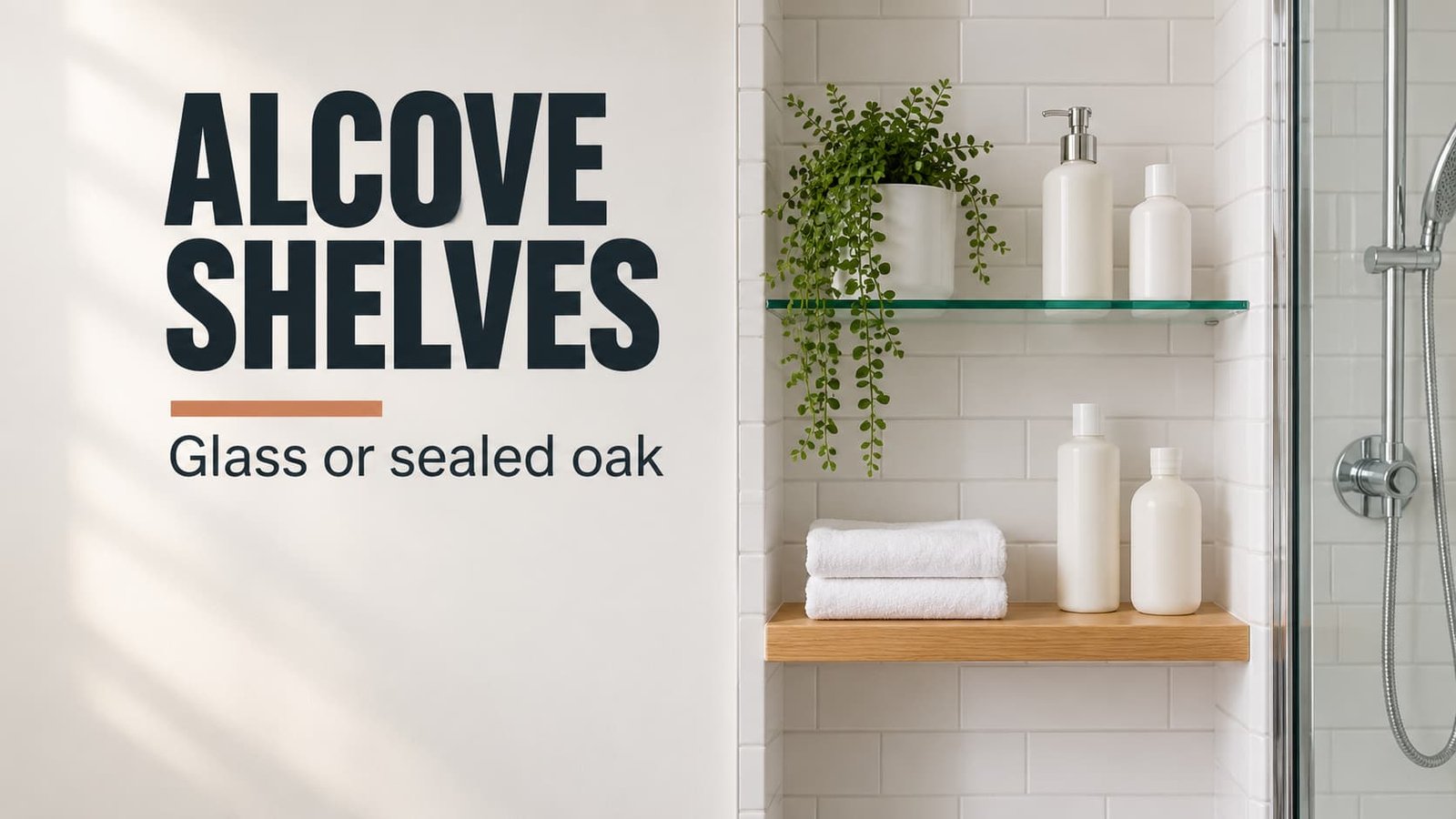
Shelves for a bathroom alcove live in steam and splashes with a wall on three sides, and the material matters more than the style. The recess beside the shower in our example is 90 cm wide with a depth of 20 cm, and it rises 120 cm, in an Utrecht rental. Each figure is invented for the purpose; set it beside your own tiles before ordering anything. Both materials suit a tiled bathroom, but they fail in different ways. Toughened glass meets sealed oak in a head-to-head test, and a clear rule closes the guide for each kind of bathroom.
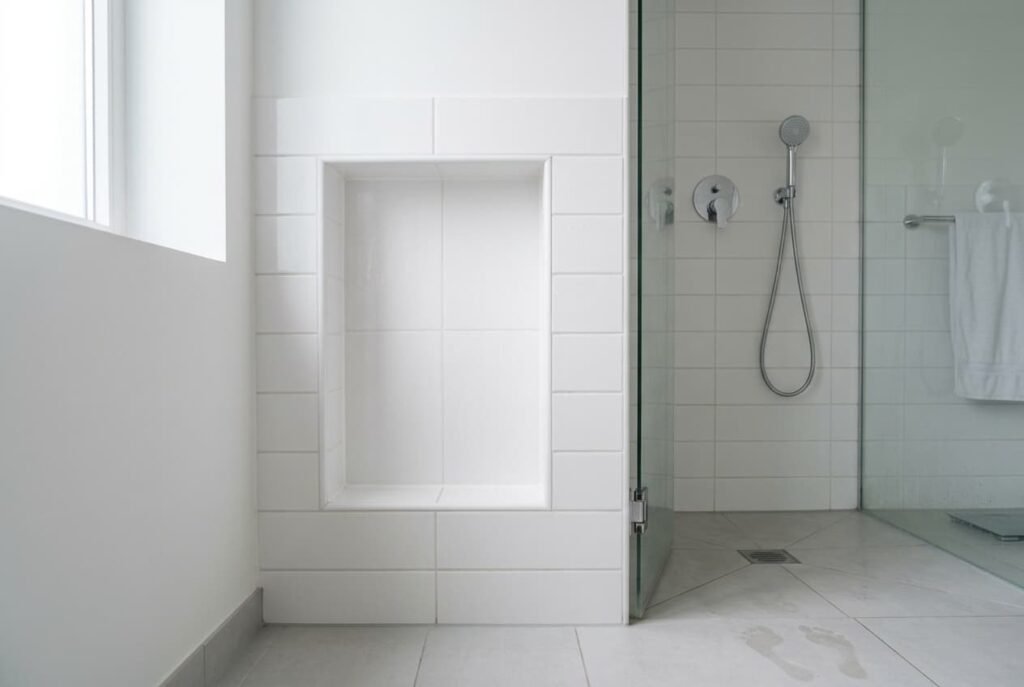
Why Shelves for a Bathroom Alcove Behave Differently in Steam
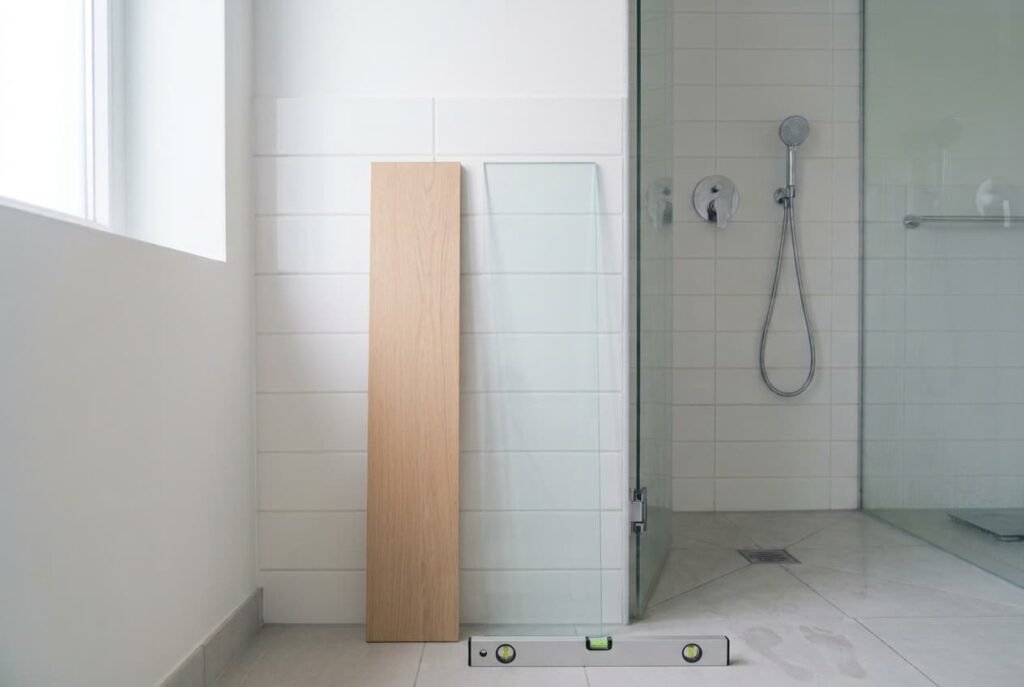
A recess is a pocket. Walls on three sides slow the air, which means steam lingers there longer than it does in the open room, and the surfaces inside stay wet well after you step out. The tiled walls hold little heat to dry them, and the air inside barely moves. A bottle on a shelf also traps a film of water under its base, and what the shelf does with that film is the first test of a material. Beyond that, a shelf has to cope in two physical ways and one optical way, and the material decides all three.
Glass takes in no water at all. A splash sits on the surface as a thin film and leaves by evaporation. Wood needs a closer look. A sealed top sheds a splash much as glass does. The underside and the end grain behave differently: they pick up vapour from the air over a span of weeks, and the board swells a little across its width. Inside a recess 90 cm across, even a few millimetres of growth matters.
The optical part is simple. With shelves 30 cm apart, a solid board shades everything beneath it, while glass passes most of the light down to the shelf below. Weigh all three effects against your own bathroom before you shop.
Glass and Wooden Shelves in a Bathroom Alcove Compared
Our sample recess measures 90 cm at the floor and 89.5 cm near the top, which makes 89.5 cm the narrowest reading. Allow 0.5 cm of clearance and each shelf is 89 cm in length and 20 cm in depth. We use three shelves per alcove, each holding 8 bottles of 0.5 kg.
| Point | Toughened glass | Sealed solid oak |
|---|---|---|
| Thickness | 6 mm | 18 mm |
| Weight of one 89 × 20 cm shelf | 2.7 kg | 2.2 kg |
| Water on the top surface | none absorbed, film dries by evaporation | sheds a splash while the seal is whole |
| Limescale marks | show clearly as white rings | hide in the grain |
| Light to the shelf beneath | most passes through | blocked completely |
| Trimming after delivery | impossible; order it to size | possible with a saw and a plane |
The weights follow from the volumes: 89 × 20 × 0.6 = 1,068 cm³ at 2.5 g/cm³ gives 2.7 kg, and 89 × 20 × 1.8 = 3,204 cm³ at 0.7 g/cm³ gives 2.2 kg. Because the two materials weigh nearly the same, the choice of shelves for a bathroom alcove rests on appearance and fitting more than on load.
Where Glass Wins Beside the Shower
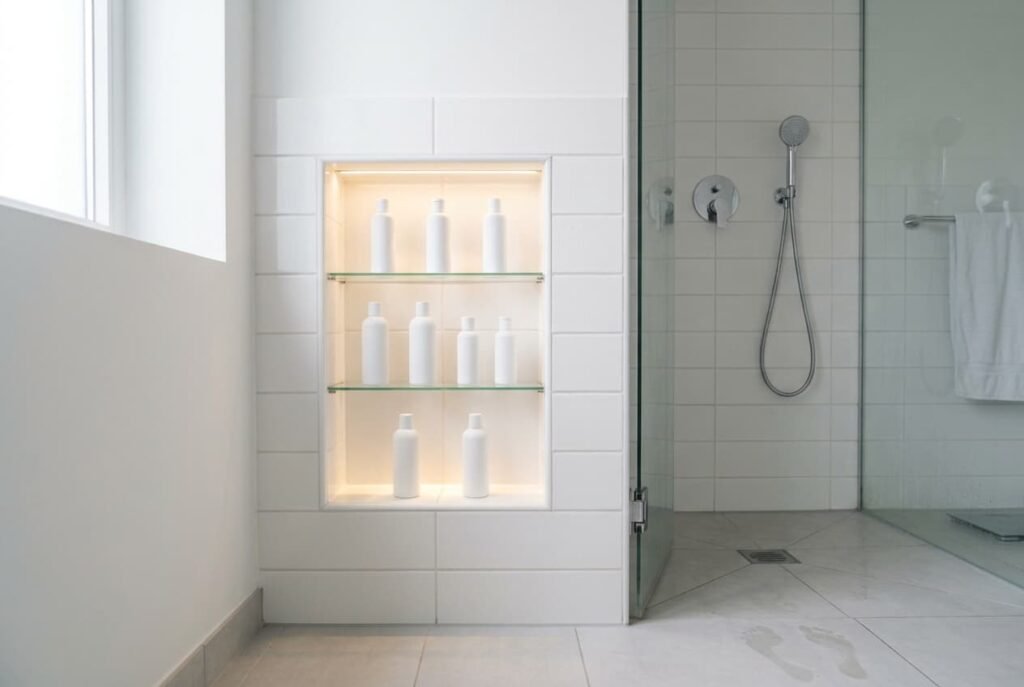
Glass wins wherever the alcove is dark. Fit a bulb above the top shelf and the panes pass the light down. All three levels stay readable and the bottles appear to float. That’s what lets a narrow recess feel wider than it is.
Cleaning is quick because nothing soaks in, and a wet cloth lifts a fresh ring in seconds. Hard water is the catch. The white spots left by evaporating drops stand out against clear glass, and you’ll notice each one the moment light touches it. Plan to wipe the top every few days.
Fitting asks for care. Toughened glass can’t be cut or drilled once it exists. You order it at the narrowest reading minus the clearance, which gives 89 cm. After that it arrives final. Each pane rests on a clip at both ends.
A tape that was off by 3 mm leaves a shelf that is off by 3 mm.
Each pane carries 8 × 0.5 = 4 kg of bottles on top of its own 2.7 kg, and the two clips share that. Stand the heaviest bottles nearest the wall, away from the open edge.
Where Wood Wins in the Same Alcove
Wood wins on forgiveness. If the tape lied, you can plane a board 2 mm shorter, and a chipped edge is mended with a dab of oil. Limescale hides in the grain, which lets a shelf go a week without a wipe and still look tidy. A warm material also softens a tiled room where everything else is hard and cold, and that’s welcome.
The cost is steam. Seal the top and the underside, then both ends, because an unsealed face takes up vapour first. Round the edges slightly with sandpaper before sealing, since sharp corners are where a coating wears through soonest. With the seal intact each shelf weighs 2.2 kg, half a kilo less than the glass one, and the supports work a little less.
Light is the other cost. With three boards 30 cm apart, a bulb above lights the top board and leaves the two below in shadow. A small light fixed under each shelf cures that, though it adds a cable run in a wet zone, which is worth planning with an electrician.
A Third Route: Keep the Caddy You Already Hang There
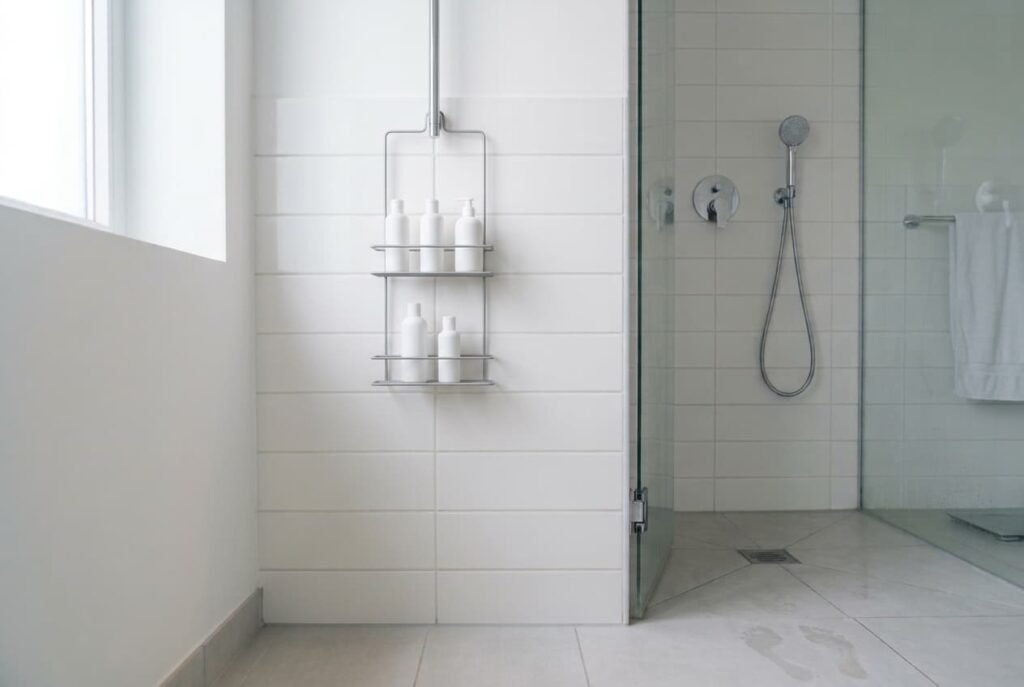
You don’t have to build anything at all. If a hanging caddy or a stacked trolley already holds your bottles beside the shower and nothing falls, keep it where it hangs and rinse it weekly instead.
Shelves for a bathroom alcove earn their place only when bottles topple or you can’t find what you need.
Rinse the caddy and the tiles behind it whenever you clean the screen, because limescale builds up wherever drops dry. Lift each bottle and wipe its base ring before you put it back. A caddy on a rail also takes no space from the recess, which stays free for towels you’d rather keep dry. If you want more room, add a second caddy on the same rail before you think about shelves, because moving a caddy costs nothing and drilling a tiled wall doesn’t. Check the rail twice a year, since a loose fixing tilts the caddy and sends bottles sliding. If you move to shelves later, the readings you took here will still be right.
Which Suits Your Alcove: Glass or Wood?
Choosing shelves for a bathroom alcove comes down to light and cleaning habits. Each branch below has a catch to weigh before you order.
When the alcove is dark and you wipe the shower daily, choose glass. Measure the width at three heights; the smallest reading wins, minus 0.5 cm for clearance. Order the pane to that length. Accept that limescale rings will show, and wipe them away before they harden.
When the alcove has its own light, or you rarely wipe, choose sealed oak. Seal every face before fitting, and add a small light under the lower shelves if you need to read labels.
Measure again once the shelves are in. A shelf that sits level and stays quiet will keep doing so for years, as long as you check the seal on the wood, or the clips on the glass, once a year. The right shelf is the one that suits the light in your alcove and the way you clean it. Everything else, including weight, is only a minor detail here.
Questions Readers Keep Asking
Which lasts longer beside a shower?
Glass lasts longer if you never chip an edge, because steam leaves it unchanged. A sealed oak shelf lasts for years as well, but its coating thins along the edges and needs renewing every couple of years. Run a fingertip along the underside now and then. A rough patch means vapour has found its way in.
How do I clean limescale off either one?
For glass, use a cloth dipped in warm water with a little vinegar, then buff the surface dry. For wood, wipe with a lightly wetted cloth and finish with a dry one, because acid can dull the coating. Wipe weekly so that white rings never get the chance to set hard.
Which suits a small rented bathroom with an uneven wall?
Wood, in most cases. You can plane it to the narrowest reading, and a board 2 mm short still looks tidy. Glass must be exact, and if the walls lean you’ll see the gap along one side. Measure at three heights before you decide, and keep the lowest figure.