A kitchen tap that drips after you turn it off has a seal that no longer shuts the water path completely. Mains pressure squeezes through a gap far narrower than a hair, and every squeeze forms a drop. Where the water appears points to the part at fault, and a dry sheet of paper shows it within minutes. Take a single-lever mixer above a stainless sink in a Groningen rental, with mains pressure of 3 bar. All flows and forces in this piece are assumed samples. Use your own readings instead. Below are four repairs ordered by effort, from a rinse up to a plumber’s visit, then a tempting shortcut that backfires inside seven days.
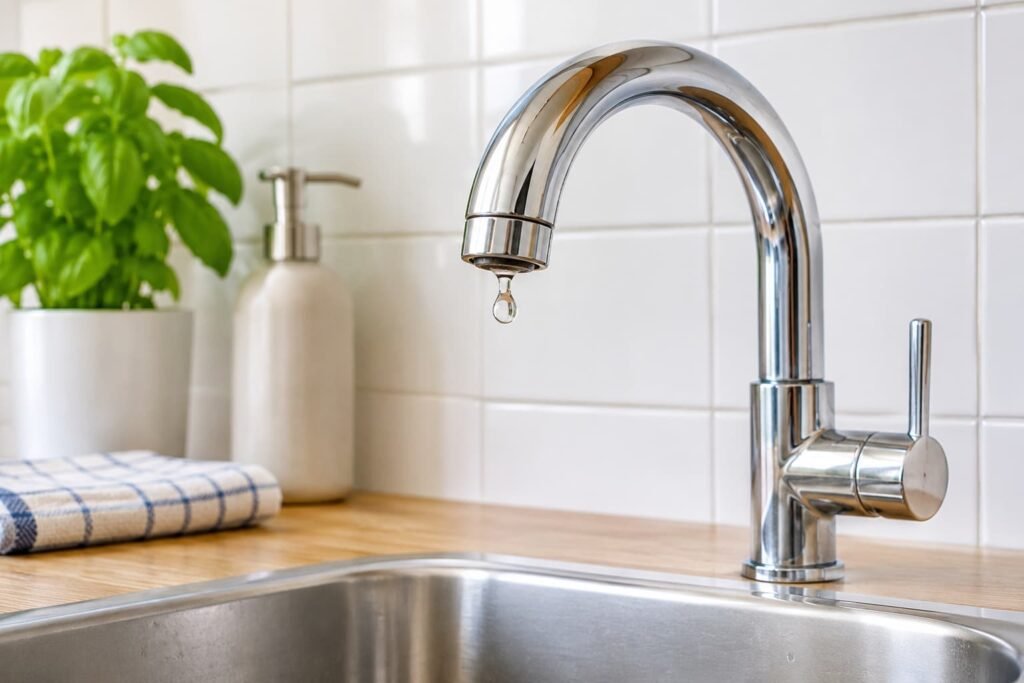
Why a Kitchen Tap That Drips Is Really a Failed Seal
Inside the tap, a closed valve holds back the full pressure of the mains. In our sample the opening is 10 mm across, which is 78.5 mm². At 3 bar, or 300 kPa, the water pushes on that opening with 23.6 N. The seal has to resist that push every hour. A worn or gritty seal gives way in its weakest spot first.
The gap can be tiny. Two ceramic discs inside a mixer slide over each other and meet as flat faces. A grain of limescale 0.05 mm across, caught between them, holds them apart by that distance. Water finds the slit and crosses it as a slow trickle, not a gush.
Put numbers on the trickle. One drop each second at 0.05 ml makes 3 ml a minute. Over a day that’s 4.3 litres, and across a year it reaches 1,577 litres, about 1.6 m³. A 10-litre bucket would fill in 2.3 days. A kitchen tap that drips is wasting water because the gap is tiny while the pressure never lets up. Nothing inside has snapped, and that’s why the remedy can be so modest.
Which Drip You Have in Your Tap
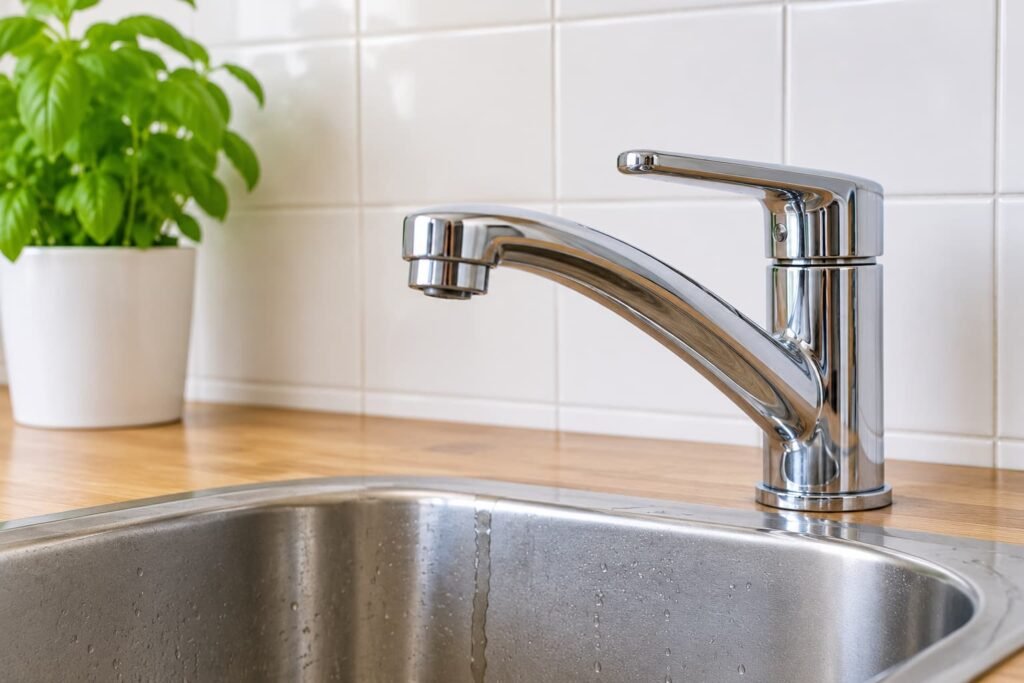
Three places can leak, and each points to a different part. Water on the spout’s tip comes through the main valve, which is the commonest case. Wetness where the spout meets the body means a worn ring around the swivel. Water creeping out of the handle itself comes from the seal around the spindle.
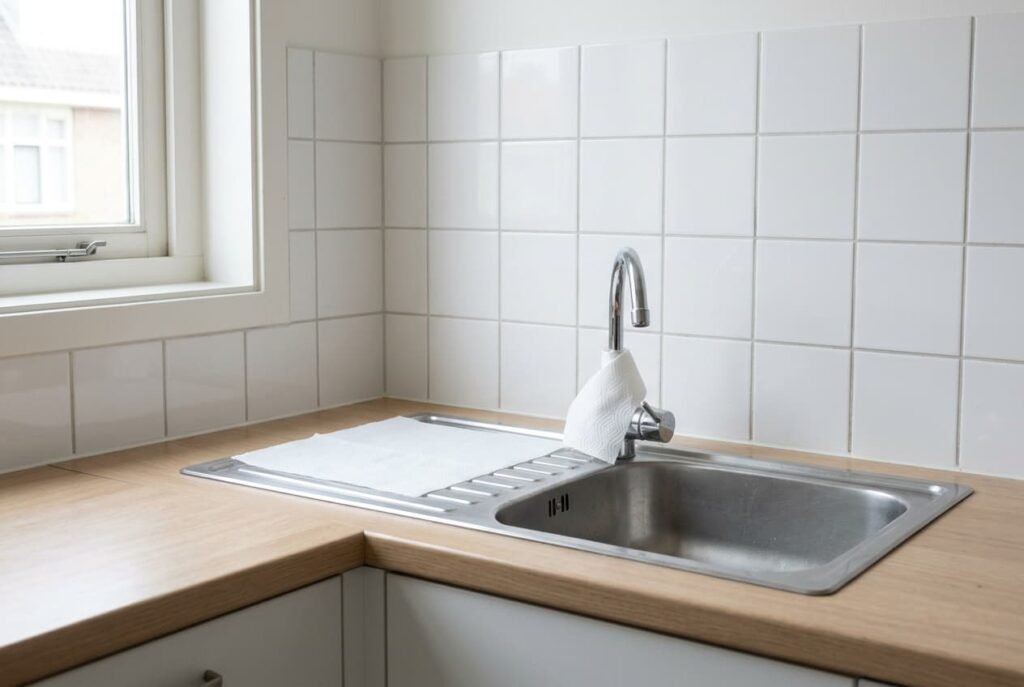
Dry everything with kitchen paper. Slide a dry sheet under the spout and another round the base, then leave the tap alone for ten minutes. A wet sheet under the spout confirms the valve. Count the drops over 60 seconds, since 60 drops matches our rate of one a second. If the spout drips for a brief moment before it stops, you watched the last water drain from the aerator, and a kitchen tap that drips for only that long has no leak at all. Keep the paper and write the count on it.
A drop at the spout that returns on schedule is the version the repairs below deal with.
Four Fixes for a Kitchen Tap That Still Drips, Cheapest First
Each repair goes after a different weak point, and the cheap ones come first. Stop the moment the paper stays dry for ten minutes.
Flush the grit with a full-open rinse. A grain between the discs is the likeliest cause in a newer mixer. Lift the lever fully for ten seconds, then lower it gently to the off position, and repeat three times. A strong flow carries a loose grain out of the gap. The cost is a minute of water and nothing else. If a scratch has already marked a disc, the drip returns within days, because rinsing can’t repair a surface.
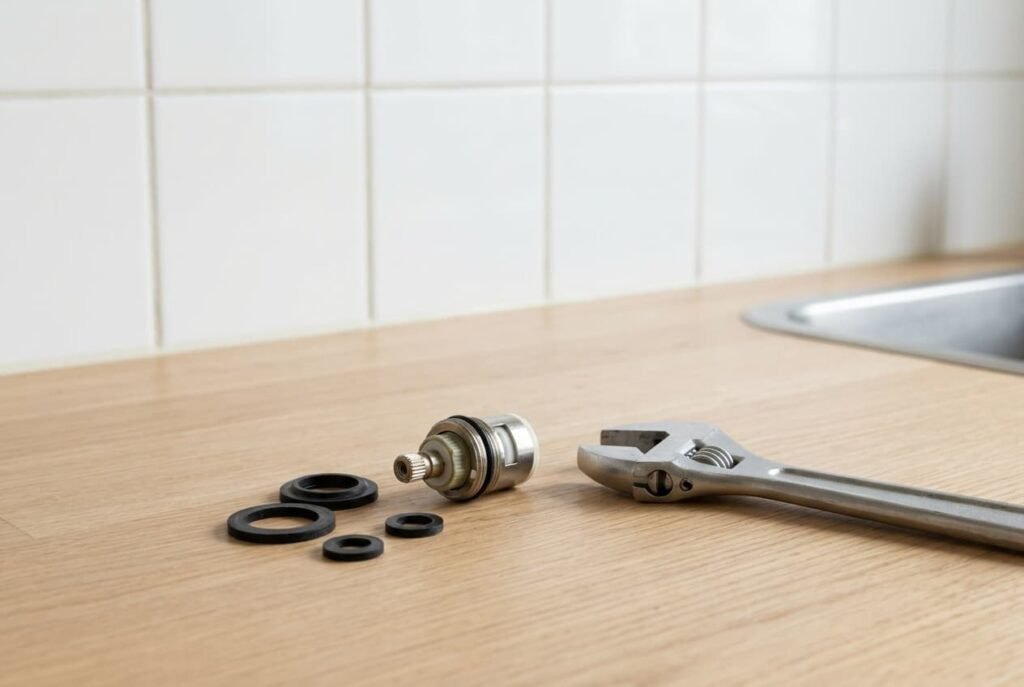
Replace the washer in a two-handle tap. This applies only to taps with separate hot and cold handles. A soft rubber washer presses onto a brass seat and shapes itself to it, and old rubber hardens until it no longer adapts. Close the isolation valve and open the tap to empty it. Then unscrew the bonnet and fit a washer of the same diameter, smearing a little silicone grease on the thread so the bonnet turns freely next time. A pack of washers and a spanner cover the job, and the work takes around twenty minutes. A pitted seat will cut the new washer within months.
Fit a new ceramic cartridge. In a single-lever mixer the cartridge holds the flat discs, and once a scratch forms only a fresh pair seals again. Take the old one out, measure its diameter (35 mm in our sample) and buy a match. The work takes thirty minutes and an adjustable spanner. Note which way the lever faces before you pull the old one out, because the new part has to face the same way. The limit is the tap body, since a corroded body can hold the old cartridge so tightly that force breaks the thread.
Call the landlord or a plumber. When the brass seat is pitted, no washer can seal against it. A plumber cuts the seat flat again or fits a new tap in about an hour. Landlords usually decide in a rental. A new tap may look different from the old one. Photograph the leak before you report it, and describe it exactly: 60 drops a minute is 4.3 litres a day. Ask for any quote in writing.
What the Sink and the Landlord Settle
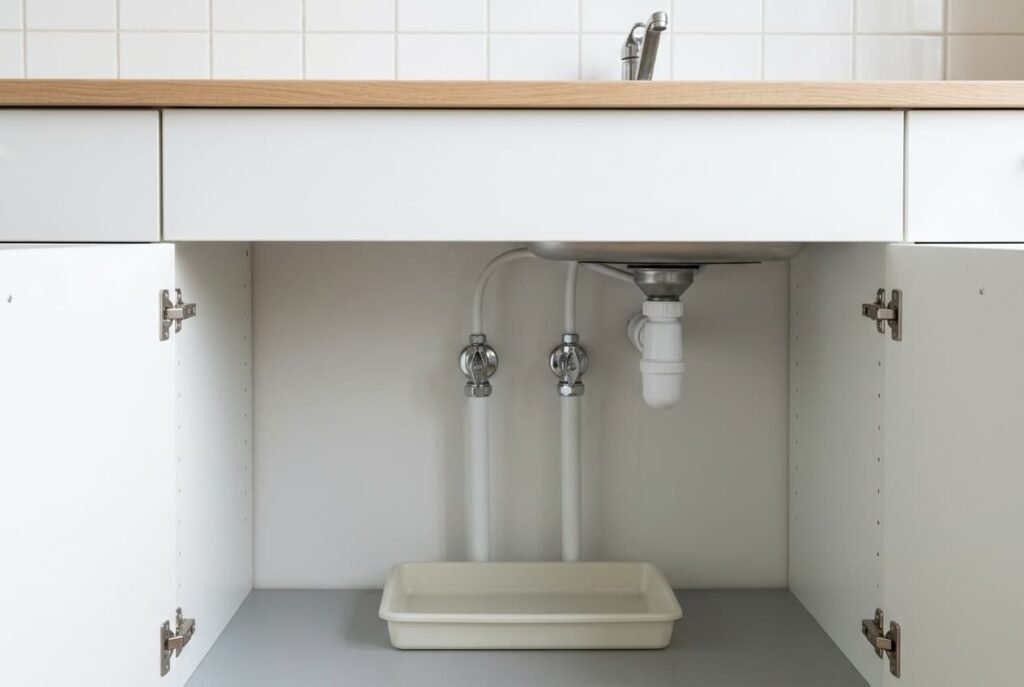
The sink has a single tap hole of 35 mm. That fixes the shape of any replacement, because only a single-lever mixer fits without a new sink. Two isolation valves sit under the bowl, 20 cm above the cupboard floor. A slot along the pipe means open and a slot across it means closed. The cupboard is 30 cm tall inside, which leaves room for a wrist but not for a long spanner. Without valves, the whole flat has to be shut off at the stopcock in the meter cupboard, and every job then begins with a trip down the corridor.
Check your tenancy agreement before you start. Rinsing the tap and swapping a washer or cartridge are repairs many tenants may carry out. Cutting a seat or fitting a different tap is the building’s business, and the landlord should approve it in writing.
The valves and the single hole decide which repairs are open to you.
A Quick Fix That Makes the Drip Worse
Cranking the handle shut with all your strength seems the natural cure for a kitchen tap that drips. The drip often eases that evening, because the stiff rubber has been squeezed into the seat. It comes back within a week. Extra force presses the washer into every pit in the brass, and the pit then cuts it. In a mixer, extra force merely strains the handle screw and may crack it. A cranked tap also becomes stiff to open, and you’ll tug at it every morning.
Wrapping tape round the spout does nothing either, because the leak sits inside the body. The water simply finds another way out.
Leaving the tap slightly open so that it runs instead of drips is no better. A steady trickle wastes far more than 4.3 litres a day, and it hides the fault until the day you close the tap fully.
Leave the force alone and begin with the paper. Dry the tap. Find the wet spot, then count the drops for 60 seconds. Try the rinse before any other step, because it costs nothing. Write the date and the count on the paper so next month’s check has a starting point. If the drip persists, measure the part before ordering, and keep the receipt in case the size is wrong.
Questions Readers Keep Asking
Can a dripping tap be fixed at all?
Nearly always. Every source has a repair that a spanner can reach, from a rinse to a new cartridge. Only a pitted seat or a corroded body needs a plumber. Count the drops over 60 seconds before anything else, because that count shows you which route to follow.
What does it cost to fix?
The rinse is free. A pack of washers or a cartridge costs little beside a plumber’s visit, which is the single large expense. Stop when the paper stays dry for ten minutes, since that proves the seal has closed again.
What is the most common specific cause?
Limescale grit or an aged washer. Grit scratches ceramic discs, and old rubber hardens until it can’t adapt to its seat. Rinse, then identify the type of tap before you touch any valve. Wetness at the base points to a worn ring, which is a different repair.