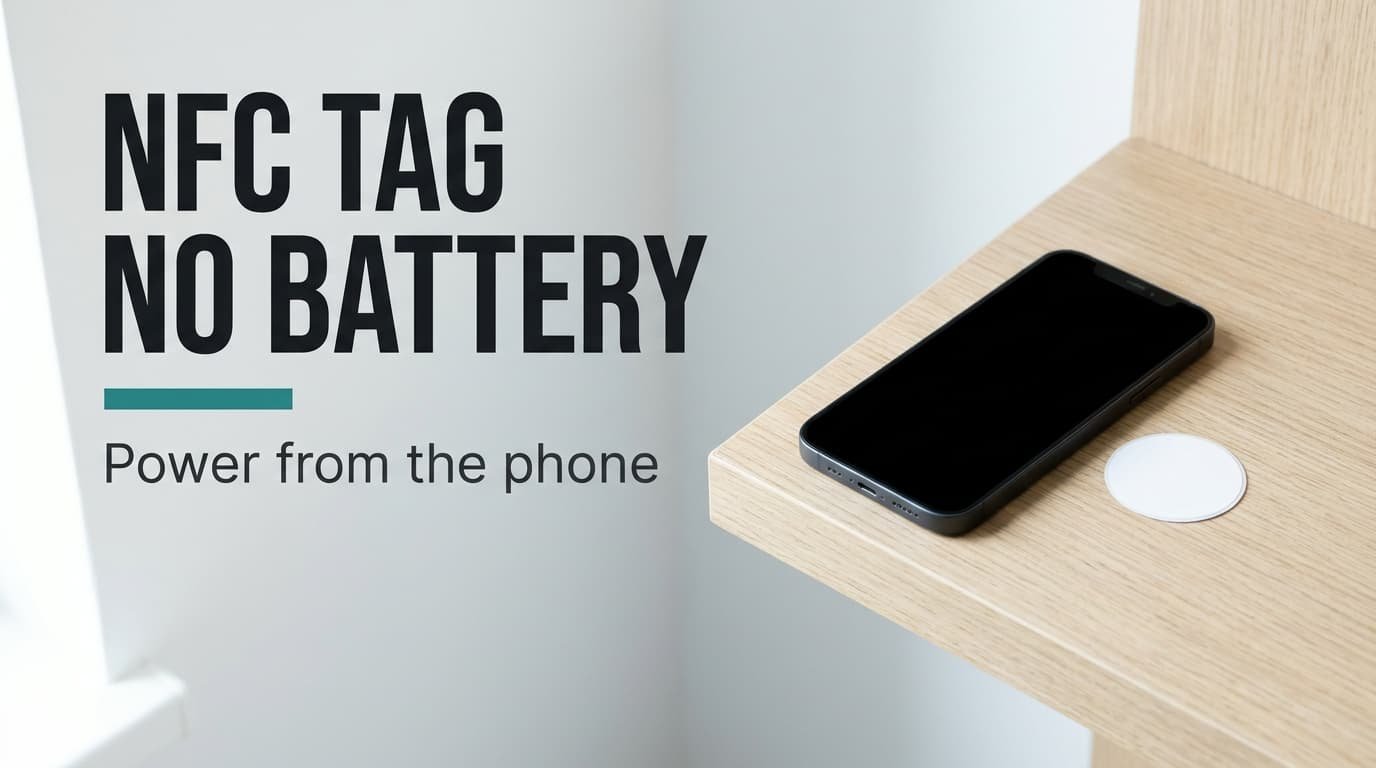
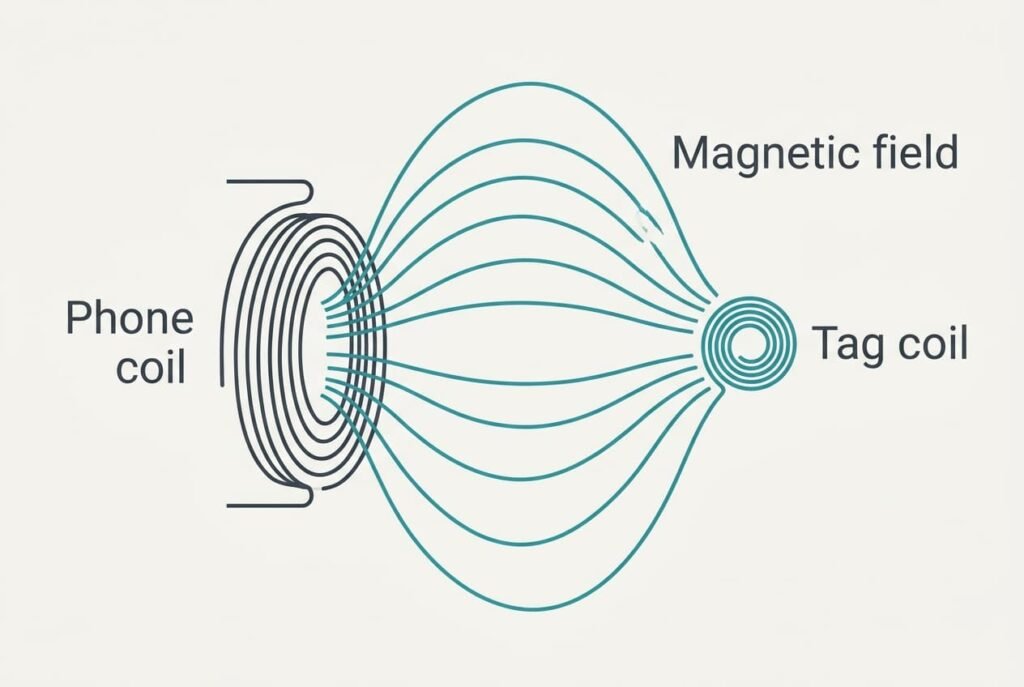
An NFC tag works without a battery because the phone lends it power for the few milliseconds it needs. The phone’s reader coil sets up a magnetic field that reverses direction tens of millions of times a second. A tag held within about 4 cm collects a small voltage from that field and wakes its chip. The chip then answers by nudging the field itself. That’s the entire trick, and this guide follows one tap from start to finish. Our sample is a sticker on a hall door frame in a Leeds flat. Every number is an assumed example.
Does an NFC Tag Work Without Power? The Short Answer
The phone powers the tag through a shared magnetic field, and the tag replies by slightly loading that field. Nothing inside the sticker stores energy for later. It goes dead the moment the phone moves away.
That answer omits three things. The tag’s coil and the phone’s coil act as a loose transformer, and “loose” is the word to remember. Energy crosses the gap only while the coils sit close together, which explains a range of centimetres rather than metres.
The tag also carries a small memory. Take 500 bytes as an assumed size. A web address or a short instruction of about 30 bytes fits with room to spare, and the rest stays empty. Most tags let a phone write to that memory too, unless the owner has locked it.
A tag has no clock of its own either. The beat of the phone’s field supplies the timing. A chip that receives no field has no sense of time at all.
The chip keeps a stored message and hands it over when the phone asks.
One Tap Traced From Field to Reply
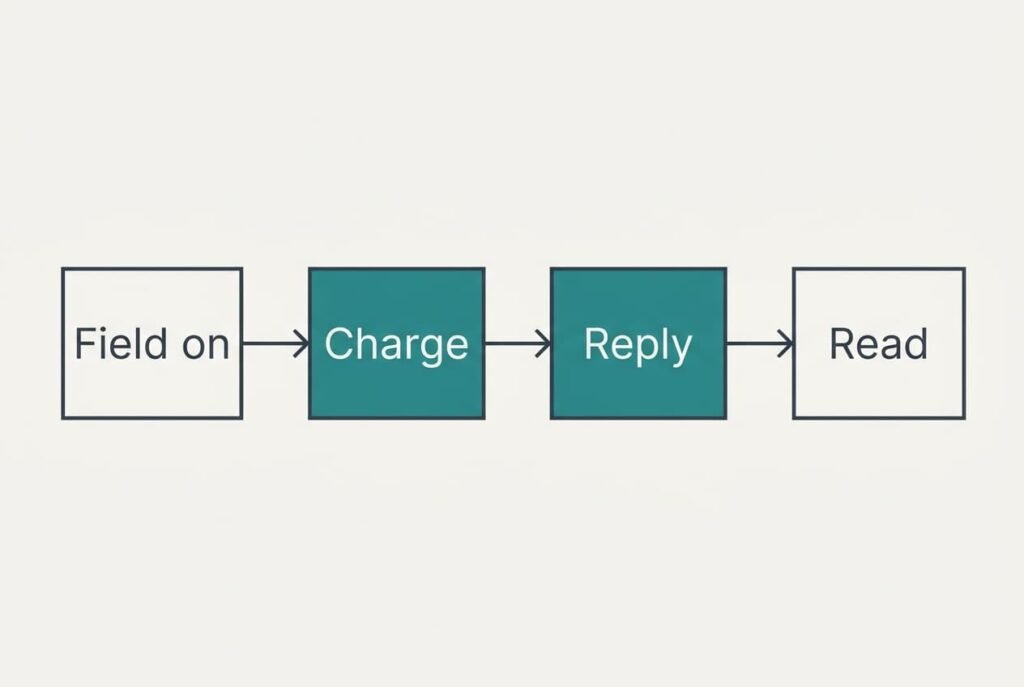
Follow a single tap at the door frame to see how an NFC tag works in practice. You hold the phone 3 cm from the sticker with its screen lit.
The phone’s reader switches on a field alternating at 13.56 MHz, which means 13.56 million full cycles every second. Inside that field sits the tag’s coil, and the changing field pushes a small alternating voltage through it. Tuning the coil with a small built-in capacitor to that one frequency makes the voltage build there and barely register at others. A circuit in the chip converts the voltage into a steady current and stores the charge in a second capacitor.
Assume the harvest at this distance is 0.2 mW. The capacitor holds about 0.2 µJ once full. Filling it takes 0.2 ÷ 0.2 = 1 ms. At that point the chip has enough to start.
The phone then asks whether a tag is present. The chip answers by switching a small load across its own coil on and off in the pattern of its reply. That switching leaves a faint ripple in the reader’s field, and the phone’s electronics read the ripple as data. Engineers call this load modulation, and it means the tag never transmits anything of its own.
Next the phone requests the stored message. Assume the chip draws 0.1 mW while it works and the exchange lasts 2 ms. That work needs 0.1 × 2 = 0.2 µJ, while the field delivers 0.2 × 2 = 0.4 µJ over the same 2 ms. That surplus lets the chip keep working while the phone stays put.
Your phone now holds the 30 bytes, say an instruction to switch the hall light on at 6 pm. Software on the phone decides what to do with it, and the chip plays no further part. Data moved for about 3 ms of a 2 s hold. About 670 times more of the tap goes on waiting for you to glance at the screen.
The Hand Mirror Comparison and Where It Breaks
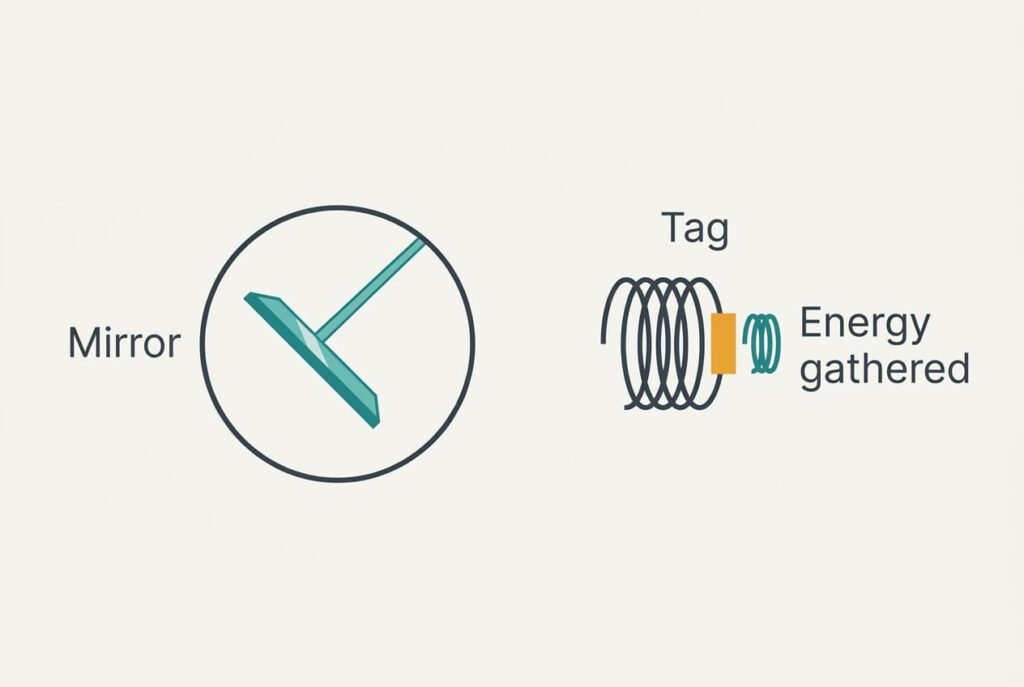
Signalling with a hand mirror is a fair picture of the reply step. The sun supplies the light, and the signaller merely tilts the mirror to send a pattern. In the same way the phone supplies the field, and the tag merely varies how much it loads it.
Two differences matter. A mirror needs no energy at all, whereas the tag must first harvest enough to wake its chip. A mirror also carries a message across a valley, while a tag manages only the width of your thumb.
Keep hold of the first difference. A mirror reflects whatever arrives. A tag answers only after its harvested energy crosses the level the chip needs, and a phone held too far away leaves it silent.
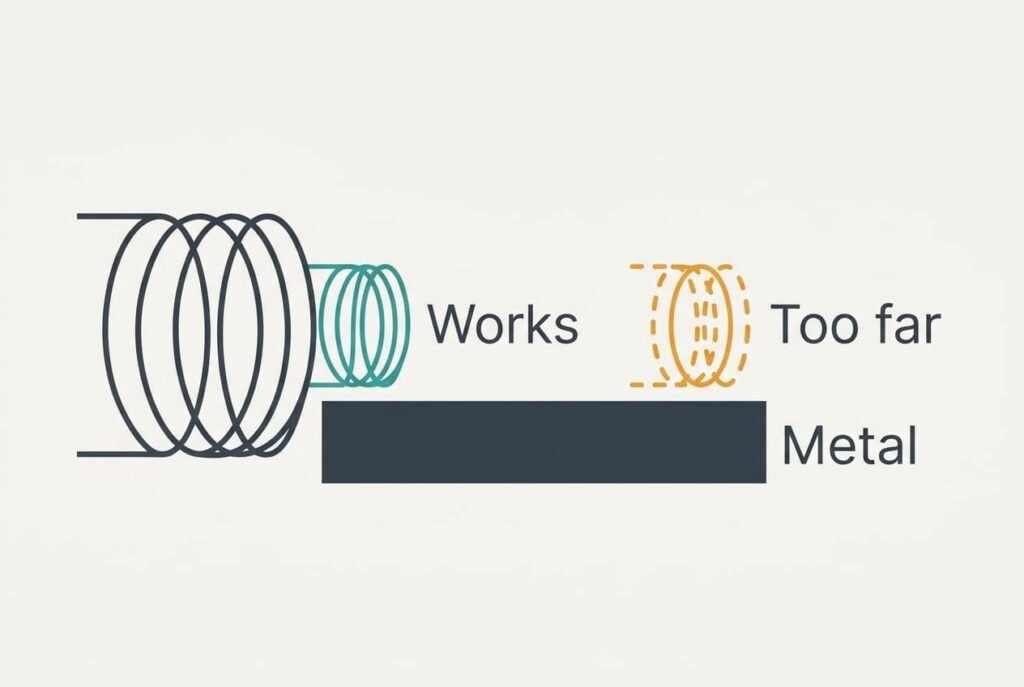
Where a Tag Works and Where It Stops
Distance is the first limit on how far an NFC tag works. Suppose a bench test gives 1.0 mW at 1 cm, 0.2 mW at 3 cm and 0.08 mW at 4 cm. Those readings are assumed, but the shape is real: the harvest drops steeply. At 4 cm the 0.08 mW falls below the 0.1 mW the chip draws while working, and the phone reads nothing.
Metal sets the next limit. A steel door frame behind the sticker lets the changing field drive currents in the metal, and those currents fight the field at the tag. Tags built for metal include a thin ferrite layer that redirects the field. A plain sticker on bare steel usually fails.
The third limit surprises people. Anyone holding a phone can read what a tag stores, since the tag has no way to check who is asking. Keep passwords and private details off it. Many tags can be locked after writing. Confirm that for the one you buy.
Three Beliefs That Sound Right but Aren’t
“There must be a tiny battery in there.” It formed because nearly every other small electronic gadget has one, and a sticker with a visible coil looks like a gadget. A battery would also make the tag thicker and shorten its life. Yet tags tend to last for years, since there’s no battery inside to run flat.
“The tag sends the web page.” It formed because the phone opens a page straight after the tap. The tag holds only a short address, and the phone fetches the page over its own connection. If your phone has no signal, the tap still reads the address and the page simply doesn’t load.
“It’s the same as Bluetooth.” It formed because both wake a phone near another device with no cable. Bluetooth pairs two powered radios over several metres. An NFC tap needs one side to supply power and both sides to be almost touching.
A Rule for Deciding Whether You Need One
Buy a tag only when the place and the action never change, and your phone already passes within 4 cm of that place. A door frame and a bedside table both qualify. A desk that gets rearranged every week doesn’t. Remember that an NFC tag works only where the phone naturally goes, and a shortcut on the home screen serves everything else.
A tag on a moving object will be missed more often than it’s read.
Place the tag on a wooden or plastic surface, then test it three times with your phone case fitted. A tag that reads with a bare phone may still fail once the case is on.
A failed morning tap costs more patience than a minute of testing ever will. Write the test date on the back in pencil, and you’ll know when to retest. An NFC tag is a small convenience that earns its place at one fixed spot. Give it a surface that suits it and a distance you’ve tested, and it will outlast most gadgets in the room. Skip either step and you’ll tap and wait.
Questions Readers Keep Asking
How far can a tag be read from?
Usually about 4 cm or less. Beyond that the phone’s field is too weak to wake the chip. Metal behind the tag cuts the range further, and so does a thick case. Try it in the very spot you’ve picked.
Do I need a tag if I already have a home-screen shortcut?
Only if the action belongs to a place. A shortcut works anywhere but needs a few taps, while a tag does one thing at one spot with a single touch. With no fixed spot, the shortcut wins at zero effort.
How does a tag compare with a printed QR code?
Scanning a QR code needs the camera and a clear view, while a tag needs only a close tap. Printed on a poster, the code can be scanned from the doorway metres away. A tag cannot manage that. Choose by distance, and keep tags off bare metal.