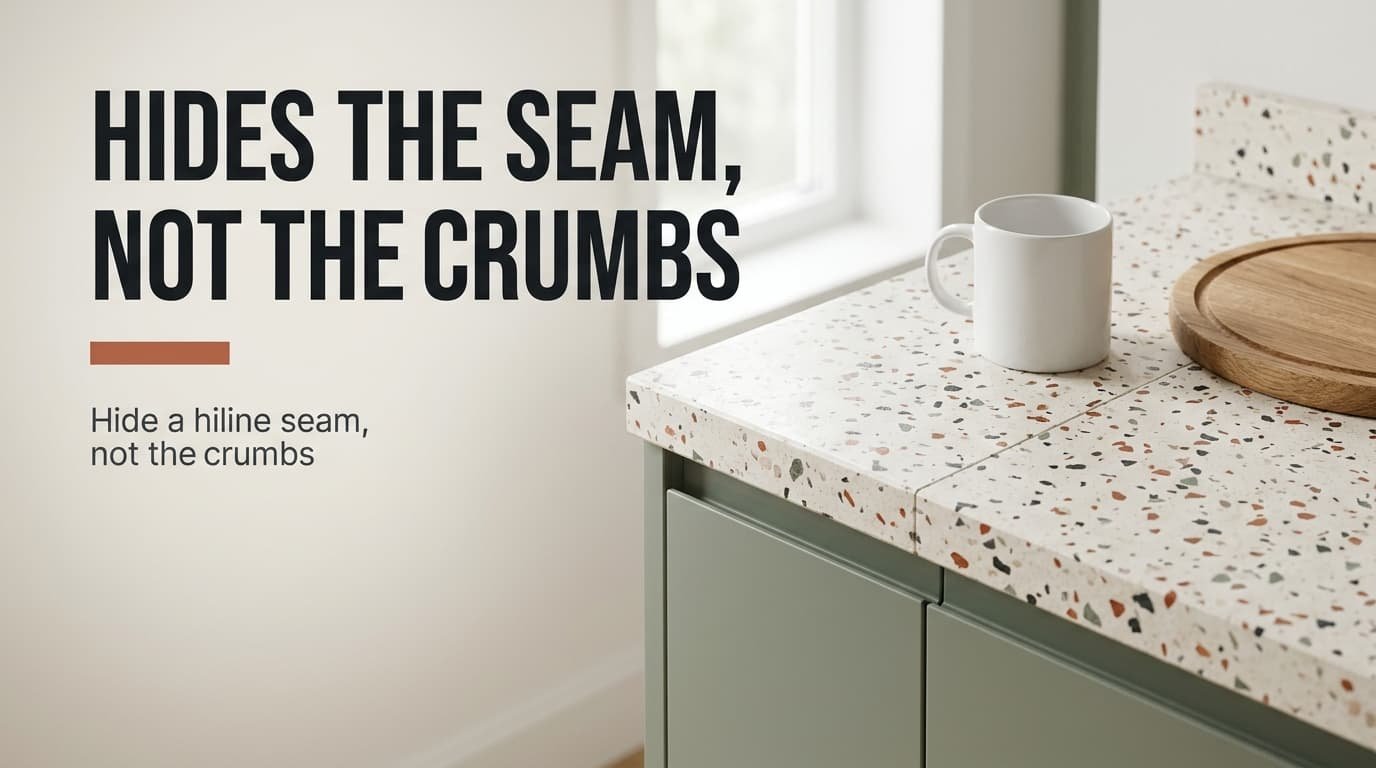
The idea that speckles hide dirt is mostly myth, and the numbers show why. Terrazzo is replacing plain stone worktops in small Dutch kitchens for other reasons: it breaks up seams and it can be refreshed. In our model a dark crumb vanishes on only 18% of the surface. The sums use a worktop run of 280 × 60 cm plus a return measuring 120 × 60 cm, so 2.40 m² in all. Every chip size and tone is assumed, so trust your own sample over these figures. Brands and showrooms stay out, and so do prices, since they age faster than the reasoning.
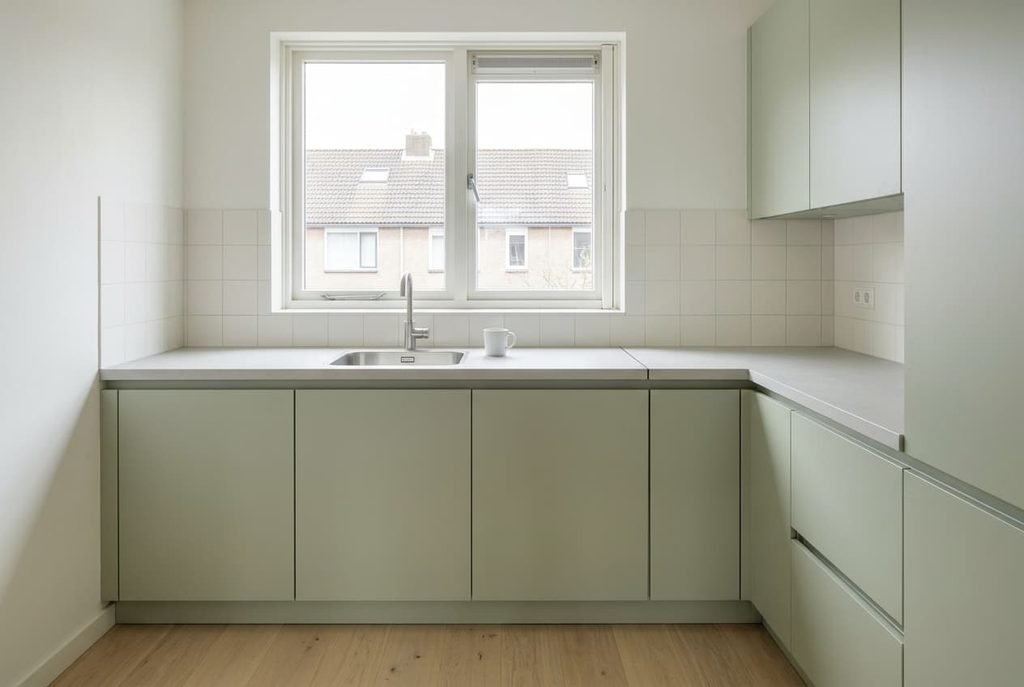
Where flat single-colour worktops came from
Plain slabs won their place by solving real problems. One even colour suits any cabinet door, and a large slab covers a long run with few seams. Fitters template it and cut it, then set it in a morning. A plain face also looks calm, which pleased small kitchens where everything else is already busy.
Terrazzo is far older than the kitchen. It’s marble chips set in a binder, then ground flat. Chips and binder end up sharing one surface. For generations it lived in floors. Crews poured it on site and polished it where it lay. Two changes brought it onto the worktop. Factory-cast slabs arrived in sizes a fitter can handle like any other slab. Resin binders joined the older cement ones, which gave a choice between a surface that can etch and one that doesn’t.
Plain stone kept one weakness. Wherever two slabs meet, a clean line runs across the surface and the eye follows it. Terrazzo is the first plain-slab rival that treats that line as a feature to dissolve. What follows counts what that buys.
What actually changed now terrazzo is replacing plain stone worktops
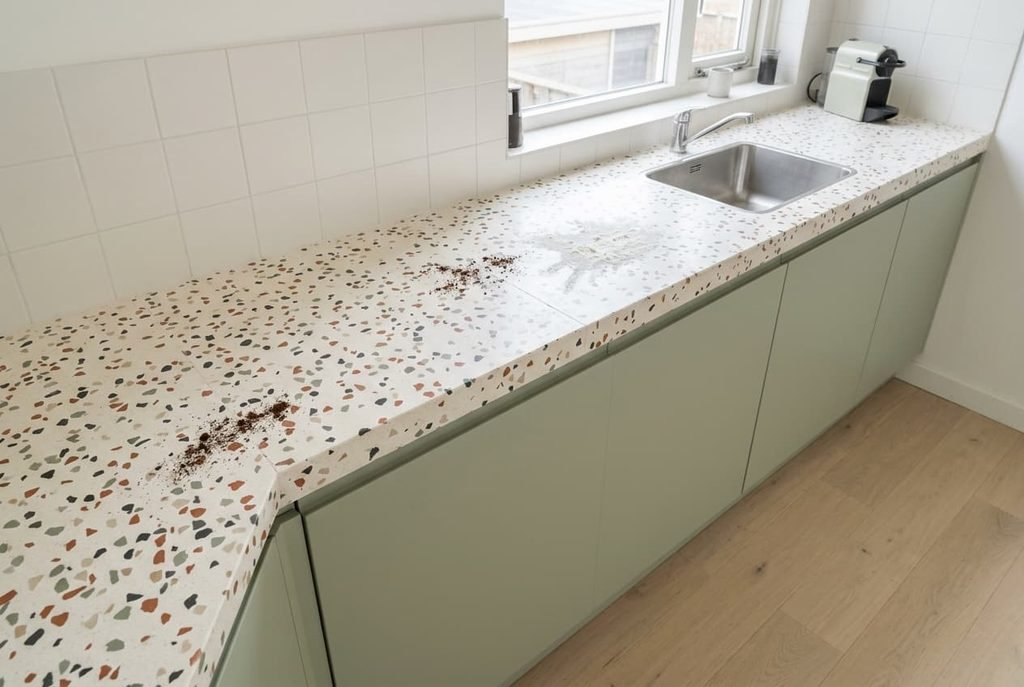
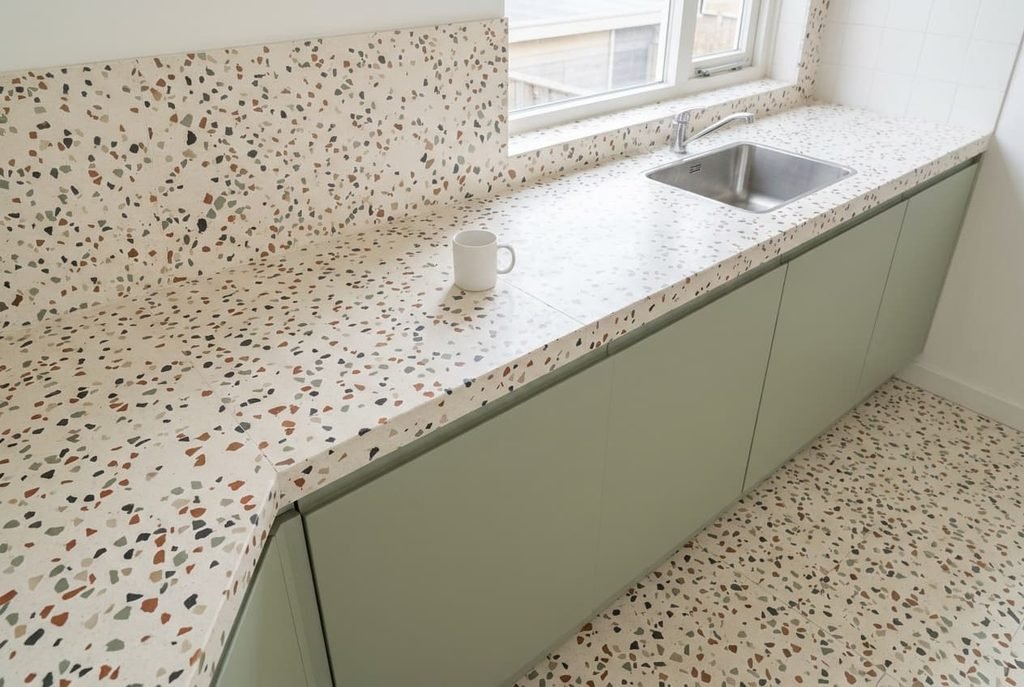
Three measurable shifts follow when a plain worktop gives way to terrazzo on the same 2.40 m². The first is texture. A plain face carries none, while terrazzo with 8 mm chips covering 45% of the surface carries about 21,500 of them (24,000 cm² × 0.45 ÷ 0.5 cm² per chip). A patch 10 cm square holds around 90 chips, so no hand-sized area is ever plain.
The second is the seam. Our 280 cm run needs a joint, because the slabs are cast no longer than 240 cm, and that joint is 60 cm long. On plain stone it’s a clean line. On terrazzo, 45% of its length crosses chips, which is 27 cm of the 60. A fitter closes the joint with a gap of 1 mm, which a chip-rich face disguises far better than a plain one. The measurable change is a seam that shows along all 60 cm falling to about 33 cm, with the face gaining 21,500 chips.
The third is the one people expect, and it’s smaller. A dark crumb hides only when it lands on a dark chip. If 40% of the chips are dark, that’s 45% × 40% = 18% of the surface, so 3.6 of 20 daily marks disappear. Flour behaves the same way on pale chips. With 30% of the chips pale, it hides on 13.5%.
A speckled surface hides a little of the mess and a lot of the seam.
Who a speckled surface suits, and who it doesn’t
It suits a kitchen with a seam to hide. Terrazzo is replacing plain stone worktops first in kitchens where the run passes 240 cm, because that’s where the joint appears. It suits people who accept wear. A ground face can be ground again, and each pass removes about 1 mm, so a 30 mm slab has room for several.
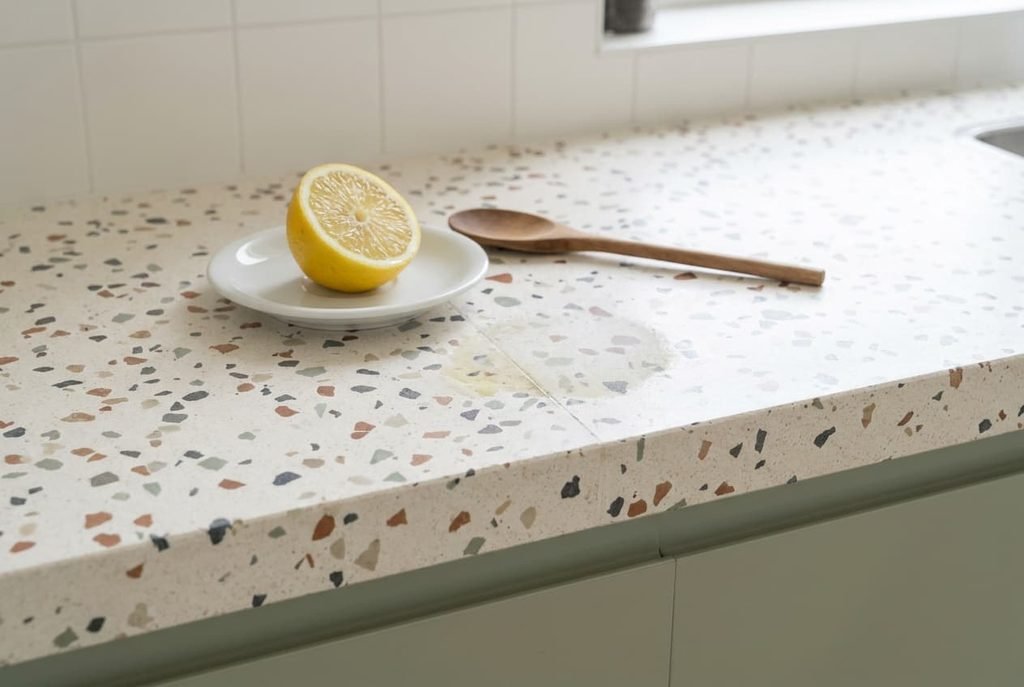
It suits poorly anyone who wants one spotless, uniform plane. The speckle shows every shade difference between a clean patch and a stained one, and a cement binder takes up spills if it isn’t sealed. Cement terrazzo also reacts with acid, so a drop of lemon juice can dull the spot within minutes. Resin-bound terrazzo avoids that, but the surface feels different. A fitter can seal the cement kind, but the sealer needs renewing as it wears.
A cement matrix etches under lemon juice within minutes.
Weight matters too. We assume a terrazzo slab of 30 mm at 2,300 kg/m³, which is 69 kg/m², against a plain slab of 20 mm at 2,400 kg/m³, which is 48 kg/m². Across 2.40 m² that’s 165.6 kg against 115.2 kg, a rise of 50.4 kg or 44%. Ask your fitter whether the cabinets and wall fixings carry the extra.
Are terrazzo worktops replacing plain stone, and is it worth adopting
Count what each benefit is worth. The crumb benefit is 3.6 fewer spot-wipes a day. At 3 s each that’s 10.8 s a day, or 65.7 minutes a year, so crumbs are no reason to switch. A seam is a good reason. The seam benefit is real but applies to one joint of 60 cm.
Our advice is that terrazzo earns its place where a worktop needs a seam, and it has little to offer where one slab covers the run. In our kitchen that means the 280 cm run, while the 120 cm return would need no joint at all. If your worktop is sound, keep it. Whether terrazzo is replacing plain stone worktops in your own kitchen gets settled on the day you renew the cabinets. The slab and the carcass come out together.
The version that will date fastest
The extreme version means the same chip mix on every surface in the kitchen. Look for the signs: chips over 20 mm, and the same speckle on every surface. Our kitchen would carry 2.40 m² on the worktop and 2.40 m² on the splashback. The floor adds 3.5 m². That’s 8.3 m² of speckle and about 74,000 chips of 8 mm, inside a room whose eye never finds a plain surface to rest on.
The floor is the weak point. It’s where grit lives, and grit scuffs polished chips faster than anything on the worktop. A floor also can’t be swapped when the look fades. Removing it means breaking out a layer bonded to the room.
The moderate route puts terrazzo on one surface and leaves the rest plain. On the worktop alone, speckle covers 2.40 of 8.3 m², or 29% of the area. That’s enough to see and still leaves the room somewhere quiet.
How to try it without committing
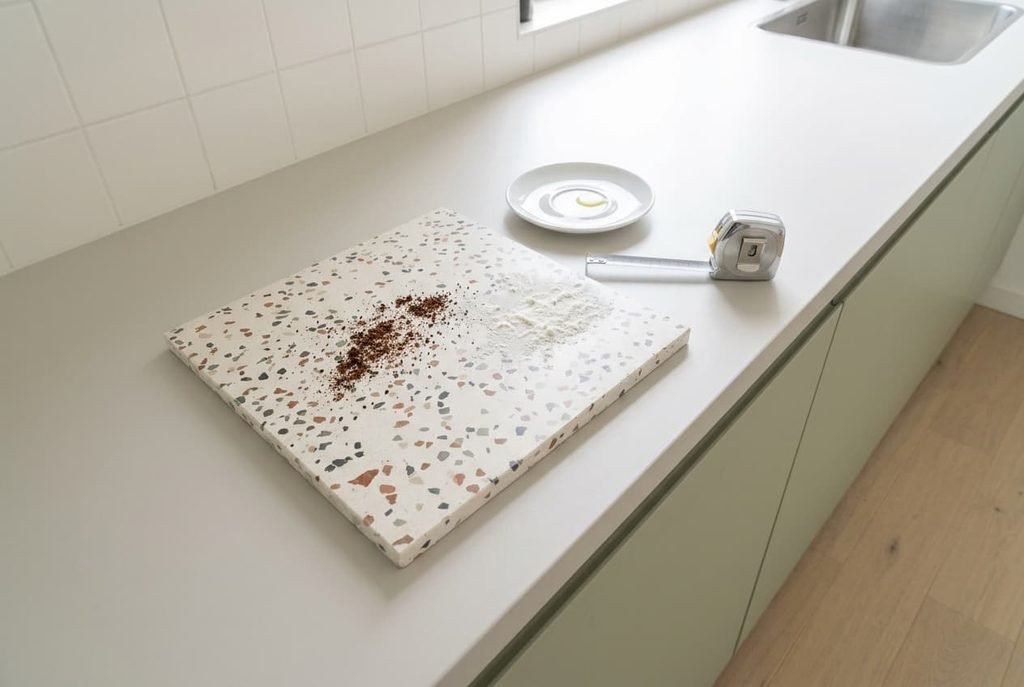
Ask for a sample about 30 cm square, which carries around 800 chips. Start by scattering a teaspoon of ground coffee plus a pinch of flour on it, then photograph it from standing height. Count how many marks you can still pick out. Repeat the test on your current worktop and compare the two photographs.
Put a drop of lemon juice on the underside of the sample. Wipe it off after ten minutes, then check for a dull spot. Cement terrazzo will often show one. Ask the supplier which binder the sample uses, because that decides whether the lemon test means anything. Keep the sample for a week.
Terrazzo is replacing plain stone worktops because it hides seams and can be ground again, not because it hides crumbs. Test the sample before you test the budget. Keep the room’s other surfaces plain. A week with the sample on the counter teaches more than a showroom visit. Pick the version whose seam you can point to. Then decide.
Questions readers keep asking
Should I replace a sound plain worktop with terrazzo?
Not for fashion. A sound plain slab still works, and the seam benefit is the only large gain in our sums. Replace it when you’re renewing the cabinets anyway. The old slab and the carcass come out together. Then choose terrazzo only if your run needs a joint.
Does terrazzo suit a very small kitchen?
Often yes, on one surface. A worktop of 2.40 m² with 45% chip cover adds texture without crowding the room. Leave the walls and floor plain, which gives the eye a place to rest. Danger lies in the all-surface version, which puts about 74,000 chips in a small room.
How long will a terrazzo worktop last?
Ground faces outlast most kitchens, since each pass removes about 1 mm. Only the look is uncertain. A moderate version on one surface ages quietly, while an all-surface version with large chips is the one that dates. Ask what you’d break out to change it.