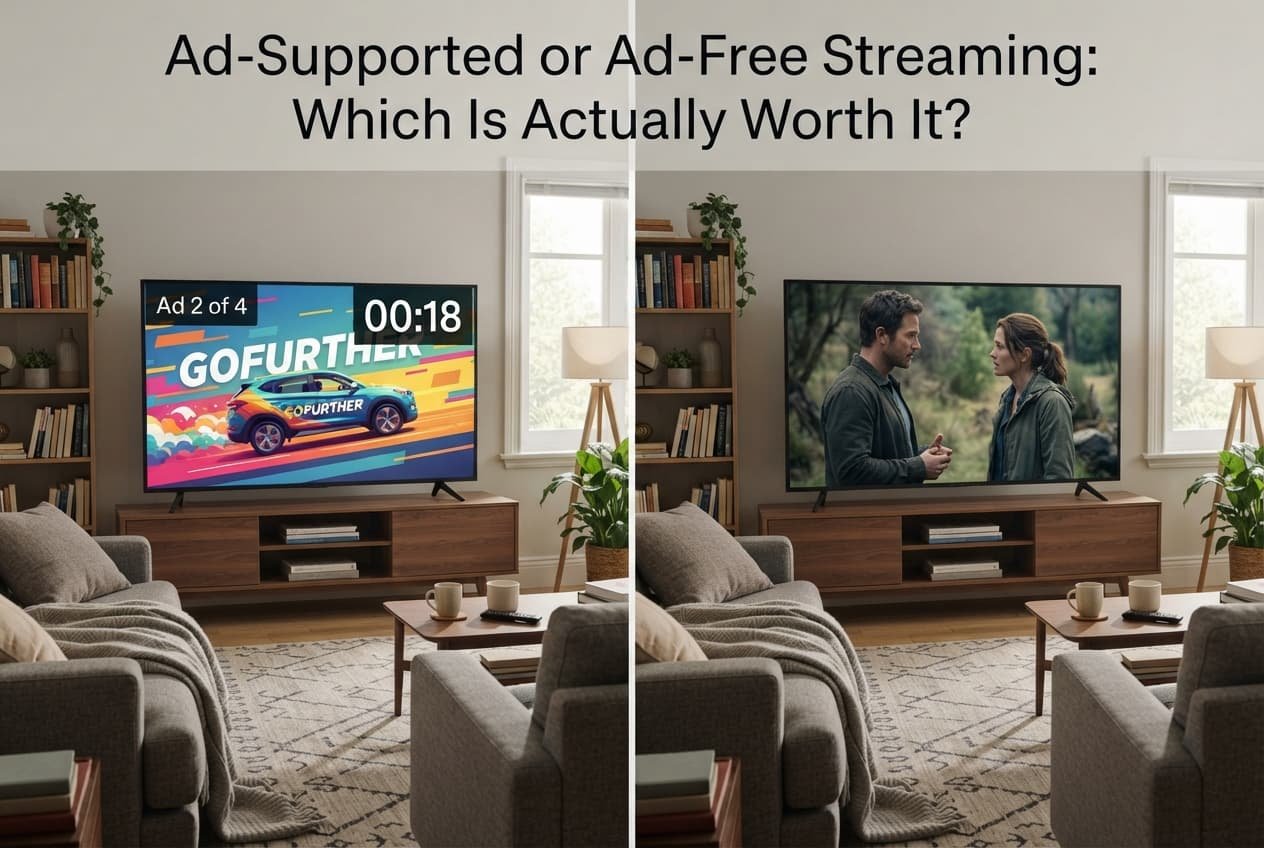
The right tier isn’t decided by which one sounds more premium – it’s decided by how much the price difference actually matters to you against how much interrupted viewing genuinely bothers you specifically. An ad-supported tier and an ad-free tier solve genuinely different priorities, and defaulting to ad-free purely because it sounds better misses what actually determines whether the extra cost is worth it for your specific viewing habits.
The one property that decides it
The deciding factor is genuinely how much value you place on uninterrupted viewing relative to the actual price difference between tiers, not simply which option carries less of a compromise-sounding label attached to it. An ad-supported tier directly saves you money specifically, while an ad-free tier directly protects your viewing experience from interruption, and neither preference is objectively more reasonable than the other.
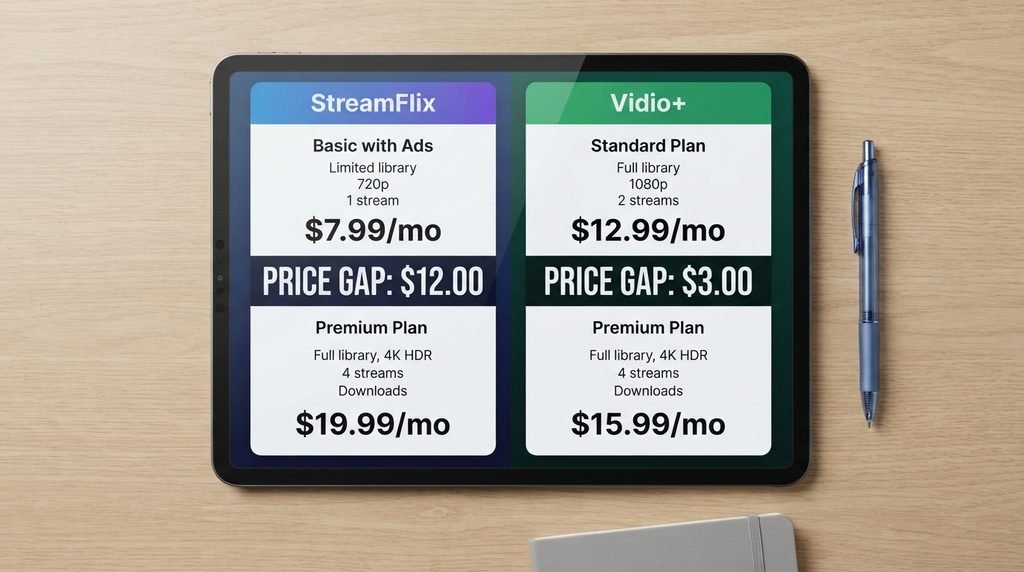
This matters considerably because the actual price gap between tiers varies quite considerably by specific service, meaning the genuine value of paying more for ad-free viewing depends specifically on that particular gap, not on a general assumption that ad-free is always worth whatever the premium happens to be for any given service.
Head to head
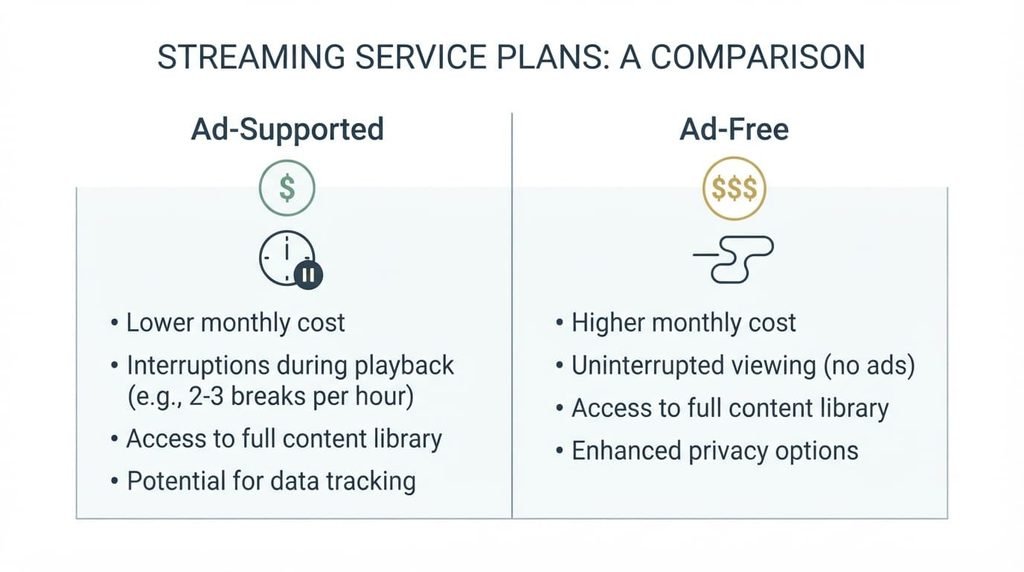
| Ad-Supported | Ad-Free | |
|---|---|---|
| Monthly cost | Lower | Higher |
| Has ad breaks | Yes | No |
| Price gap size | N/A | Varies by service |
| Content library access | Usually same | Usually same |
| Video quality | Can vary by service | Usually consistent |
| Best suited for | Price-sensitive viewers | Interruption-sensitive viewers |
The single row that surprises most people the most is content library access specifically, more than any other row in this particular comparison. Many assume an ad-supported tier offers a meaningfully reduced content selection, but for many services the actual available content library is identical between tiers, with the difference genuinely limited to interruptions and sometimes video quality, not what you can actually watch.

Where ad-supported wins
Anyone genuinely price-sensitive about their streaming budget specifically benefits from an ad-supported tier’s lower cost, since this directly addresses the actual financial priority without sacrificing access to the same core content library most services provide across both tiers. The unglamorous reason: ad-supported tiers also tend to receive more attention and investment from services currently, meaning the ad experience itself has often genuinely improved compared to earlier, more heavily interrupted versions of similar tiers in the past.
Anyone genuinely juggling several streaming services simultaneously benefits from this same cost reduction in a compounding way, since the savings from choosing ad-supported specifically across multiple services adds up considerably more than the same choice made for just one single subscription in isolation.
Where ad-free wins
Anyone who finds interruptions genuinely disruptive to their viewing experience – during a tense narrative moment, for instance – benefits from ad-free viewing’s uninterrupted format, since this directly addresses a specific viewing-experience priority an ad-supported tier structurally can’t fully replicate regardless of how well-designed its ad experience becomes. The unglamorous reason: ad-free viewing also tends to have more predictable, consistent total viewing time for a given piece of content, since there’s no variable ad-break length affecting how long an episode or film actually takes to finish watching.
Anyone who tends to watch content in a single sitting without pausing benefits from this same consistency in a related way, since predictable, uninterrupted timing matters more for someone planning a specific viewing block than for someone who naturally pauses and resumes content across several separate sessions anyway.
When neither is right
Assuming the price difference between tiers is roughly the same across every streaming service you use, without checking each specific service’s actual gap, is worth ruling out regardless of which tier you’d otherwise default to.
The genuine value calculation between ad-supported and ad-free varies meaningfully by service, since the actual price gap differs considerably between providers – a small gap makes ad-free considerably easier to justify than a large one does, meaning a blanket policy across all your services misses this service-specific variation entirely.
How to decide in thirty seconds
If the price difference for a specific service is genuinely small relative to your budget, choose ad-free. The modest additional cost directly addresses interruption sensitivity without meaningfully affecting your overall streaming budget.
If the price difference is genuinely significant relative to your budget, choose ad-supported. The meaningful savings directly addresses price sensitivity, and for many services, ads have become considerably less intrusive than earlier versions of similar tiers.
What changes the answer later
A service significantly changing its ad load or ad frequency within its ad-supported tier is worth reconsidering the choice at, since the actual interruption level – not just the tier’s existence – is what genuinely determines whether the trade-off remains worthwhile for your specific tolerance.
Your own viewing habits shifting toward content where interruptions genuinely matter more – live sports, tense dramatic content – is also worth reconsidering the choice at, since the value of uninterrupted viewing isn’t uniform across every type of content you watch.

What people get wrong when choosing between them
The most common mistake is assuming ad-free is inherently the “correct” or more sophisticated choice, treating the ad-supported tier as something to upgrade away from as soon as budget allows, rather than as a genuinely reasonable ongoing choice for someone who simply doesn’t mind occasional ads relative to the savings. This particular framing pressures people toward paying meaningfully more than their actual genuine preferences would otherwise reasonably justify.
A second common mistake is comparing tier prices once at signup and never revisiting that comparison, when services do periodically adjust pricing and ad loads for both tiers independently. A price gap or ad experience that made ad-supported clearly worthwhile at the original signup can genuinely shift over time in either direction, making an occasional recheck worthwhile rather than simply assuming your original decision remains optimal indefinitely without ever revisiting it.
Questions readers keep asking
Do ad-supported tiers show the same number of ads throughout an entire viewing session?
This varies by service and sometimes by specific content, so checking a particular service’s actual typical ad load, rather than assuming a universal standard, is worth doing if ad frequency specifically is your primary concern in choosing between tiers.
Does choosing ad-supported affect video or audio quality?
For some services, yes – certain providers do cap resolution or audio quality specifically on their ad-supported tier, so checking a service’s own specific tier details for quality differences, not just ad presence, is worth confirming before assuming the only difference is interruptions.
Can I switch between ad-supported and ad-free at any time, or is there a commitment period?
This varies quite a bit by specific service, so checking carefully whether your particular provider allows immediate switching or requires waiting until your next billing cycle is genuinely worth confirming, since this genuinely affects how practically feasible seasonal or situational switching actually is for your own specific circumstances.
Is it worth switching tiers seasonally, based on what I’m currently watching?
For some households, yes, if a service allows this flexibility without penalty – switching to ad-free temporarily during a period of interruption-sensitive viewing, such as watching a particularly tense series, then reverting to ad-supported afterward, can be a reasonable way to get both benefits at different times.