The doors were all painted from one tin, yet they refuse to agree. Our example is an Utrecht flat. The hallway measures 120 cm across. Each of its four doors measures 78 cm by 201.5 cm. Seen from the entrance, the white doors in our flat read as four different colours, from warm cream to cool grey. Nobody chose four whites, and the paint went on correctly. What differs is the light around each door, which is welcome news, since nothing needs rebuilding. All measurements here are approximate, and your own hallway deserves a ruler before you act on them.
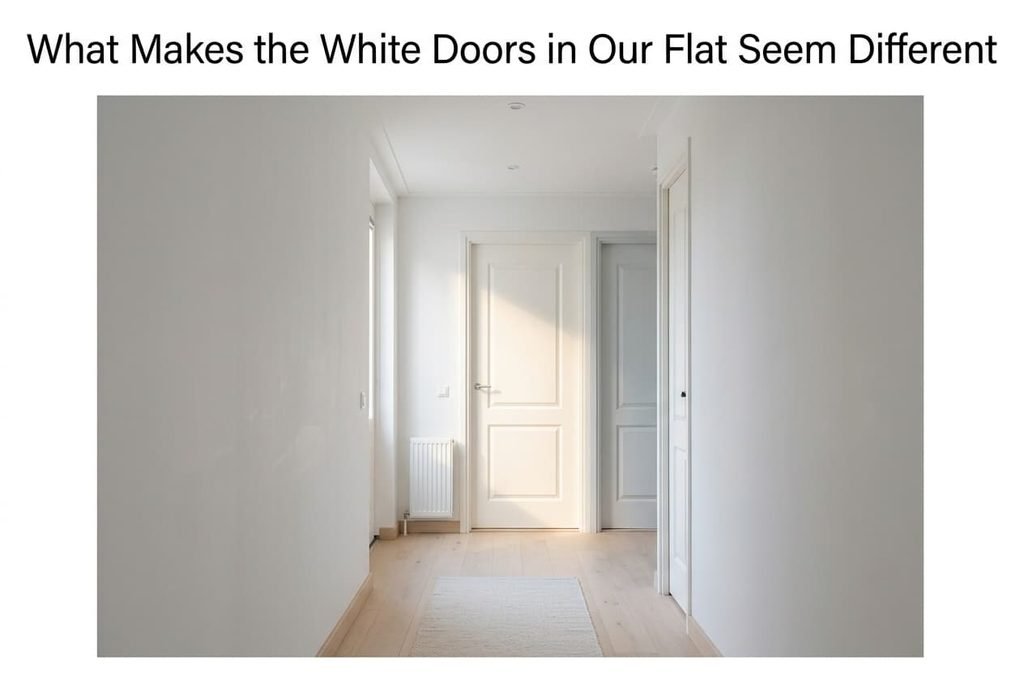
What Makes the White Doors in Our Flat Seem Different
White paint has no colour of its own. It returns whatever arrives. Each door therefore shows a different blend of window light and lamp light, plus a warm glow bounced up from the floor. A door beside the window collects roughly triple the light of one near the back wall. We read that gap as a difference in the paint. That reading feels natural, yet it’s wrong.
The common misdiagnosis is blaming the paint, when the doors usually differ in what falls on them and how they return it. Sheen adds a second layer. Satin scatters light softly, whereas gloss throws back a bright streak of the window, so one white looks greyer or paler depending on where you stand.
Age plays a quiet part too. A door that’s handled daily picks up marks faster than one that’s rarely opened, and a fresh coat beside an older one always shows. Add a pale oak floor that reflects warmth upwards, and four identical coats end up reading as four colours. Your eye is reporting the light accurately, and that’s why the effect feels so convincing.
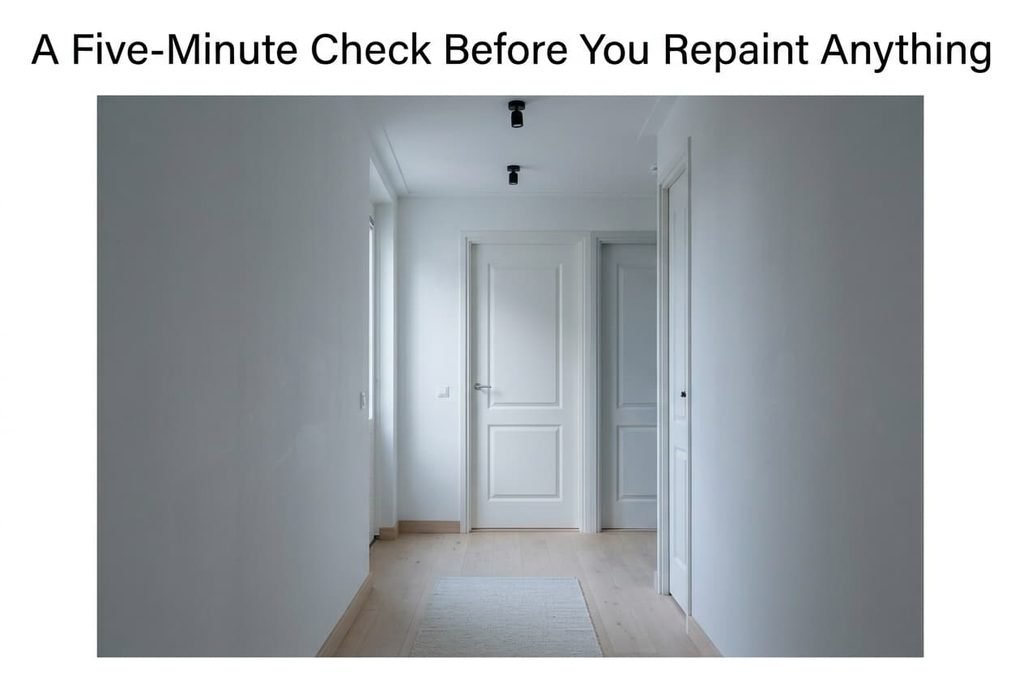
A Five-Minute Check Before You Repaint Anything
Photograph all four doors in one frame on a grey afternoon, with the lamps switched off. Take it from the entrance, where most visitors first see the hall. If the doors look alike in daylight, the paint is sound. The lamps or your viewing angle are then the trouble.
Switch the camera to monochrome and take the picture again. Colour drops away and only brightness remains, and keeping the phone at one height each time keeps the comparison fair. So a door that is clearly lighter or darker has a light-level problem.
Turn the lamps on and repeat both pictures. A door that slides from white to cream under the bulbs has a colour-temperature problem, and you’ll want to read the bulb ratings next.
Finally, walk to the last door and look back. The white doors in our flat are seen face-on from one end and almost edge-on from the other, and that angle alone changes how much light each one returns. Note which door looks brightest in every picture, because that one is the focal point.
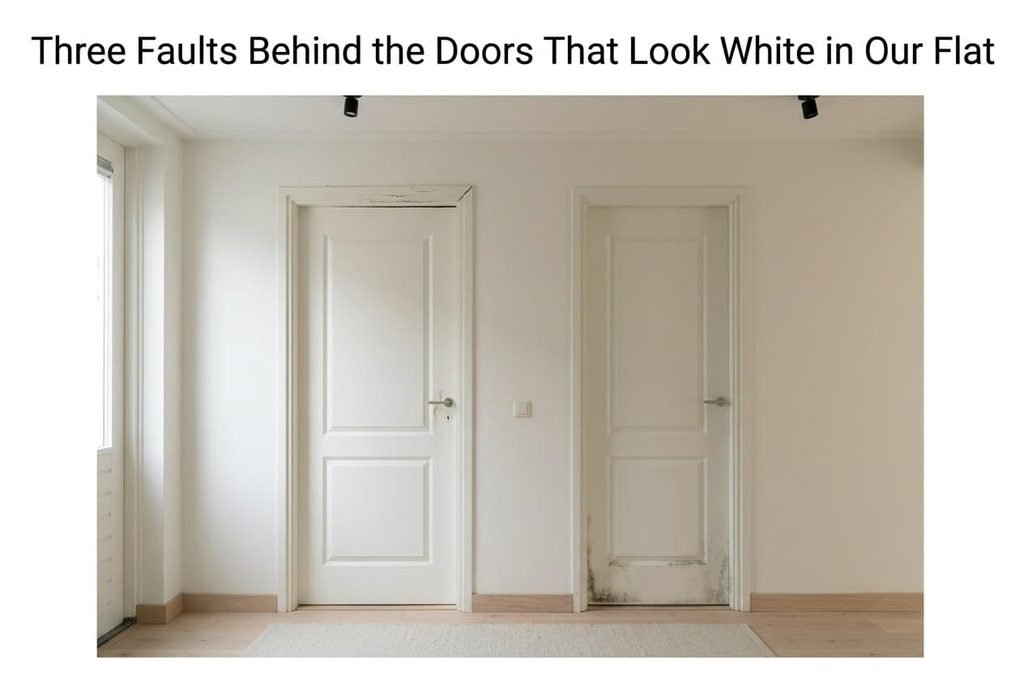
Three Faults Behind the Doors That Look White in Our Flat
One door looks heavier than the rest. Its frame measures 7 cm across while the others measure 4 cm. Around an opening 78 cm wide and 201.5 cm tall, a 7 cm frame adds up to about 0.34 m² of white. A 4 cm frame covers 0.19 m², so the wide one carries 0.15 m² more. That extra area draws attention and exaggerates the shade. The free test is a photograph with strips of paper laid over the wide frame: if the doors then match, the frame is the culprit. Measure with a tape, because 3 cm of extra width is easy to miss by eye. The next step is a change of finish. Painting the wide frame in the wall colour makes it recede, and it takes one small tin and an afternoon. A slimmer frame fitted by a joiner is the costly last resort.
One door turns cream after dark. A bulb rated 2700 K gives a warm, yellowish light. One rated 4000 K gives a cooler, whiter light, so a mixed set shifts each door according to the fitting above it. Check the rating marked on every bulb, which costs nothing. Then move bulbs between fittings so the warm ones stay together and a cool one never lights a single door. If the set still clashes, buy matching bulbs for the hall; they’re the cheapest purchase on this list, and they settle the matter for good. A warm bulb is gentler on cream walls, while a cool one flatters a bright white, so the match matters more than the choice.
The far door always looks the brightest. It faces anyone who walks in. It catches the most light from the window, so it becomes the focal point while its neighbours look duller. Keep it shut for a week and notice how much of the effect fades; that’s a free test. A door closing off a corridor draws the eye, however plain it is. Next, a slim console standing before it breaks the line of sight. A runner that leads the eye along the floor spreads attention over the whole hall, but it’s the priciest step here, so try the other two first.
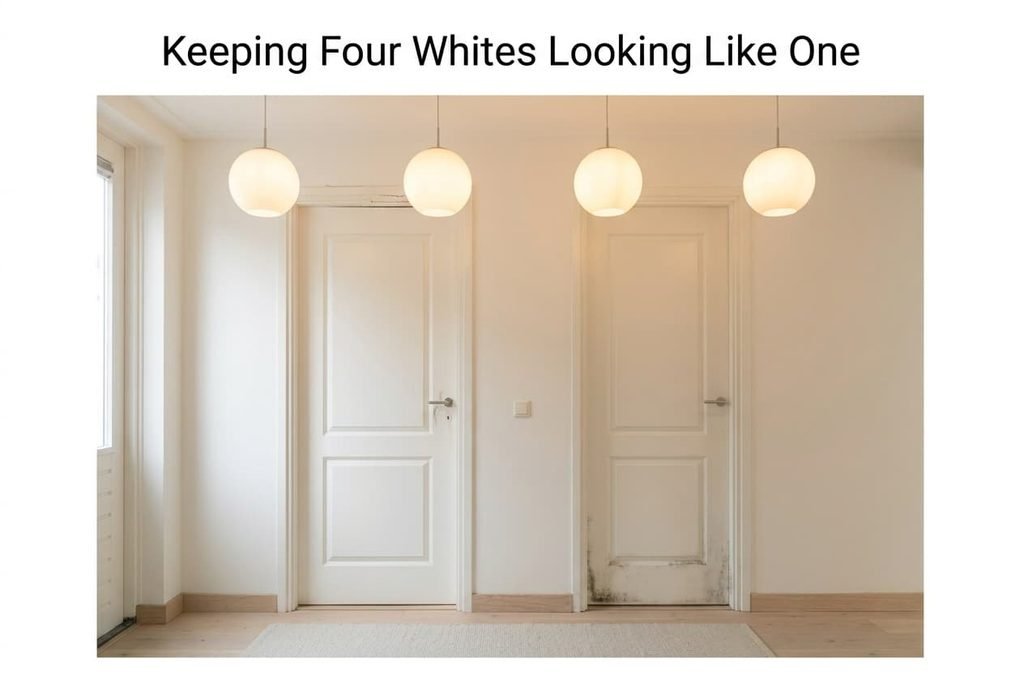
Keeping Four Whites Looking Like One
Fix the conditions and the doors stay in step. Use one sheen on every door and frame, since a mixture of gloss and satin always reads as two whites, each catching the window differently. Wipe the frames and door tops twice a year, because grime dulls a white faster than you’d expect.
Pick one bulb temperature for the whole hall and note it on a label inside the fuse cupboard. Replace bulbs in pairs, so a new one never burns beside a tired one.
When you repaint a door, finish the others that same weekend from the same tin. The white doors in our flat looked uneven partly because they were painted in different years, and a fresh coat beside an old one shows at once.
Keep a small sample card of the white you used, with the date on its back.
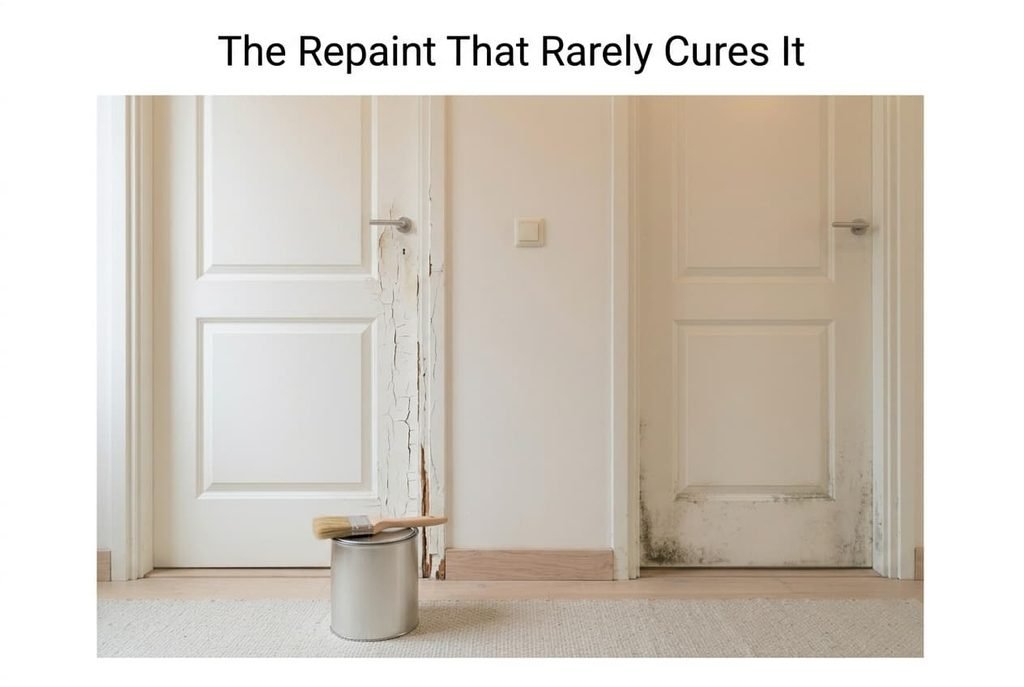
The Repaint That Rarely Cures It
Repainting every door in a “warmer” or “colder” white seems the natural cure, yet it rarely works. The tin was never at fault, so a new shade just adds a fifth white to the hall. Light still falls unevenly on the doors, and the mismatch returns within a week. The job also costs a weekend of masking and sanding, a poor trade for a problem the five-minute check could have explained. Dust and masking tape leave their own marks, too.
Blaming your eye or the paint is the wrong reading. The white doors in our flat behave exactly as light does in any hall, and yours will too. Hallways are tricky in every home, so the effect says nothing about your decorating.
Do the cheap steps first, and touch a brush only if one door still looks wrong afterwards.
A hall with matching bulbs and one sheen rarely needs more. Each of those changes works on the light, which is the real source of the trouble, so the doors can stay as they are. Take a second photograph after the changes and set it next to the first. In most halls the improvement is obvious, and the four doors read as a single white. If one door still stands out, repaint it alone from the same tin and leave the rest untouched. That single job fits into an afternoon and costs much less than repainting all four. Photographing the hall again next year will confirm the result holds.
Questions Readers Keep Asking
What usually causes white doors to look different?
Mostly the light falling on each one. A door near the window collects more of it than a door by the back wall. Bulbs of different temperatures push a white towards cream or grey. Sheen and age add smaller differences, whereas the paint itself is rarely to blame.
Is there a quick fix before repainting?
Yes. Match the bulbs in the hall and keep the far door shut so attention rests on a wall. Then take a monochrome photo to spot any door that’s genuinely lighter. All of that fits into an hour. Repaint only if a door still disagrees after those changes.
Can the doors be fixed without renovation?
Almost always. Bulbs and furniture positions can be adjusted in an afternoon, and one stubborn door can be repainted from the same tin as the others. None of that needs a builder. The hall keeps its doors and its paint. Only the light around them changes.