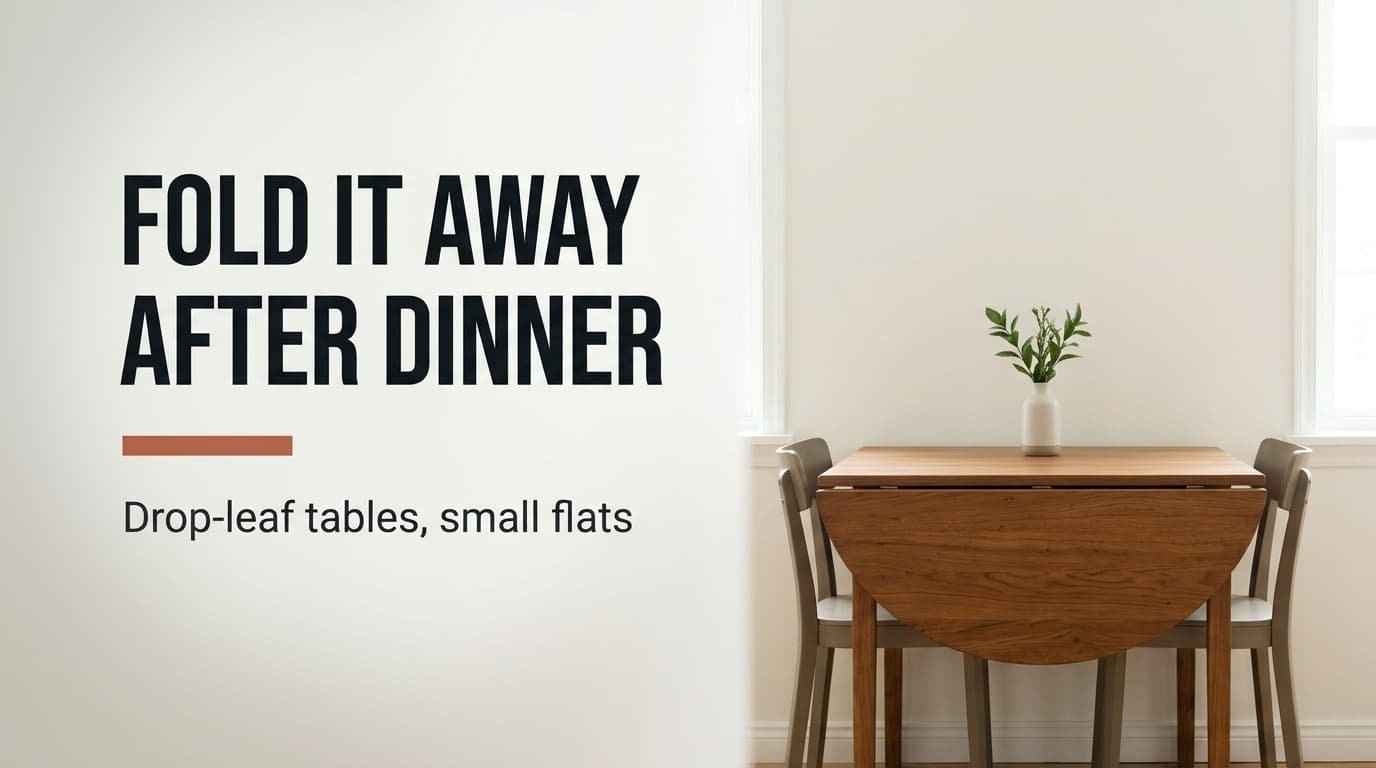
Drop-leaf tables are replacing fixed dining tables in small Dutch flats since one room must now work as dining space and desk while still serving as a thoroughfare. A table that shrinks to a slim strip against the wall hands back floor through the daytime, and it still seats four when friends come. Folded, it is about as deep as a bookshelf. The price shows up in legroom and in seat count. Below you’ll find the measured change and its causes, then the cost and the extreme version, plus a quick test. All figures assume a living-dining room of 3.8 by 5.2 metres.
Why drop-leaf tables keep replacing fixed dining tables: the short version
A dining table once held its ground. You sized it for the largest dinner of the year, then walked around it for the other 364 days. That logic fitted a house with a dining room that had no second job.
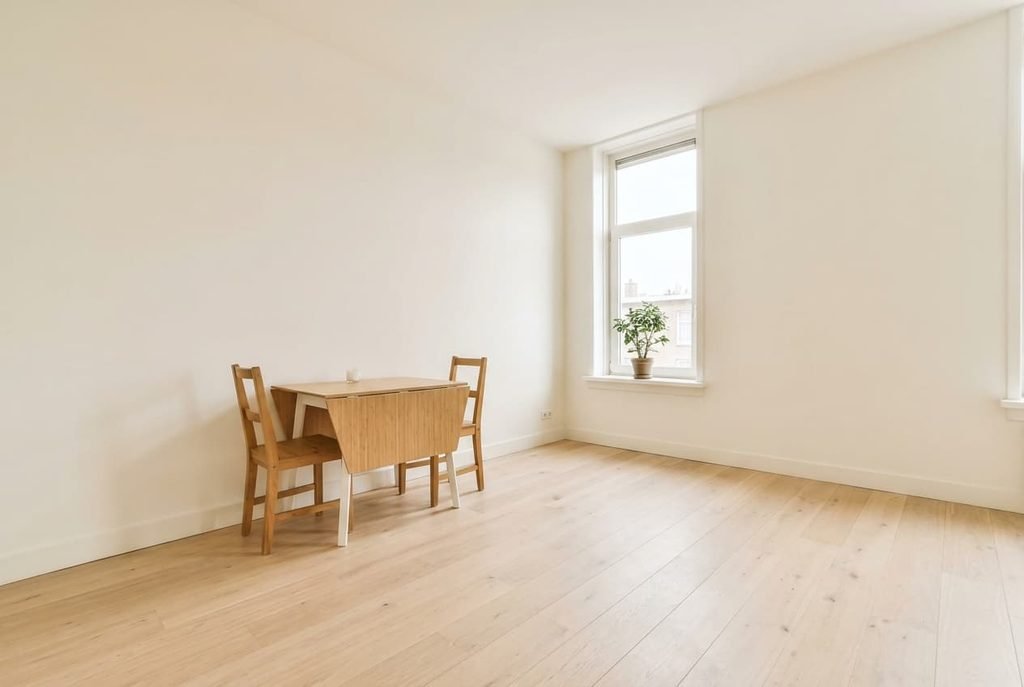
A drop-leaf starts from the reverse premise. Two hinged flaps hang at the sides, and the top shrinks to a narrow strip beside a wall. Raise both flaps and the same table opens into a full square. What changes is the timing: the table reaches full size only while someone eats at it.
Variants differ in how the flaps are held. Swing legs fold out from the frame, while bracket supports slide out from beneath the top. Both give the same footprint, and the choice mainly affects knee space.
Flats are the pressure here. A fixed table claims its floor around the clock, in rooms where each square metre is already promised twice. Households also gather less often than their furniture assumes, so most seats stay empty on an ordinary evening.
Size now follows the meal, not the calendar.
What changed, in measurable terms
Measured plainly, a fixed table measuring 180 by 90 cm holds about 9.7 m² of floor all day, whereas a drop-leaf folded to 120 cm holds about 1.6 m² for most of it. The fixed top covers 1.62 m². The chairs and the walking lane add 90 cm on every side, which produces a clear zone of 360 by 270 cm. Folded, the drop-leaf is 40 cm deep, and with 90 cm of lane on its open side it needs 120 by 130 cm.
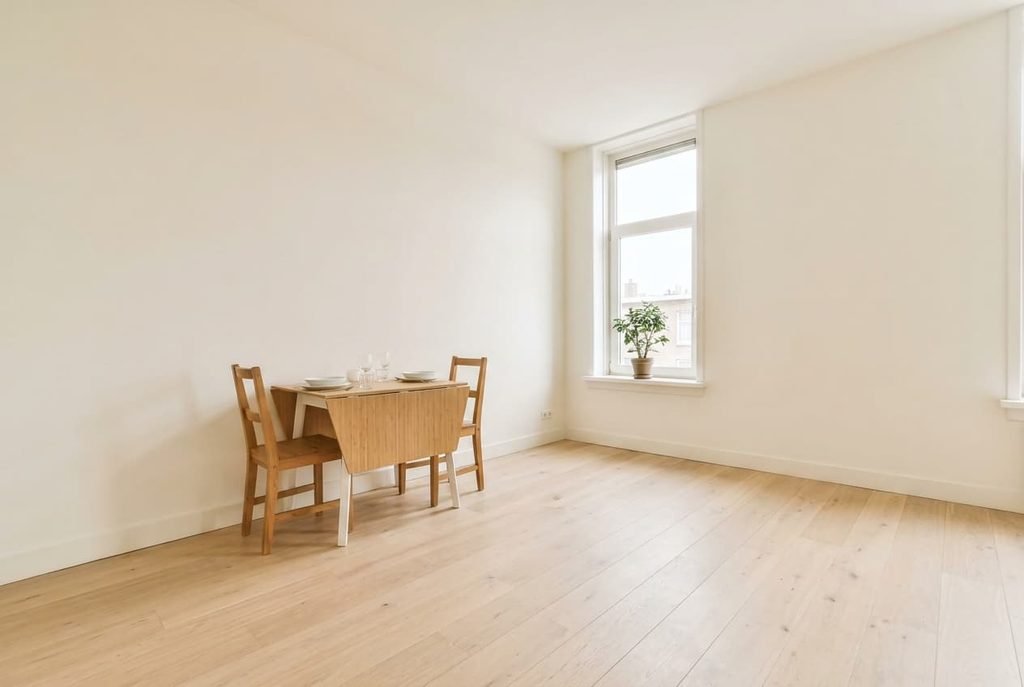
Fully open, the drop-leaf measures 120 by 110 cm and seats four. Its clear zone grows to 300 by 290 cm, or 8.7 m², though only for the meal. Say a household sits down for about 2.5 hours a day. The table is then at full size for roughly a tenth of the day and folded for the other 21.5 hours. In the invented room of 19.8 m², the floor returned is 8.1 m², or 41% of the room.
Seats shrink with the footprint, from six at the fixed table to four at the drop-leaf. Two slim chairs tuck into the folded strip, whereas six chairs round a fixed top need parking somewhere else. A pair who host a guest or two uses the bigger count about four times a month, so the missing seats pass unnoticed.
Weight moves as well. A solid top measuring 180 by 90 cm weighs around 40 kg, while the drop-leaf comes to roughly 25 kg and splits into three pieces.
Three reasons rented flats are switching tables
The first reason is the room’s second job. Plenty of people now work at the dining table for a few hours, and a table able to fold lets the same corner turn back into a lane or a play area. A laptop and a mug need only 60 by 40 cm, and one raised flap gives that. A fixed top can’t change jobs between lunch and dinner.
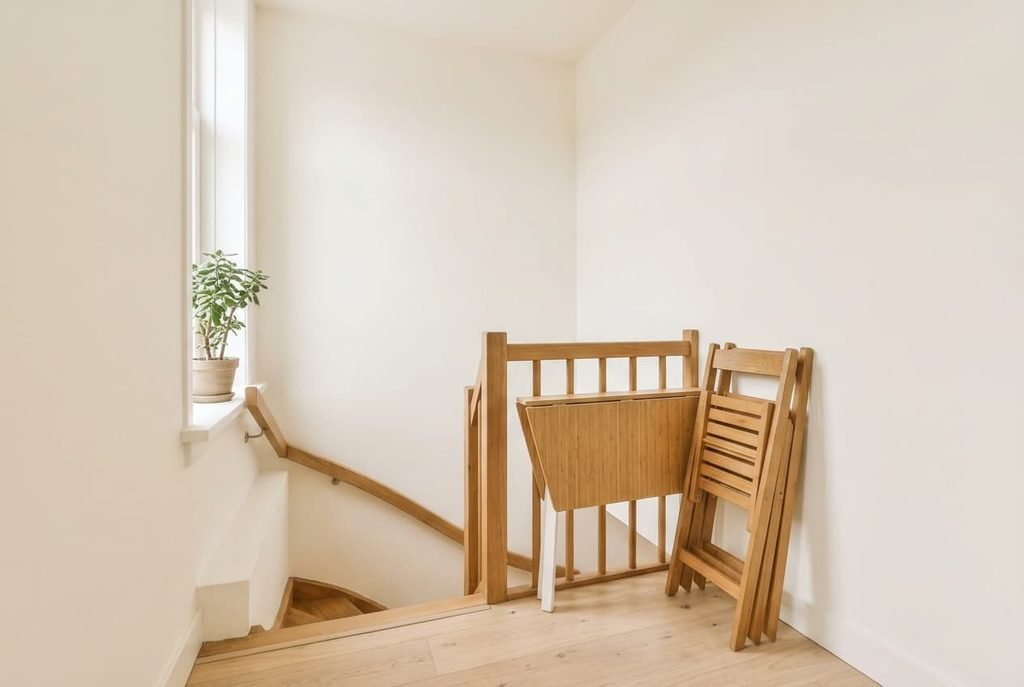
The stairwell is the second. An upper-floor flat often has a stair turn about 70 cm wide, and a rigid top 90 cm across can’t be rotated through it. A closed drop-leaf measures 40 cm at its deepest, so it clears the corner. One person can carry it where the fixed version needs two. A set of flat-packed chairs goes upstairs easily, so the table is usually the only piece to check against the stairs.
Headcount is the third. Suppose a household of two hosts guests four times a month. A table for six then sees full use on about 13% of evenings. A table that grows only on request has no empty chairs to defend.
Under 60 m², floor is scarce. Seats are cheap. Replacing fixed dining tables with folding ones is the logical move once that arithmetic is written down.
What you give up when replacing a fixed table for dining
Of the three losses, legroom goes first, because the swing legs under each flap sit where knees want to be. With one flap raised, two people can take the long side, and the support leg claims about 30 cm below the other half. Guests tend to dodge the fourth seat at a drop-leaf for that reason.
Rigidity drops too. A hinge is weaker than a solid top, and a flap with a loaded plate near its edge can tip when the support sits badly. A gap above 2 mm between a raised flap and the top catches glasses and crumbs.
Seats are the third loss. Six people fit round a fixed table with no fuss. A drop-leaf makes you borrow a chair or fetch a stool, so a dinner for six turns into a puzzle. Daily life gains the floor, and the rare large dinner pays the bill.
The extreme version
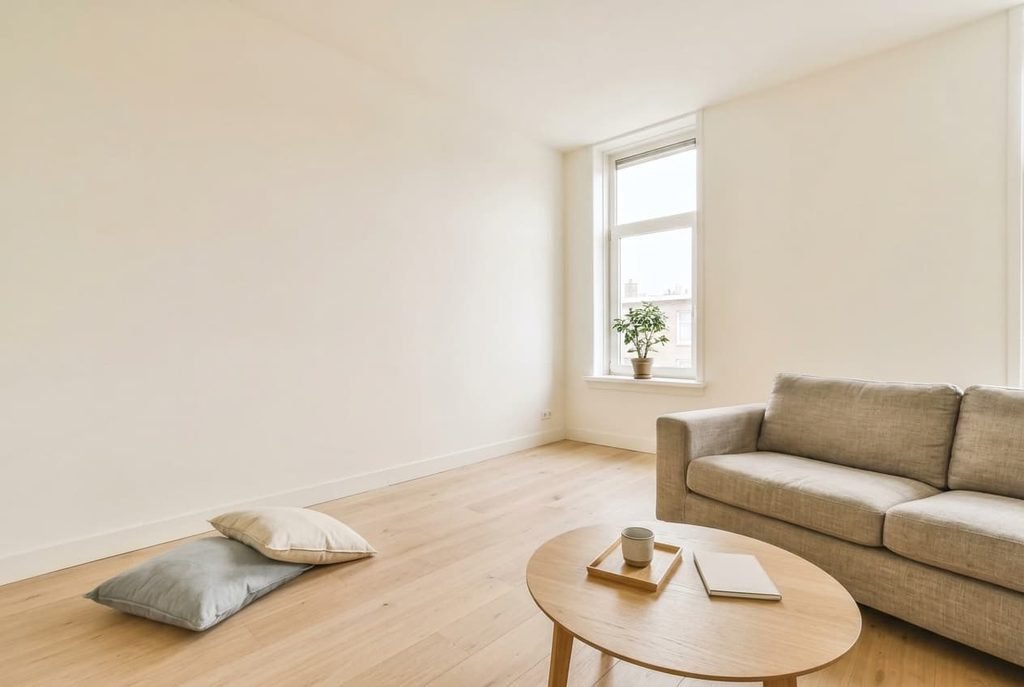
The extreme version removes the dining table altogether. Meals move to a low coffee table or to knees, and the room gains the full 9.7 m². That swaps a layout problem for a posture problem, since a whole meal balanced on a lap suits nobody for long. Living with no dining table is a different thing from this trend pushed further, because it removes the one surface that gathers people round a meal.
Hardly any household needs to go there.
When the table is the problem, shrink it before you remove it. A drop-leaf folded through the daytime returns nearly the same floor as no table, and the evenings with four at dinner stay intact. That’s a long way short of removing the table, and it’s the sensible form of replacing fixed dining tables with a folding one. A first dinner with the flaps raised is the cheapest check of whether the layout works. People who try the table-free version often bring a small table back, because eating at knee height wears thin.
Who it suits
Drop-leaf tables suit a flat under 60 m² whose dining corner doubles as a lane or a desk. They also help in a rented home where the table has to pass a narrow stair turn. Households of two or three gain most, since the missing seats are rarely missed. Stay with the fixed table if four or more people eat with you most weeks, because then seats and legroom outweigh the floor you’d win back. Count the evenings last month when more than four people sat down together. Three or more points to a fixed table, none points to a drop-leaf, and a single evening is a toss-up.
Drop-leaf tables are replacing fixed dining tables fastest in the rooms that work hardest, which hints at what to do. Fit the table to the evenings you actually have, then fold it once the plates are cleared. A drop-leaf left open all week is only a small table blocking the lane, and it returns none of the floor the fixed one took.
Questions readers keep asking
Should I replace a fixed table I already own?
Only when it blocks the room. A table in good shape doesn’t ask anything of you, so swapping early gains little. Change it when you can’t walk round it or when it won’t fit through the next stairwell. Before deciding, tape its outline on the floor with 90 cm of lane and let the tape stay put for a week.
How many people can a drop-leaf table seat?
Two with one flap raised and four with both up, provided the support legs stay clear of knees. A sixth person needs a borrowed stool or a second small table. If you host six more than once a month, a fixed table suits you better.
How long does a drop-leaf table last?
Solid hinges and sturdy support legs keep it working for many years. The hinges and flap supports wear first, so check them each year and tighten loose screws. Prefer a design whose flaps rest on a bracket rather than on the hinge alone.