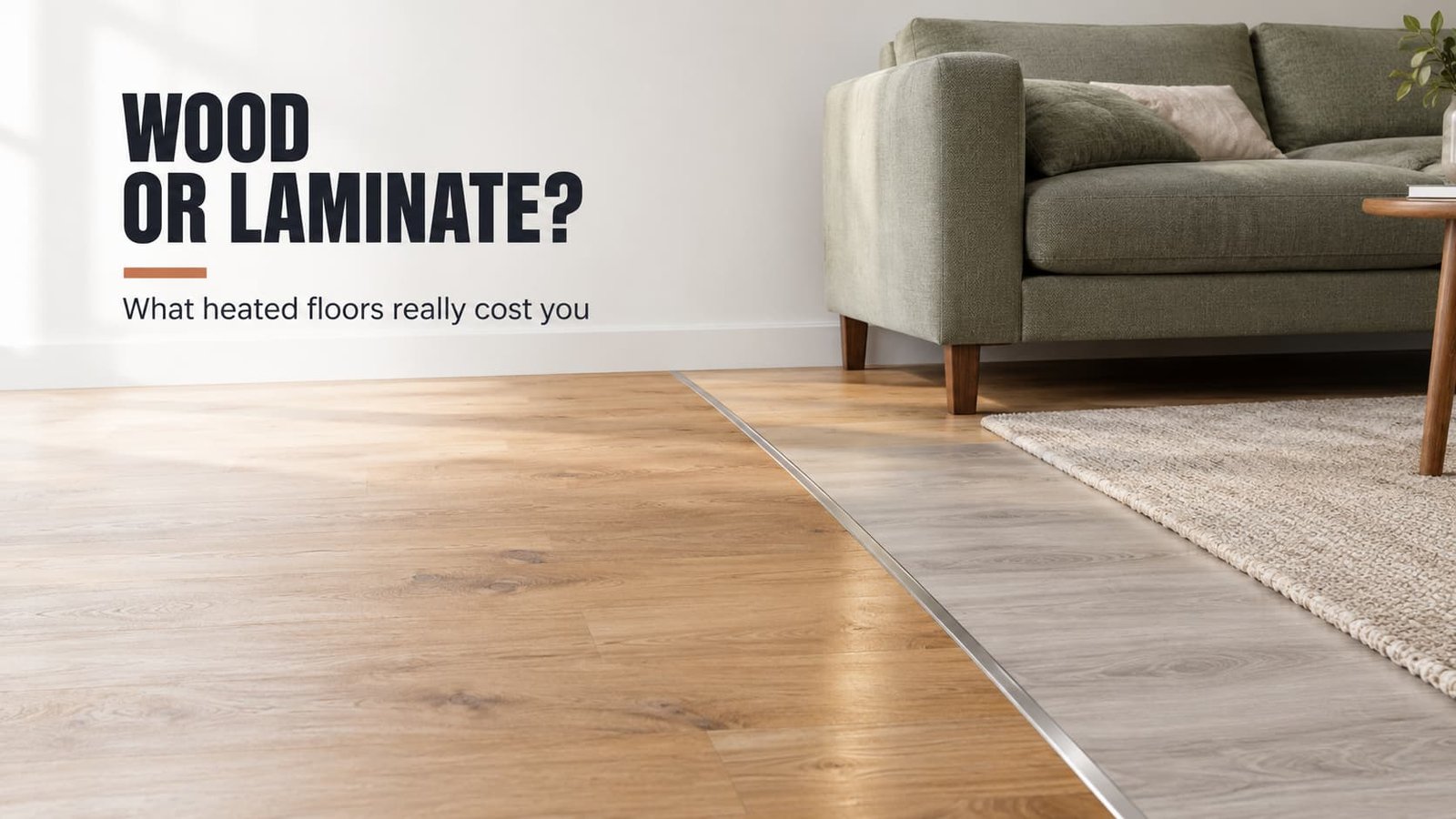
Underfloor heating rarely feels as warm as it should, and the floor on top is usually the reason. Choosing flooring for a rented flat with underfloor heating comes down to one number: the thermal resistance of the board plus its underlay. Laminate with its underlay sits near 0.10 m²K/W. A 14 mm engineered wood board with the same underlay sits near 0.15. Each step up costs you output, and the loss shows in the room long before it shows on a bill.
I assume a 20 m² Dutch living room with 35 °C water in the pipes and 20 °C air above the floor, so swap in your own figures before you buy anything.
The one property that decides flooring for a rented flat with underfloor heating
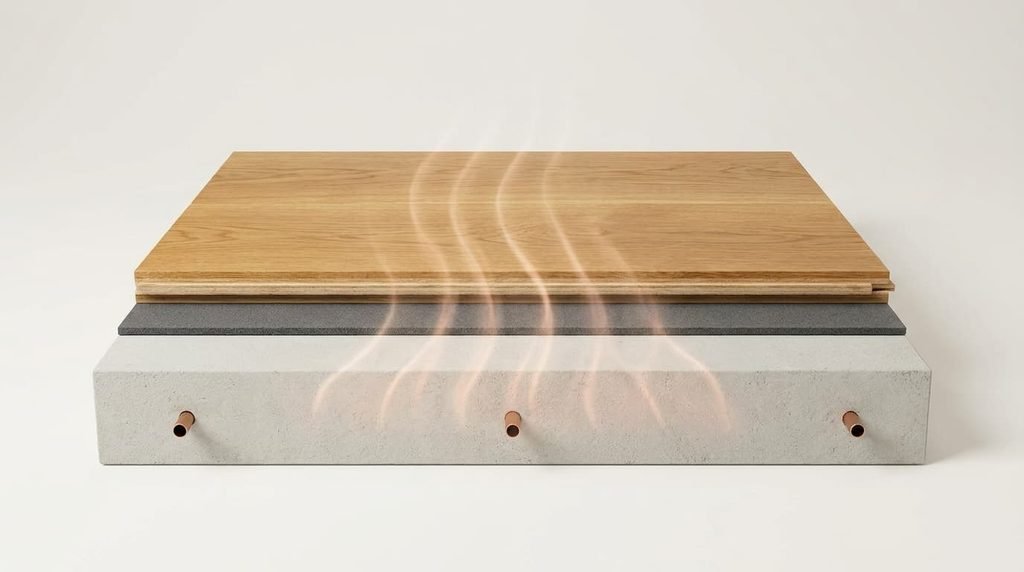
Heat leaves the pipes through every layer above them. Each layer resists in proportion to its thickness divided by its conductivity. Resistance, written R, is measured in m²K/W, and the total resistance of board plus underlay sets how much heat reaches the room when everything else stays fixed. A bigger R means less heat gets through.
An 8 mm laminate board at 0.17 W/mK has R = 0.047. A 2 mm underlay at 0.04 W/mK adds 0.050, so the build-up totals 0.097. A 14 mm engineered wood board at 0.14 W/mK gives 0.100, and the same underlay lifts it to 0.150.
Screed and the surface film of air add 0.14 more in every case. The heat flow is 15 K divided by the sum. That gives 63 W/m² for laminate and 52 W/m² for the 14 mm wood. Across 20 m² that’s 1,266 W against 1,034 W, a loss of 18%. Heating makers often cap the covering at 0.15, so read the cap in your own manual.
Thickness counts for more than species. Trimming the wood from 14 mm to 10 mm cuts 0.029 from the total and returns 114 W across the room. Swapping an 8 mm wood board for 8 mm laminate would return only 52 W.
Head to head: flooring for a flat with underfloor heating that is rented
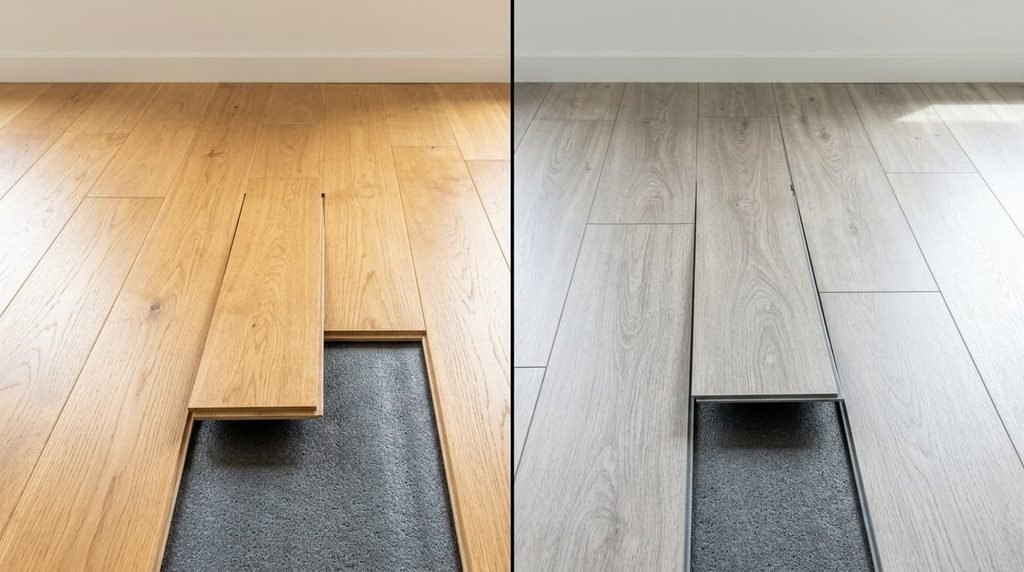
The table puts the two build-ups side by side in the example room. Every wood figure assumes the same 2 mm underlay, so the only variable is the board itself.
| Question | Engineered wood, click-lock | Laminate, click-lock |
|---|---|---|
| Total resistance with a 2 mm underlay | 0.121 at 10 mm and 0.150 at 14 mm | 0.097 at 8 mm |
| Heat output over 20 m² | About 1,150 W at 10 mm and 1,030 W at 14 mm | About 1,270 W |
| Surface temperature in the example | 25.7 °C at 10 mm | 26.3 °C |
| Water temperature needed to match laminate | 36.5 °C at 10 mm and 38.4 °C at 14 mm | 35 °C, no change |
| Fixing without glue | Click-lock boards float on the underlay, while solid planks need glue and most leases rule them out | Click-lock floats on the underlay and bonds to nothing |
| Seasonal movement at the joints | Gaps can open by about 1 mm in a dry winter | Almost none unless water reaches the edges |
| Moving out | Lift the boards and underlay with no marks | The same, though chipped edges stop reuse |
Rows one to four decide the heating bill, and rows five to seven decide the deposit. Read them in that order, because a floor that fails the first four rarely redeems itself in the last three.
Where wood wins on a heated floor
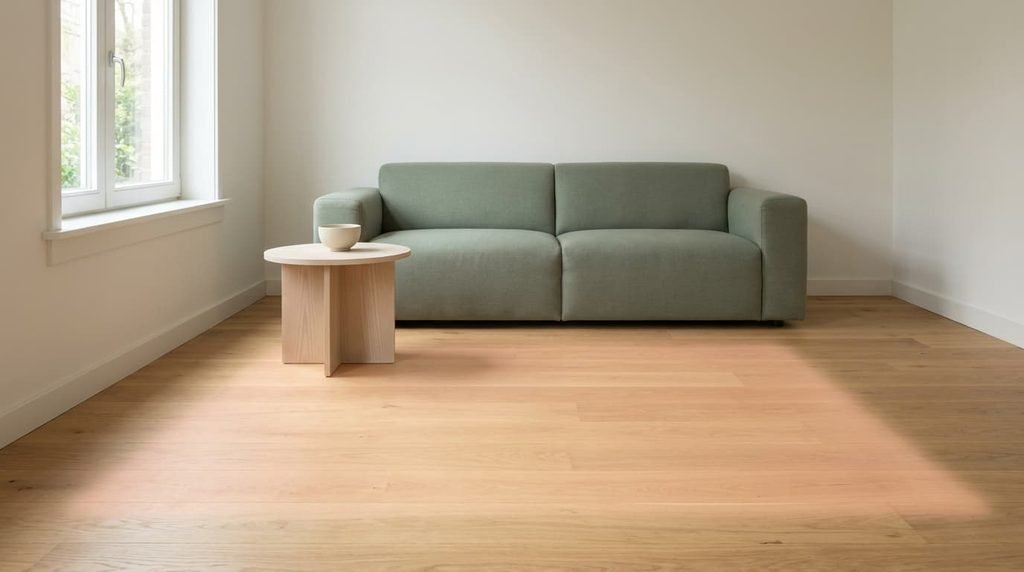
Wood wins when the heating has spare capacity. A 10 mm engineered board with a 3 mm oak top costs you 118 W over 20 m². That’s 9%, and the surface runs only 0.6 °C cooler. Most rooms never show that gap, and a real oak surface looks and sounds like timber underfoot. If you control the flow setting, a rise of 1.5 °C closes it.
It also wins on looks that last. Scuffs on a natural oil finish blend into the grain, while a printed laminate surface can show a chip as a pale line. When you choose flooring for a rented flat with underfloor heating, that tolerance for wear matters, because nothing can be sanded or re-oiled before you leave.
The limits are thickness and movement. At 14 mm the build-up reaches the 0.150 cap, and the water must run 3.4 °C hotter to match laminate. Joints can open by about 1 mm in a dry winter, and damp mopping has to stay light.
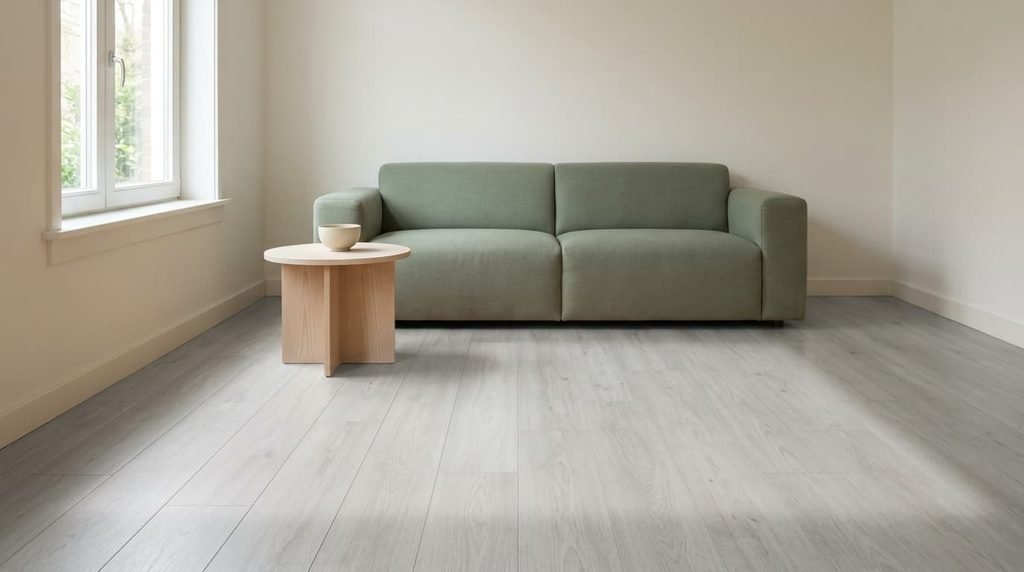
Where laminate wins on a heated floor
Laminate wins on resistance. At R = 0.097 it passes 1,266 W to the room without asking the boiler to work harder. The surface reaches 26.3 °C. The flat warms faster after a cold night because less heat is held back in the build-up. You never touch the flow setting, and the extra 118 W equals a small panel heater that you don’t have to buy.
It wins on joints as well, since a laminate board hardly moves with the seasons and keeps its planks tight when wood opens up.
The limits are water and wear. Edges swell when a mop leaves standing water, and the swelling doesn’t reverse. A chipped corner can’t be repaired in place. A spill left overnight beside the kitchen door is where the damage usually starts. Laminate also sounds hollower underfoot than wood. A denser underlay quiets it, but a thicker one adds resistance, so pick one rated for heating and keep it at 0.05 or lower, which holds the total near 0.10.
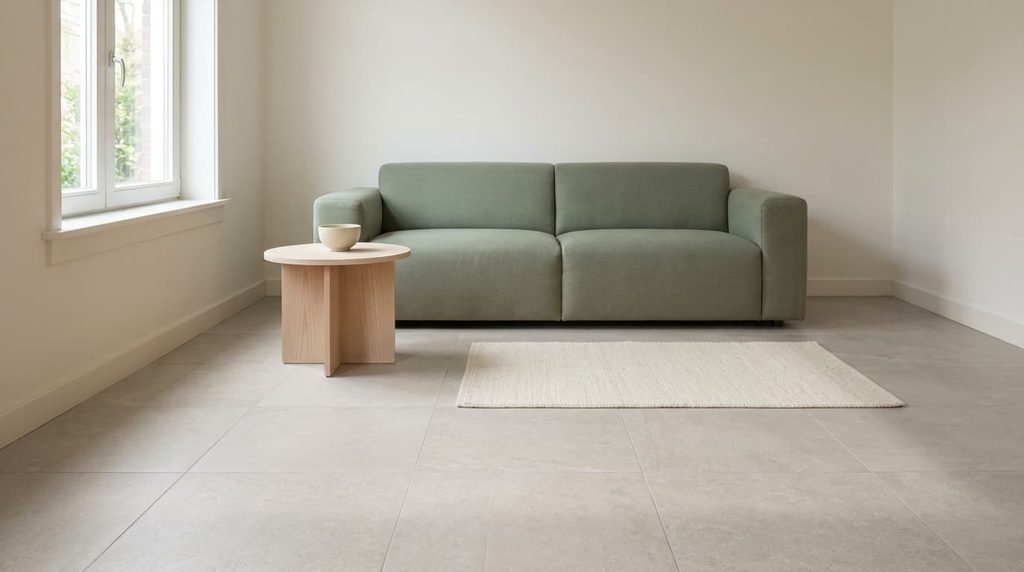
When neither is right
The floor that is already there can beat both. A tile or vinyl surface has R near 0.02, so the same 20 m² room delivers about 94 W/m². That’s 1,875 W, and the boiler can drop the water below 35 °C to hold the same temperature. Nothing is bought and nothing is laid.
Rugs are the trap, because a rug is a floor covering too. A 6 mm wool rug at 0.06 W/mK adds R = 0.10, which equals an entire laminate build-up. Laid over 6 m² of tile, it costs about 216 W, and that’s about 12% of the 1,875 W the bare room would give.
A 3 mm flat-weave rug costs about 134 W over the same area. Use one only where you sit and leave the other 14 m² bare. Living with the existing look is the price of the cheapest flooring for a rented flat with underfloor heating. Ask the landlord whether the floor is rated for heating before you cover any of it.
How to decide in thirty seconds
Find the resistance printed on each pack, or divide its thickness in metres by its conductivity. Then add the underlay’s figure to get your total. A 12 mm board at 0.14 W/mK scores 0.086 before the underlay, for example. If the sum comes to 0.12 or less, take the engineered wood you prefer, because the loss stays under 10% and the oak earns its place. If it runs higher, or your water runs cooler than 35 °C, take the laminate and keep the underlay thin. Check what the lease says about lifting boards first: a ban on them points back to the floor already there. That option costs nothing and returns the most heat.
The right flooring for a rented flat with underfloor heating is the thinnest build-up you still like walking on. The example gave 1,266 W for laminate against 1,149 W for 10 mm wood, and 1,034 W once the wood reaches 14 mm. Pipe spacing and screed depth change every figure here, and I can’t see either from your side. Treat the numbers as a way to compare two packs rather than a forecast for your room.
Questions readers keep asking
Which lasts longer on underfloor heating: wood or laminate?
Both last for years when the surface stays under the maker’s temperature limit. Engineered wood tolerates scuffs better, while laminate keeps tighter joints. Heat drives the gaps, so a build-up with low resistance and a modest flow temperature lasts best, and gentle cleaning protects either one.
How should you clean a heated floor?
Use a barely damp cloth and dry the floor straight away. Standing water gets into the joints, where it swells laminate edges and darkens the lines on oiled wood. Heat dries the surface fast, which makes it easy to forget the water still sitting in the joints below.
Which suits a small bedroom better?
Either works in a 10 m² bedroom, because a small room needs less heat and the 9% to 18% loss matters less. Pick the engineered wood if you like the look and the total stays at 0.12 or under. Choose laminate when you want the fastest warm-up.