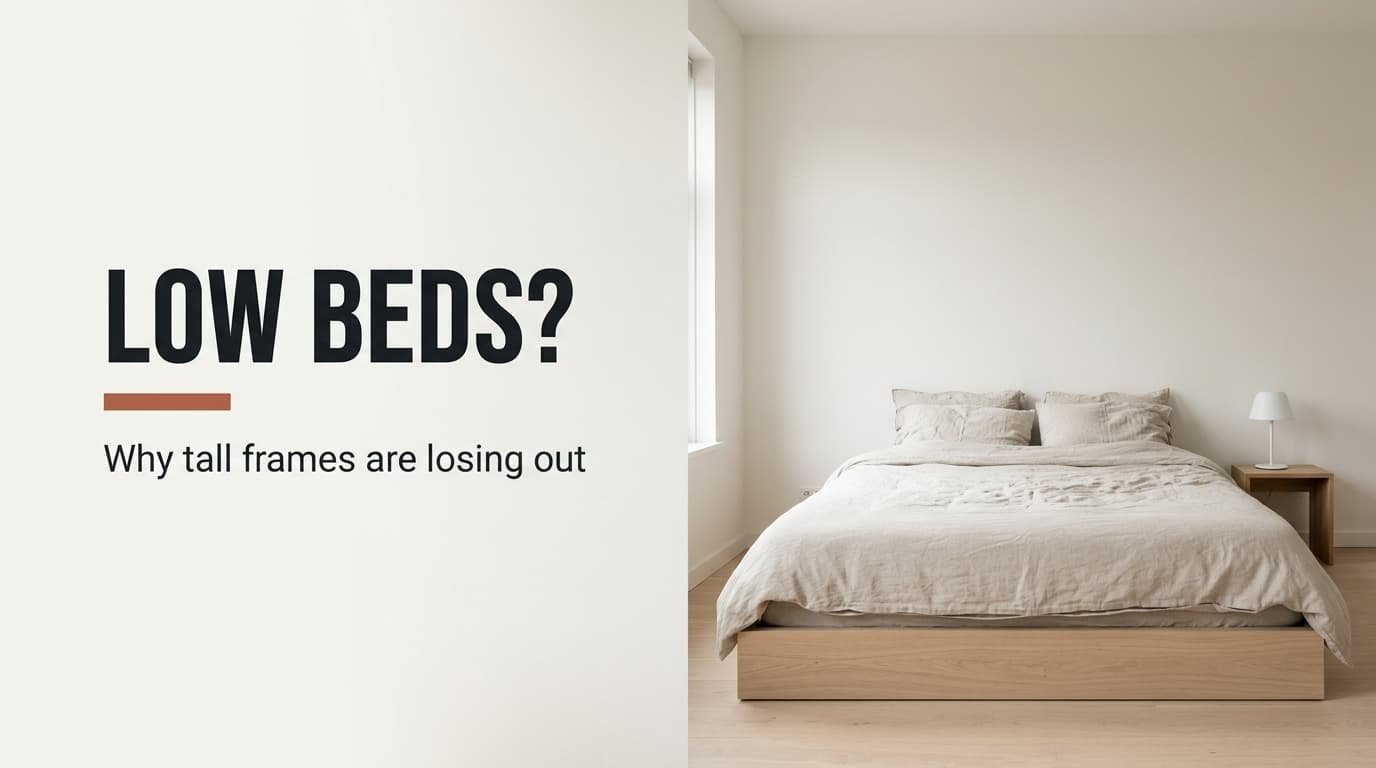
The usual claim says low beds make a room feel bigger. The room’s volume stays at 30 m³, so what really shrinks is the largest object in it, which falls from 1.68 m³ to 0.84. Low beds replacing tall ones is a real change in proportion, and it earns a place in your room only in a moderate form.
The numbers all come from one rented Dutch bedroom measuring 300 by 400 cm. Its ceiling reaches 250 cm and the mattress measures 140 by 200 cm. Nothing below names a brand or a price, and no showroom appears.
Where the tall bed came from
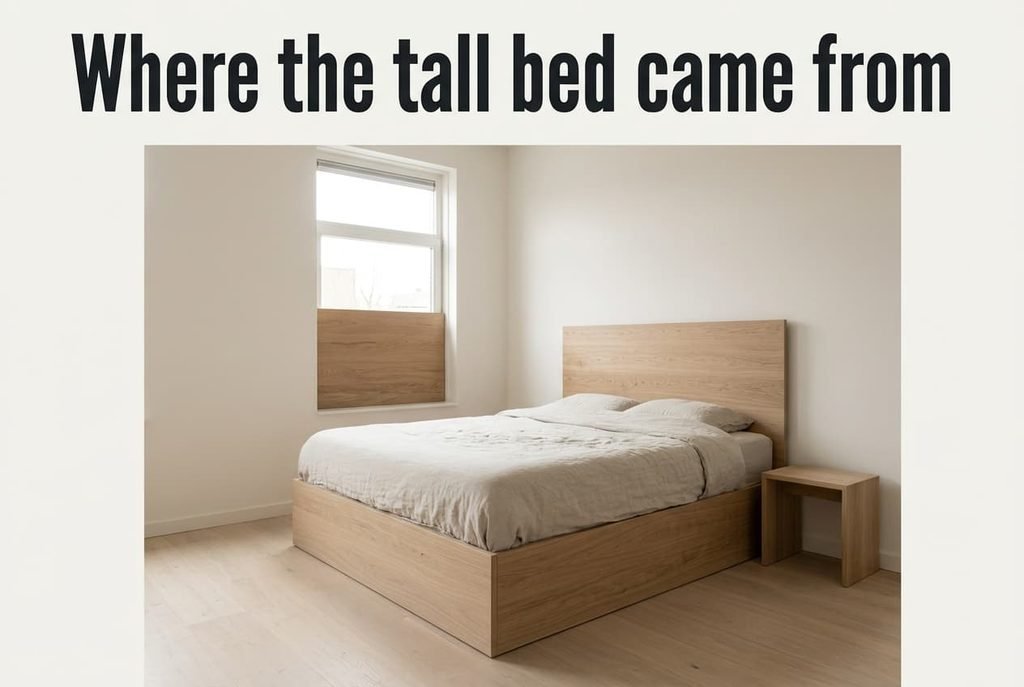
A bed used to mean a deep base with a mattress on top, and the top surface sat about 60 cm above the floor. The base was a box for storage. A rented room rarely had enough wardrobe, so the space beneath the mattress did a job. Tenants kept the habit because the bed was the first thing they chose and the last thing they questioned.
Then storage moved. Once wardrobes and wall units took over, the space under the bed lost its reason to exist. A bed with nothing beneath it can shrink to a platform of about 10 cm. Add a 20 cm mattress and the top sits at 30 cm.
Lower beds had always existed in rooms built around a mattress on a platform, though they stayed the exception. The change came from what the tall bed no longer had to do. Nothing here needs a date, because the mechanism explains the present better than a year could.
What actually changed with low beds replacing tall ones
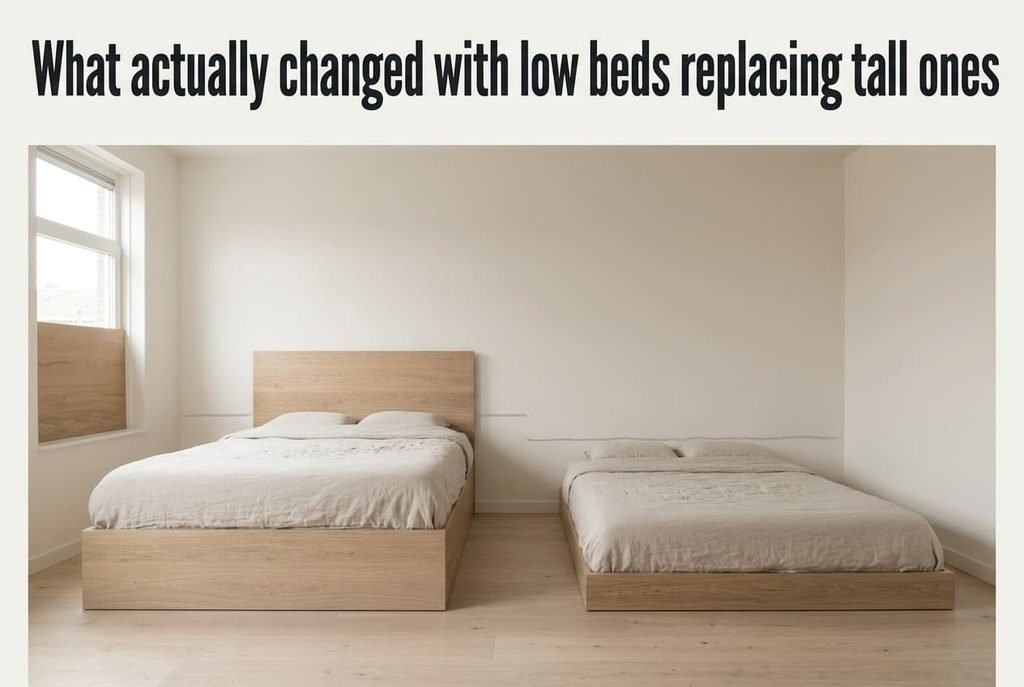
A 40 cm base under a 20 cm mattress used to put the bed’s top at about 60 cm. A 10 cm platform now puts it at 30 cm.
Every measure that follows comes from that one drop.
The block of bed halves. On a 140 × 200 cm footprint, a bed 60 cm tall holds 1.4 × 2.0 × 0.6 = 1.68 m³, and one 30 cm tall holds 0.84. In a room of 30 m³ that’s a fall from 5.6% to 2.8%. On a 250 cm wall the bed’s height share drops from 24% to 12%. The clear wall above it grows from 190 to 220 cm, a gain of 16%.
The neighbours have to follow. A bedside surface works when it sits within about 10 cm of the mattress top, so you can set a glass down without reaching. Beside a 60 cm bed the table lands between 50 and 70 cm. Beside a 30 cm bed it belongs between 20 and 40 cm. A standard 55 cm table next to the low bed sits 25 cm too high.
Headboards follow the top. A 110 cm headboard behind a tall bed covers the bottom 25 cm of a window whose sill sits at 85 cm. That’s 21% of a pane 120 cm high. A headboard of 80 cm behind the low bed stays under the sill and covers none of it.
The cost is storage. A tall base leaves 30 cm underneath, which is 140 × 200 × 30 cm, or 0.84 m³. A wardrobe 200 cm high and 50 cm deep needs 84 cm of width to hold that volume.
Who it suits, and who it doesn’t
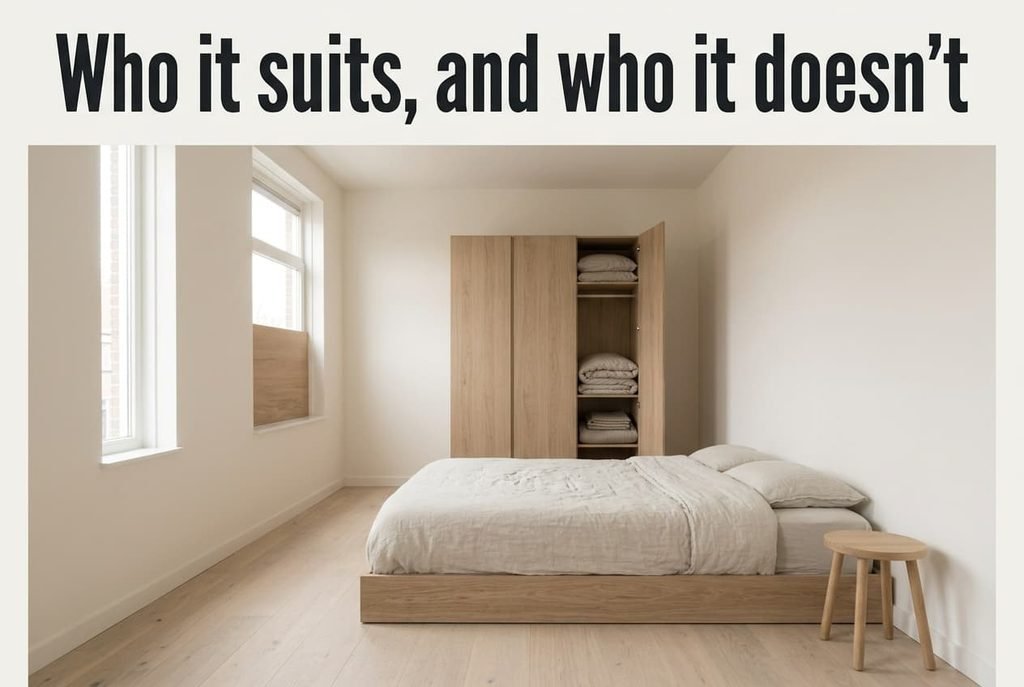
Low beds replacing tall ones suit a room where the wardrobe already holds the clothes and the spare bedding. A wall that wants art or a shelf above the bed fits too, since the clear height grows to 220 cm. So does a bed under a window, where the 21% of glass the headboard used to cover comes back. Anyone who gets into bed and out of it without using the edge as a seat will notice no loss.
A low bed fits you badly if the space under the bed stores your winter duvets. The 0.84 m³ has to go somewhere. A room without a spare 84 cm of wardrobe wall can’t absorb it. It also fails in a bed-sitting room where the bed is the sofa, because a seat at 30 cm gives your back nothing to lean on.
The edge matters too. A standard seat sits near 45 cm, so a 30 cm edge is 15 cm below it. Your knees rise above your hips there, so putting on shoes becomes a lower, longer move. If you dress sitting on the bed, a stool at 45 cm at the foot gives that seat back.
Pick by what your room already stores.
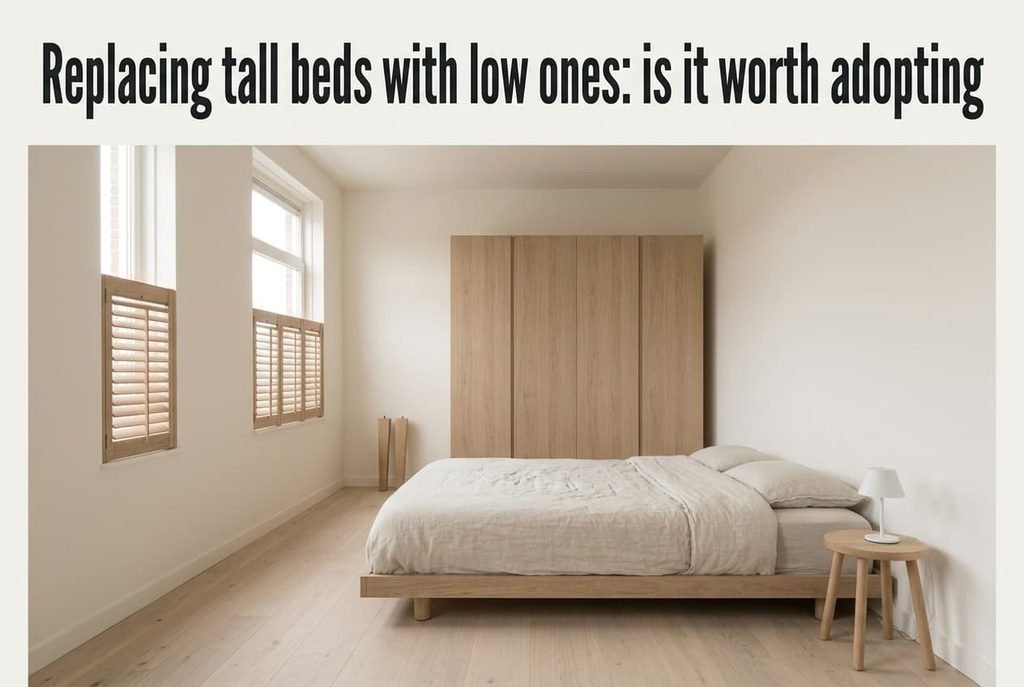
Replacing tall beds with low ones: is it worth adopting
Judge it by how much you must change. A tall bed set on bolt-on legs lets you keep the mattress while the base and the bedside table change. That’s reversible, since the old legs go in a cupboard and the swap back takes an afternoon. Test reversibility by asking what happens at your next move: a base on legs travels with you, and one built into a room stays behind.
Adopt the moderate version, a mattress top near 35 cm with the bedside table lowered to match, and stop there. It keeps a handy edge and gives back most of the wall.
What would date it is any commitment you can’t undo. A platform built into the room ties you to one idea of a bed. So does a table made to a 20 cm height. Rebuilding either costs far more than a weekend with a spanner.
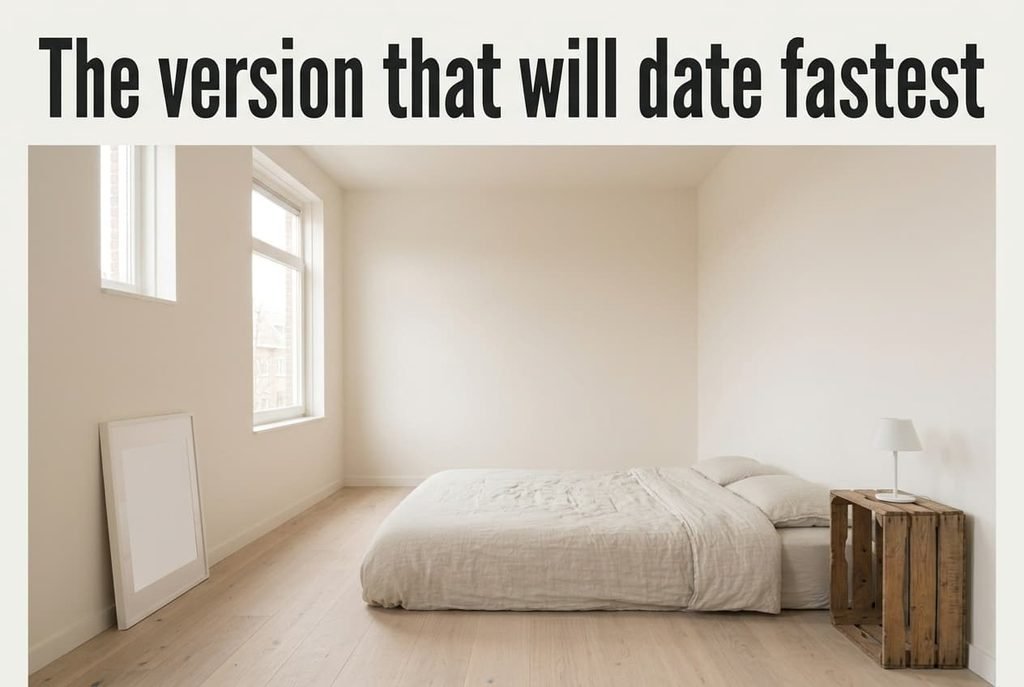
The version that will date fastest
Low beds replacing tall ones has an extreme end, and it’s a mattress on the bare floor. The top sits at 20 cm, so the edge is 25 cm below the 45 cm seat standard, and the clear wall rises to 230 cm.
Three marks identify it. Bedside surfaces drop to 20 cm, which in practice means a crate or a tray. Art and lamps follow the bed down until the whole room hangs at ankle height. The 0.84 m³ of storage also vanishes with nothing in exchange. Run the sums. Wall gain over the moderate version is only 15 cm, 230 cm against 215, while the edge falls another 15 cm.
I’d skip that version. A moderate bed holds a 35 cm top and a matching table, so you can still sit on the edge and reach a glass. It keeps 25 of the 30 cm of wall gain at a small share of the compromise.
How to try it without committing
Tape two lines on the wall beside the headboard, one at 60 cm and one at 30 cm, then stand in the doorway. The strip between them is the wall your current bed hides and a low one would return.
Next, swap the bedside table for a stack of boxes 35 cm high for a week. If you reach it easily, the table height is right. Last, shoot a photo from the doorway before and after you change anything, so the comparison uses rooms rather than memories. Check the clearance beneath your current bed as well, since 30 cm there is the storage you’d give up.
Low beds replacing tall ones makes sense when your storage lives elsewhere, and it takes a tape measure to prove it. Check the wall and the table first, then the 84 cm of wardrobe. Move the table before the bed, because it shows you the new proportions for nothing. The tall bed can stay until the tape lines have convinced you.
Questions readers keep asking
Should you change a tall bed for a low one?
Only if a wardrobe elsewhere can take the 0.84 m³ of storage the tall base gave you. In the example the bed’s top drops from 60 to 30 cm and the clear wall grows from 190 to 220 cm. Tape the two lines first, then decide.
Who suits a low bed best?
Anyone whose clothes and spare bedding live in a wardrobe and who enters and leaves the bed without using the edge as a seat. The edge sits 15 cm below a 45 cm seat. If you dress sitting on the bed, add a stool at the foot.
Will low beds go out of style?
No forecast is possible here. Proportions hold either way: the bed’s top surface halves and the bedside table has to follow. A floor-level mattress dates fastest, so choose a top near 35 cm and keep the old legs. The change can then be undone.