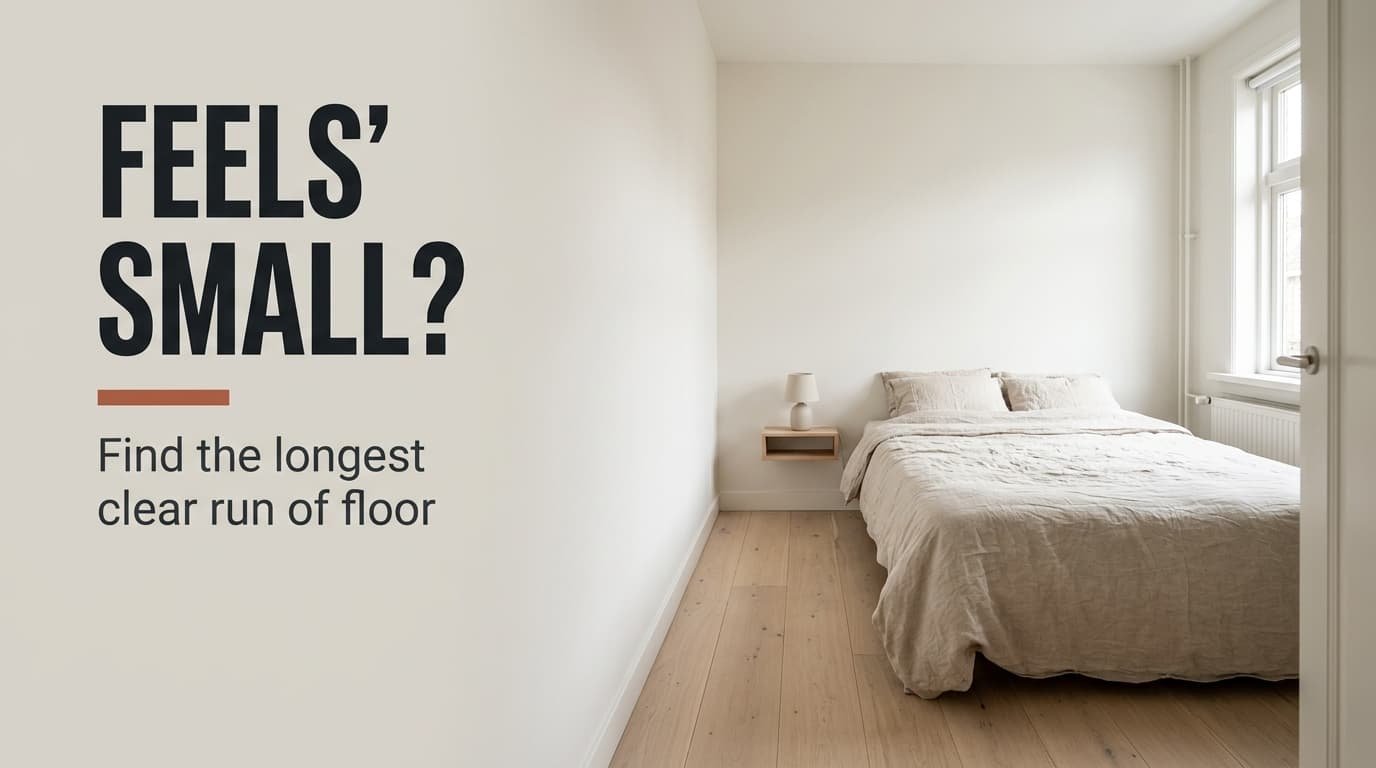
A bedroom that feels small is rarely short of floor. It’s short of floor you can see in one piece. That’s the complaint behind a bedroom that feels smaller than it is: the tape says 12 m², and the eye reports half of that. The first fix is free, since it’s one push of the bed. Our example room is 300 cm wide and 400 cm long with a 250 cm ceiling, and a 160 × 200 cm bed stands in it. Use your own readings after measuring. A tape measure and an evening are all it takes.
What is happening in a bedroom that feels smaller than it is
The eye doesn’t add up floor area. It follows the longest clear run of floor it can see from the door, and a run only counts when it’s wide enough to stand in. Take 100 cm as that width, a shoulder span plus a margin.
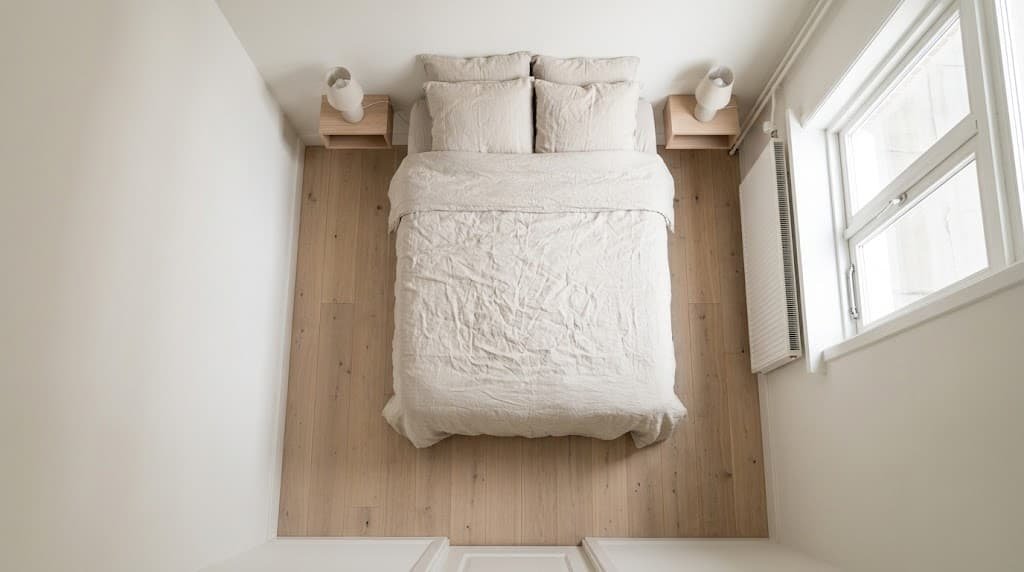
In the example the bed sits centred on the far wall, with its foot 200 cm from the door. The room is 12 m² and the bed takes 3.2 m², so 8.8 m² of floor is clear. But it’s cut into pieces: a patch of 300 × 200 cm at the foot, and two lanes 70 cm wide beside the bed. The lanes fall under 100 cm, so they don’t count. The longest clear run is 200 cm, half of the 400 cm depth. That’s why the room behaves like a 200 cm room that happens to hold a bed.
A second effect adds to the first. Floor hidden under furniture reads as missing, so a bed standing flat on the boards ends the run at its foot. A bed raised on legs lets the eye slip underneath.
Every fix below changes one of three numbers: the clear run, the floor you can see under furniture, or the width of the lanes.
Why that bedroom feels smaller than it is: check which cause is yours
Every check gives one figure to note. Do them after dark with the room as you usually leave it, and keep the figures in one place.
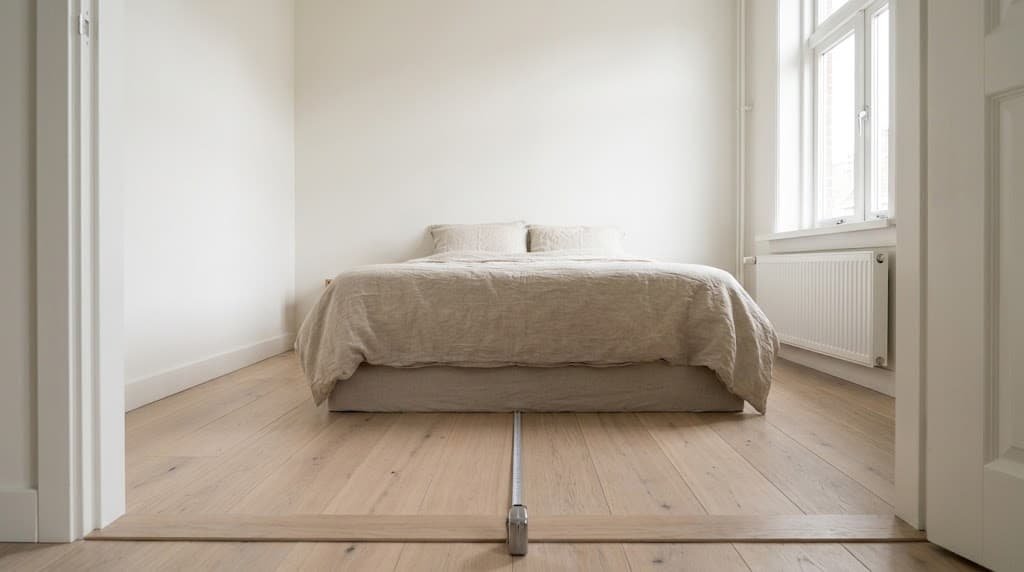
Start in the doorway and measure the run. Pull the tape from the doorway to the nearest big object straight ahead, then divide it by the room’s depth. Under 60% means the layout is the main cause. Here it’s 200 ÷ 400 = 50%.
Second, measure the lanes beside the bed at their narrowest point. Anything under 100 cm doesn’t count as run. Here both lanes read 70 cm, so neither counts.
Third, photograph the bed from the door at your own eye height. If no floor shows beneath it, the bed sits on the floor and ends the run. In the example none shows.
Finally, open the door as far as it goes and note the floor its leaf sweeps. A leaf 80 cm wide sweeps a quarter circle, which is about 0.5 m², and nothing can stand there while the door is open.
The fixes, in order
In a bedroom that feels smaller than it is, make a single change per evening and re-measure the run before the next. Keep a note of each reading.
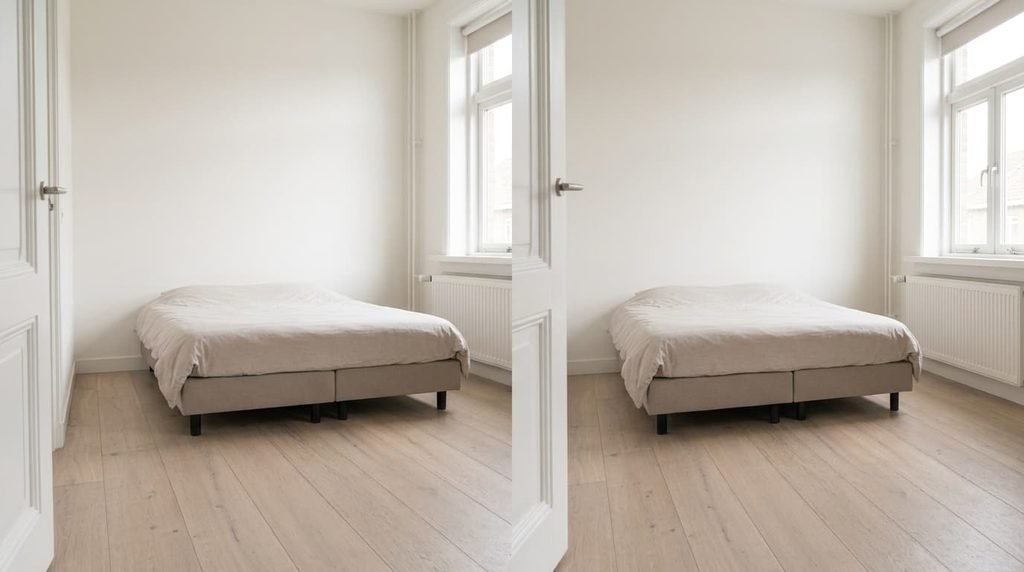
Pushing the bed against the left wall is free and takes ten minutes. Along one long wall, the bed leaves an open lane 140 cm wide, so the lane counts. Your run goes from 200 cm to 400 cm, from half of the depth to all of it. Leave 5 cm between mattress and wall so sheets can tuck in. Access is the limit, since only one side of the bed stays open. That suits one sleeper. If two people share the bed, use one of the next fixes instead.
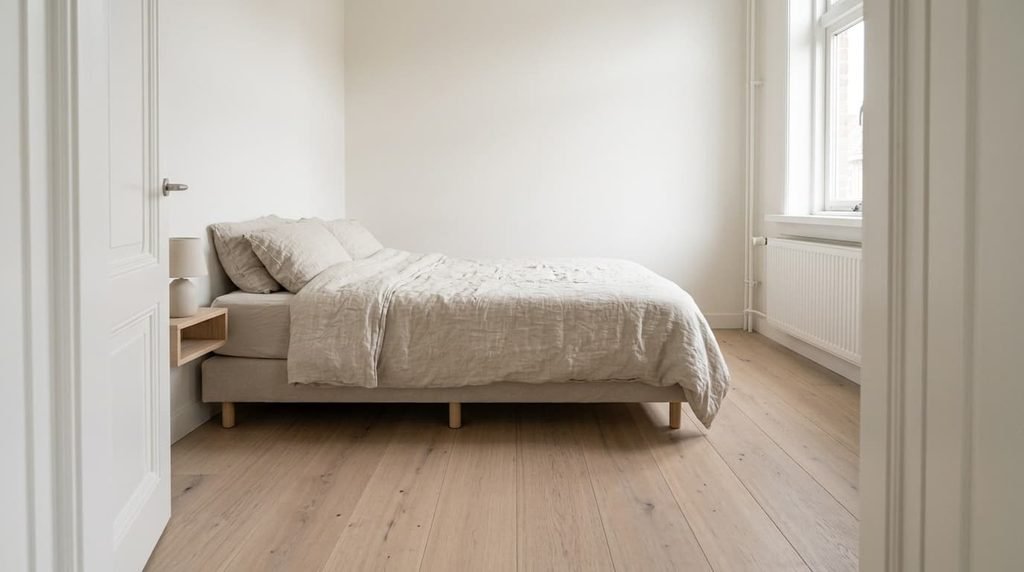
Lifting the bed 20 cm on risers costs a set of four risers. A frame that clears the floor by 25 cm lets the eye see under its foot. From a doorway 200 cm away, with the eye at 150 cm, the sightline reaches the floor 40 cm beyond the foot. That’s 40 × 160 = 0.64 m² of extra floor you can see, and the run grows from 200 cm to 240 cm. It only works along the doorway’s line of sight, and boxes stored beneath cancel it. Pick plain legs in matt wood near the floor colour, so the risers vanish.
Replacing the two bedside tables with wall-hung shelves tackles the lane width. Each table is 40 × 35 cm, so together they take 0.28 m² of floor. After the bed has moved, the open lane keeps 100 cm at the head end beside a table, right on the threshold. A shelf at 55 cm lifts that to the full 140 cm. Make it 30 cm deep, which is enough for a lamp. It costs two shelves and fixings, and in a rental, ask the landlord before you make any holes.
Rehanging the door so it opens against the wall is the job for a carpenter. A leaf that swings across the lane takes a 0.5 m² quarter circle, and it breaks the run each time it opens. Hinged on the other side, it rests flush with the wall and keeps the entry clear. Expect an hour of labour, and ask the landlord first. Check that the light switch isn’t hidden behind the open leaf.
What this room’s own architecture means for you
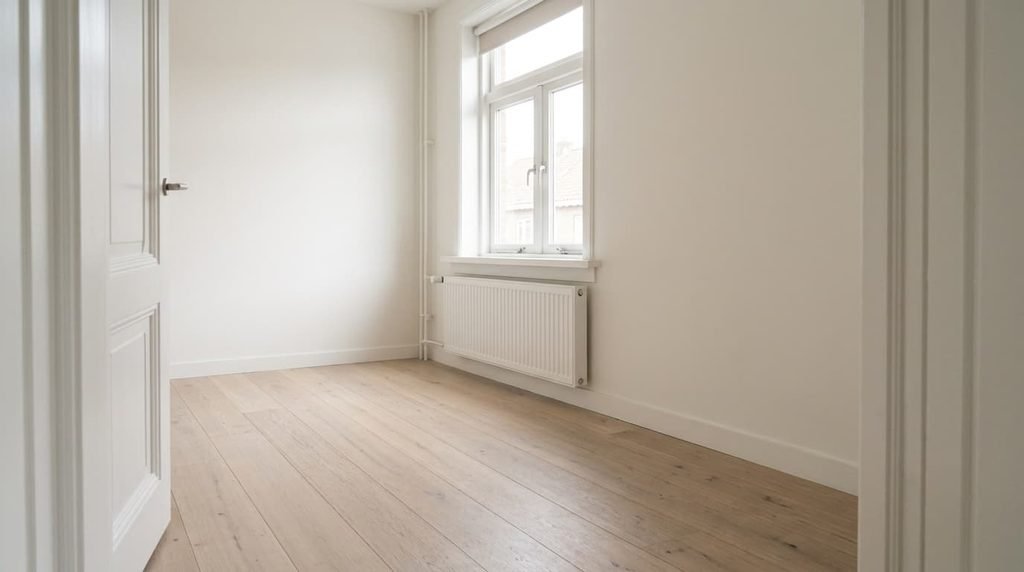
In a bedroom that feels smaller than it is, some limits are built in. Window and radiator on the right wall stay put. That radiator stands 8 cm out, so the 140 cm lane narrows to 132 cm beside it, which still counts.
The floor stays 12 m² too. After every fix, 8.8 m² is clear and the bed still holds 3.2 m². That’s 27% of the room, and no arrangement removes it.
The best result here is a 400 cm run. That’s the whole depth, so there’s nothing left to win once you reach it.
The 80 cm door frame occupies the corner of the near wall. That fixes where the run starts, and it’s why the lane has to run along the right-hand side. A fixed frame also means the door can only be rehung, never moved.
The fix that doesn’t work
Swapping the double bed for a 140 cm one is the usual first thought, because a smaller bed feels like more room. That frees 20 × 200 = 4,000 cm², or 0.4 m², which is 3.3% of the floor. Centred, the lanes widen from 70 to 80 cm, still under 100 cm, so the run stays at 200 cm. You buy a bed and a mattress, and the room reads exactly as before.
Moving the existing bed gives a run of 400 cm for nothing.
A longer rug misses for the same reason. It covers floor and leaves the bed where it stood, so the run stays at 200 cm while the rug costs more than risers. Test any purchase with one question: does it change the run, the floor you see under furniture or the lane width? If not, skip it.
A bedroom that feels smaller than it is has floor to spare. Start with the push, then the risers. Hang the shelves next, and call the carpenter last. Write down the run and the lane width on the first page of your notes, with the floor visible under the bed beside them. Re-measure after every step, and quit when the run equals the depth.
Questions readers keep asking
Can a small bedroom be improved for free?
Often, yes. Pushing the bed to one wall changes the run from 200 to 400 cm in the example, and it costs ten minutes. Buy risers or shelves, or hire a carpenter, only if that leaves the run short or two people need access to both sides.
How much does it cost to open up a small bedroom?
Moving the bed costs nothing, and risers cost little. Shelves cost more once fixings are counted. A carpenter’s hour costs the most. Costs differ by shop and city. Start with the free step, then add one purchase at a time, and stop once the run equals the depth. Most rooms never reach the carpenter.
Does the ceiling height matter here?
Not for the run. A ceiling changes how tall the room feels, while the run measures how deep it feels. In the example the 250 cm ceiling plays no part, so check the run first and look up only if it already equals the depth.