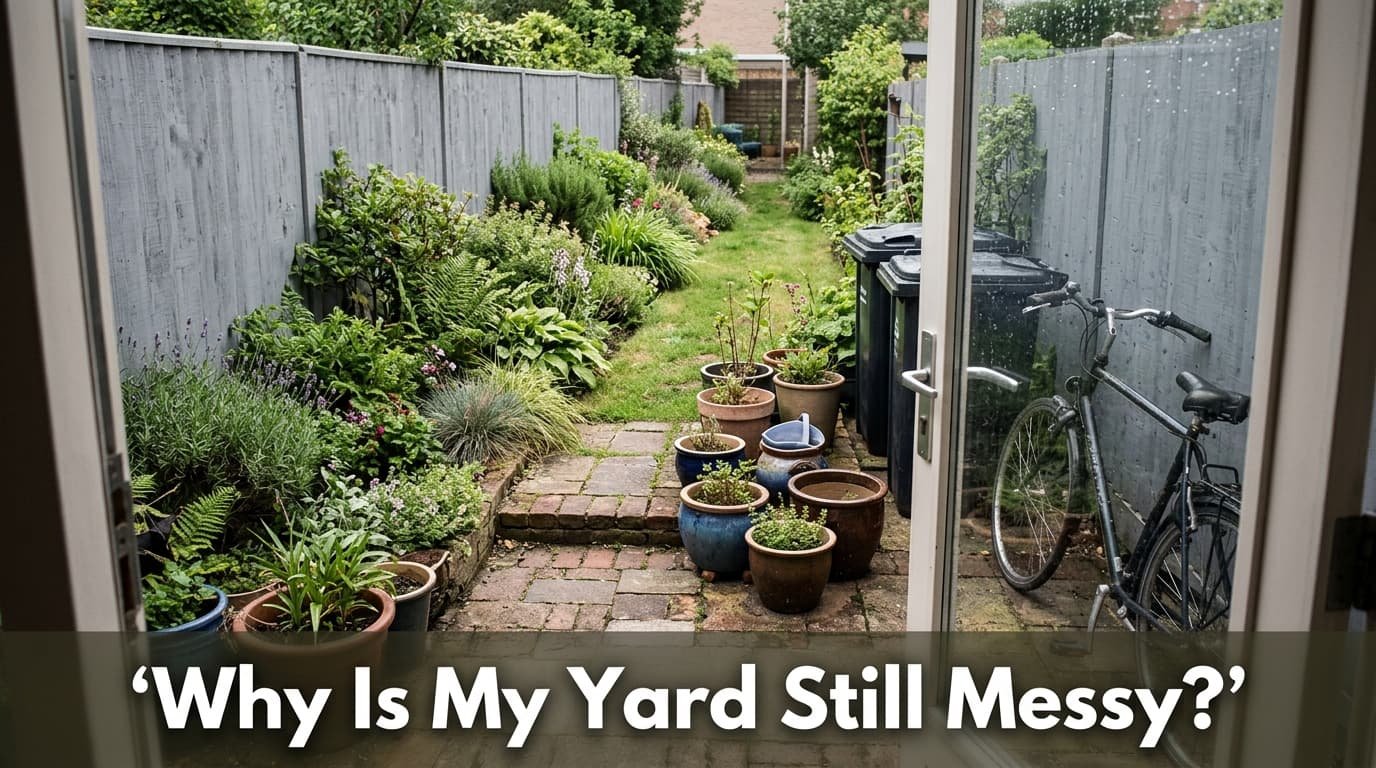
Planting more is usually what keeps a backyard messy. A messy yard rarely lacks plants. What it lacks is repeats, and somewhere for the eye to land. The question “why does our backyard look messy” has a countable answer. A tape and a phone will find it.
The yard here is a back garden in the Netherlands, 500 × 800 cm, entered through a glass door in the back of the house. A bed 80 cm deep runs along the left fence for the full 800 cm and holds 22 plants. Every count below is an assumed value.
Why does our backyard look messy when it holds so many plants
The eye tidies what it can group and flags what it can’t. Repeats make a group. So do shared edges and shared finishes. A plant that’s alone in its kind matches nothing, so the eye logs it as one more item to sort.
Count what the back door shows. The bed holds 22 plants of 15 kinds, so the average kind appears 1.5 times. Add six pots and three bins. A hose reel and a bike come next, then a table with two chairs. That brings the total to 36 separate outlines competing across 8 m. Order needs the reverse: few kinds, each repeated, with a short list of finishes and one clear place to look. A tidy yard of this size can carry about five kinds without strain, though that figure is a working guide and no standard.
So does our backyard look messy for lack of plants? Almost never. Each new kind raises the count by one and leaves the eye with no match for it. The usual misdiagnosis is buying more plants to fill the gaps, which adds outlines to a view that already has too many.
A yard planted weekly can look worse every month.
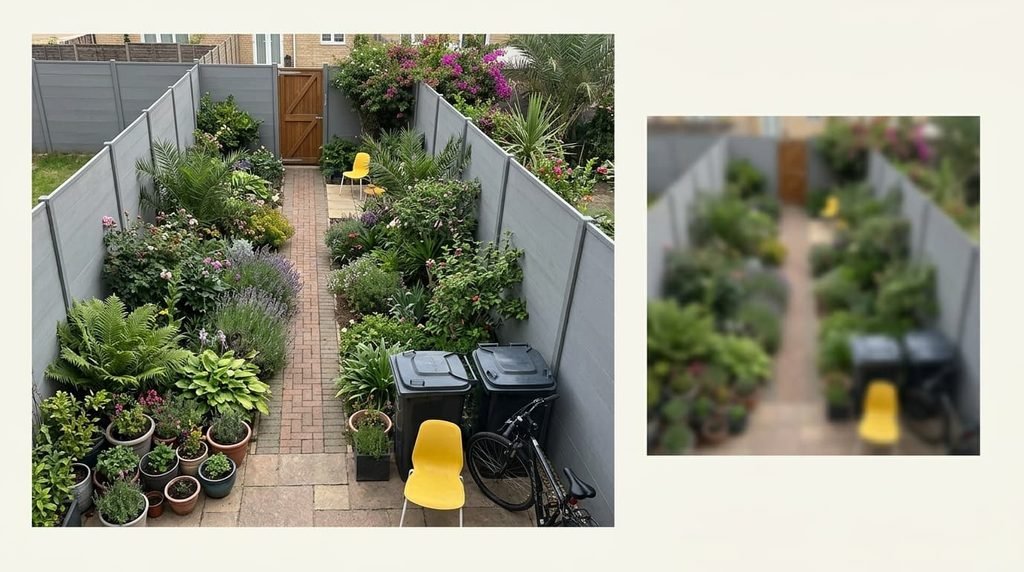
Where does our backyard still look messy? Three checks
Start with kinds. Stand at the back door and photograph the view. Count the plants in it, then count how many different kinds they make. Divide the first number by the second. Below 3, the fault is scale. Here 22 ÷ 15 gives 1.5.
Next, list every finish among the pots and furniture. Terracotta and black plastic count as two. Write one line per finish and tick each piece against it. More than three finishes means the fault is contrast. Here six pots show five finishes before the table and chairs are counted.
Last, shrink the photo to the size of a stamp and note what you see first. If the first thing you see is a bin lid or a bike, the fault is placement. A plant or one clear focal piece means the view is working. Plan on two of them coming out wrong, and jot the scores beside the photo. The stamp-size view removes detail, which is why it shows where the eye goes before details take over.
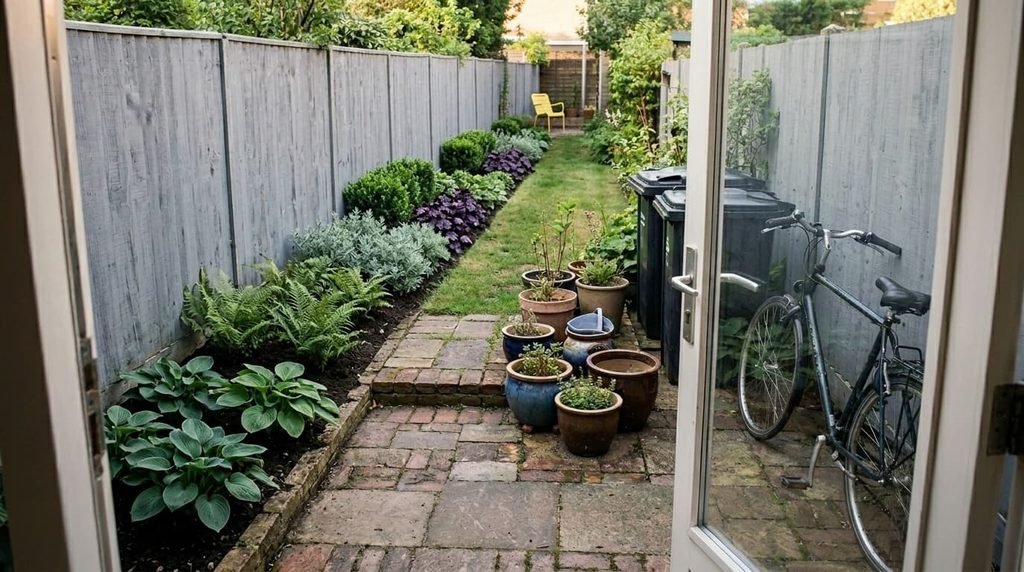
The three faults, diagnosed
“Every plant looks different, and none looks planned.” The cause is scale, or more exactly a missing repeat. Fifteen kinds in 22 plants leave no group big enough to read from 8 m. Pick the five kinds that do best in your light and soil. Lift and divide them into groups of four or five along the bed. At 36 cm centres, 22 plants fill 792 cm of the 800, so five drifts of four or five run the whole length. The other ten kinds go into pots by the door or to a neighbour. That costs nothing and needs an hour per kind. Move them in autumn while the soil is warm and damp. Leave any kind that sulks for one more season before you judge it.
“The pots and chairs don’t belong to one picture.” The cause is contrast between finishes. Six pots in five finishes, plus a painted seating set, give the eye five different edges to compare. Group the two finishes you own most of by the door, and send the rest out of the view. That’s a rearrangement and takes ten minutes. If the odd pieces must stay, a tin of one exterior paint covers three pots and a table in a weekend, which makes it a modest purchase. Glazed pots need a primer made for glaze, or the paint will peel within a season. After either fix the five finishes drop to two.
“The first thing I see is the bins.” The cause is placement. Three bins stand 150 cm from the door, directly in the view. A hose reel and a bike share the spot. The eye heads for the strongest contrast it can find, and here that is a black lid. Move the bike and reel behind the shed this afternoon, which costs nothing. Next, shift the bins against the side wall, out of the view from the door. Where they can’t move, a screen 180 cm wide and 120 cm high hides all three, and it’s the one purchase here. Then set a single large pot or bench where the lawn ends, in line with the door, so the eye has somewhere to travel.
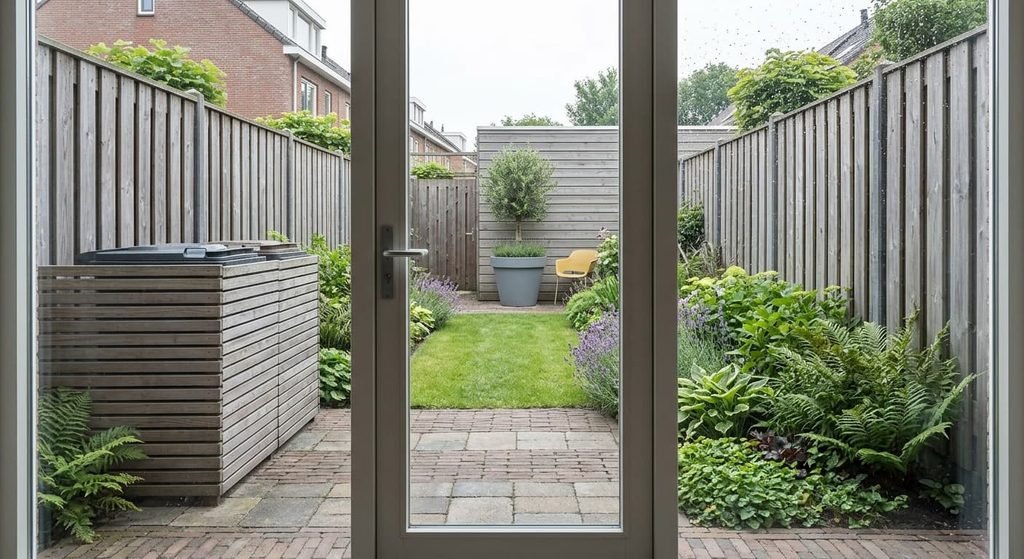
What to ask before each new plant
Three questions guard the count. Does the bed already hold a kind this plant could repeat? A fourth plant of an existing kind helps the group, while a sixth kind splits it. Does a pot or chair match one of your two finishes? Does the new piece sit outside the view from the door? Ask it as a habit: does our backyard look messy, or will this plant tip it?
Write the five kinds on a card and keep it in the shed. A card makes the rule easy to follow at a garden centre, where a fresh label can pull anyone off plan. Your own light and soil decide which five survive, and only a season of watching will settle that.
The fix that isn’t worth doing
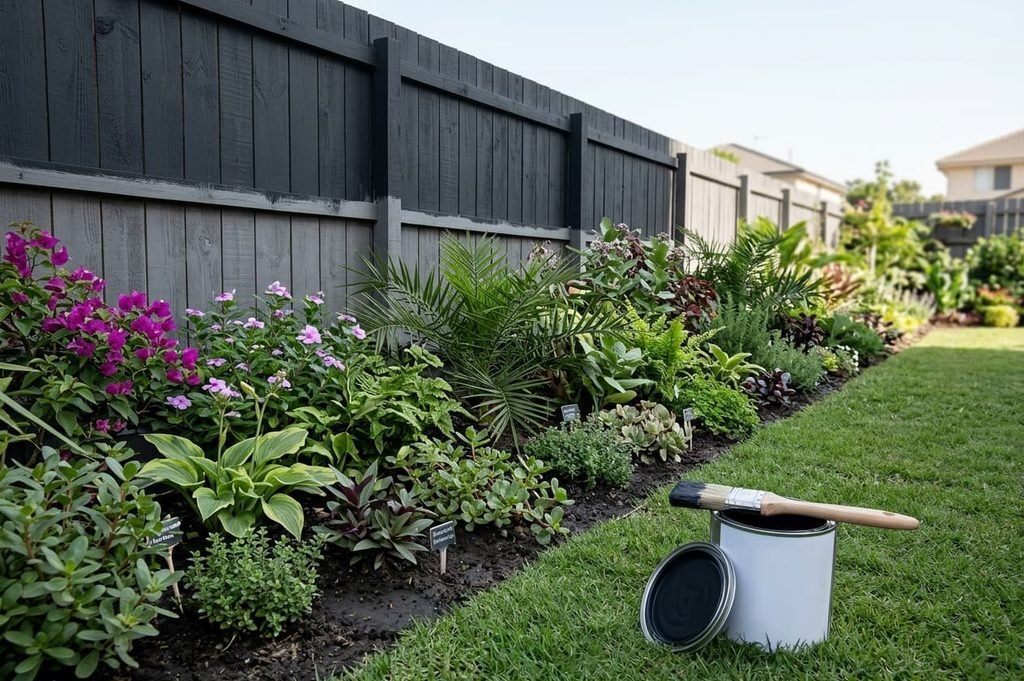
Painting the fence a dark colour so the plants stand out is a popular tip and it works against you here. A dark ground outlines every plant, and with 15 kinds that gives you 15 crisp outlines to compare. The fence is 800 cm long and 180 cm high, so one side alone is 14.4 m² of paint, or about 29 m² with two coats. That’s a weekend of work for a higher count, and the paint needs a dry week to cure. Dark paint also shows every bird mark and snail trail against the fence, which adds small marks to a view that doesn’t need more. I’d leave the fence alone until the bed is down to five kinds. After that, a dark fence can frame a calm bed well.
A darker fence frames the mess more clearly.
Messy comes from three countable faults. Kinds have no repeats. Finishes are too many. The view ends at the bins. Take the photo and the count this weekend, since the pair names your cause within the hour. Begin with the free move. Keep five kinds and group them in drifts. Send the other ten elsewhere. Rearrange the bins and the bike next, and buy a screen last. Run the stamp-size photo again once a month has passed, to see where the eye lands now, because a measured result beats a feeling. Next time you ask why does our backyard look messy, you’ll have a count to check.
Questions readers keep asking
What makes a backyard look messy even with lots of plants?
Too many kinds and too few repeats. Twenty-two plants of 15 kinds average 1.5 per kind, that the eye treats as 22 separate items. The same plants in five groups read as five. Count the ratio at the back door before the next purchase.
How can a messy backyard be fixed fast?
Pick the five kinds that thrive and move the rest, since that costs nothing. Then take the bike and the bins out of the view from the door. Together those moves handle most of the mess in an afternoon and a weekend.
Can a messy backyard be fixed without redoing the whole garden?
Yes. Lifting plants and painting a few odd pieces need no building work, no tools beyond a spade and a brush, and no permit. Only a view that lacks any place to look may need one added item, such as a large pot or a bench where the lawn ends.