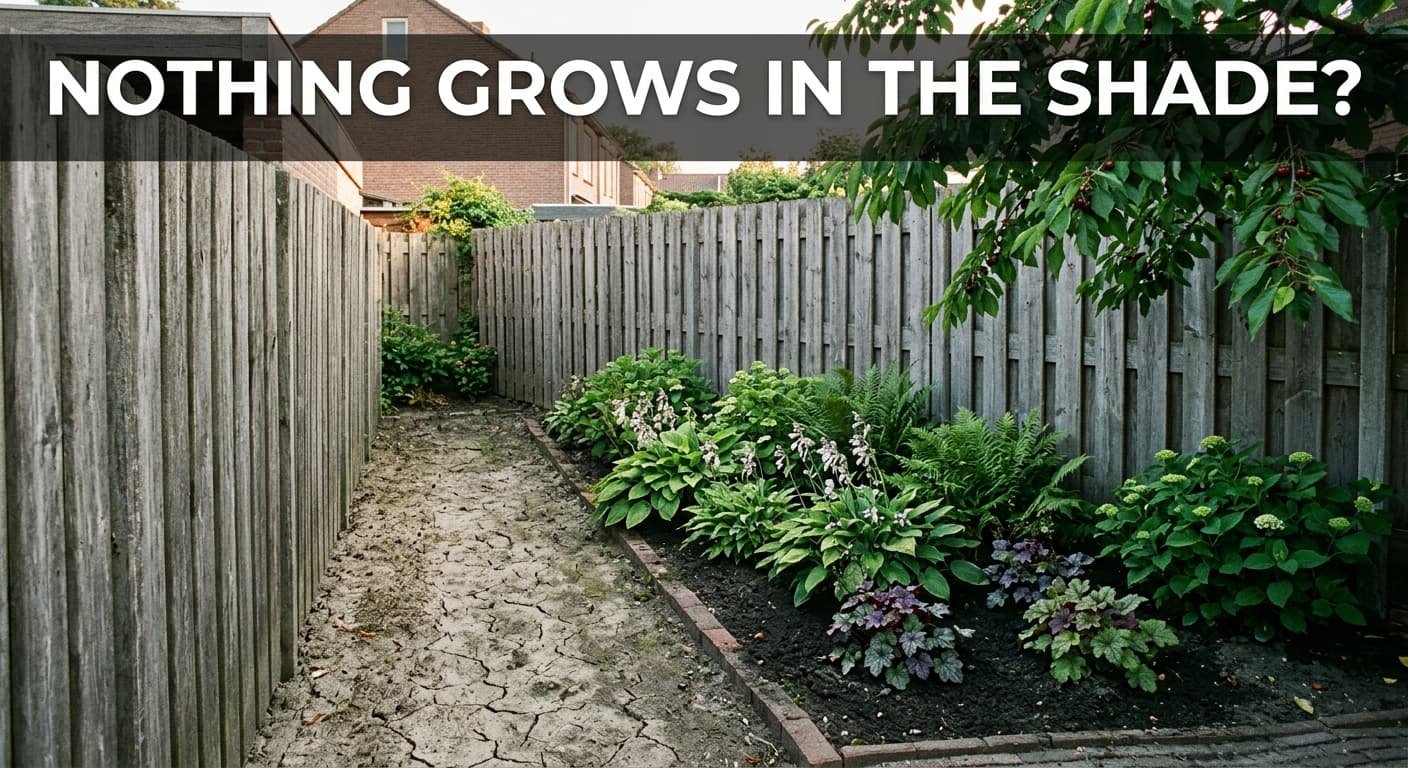
Shade is rarely what kills a planting. Dry soil under the fence does that, and low light only slows whatever survives. To fix a backyard garden where nothing grows, first work out whether water or light is the missing ingredient. Planting more won’t help until you know.
The garden here is a Dutch rear plot of 420 × 700 cm. Along its south-west side runs a 180 cm timber fence, and a bed 150 cm deep and 500 cm long lies in the fence’s lee. That bed is 7.5 m². A cherry in the corner overhangs one end. Every rain and sun figure below is an assumed round value.
Why a backyard garden where nothing grows is usually dry
Shade takes two forms, and they fail plants in different ways. Low light slows a plant down. Dry soil ends it.
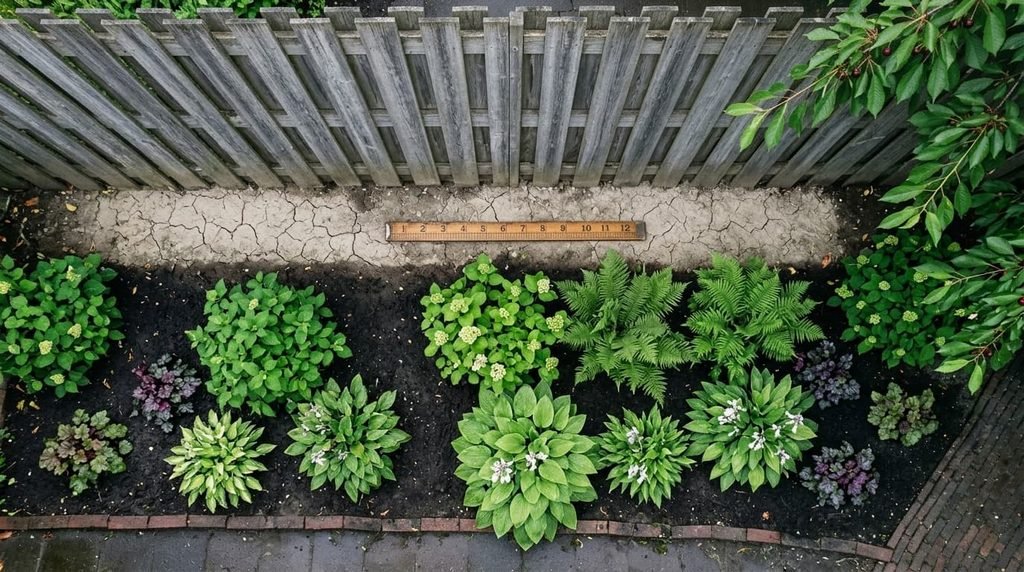
A fence casts a rain shadow as well as a light shadow, and the rain shadow is usually the killer. Wind drives rain at an angle, say 25° from vertical. A fence 1.8 m high then shelters a strip 1.8 × tan 25° wide, which is 0.84 m, on its lee side. Along 5 m that strip is 4.2 m², or 56% of the bed. A 10 mm shower puts 10 L on every square metre, so the strip misses 42 L each time it rains. Three such showers in a wet week leave 126 L that the soil never receives.
Roots add to the loss. A tree or hedge on the boundary pulls water out of the same strip before your plants can reach it. Low light then decides which plants can live there at all, since shade leaves are larger and thinner and use weak light better. A plant that copes with the dimness still fails when the soil under it is dry.
A backyard garden where nothing grows is therefore often a dry one first and a dark one second.
Confirm which version you have
Three quick digs and photos name the culprit, and each takes under an hour. Start with sun hours. On a clear day in June, photograph the centre of the bed at 10:00, 12:00, 14:00 and 16:00. Count the pictures that show direct sun. Fewer than two means deep shade, and light is part of your fault.
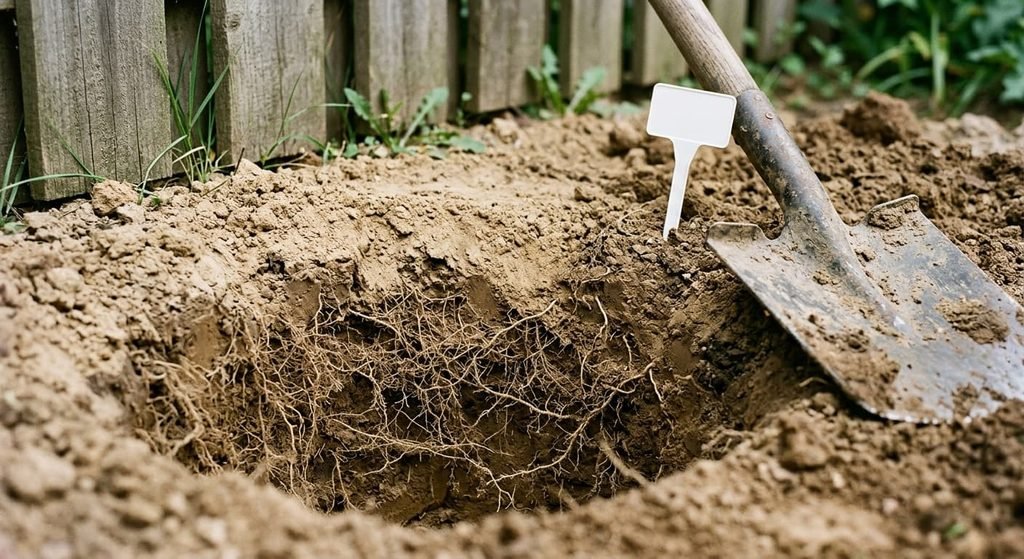
Next, test the rain. Wait for a shower of about 10 mm, then dig a spade’s depth at 30 cm from the fence. Dig another hole at 100 cm and a third at 140 cm. Soil that is damp at the far two but dry at the near one points to a rain shadow. Dry at every hole, with a mat of fine roots, points to the cherry. Leave a day after the shower so surface water drains, because a wet crust can fool you.
Last, lift one struggling plant. Then look at its roots. Pale, brittle roots mean thirst. Dark, soft roots mean waterlogging, which this sandy soil makes unlikely. Note the result of each test, since the fix you choose depends on which one came out worst.
Four fixes for a backyard garden where little grows, in order
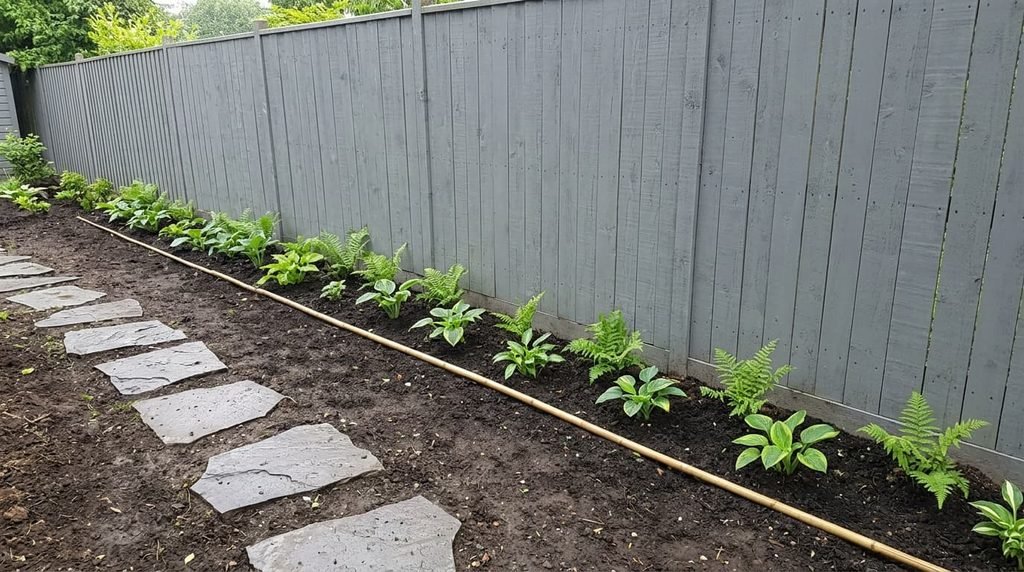
Plant outside the rain shadow. This addresses where the rain lands, and it costs nothing. Lay a cane 84 cm from the fence along its whole length and plant only beyond it. That shadow strip can become a path or a home for the compost bin. You give up 4.2 m² of bed and keep 3.3 m². The limit is that over half the bed goes. A shower from the opposite side also flips the shadow, so watch which way the next few storms blow before you commit.
Water once a week, deeply. This addresses how far the water reaches, and it costs only time. A soak of 10 L per m² wets roughly the top 10 cm of sandy soil. The planted 3.3 m² needs 33 L, which is three cans of 10 L plus a splash. A sprinkle of 2 L per m² each day wets about 2 cm and evaporates before roots use it. The limit is a tap or butt within reach, since the tap here sits 11 m from the bed. A 200 L butt at the fence holds six weekly soaks.
Mulch the planted zone with 5 cm of compost. This addresses how much water the soil holds, and it’s a purchase. Five centimetres over 3.3 m² is 0.165 m³, which is just over two bags of 75 L, so buy three. The mulch slows evaporation and adds humus that holds water. It adds no water of its own, so it works only alongside the soak. Keep it a hand’s width clear of stems, because a damp collar invites rot.
Have the lowest branches of your own tree lifted. This addresses light arriving from the side, and it needs a tree surgeon. Removing the lowest third of the crown opens the bed to the low morning light that a dense skirt blocks. The limit is that taking more than about a third of a crown weakens the tree. A neighbour’s tree can’t be touched, so find out who owns it and whether a local rule covers the work before you book anyone. A surgeon will also tell you how much crown the tree can spare, which is worth hearing before any branch comes off.
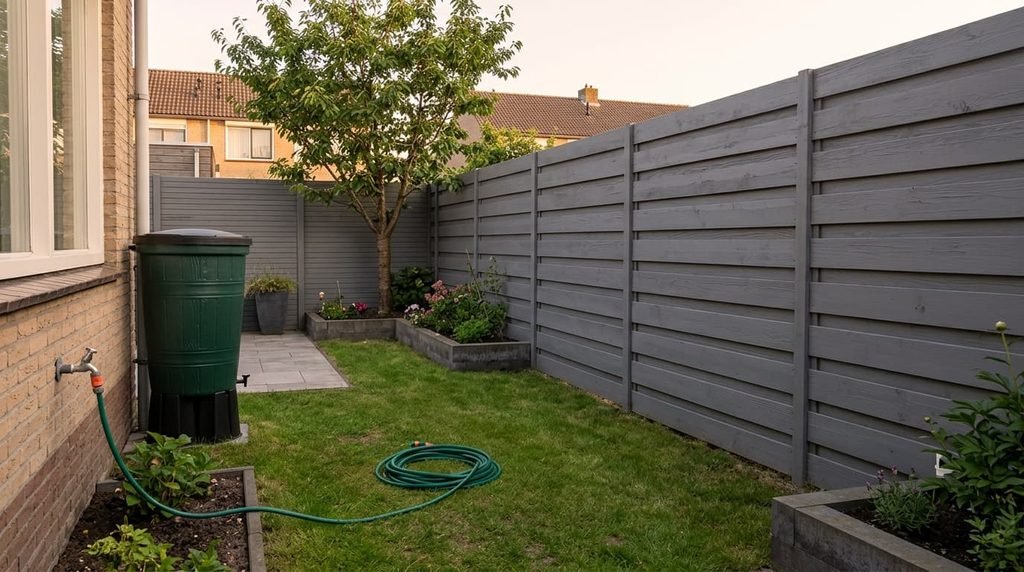
What this garden’s own build means for you
The fence sets the shadow. At 1.8 m high it shelters 0.84 m of soil whatever you plant. Lowering it to 1.5 m cuts the strip to 0.70 m, though it costs you privacy, so the fence stays here.
The cherry stands in the corner, so its roots reach the bed from one end. Because the fence’s south-west side takes the prevailing wind, the dry strip lies where it does. Then there’s the tap on the house wall, 11 m from the bed, which decides how you will water. A hose reel or a 200 L butt at the fence changes that sum. If you share a backyard garden where nothing grows, match each of these facts to your own plot before you copy a fix.
Only your own soil can tell you how well it holds water.

The fix that doesn’t work
Feeding the struggling plants looks like care and makes the problem worse. Fertiliser is a salt, and it needs water to dissolve and to reach the roots. Applied to dry soil, it raises the concentration around the roots and can scorch them. A plant short of water can’t use extra food anyway.
A stronger feed also hides the real fault for a few weeks, because the leaves darken before the plant gives up. That delay costs you a season, since by the time the plant fails you have lost the chance to test the soil. A liquid feed in a dry strip is the same mistake in a faster form, because it reaches the roots as a stronger solution. Slow granules fail the same way when the soil around them stays dry. I’d skip feeding until the soak and the mulch have been in place for a month.
Dry soil ends a planting first, and low light slows what remains. Run the three tests this weekend, because they name the cause before any money leaves your pocket, and then repeat the rain dig after a month to see whether the soil now holds its water. To fix a backyard garden where nothing grows, move the planting out of the strip. Then water deeply once a week and mulch the planted zone.
Questions readers keep asking
Can a shady backyard garden be fixed at all?
Yes, if the problem is dry soil, because water is something you can supply. Deep shade limits the choice of plants but doesn’t forbid planting. The sun-hours photos show which case applies. Fewer than two hours of sun means choosing shade-adapted plants such as epimedium or Geranium macrorrhizum, which tolerate dry shade once established.
How much does it cost to fix a shady bed?
Time is the only price of the first two fixes. Compost for the mulch is a small outlay. A tree surgeon is the one real expense, and it’s only worth paying when the sun-hours test flags light. Begin with the two free steps, then dig the soil again after a month to see what changed.
Why is the soil beside my fence always dry?
The fence blocks slanting rain, so a strip along it gets little. Behind a fence 1.8 m high, with rain at 25° from vertical, that strip is about 84 cm wide. Roots from a hedge or tree can dry it further. Dig after a shower to see how far the dryness runs.