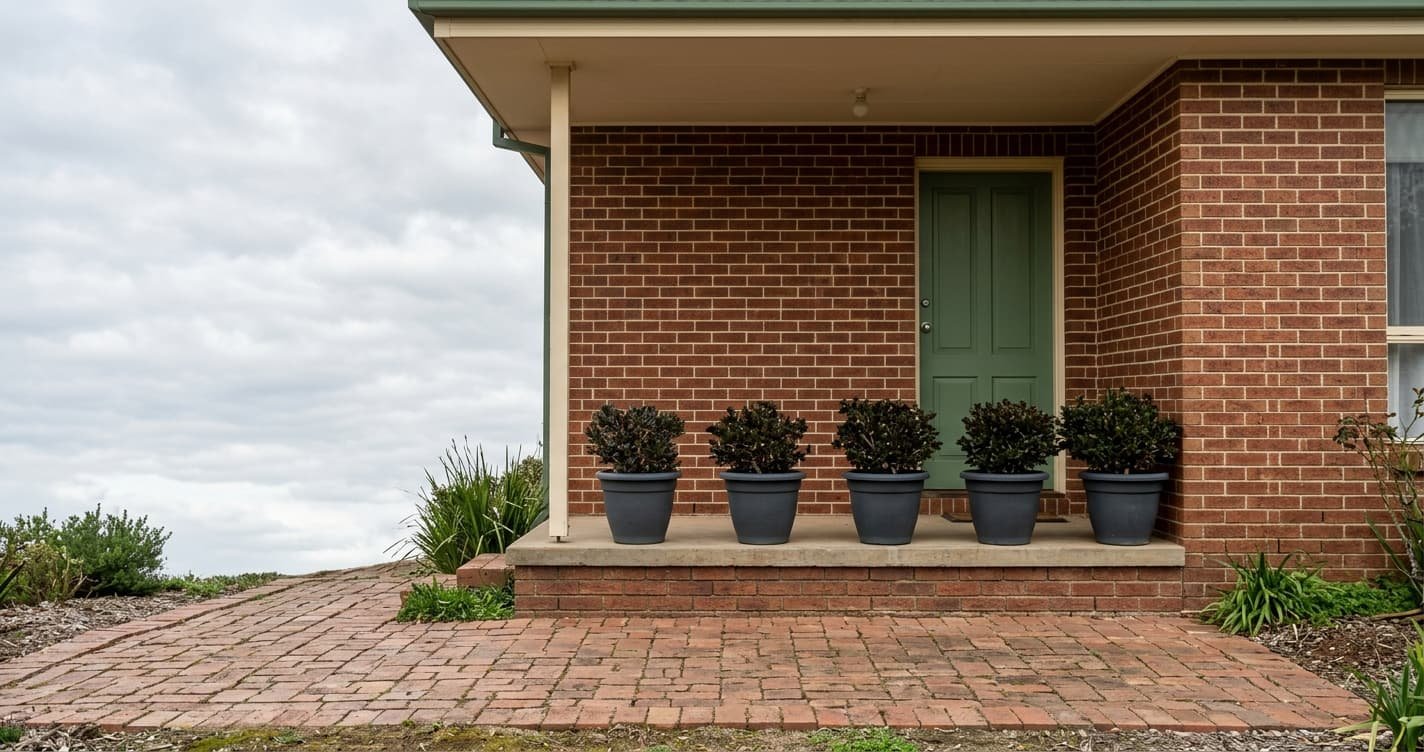
Five pots, each 30 cm wide, stand along the porch’s front edge. The brick behind them looks as bare as before. A front porch still looks plain after planting when the plants share one height and one tone with everything around them. Those are properties of the porch, and none of them reflects on your choices.
These figures assume a covered porch on a terraced Dutch house: ceiling 250 cm, floor 240 cm wide by 150 cm deep. The door is bottle green and the floor dark grey. The walls are red-brown brick. Reflectance values are rounded guesses, so read the results as outlines.
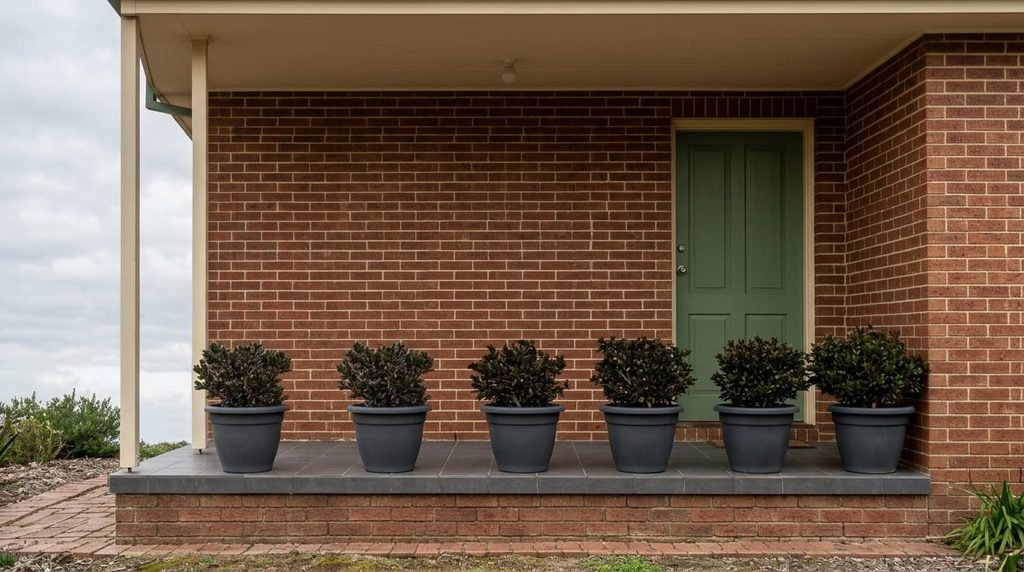
Why a front porch still looks plain, even with plants in it
A scene reads as finished when the eye finds separate layers in it. The eye finds them through differences in lightness, because edges are read mostly from lightness and only partly from hue. Here the dark floor and the green door sit close together in lightness. Brick and leaves sit near them. They merge into one mass, so the plants register as shapes in front of a wall and never as a layer of their own.
Height is the second layer. A pot 30 cm wide and as tall, holding a plant 40 cm high, tops out at 70 cm. That fills the lowest 28% of a 250 cm wall and leaves 72% bare. Standing eye level is about 165 cm, so from the path you look at brick. The plants sit at the bottom of your view.
Most people see a shortage and conclude the porch needs more plants, so they return to the nursery for more pots of the same height. That lengthens the low band without adding a layer. You can predict the fault before buying anything by asking what height and what tone the new plant adds.
A layer needs height and tone, and a place where the eye can rest.
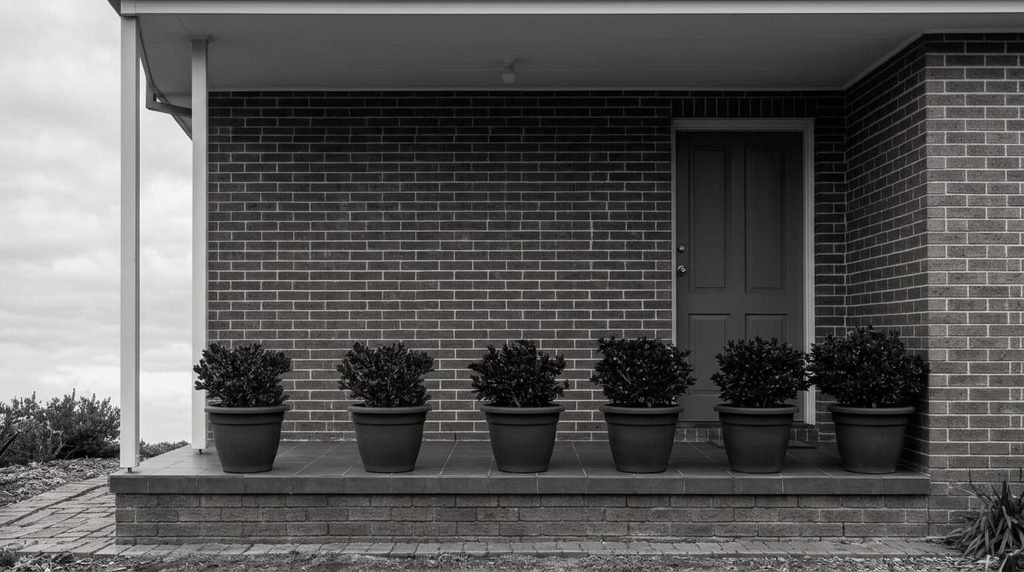
How to tell which fault you have
Take a photo from the path, standing 3 m back at eye level, and run three looks. Don’t zoom in, because the fault shows at the distance a visitor sees it from. Run the looks in order and halt at the first failure. A front porch still looks plain for whichever fault is largest.
Height look: mark a horizontal line across the photo at 100 cm, about hip height. If every leaf sits below it, the fault is scale.
Tone look: turn the photo black and white. That strips out hue and leaves only lightness. If the leaves merge with the door or the floor, the fault is contrast. The gap in lightness is too small to separate them.
Focus look: notice which spot your eye reaches first, then where it goes next. If it slides along the pots and leaves the frame, the fault is placement. If it lands on the door and stays there, the plants are working. Something else is at work then, such as the light the porch receives.
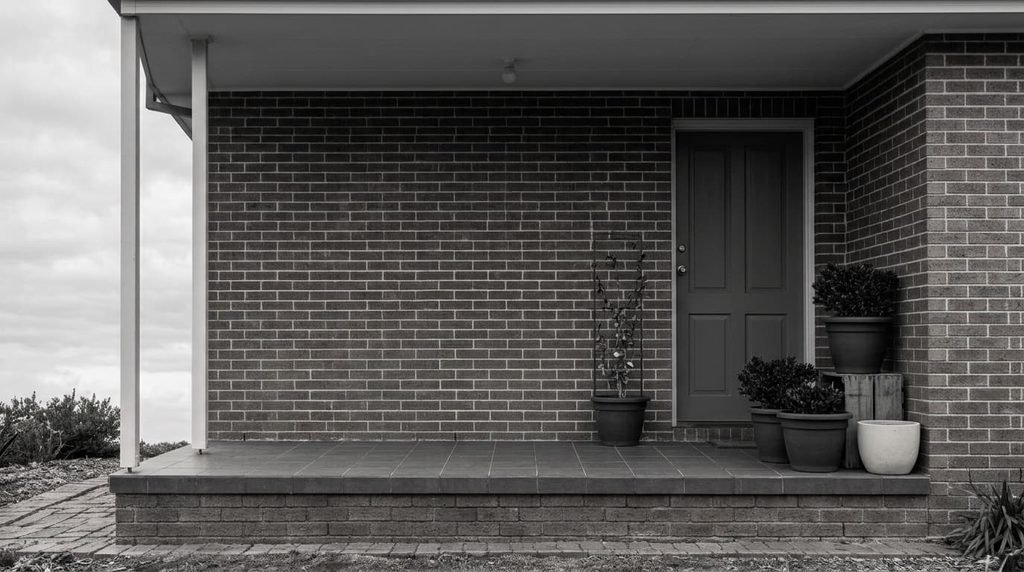
Where the porch still looks plain: three faults, diagnosed
The pots look small and the wall still looks empty. The cause is scale. Every plant tops out near 70 cm, so 72% of the wall’s height has nothing on it. Start with what you’ve got. Lift the largest pot onto a spare crate so its top reaches 100 cm. The group gains a second height, and a pot at 40 cm beside one at 100 cm shows a step. The eye reads steps as layers. A purchase comes next: one tall plant on a freestanding frame about 150 cm high reaches well into the empty wall without drilling into brick. Cost: nothing for the lift, one purchase for the frame.
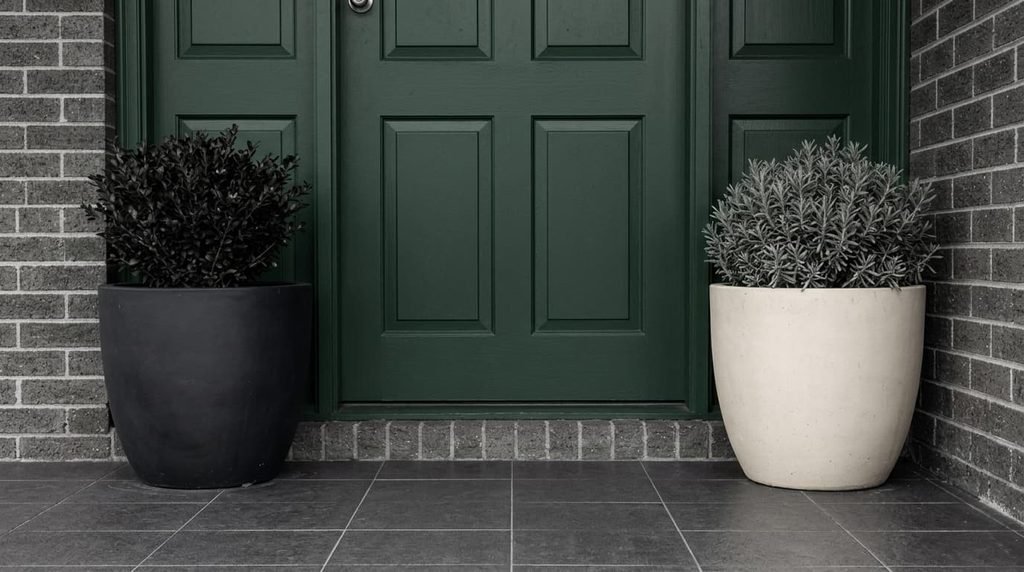
The plants disappear into the door and the brick. The cause is contrast. A dark evergreen leaf reflects about 10 in these sums, the same as the bottle-green door. The dark floor sits at 15. A gap of about 30 points is a common working threshold for two surfaces to read as separate. The leaf and the door have almost none. Start by moving the darkest pots off the door. Against brick at 25 they gain a gap of 15. Then buy one pale pot of cream stone, around 70 in reflectance, which opens a gap of 55 against the floor. Variegated or grey-green leaves help as well. A deep-shade porch fades the pale margin of variegated leaves, and I have no view of which way yours faces. Cost: nothing for the move, one pot for the pale.
The eye runs along the row and has nowhere to stop. The cause is placement. Five 30 cm pots with gaps of about 15 cm make a row, and a row has no centre. At the front edge it also sits between you and the door, the one natural focal point. Gather the pots into a cluster of about 90 by 60 cm in the back corner with the wider stretch of brick. That is 0.54 m², or 15% of the floor, and it leaves 90 cm of depth in front, the least that still feels like a way in. Measure it before you commit. Turn each pot a quarter every month. Leaves lean toward the open front and flatten the cluster into a one-sided line over a few months. Cost: nothing.
What to check before the next plant goes in
Check the height first. A plant that stays under 70 cm only extends the low band. Look for a mature top above 100 cm on the label. Check tone second by asking what stands behind the plant, then compare the two in a black-and-white phone photo. A pale pot can supply the gap when the leaves can’t.
Then ask which cluster it joins, since a front porch still looks plain when each new plant becomes another dot in the row. Add up the footprints last. Cap the group’s footprint at 0.54 m², roughly 15% of this floor. That leaves a clear route to the door. The share is a working figure. A group sized in July looks thinner in January when deciduous plants drop their leaves. Keep one evergreen at the back to hold the height.
The fix that isn’t worth doing
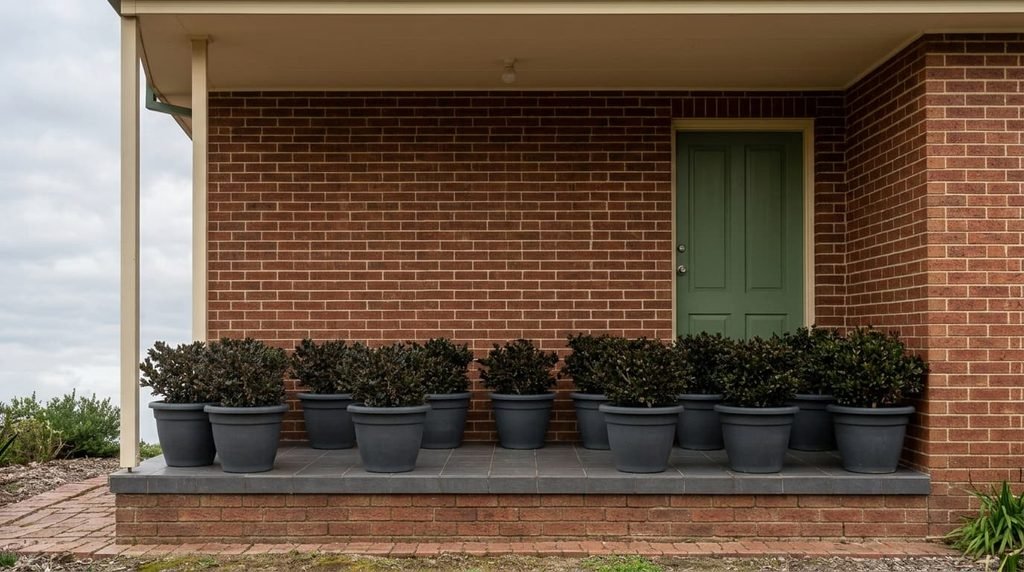
Adding more pots to the same row is the usual answer, and it repeats the fault. Ten pots of 30 cm take 0.9 m² of floor, or 25% of this 3.6 m² floor. Every plant still tops out near 70 cm. The wall stays 72% bare while the floor shrinks. A front porch still looks plain after the tenth pot, just as it did after the fifth.
A row is a line, and a line divides the space it was meant to fill.
I’d also drop the rule that pots must come in odd numbers. It counts pots and ignores heights, so it approves five equal pots as readily as a stepped cluster. Odd or even makes no difference to a layer. Only height and tone make one. Each extra pot also needs its own water and saucer. That adds upkeep and no layer.
A porch gains layers from height and from a pale edge beside its darkest surface, and one cluster then gives the eye a stopping point. The fastest check is a black-and-white shot taken from the path, which shows at a glance whether the leaves separate from the door and where the eye goes. Run it this weekend, before the next trip to the nursery, and make the free moves first, because they show how much a purchase would still add. If the photo still looks flat after those changes, the cause lies in how much light the porch receives, which is a separate problem that the plants can’t solve.
Questions readers keep asking
Why is a porch with plants on it still bare?
Because the plants share one height and one tone with the porch. Pots under 70 cm fill only the lowest part of a 250 cm wall. Dark leaves sit close in lightness to a dark door and floor. The eye finds no new layer, so the porch reads the same as before.
How do you make porch plants show up against a dark door?
Gather the pots into one cluster in a back corner and raise the largest on a crate. Then stand the palest pot against the darkest surface. Both steps cost nothing or one small purchase. A black-and-white photo from the path will show whether the leaves now separate from the door.
Is building work needed to make a plain porch look finished?
No. Each fault comes from how the plants are chosen and placed. A cluster and a taller plant cover scale and placement, while a pale pot covers contrast. The structure can stay as it is, door colour included, and the changes fit into one weekend.