How many times a day will the camera wake? Answering it takes a three-day tally and one sum. In wired or battery security cameras for a family home, wired wins above roughly 12 wakes a day and battery wins below that.
This guide assumes a UK house whose front door faces a road with deliveries and school runs. The pack figures are assumed round values: 18 Wh of usable energy, 1.2 Wh a day of standby and 0.05 Wh a clip. Products and costs stay out of the sums. A house often needs both answers. A front door and a back garden produce very different counts.
The one property that decides wired or battery
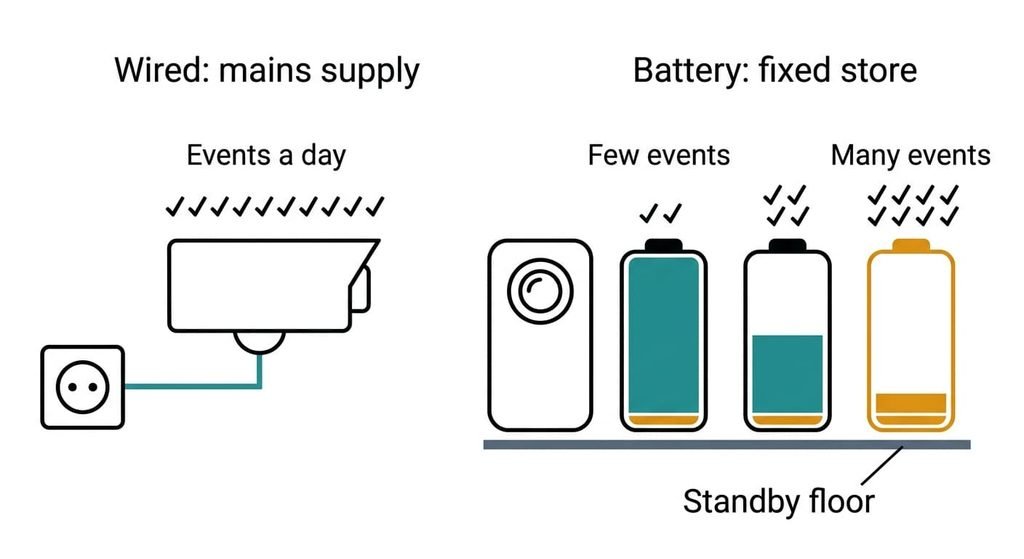
The number of events a day the camera must handle settles it. An event is any time the camera wakes and records a clip. A wired camera draws from the mains whatever the count, so events cost it nothing that matters. A battery camera pays for each one out of a fixed store. That store is the pack, and its size is capped by the case that has to hold it, which is why makers keep packs small.
For wired or battery security cameras alike, take the assumed 18 Wh pack. Twelve events cost 0.6 Wh, so with standby the day totals 1.8 Wh and the pack lasts 10 days. Thirty events total 2.7 Wh and last 6.7 days. Sixty events total 4.2 Wh and last 4.3 days. A cold week trims the pack to about 70%, so those 10 days become 7.
Pack life is a store divided by a daily count.
Even a silent camera lasts at most 15 days, because standby alone empties 18 Wh in that time. A trickle from a small panel shifts the sum only where the spot gets sun for hours each day. That ceiling is why a family door hurts the battery option more than a quiet side gate does. I’d count before you choose.
Wired or battery security cameras, head to head
Seven questions cover most of the difference. The table keeps them side by side.
| Question | Wired | Battery |
|---|---|---|
| What sets its running time | The mains, so events barely matter | Events a day against the pack’s size |
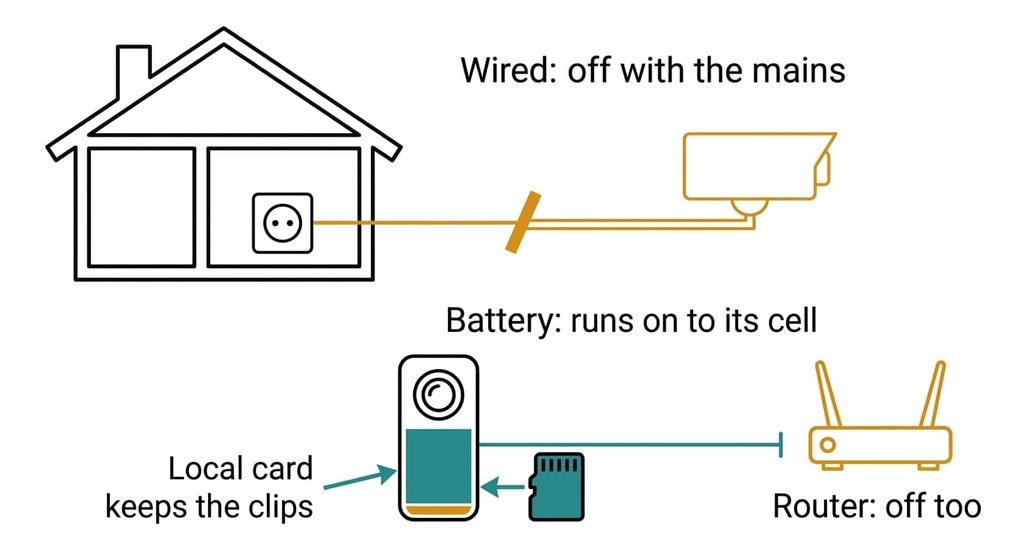
| When the house loses mains | Off until power returns, unless it has a cell | Keeps watching on its own cell |
| Where it can go | Near a socket or a cable run through the wall | Anywhere with a clear view and a signal from the router |
| What it records | Can record all day to a card or recorder | Clips after a trigger, with little before it |
| Monthly effort | None after fitting | A recharge every week or two at a busy door |
| Cold spell | Unaffected | Capacity falls by about 30% |
| How it fails when neglected | A lead gets unplugged or cut | The pack runs flat unseen |
Row two catches people out, since a battery camera keeps watching through a mains cut while the router that carries its clips is usually off as well. The footage then waits on a memory card or is lost, and a wired camera with a local card and a small backup cell closes the same gap.
Where wired cameras beat battery security cameras
Wired wins at a door with traffic. A family front door sees deliveries and school runs. Thirty events a day is ordinary. That means a recharge about weekly in summer and every five days in winter. A busy door is where a camera earns its keep, so it’s the last place to rely on a recharge you must remember. A mains lead takes the count out of the sum.
It also wins if you want continuous recording. A mains-fed camera can write all day to a card or recorder, while a battery camera stores only what follows a trigger.
It wins on position, too. A lead lets you fix the camera under the eaves where a pack would be awkward to reach for recharging. Height there suits faces and keeps the lens clear of casual hands. It also carries on through a cold snap, with no pack to lose capacity.
Finally it wins on routine. After fitting, nothing needs remembering. No chore waits to be forgotten on a wet Tuesday.
Where battery cameras win
Among wired or battery security cameras, battery wins wherever a cable can’t go. A rented home often forbids drilling. A side gate may have no socket in reach. You can fit the camera in minutes with a bracket.
It wins at quiet spots. A side gate with five events a day uses 0.25 Wh plus 1.2 Wh of standby, so the pack lasts about 12 days in summer and 8 or 9 in winter. That’s a recharge you can fit into a monthly chore round.
It wins in a mains cut, as the table shows, because the camera carries on. It leaves with you too when you quit a rental. Nothing stays in the wall. A second pack, charged while the first works, removes the downtime. A battery camera also suits a trial, since you can test one spot for a week before committing to a drilled route.
Last, it wins on speed of change. If the first position shows too little, you move the bracket in minutes and keep the view you tested.
When neither is right
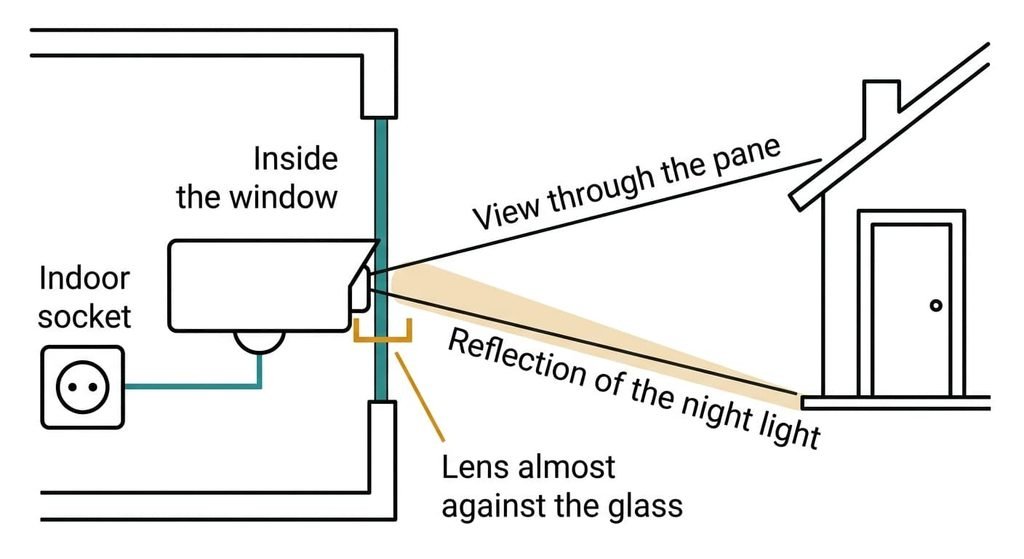
A rented flat with a busy door can fail both options. Drilling is forbidden, and a pack at 30 events a day goes flat in under a week. In that case, put a plug-in camera inside the window, facing out. It takes power from an indoor socket and needs no holes in the wall.
That spot asks nothing of the landlord.
The limits are real. Check the sill first, because a deep one gives the lens a firm place to sit and a shaded pane stops the sun bleaching the picture. Glass reflects the camera’s own night light, so the lens must sit almost against a clean pane. Wipe the pane monthly. Tilt the lens slightly down to keep the pane’s reflections out of the frame. The view narrows to what the window frames, and the pane must face the approach. For a door that sees the street, those limits cost less than a pack that dies each week.
How to decide in a minute
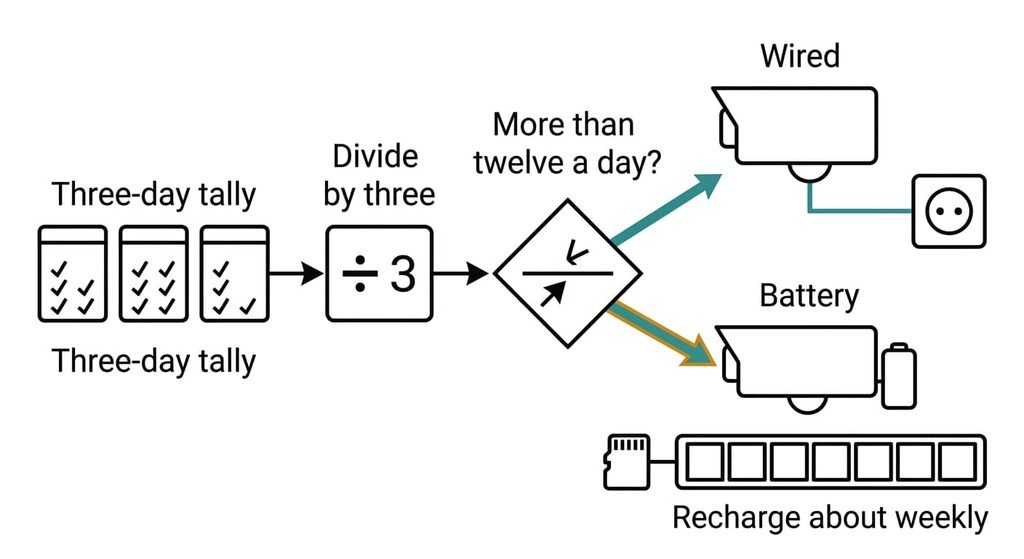
Tally every arrival within view of the spot for three days, then divide by three. Count each visit once, even when the visitor stays, and include the postal round and the neighbour’s cat if it triggers the camera. If the count is above about 12 a day, choose wired. If it is 12 or below, go with battery.
At 12 events the assumed pack lasts 10 days in summer and 7 in winter, which is about the longest wait most households tolerate between recharges. Your own limit may differ, so scale the threshold to the recharge you’d actually do. Write the figure beside the date, and tally again after a season, since traffic shifts with school terms.
Events a day set the answer. Wired takes the count out of the sum. A battery lives or dies by it. Run the tally this week, and a measured count will outweigh any rule from a page. A figure from your own door beats a general rule, and the sum takes five minutes. Wired or battery security cameras both work well in the right place.
Questions readers keep asking
How often do battery cameras need recharging at a family front door?
At 30 events a day, about every 6 to 7 days in summer and under 5 in winter on the assumed 18 Wh pack. Quiet spots stretch past 10 days. Your pack and settings will move these figures, so note the first few recharges and plan from those.
What happens to a wired camera when the power or router fails?
It can’t upload while the home network is down, and it stops altogether without mains. A local card keeps recording while the camera has power, and a small backup cell keeps it running through a short cut. Neither fix helps once both are gone.
Which suits a rented home better?
Usually battery. Nothing is drilled, and the camera leaves with you. If the door is busy, the plug-in camera inside the window avoids the weekly recharge. Both leave the walls as you found them, which matters for a deposit. Check the lease before fixing anything outside.