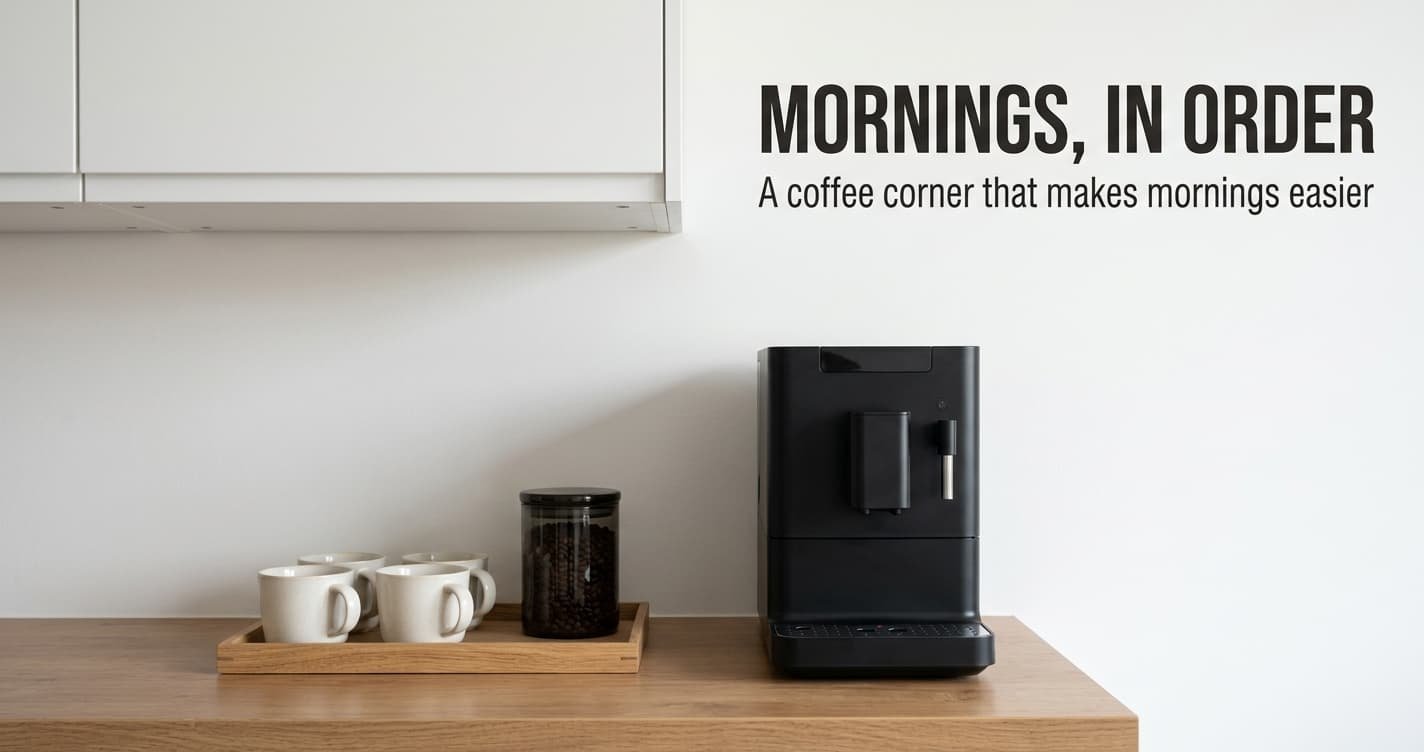
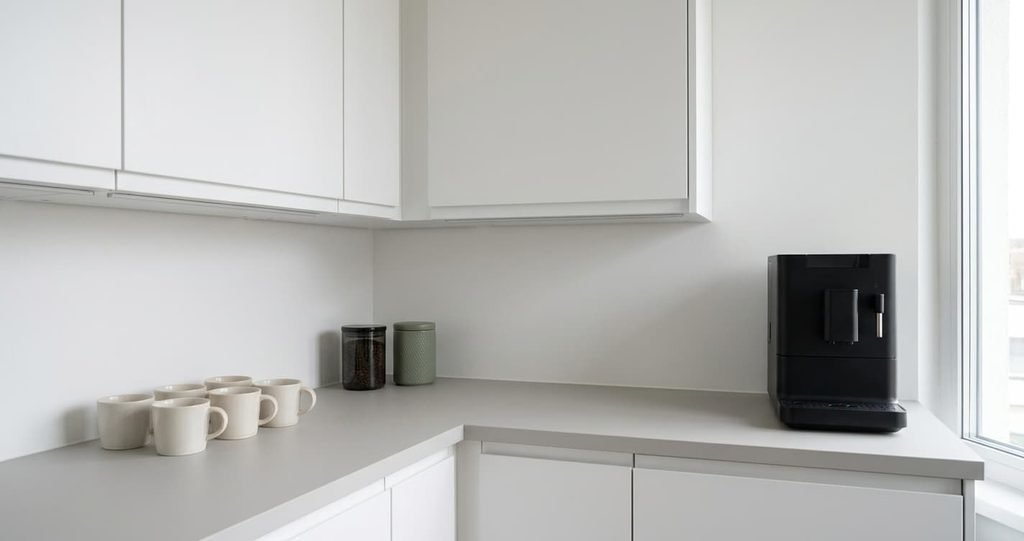
“The coffee things are everywhere and the morning still takes twice as long.” That complaint describes a corner arranged around the objects instead of the order you use them in. A coffee corner that makes mornings easier is a short line of pieces inside arm’s reach. The wall unit here leaves only 55 cm of height for it.
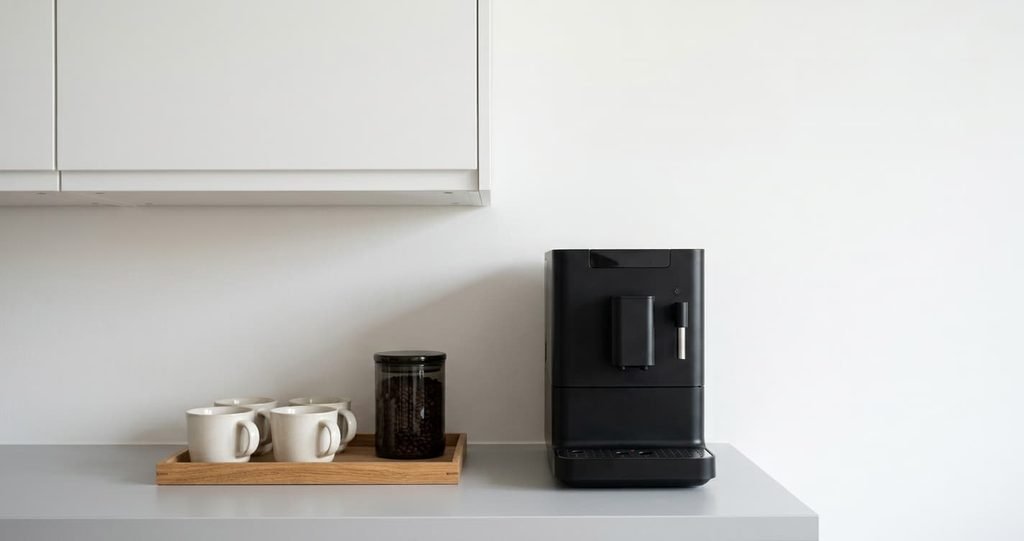
The space here is a Dutch terraced-house kitchen. A worktop 140 cm long and 60 cm deep, 90 cm high, ends at a side wall. The wall unit above it covers the left 100 cm, with its underside at 145 cm. The machine is a typical size: 30 cm wide and 40 deep, 38 tall.
What a coffee corner that makes mornings easier demands
A worktop at 90 cm sits about 15 cm below an adult’s elbow. That height suits pouring and portioning. The 60 cm depth hides a trap. A comfortable forward reach at a counter is about 40 cm for a standing adult, a rule of thumb. Everything in the rear 20 cm therefore costs a stretch each day. A morning coffee is a fixed sequence of about seven touches, from filling the tank to rinsing the jug. Each touch should sit within one pivot of the last.
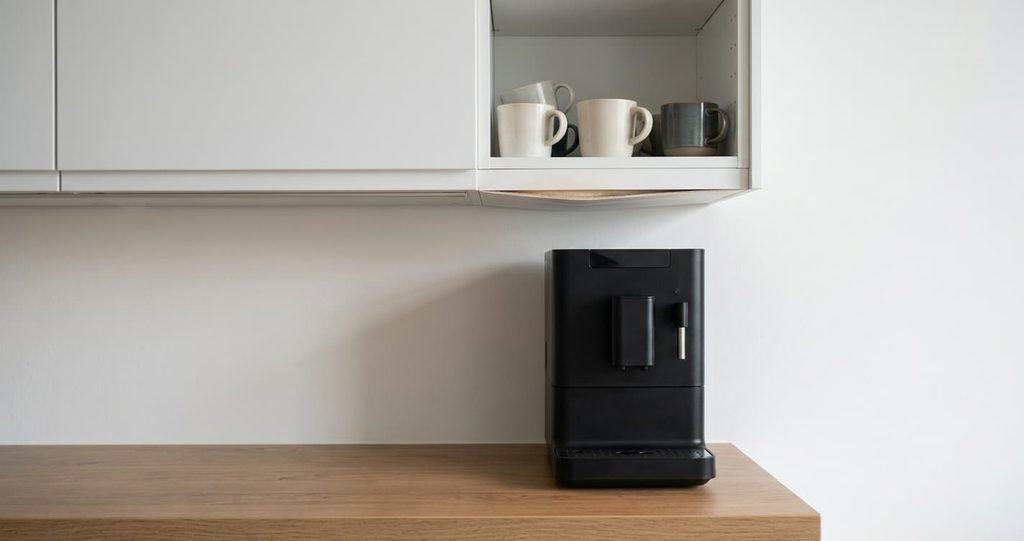
Height is the other limit. The wall unit leaves 55 cm above the worktop, and a machine 38 cm tall fills all but 17 cm of it. A lid and a water tank need about 25 cm of clear air above the highest point. That’s a working figure I’d treat as a minimum. Together with the machine that makes 63 cm against 55 on offer. So the rule is that the machine goes where nothing hangs above it, which here means the open 40 cm at the right end.
This corner has plenty of width and very little height.
From November to February most Dutch mornings start in the dark. The corner then works under artificial light for months, so the lamp is part of the layout. The socket decides which end the machine takes, and where yours sits is hidden from me.
Four layouts that make mornings easier at a coffee corner
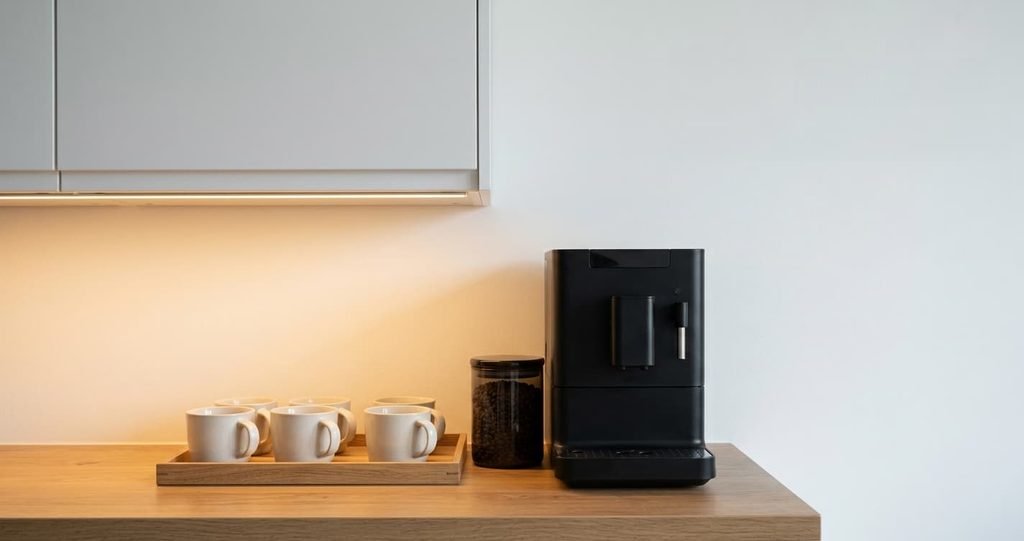
– Rental-friendly, the 140 × 60 cm worktop, nothing drilled: the machine stands in the open 40 cm, 8 cm from the front edge. An oiled-oak tray, 40 × 25 cm, holds four off-white porcelain cups, beside a dark-glass bean jar. A battery strip at 2700 K lights the line. Pieces fill 95 cm, so you pivot once.
– Tight footprint, a worktop end 70 × 60 cm with bare wall above: the machine stands at the front edge on the right. A matt black steel rail, 30 cm long, hangs at 110 cm beside it with four mugs. A 12 cm bean jar sits on the left, with a linen-shaded 2700 K lamp behind. The rail frees 30 cm of worktop, and the walkway stays 90 cm.
– Awkward shape, an L-shaped run of 150 and 120 cm with a blind corner of 60 × 60 cm: the machine takes the open end of the long leg. The cups stand on the short leg. A ceramic canister of filters and a second bean jar go into the corner. Window light falls from the right. The daily line never enters the corner.
– Full furnish, an oak sideboard 160 × 45 cm and 85 cm high: an open shelf 100 cm wide hangs over the left half at 150 cm and holds the cups. The machine stands on the right half beside sage-green stoneware canisters. A linen-shaded wall light hangs at 160 cm. A 65 cm gap clears the machine’s 63.
Where people get this corner wrong
The machine sits in the back corner. At the back, the worktop is 60 cm from the edge, 20 cm beyond a comfortable reach. Every refill turns into a stretch with a full tank. Pull the machine to within 10 cm of the front edge. That brings the tank to where you can see the water level, and the next refill is a short lift.
Cups live in a high cupboard. A cup stored at 160 cm needs a reach above the shoulder for many adults. Storage that high also sits a step away from the machine. Keep cups in the band between 90 and 135 cm, on the same level as the machine. A drawer at 100 cm costs nothing and keeps them a hand’s width from the brew.
Cups and beans are stored apart. Each hop between them adds a turn, and in a half-awake morning the turns are what you feel. Line them up left to right as cups, beans, machine, with the fridge on the machine’s side. Fewer turns mean fewer steps, and the order costs only a rearrangement.
A shelf 17 cm above the machine. Steam condenses on the underside of whatever hangs over it, and over months it swells chipboard edges and lifts laminate. Keep 25 cm clear or move the machine to the open end. Wiping it down slows the damage but can’t stop it. A coffee corner that makes mornings easier keeps steam away from the cabinet box, known as the carcass.
When the obvious corner layout is wrong
The standard advice gives the dead corner of an L-shaped worktop to the coffee machine, because the space is otherwise wasted. A machine in the blind corner fails on the numbers. The back of the corner square sits 60 cm from the front edge, which is 20 cm beyond a comfortable reach. The wall units on both legs also meet over that spot, so it carries the same 17 cm of headroom as the closed run.
A wasted corner costs less than a stretch repeated every morning.
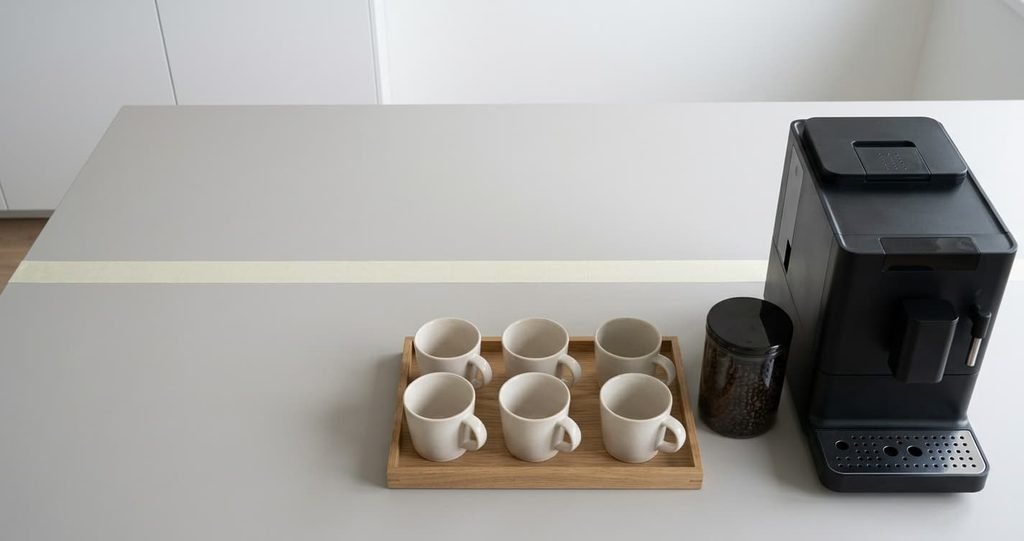
I’d give the corner to the bean jar and the spare filters, which you reach for once a week. The daily line stays on the open end. The second popular move gathers everything onto one tray for tidiness. A tray of 40 × 25 cm does suit four cups. It does nothing for the headroom, so use it for the cups and put the machine where the air is free. A coffee corner that makes mornings easier follows the order of use, and tidiness comes second.
Three things to try this weekend
1. Put a strip of masking tape on the worktop 40 cm from the front edge. Everything you touch daily should stand in front of the tape, and anything behind it can move. A stretch you notice in the first minute is the one to fix first.
2. Measure from the worktop to the underside of whatever hangs above the machine, then subtract the machine’s height. If the result is under 25 cm, the machine has the wrong spot. At 25 cm or more, nothing needs to move.
3. Make one coffee while you count steps and turns, then rearrange the line left to right and count again. Two fewer turns tells you the order works. Write both counts on the tape so you can compare next week.
A coffee corner that makes mornings easier is a line of pieces in the order you use them. It stays inside 40 cm of the front edge and keeps 25 cm of clear air above the machine. Cups beside the machine, beans on its far side and milk on the fridge side complete the order. Measure the gap above the machine this weekend. That single number decides where the whole line can stand.
Questions readers keep asking
How big does a coffee corner need to be?
A run of 100 to 120 cm of worktop, 60 cm deep, holds a machine and a bean jar, plus a cup tray. A console 80 cm wide and 40 cm deep takes a minimal set. The deciding figure is the clear height above the machine, which needs about 63 cm in total.
Where should the coffee machine go in a kitchen?
At the open end of a run, within 10 cm of the front edge, with nothing hanging within 25 cm above the lid. Put the cups beside it on the same level and the milk on the fridge side. The back corner is the worst spot, because it sits 20 cm past comfortable reach.
What lighting suits a coffee corner?
Warm white at about 2700 K, fixed under the wall unit’s front edge. The light then falls on the worktop instead of the wall behind. From November to February the corner runs on artificial light most mornings, so this lamp does daily work.