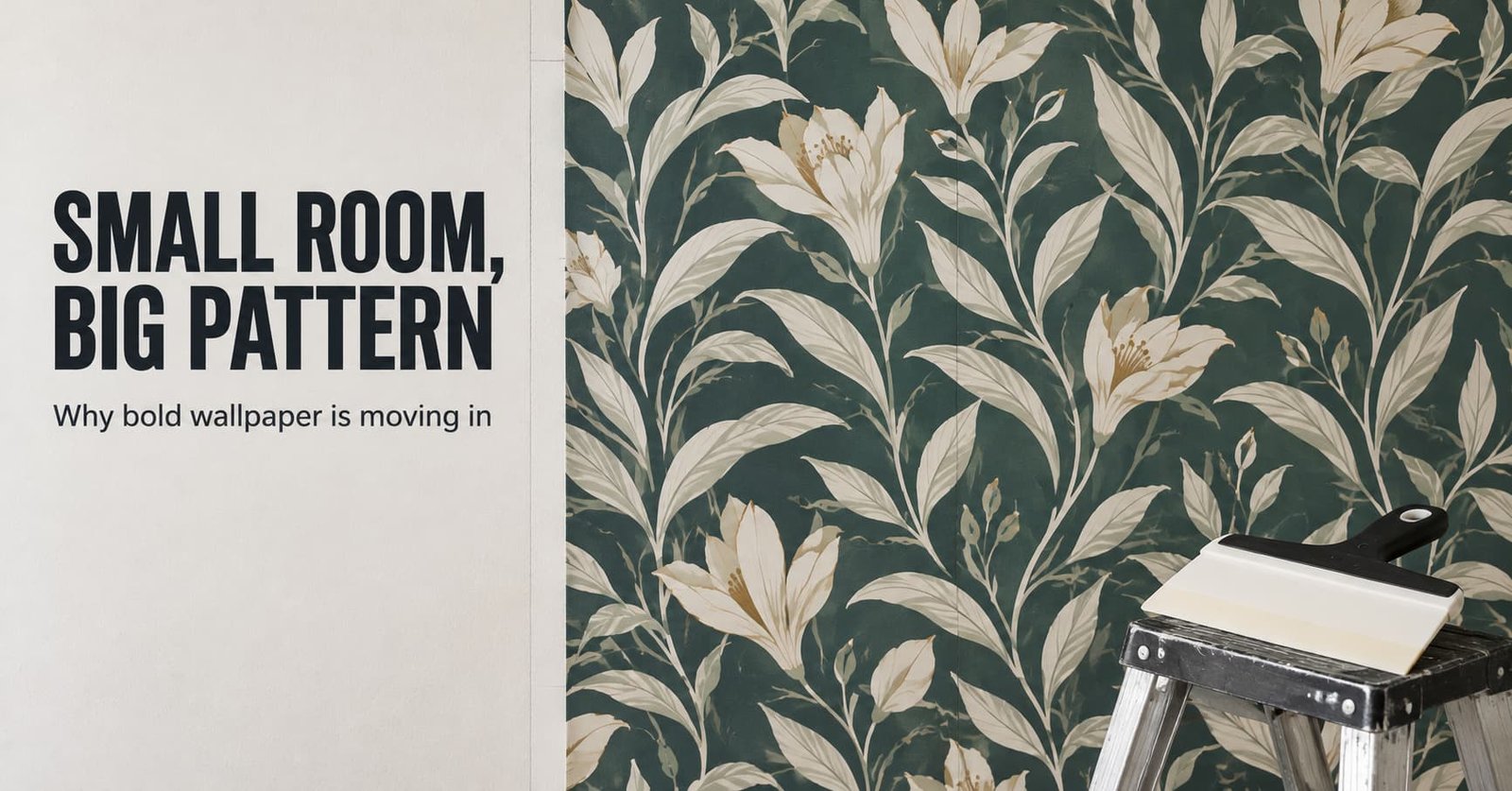
Has the smallest room in the house really become the place for the loudest paper? Yes, and the reason can be measured. Bold wallpaper is moving into small powder rooms because a room used for two minutes at a time can carry a dark, large-scale pattern that would wear anyone out in a bedroom. The sensible way to adopt it is on one or two surfaces rather than on all four walls.
The old rule said small rooms need pale walls and tiny motifs. The new practice reverses both halves, and only part of the reversal holds up. A powder room of 90 by 150 cm shows the difference most clearly.
Where the small-room rule came from
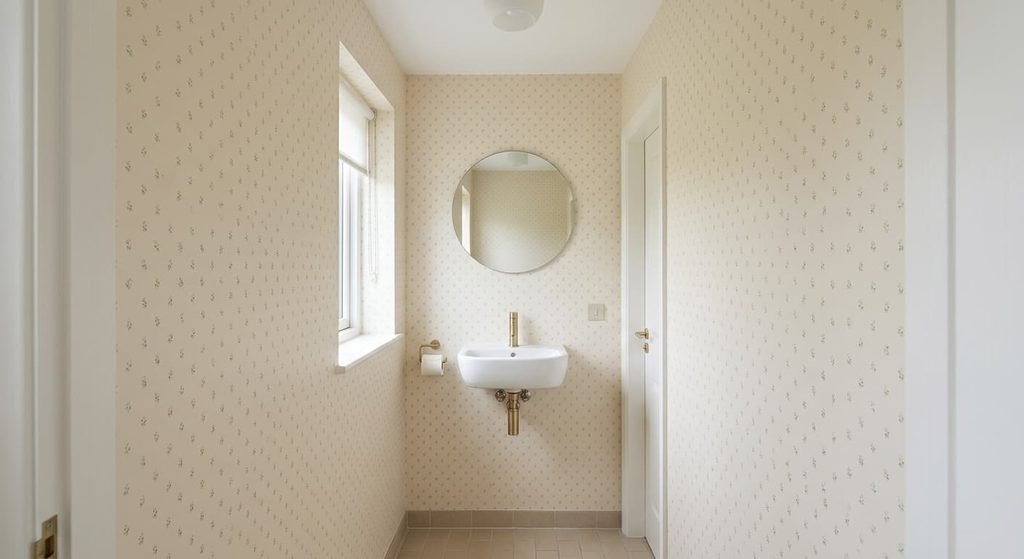
For most of the past few decades, advice for compact rooms was to go pale and keep any pattern small. The logic was sound for rooms people lived in. A pale ground bounces back most of the light that reaches it, and a motif with a repeat of 10 to 20 cm doesn’t demand attention from a wall 45 cm from your shoulder. Pattern, where it appeared, stayed at the scale of the room: a narrow stripe or a small sprig that let the eye slide past. Large patterns went to dining rooms and halls, where there was floor to stand back on.
Three conditions help explain why that rule loosened. Open-plan layouts left the powder room as one of the few spaces with a door that shuts, so a dark colour can’t spill into the rooms around it. Papers that strip off dry made a mistake cheap to undo. Small wall lights at face height became easy to fit, which matters because a dark wall returns almost no ceiling light.
What actually changed as bold wallpaper is moving into small powder rooms
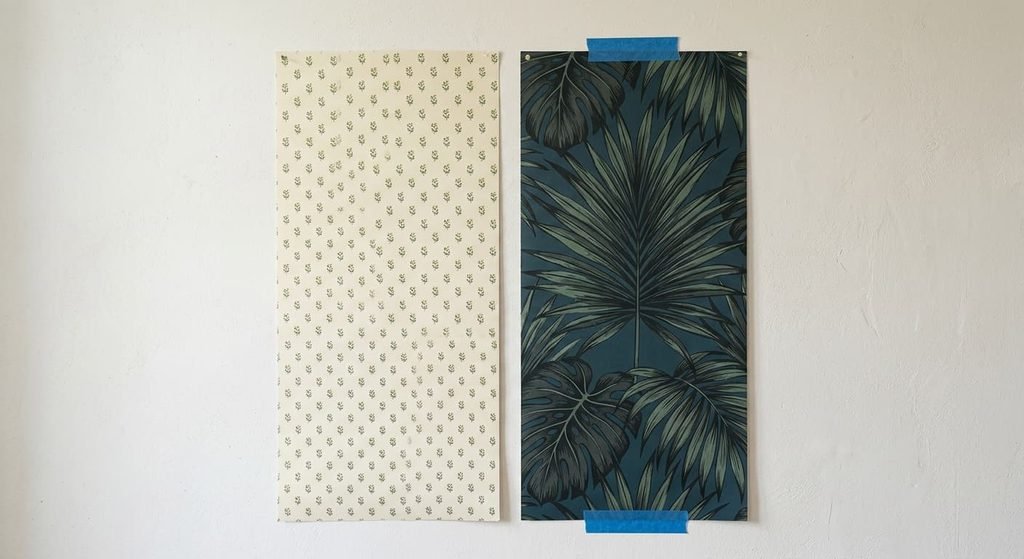
Start with scale. The measured change runs from repeats under 20 cm on pale grounds to repeats of 50 cm or more on dark ones. A repeat is the distance before the motif starts again down the roll, and 50 cm is close to the width of a standard European roll, which is about 53 cm. One motif now fills a full strip.
Light follows from the ground. Light reflectance value (LRV), the share of light a surface sends back on a scale from 0 to 100, is typically well above 50 for a pale ground. Deep greens and blues often sit under 15, so the walls return less than a sixth of what hits them. The room’s light then has to arrive from the sides at 150 to 165 cm, because the ceiling does little for a dark wall.
Distance changes the effect too. A guest at the basin is never more than 90 cm from a wall and is often about 45 cm from one, so the paper is seen as a surface in front of the face.
The order sheet changes as well. Papering every wall of a room this size takes about eight drops, a drop being one strip cut to wall height. A straight match wastes up to one repeat per drop, so a 64 cm repeat uses up to 54 cm more paper per drop than a 10 cm one. Across eight drops that is over four metres, about two fifths of a 10.05 m roll, so a large repeat can add a roll to the order.
Who it suits, and who it doesn’t
It suits a windowless powder room, where no daylight competes with the colour and the lighting is entirely yours. A room that guests use briefly suits it, as does a ceiling around 2.4 m with a wall you can fit lights to. A renter who chooses a removable paper keeps the risk small, and a household without small children keeps the wall clean.
It doesn’t suit a family toilet in constant use. Where bold wallpaper is moving into small powder rooms, the guest-only ones take it best. The wall behind and beside the basin takes splashes, and an ordinary paper tends to lift at the joins there. A wipeable, vinyl-faced paper copes better, though it usually costs more per roll.
It doesn’t suit a room with a single ceiling light and no way to run a cable to the mirror. A dark ground under overhead light alone leaves shadow below the chin.
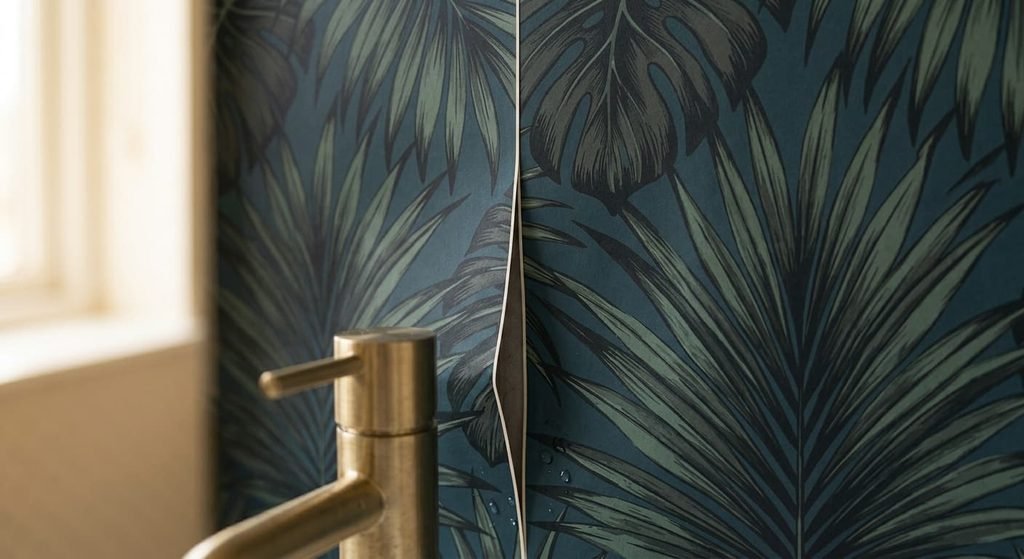
Uneven walls count against it too. Dark paper shows every bump, and a pale core can appear along each join as a thin light line. Anyone who wants the room to read as larger should also think twice, since a dark, large motif seen from 45 cm brings the walls closer, which is a matter of taste more than a law. I can’t see how much daylight reaches your room, so test a sample on the wall before you order.
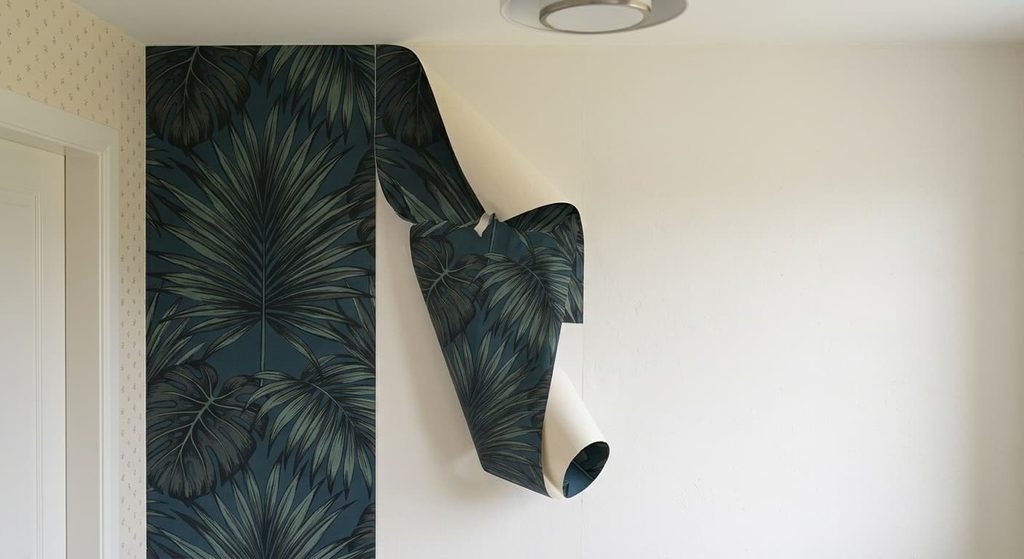
Is bold wallpaper moving into small powder rooms for good?
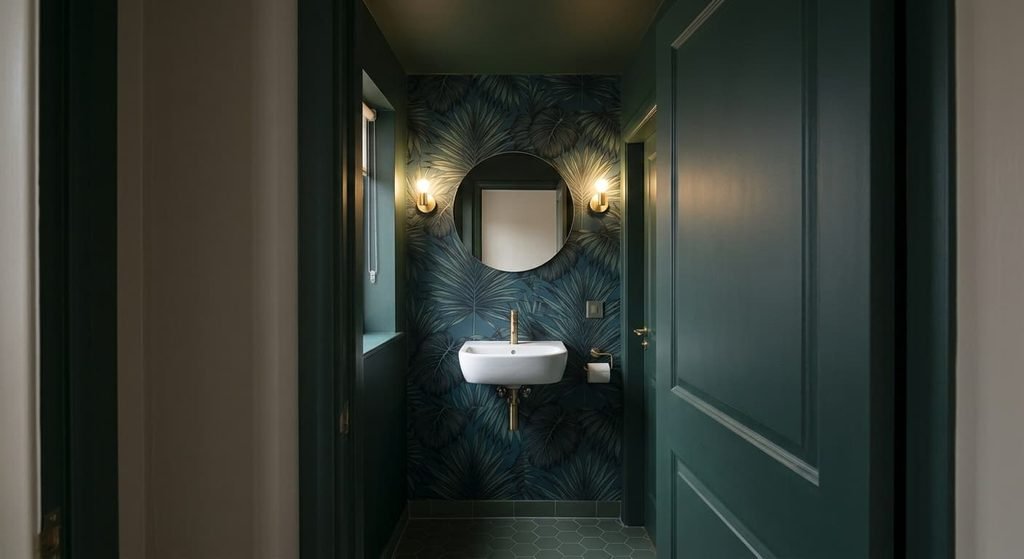
The verdict is yes for the surface and no for the whole room. It’s worth doing on the wall behind the basin and on the inside of the door, because those are the two surfaces a guest faces from the basin and from the seat, and a mistake costs one day of stripping.
Reversibility is the test. A strippable paper hung on a sealed, painted wall usually comes away cleanly, whereas paper pasted onto bare plaster can pull the skim coat with it. The commitment that costs most to undo is the glue line, so keep it off new plaster. A motif tied to one period dates fastest.
The downside is a long afternoon.
I won’t guess which motif will look tired in five years. Judge longevity by how much of the room you commit and how easily it comes off. Two surfaces and a paper that strips dry make a small bet.
The version that will date fastest
Where bold wallpaper is moving into small powder rooms, the extreme version is every wall and the ceiling in one large dark motif, often with a metallic or glossy ground. Its marks are easy to spot. The pattern runs into every fitting, so the cistern and the light switch each cut a motif in half. The ceiling at 240 cm puts the repeat overhead. A glossy ground turns a single bulb into hot spots.
I’d defend a firm view here: coverage is what ages a room, and a single bold plane rarely does. A room 90 cm wide puts pattern within reach of both hands, and the eye finds nowhere to rest.
The moderate version is one pattern plane and one deep colour. Take the darkest tone in the paper and match it in matt paint for the other walls, then fit lights at face height. The pattern gets a quiet surface to sit against, which is why it reads as chosen.
Bold describes the motif, and coverage is a separate decision.
How to try it without committing
Use one roll and one wall. A 90 cm wall needs two drops, so a single roll covers it with room to spare. Hang it and live with it for a month before touching the other walls. That is long enough to meet it on a bad day.
Mount an offcut on a thin board instead, about 50 cm by 70 cm, and hang it like a picture. It costs a fraction of a wall and leaves the plaster untouched. Alternatively, tape a sample at least one full repeat tall at 155 cm and judge it from the basin and from the seat, under your own bulb.
Bold paper moves into small powder rooms because a short visit tolerates what a long stay wouldn’t. Adopt it behind the basin and on the door. Match the rest in paint, light the face from the sides, and the pattern earns its place. A guest then leaves with one clear memory of the room, which is what a two-minute visit can deliver.
Questions readers keep asking
Should I change a powder room that already has pale walls?
Only if the room feels flat, not simply because bold wallpaper is moving into small powder rooms. Pale walls work fine with good lighting. If you do want pattern, begin with the back of the door or a single wall, since either change reverses in a day.
Does bold wallpaper suit a windowless powder room?
Yes, and often better than a room with a window. With no daylight to compete, the colour is judged under your own warm bulbs. Fit lights at the sides of the mirror, since a dark ground returns almost no ceiling light.
How long does bold wallpaper last in a small powder room?
It lasts as long as the wall stays dry and the joins stay stuck, often many years in a room with an extractor or a window. Splash zones fail first. Choose a wipeable paper near the basin, and judge the look by how much you committed.