A darker colour can’t take a centimetre off the floor. Why, then, does our bedroom feel smaller since we painted it? Three measurable things change when a wall goes from an LRV of 80 to 12. The room returns less light and the furniture loses its edge. The white ceiling also gains one. LRV, or light reflectance value, is the fraction of light a surface returns.
Every figure rests on a Dutch bedroom of 320 by 400 cm under a 250 cm ceiling, with two 800 lm lamps. The walls moved from 80% to 12%. Check your tin for its own LRV before you trust any figure.
Why does our bedroom feel smaller since we painted it darker: what is happening
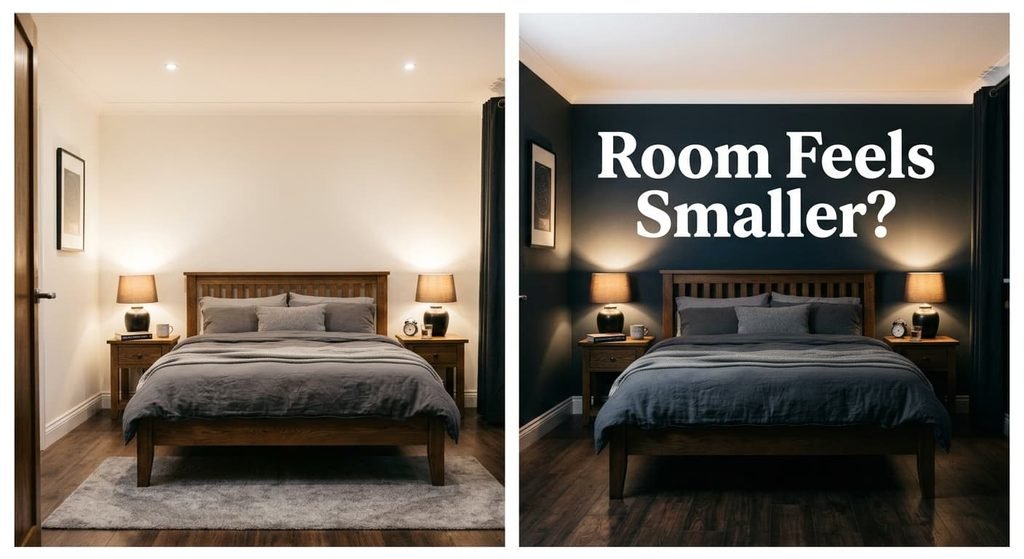
Light bounces. Each surface hands part of what it receives to the next, so a room’s brightness depends on how much the whole shell returns. Walls make up 36 m² of the 61.6 m² shell. A white ceiling returns 85% over 12.8 m², and an oak floor returns 35% over another 12.8 m². With walls at 80%, the weighted average is 0.72. Paint them to 12% and it falls to 0.32.
That average sets the brightness. Two lamps of 800 lm spread over 61.6 m² give 26 lux on first contact. Bounces then lift it by 1 ÷ (1 − average), so the room sits near 92 lux before the paint and 38 lux after, which is 58% less. Wall brightness suffers more, because it is reflectance times light. It falls from about 23 cd/m² to about 1.5, which is 16 times dimmer.
The walls now throw back 16 times less light, and the white ceiling above them forms an edge of 7 to 1. Reading a dim, edge-heavy shell as tighter is a response many people share. The numbers show where it comes from.
Bedroom: which fault makes it feel smaller, since we painted it
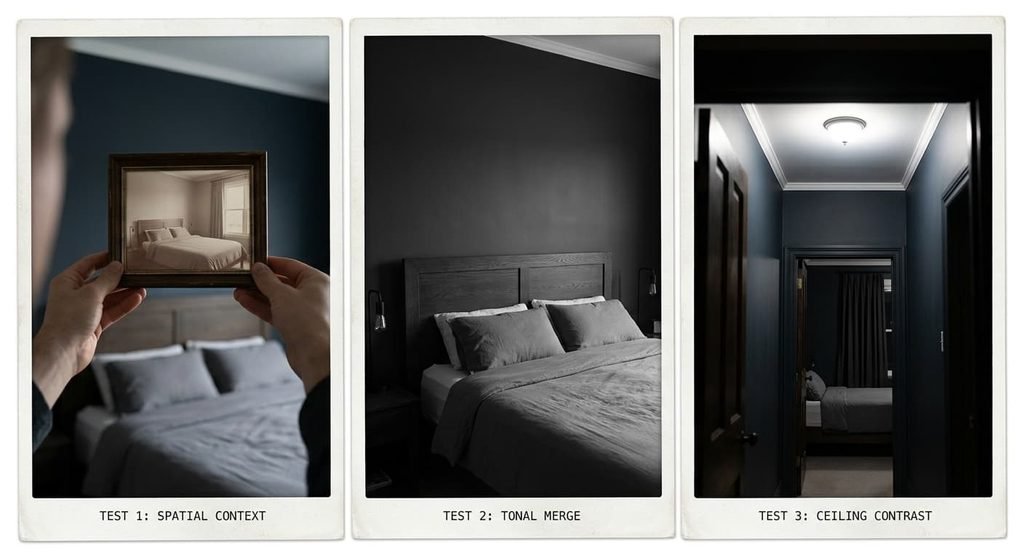
Run three looks in the evening with your phone, and keep the lamps on. They separate the three faults behind a room that can “feel smaller since we painted it”, and nothing needs measuring or buying. Wait until it’s properly dark, since daylight hides the problem.
First, find a photo of the room taken before the paint under the same lamps. Hold it next to the real wall and compare how bright the wall looks. A wide gap points to the light budget, and a small one rules it out.
Second, photograph the bed against the wall and convert the picture to greyscale. That strips out the colour and leaves only brightness. A frame or headboard that melts into the wall points to contrast. One that stands out rules contrast out.
Third, stand in the doorway. Look along the line where wall meets ceiling, and notice whether a hard line seems to press down. That points to the edge. Note which look shows the biggest change and start your fixes there, because the largest fault repays the first hour.
The three faults, diagnosed
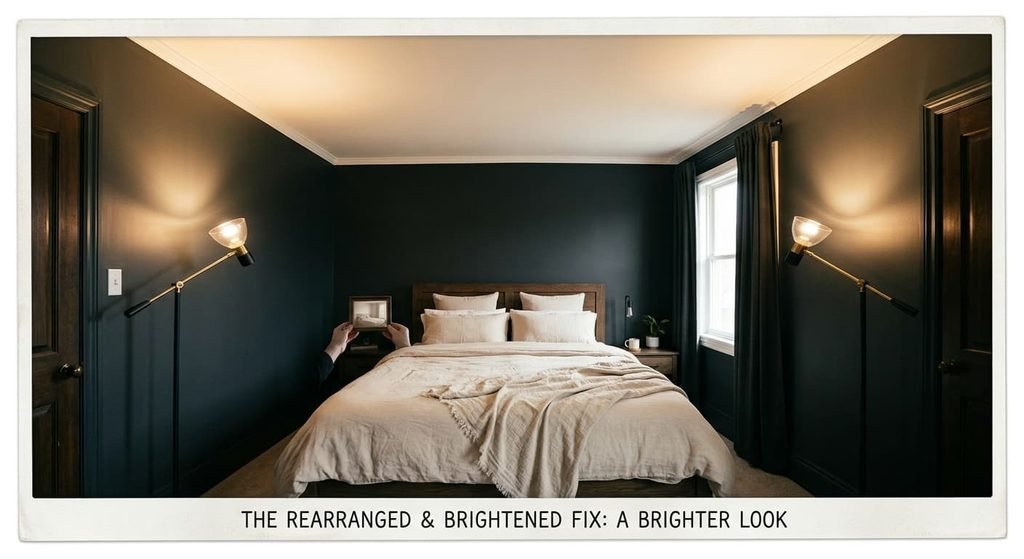
“The bed and the furniture sink into the walls.” Contrast is the weak point here. A dark oak frame reflects about 18%, and against the old white wall at 80% it stood out 4.4 to 1. Against the new wall at 12% it stands out only 1.5 to 1. Put pale bedding on the bed. Linen or a throw you already own reflects about 70%, which lifts the ratio to 5.8 to 1 over a bed top of 3.2 m². Under 38 lux, pale linen shows about 8.5 cd/m² against 1.5 for the wall. It costs a wash, and a pale rug beside the bed catches the same light.
“The room is dim even with every lamp on.” Placement explains it. Light aimed at the new walls loses 88% in the paint. Of 800 lm landing on a wall the room gets back 96 lm, while the same 800 lm landing on a white ceiling returns 680 lm, 7.1 times more. Tilt the shades of two lamps you own so they throw light up, and stand floor lamps in corners with the shade facing the ceiling. Keep one directed bedside light for reading. It’s a rearrangement and takes an evening, with nothing to buy. You trade a little shadow on the bed for a room that glows from above, and you lose the soft pool of light on the bedside table.
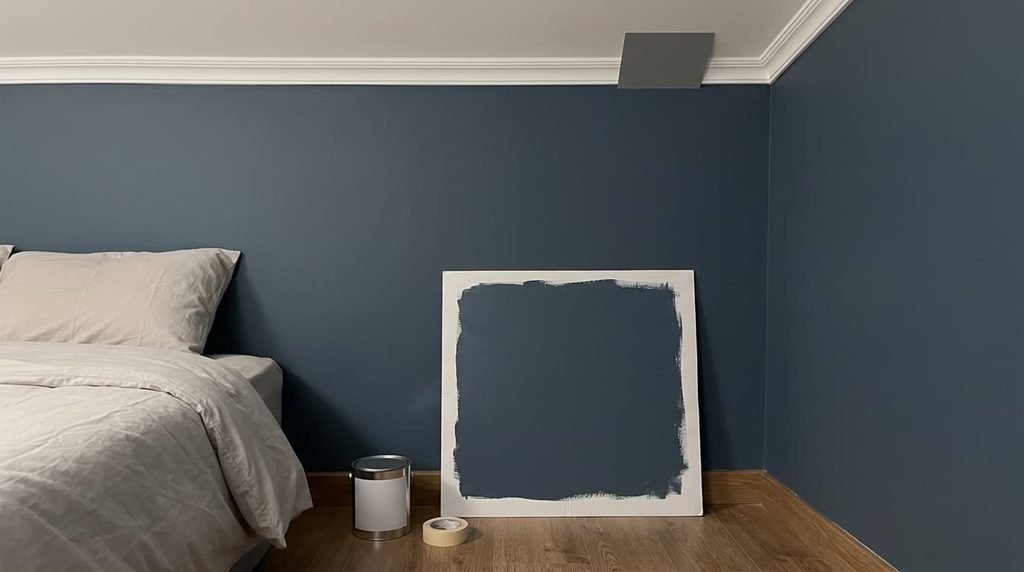
“The walls seem to close in at the top.” The edge explains it. The white ceiling at 85% sits over a wall at 12%, a ratio of 7.1 to 1, where before it was 1.06 to 1. Paint the ceiling a mid-tone of about 50%. The edge softens to 4.2 to 1. The ceiling is 12.8 m². Two coats take about 2.5 L and some masking tape. It’s a weekend and a tin. Hold a sample card of the mid-tone at the ceiling line for a week first. It also costs light: the room drops from 58% below its old level to 62% below. Run this fix last, after the lamps are aimed, because the other two win back more than it loses. Owners who say a room can “feel smaller since we painted it” usually mean one of these three faults.
What to check before you paint a room dark
Budget the light before the first coat.
The flux you need is the old flux times (1 − new average) ÷ (1 − old average). Here that is 1,600 × 0.681 ÷ 0.283, or about 3,850 lm. That’s 2.4 times the lamps you had, or three more of 800 lm. Paint a card of 1 m² in the new colour and leave it on the wall for a week, at your usual evening hour. Keep the ceiling at 50% or more so the edge stays near 4 to 1, and write the tin’s LRV inside a cupboard door. The LRV is printed on the chart or the tin, and the colour’s name tells you nothing about it. Compare it with the average you worked out, since a tin at 12% will repeat everything in this article.
The fix that isn’t worth doing
A big mirror opposite the dark wall is the stock suggestion, and it backfires. A mirror multiplies what it faces. Facing a wall at 1.5 cd/m², a mirror of 60 by 120 cm shows about 1.3 cd/m² back, a second dark wall at the other end of the room. The room gets no brighter, and the reflection adds a second edge to read. The glass also weighs about 7 kg at 4 mm thick, and it doubles whatever stands in front of it, from the bed to the clutter on the dresser. By day, opposite the window, it adds daylight. Your complaint is about the evening.
A mirror hands back the dark it faces.
I’d spend the effort on linen and lamp angles first. Paint and linen change how the room reads, and the floor area stays at 12.8 m². That is why three small fixes beat one large purchase.
When a bedroom seems to “feel smaller since we painted it”, the walls return 16 times less light and the bed has lost its edge, while the ceiling has gained one. Start with the photo beside the wall, since it tells you in a minute whether the light budget is the main fault. Then dress the bed in pale linen and tilt the lamps upward, and only afterwards decide whether the ceiling needs a tin. Keep the numbers on a card: 92 lux before and 38 after, 3,850 lm to restore the old level, and 4.2 to 1 at the ceiling line. Redo the photo test after each change.
Questions readers keep asking
Why does a dark bedroom feel smaller?
Dark walls return less light, so the same lamps give about 58% less in this example, and a white ceiling forms a hard edge of 7 to 1 against them. Pale furniture or a dark frame can also vanish. The floor area stays the same.
What is the first thing to try when a bedroom feels smaller after painting?
Put pale bedding on the bed and tilt two lamp shades toward the ceiling. Both are free and fit inside an hour. They raise the bed’s contrast to the wall from 1.5 to 5.8 to 1 and return 7 times more light per lumen.
Can I fix it without repainting?
Yes, mostly. Linen and lamp angles need no paint. Only the ceiling edge asks for a tin, and a mid-tone ceiling softens it from 7.1 to 4.2 to 1. If the first two fixes work, you may find the edge no longer bothers you.