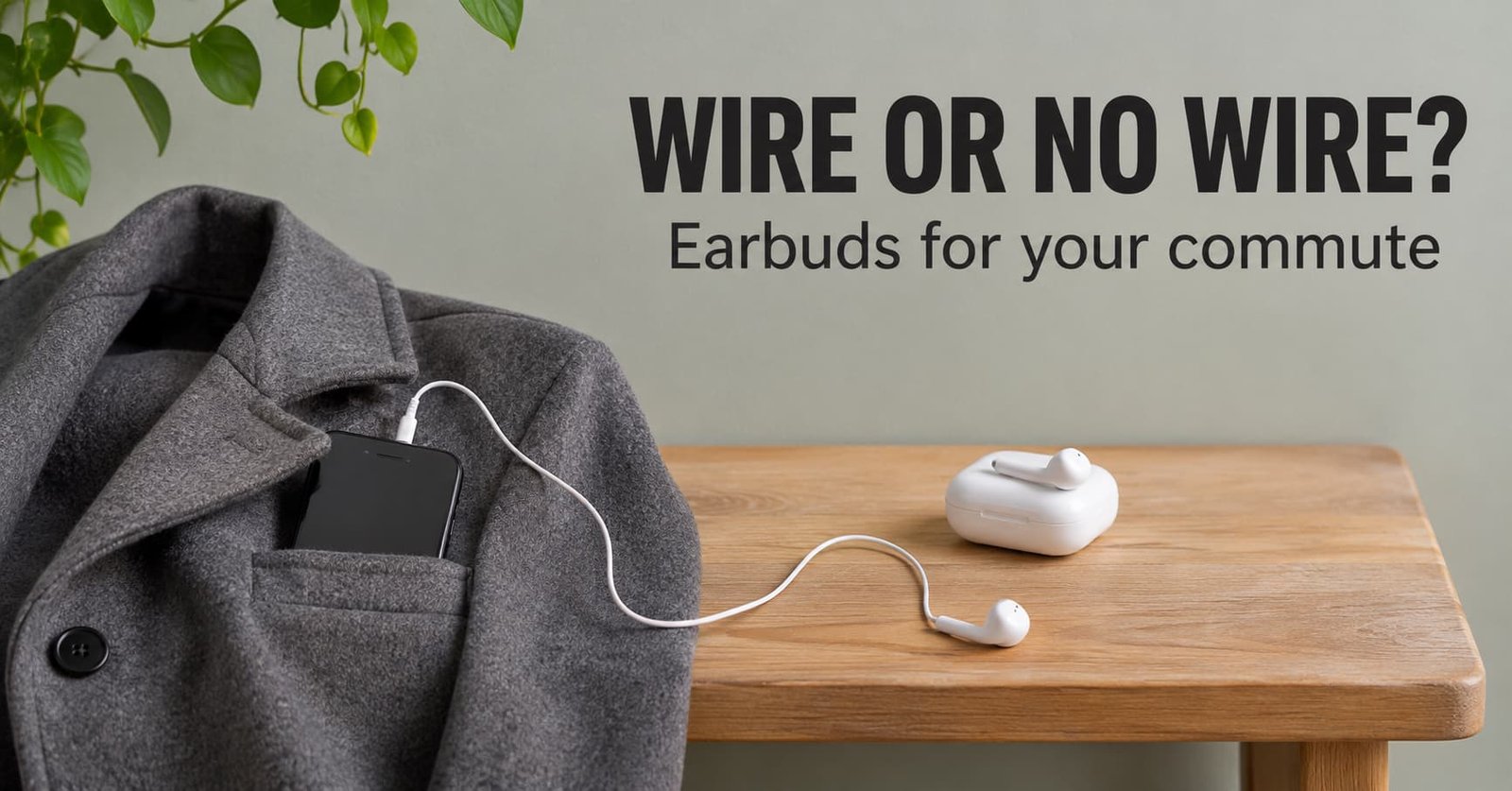
Does your phone ride in a chest pocket or a trouser pocket? That answer settles more than any spec sheet does. With earbuds for daily commutes, wired wins when the route from your ear to the phone measures 0.8 m or less, and wireless wins when it runs longer. What decides it is the length of cable that route uses up.
The figures below use a 1.2 m cable, a 1.75 m adult and 230 commuting days a year. Those are round numbers, so lay a piece of string along your own route. Product names and prices go stale quickly, so this page carries neither.
The one property that decides earbuds for daily commutes
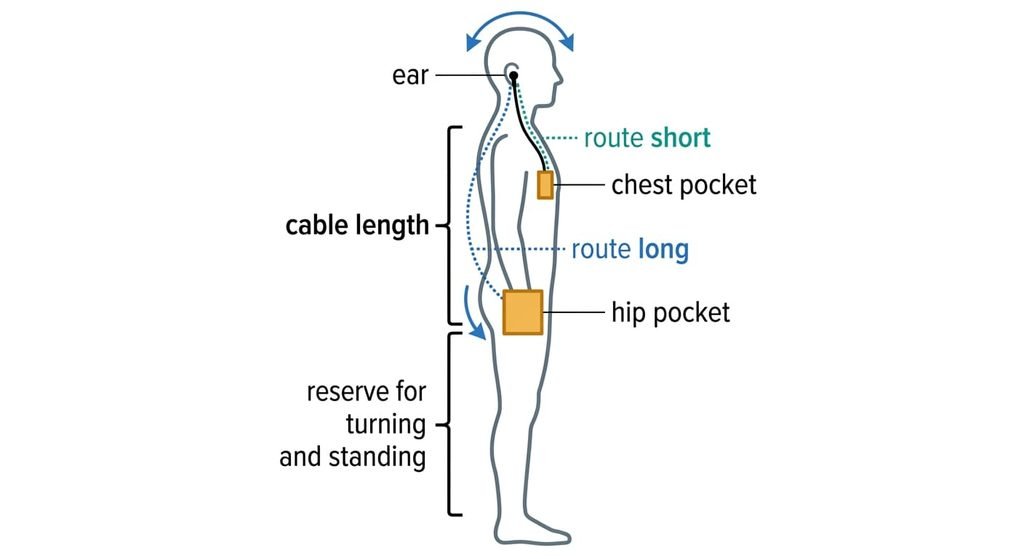
A cable has one job on a commute: the distance from your ear to wherever the phone rides sets how much cable you need. Start with 1.2 m, a common length among earbuds for daily commutes. Turning your head costs about 0.15 m of it, and standing up from a seat costs another 0.25 m. That reserve of 0.4 m leaves 0.8 m to span the route. The route follows your neck and shoulder rather than a straight line. Lay a string along yourself and it runs longer than a ruler held from ear to pocket. The seat you sit on changes it again.
Where the phone rides then changes the verdict. A chest pocket sits about 0.4 m away, which leaves 0.4 m to spare. Your coat’s side pocket measures about 0.75 m and only just fits. A front trouser pocket measures 0.95 m, so it overshoots by 0.15 m. The first stand-up or sharp turn tugs a bud out of your ear.
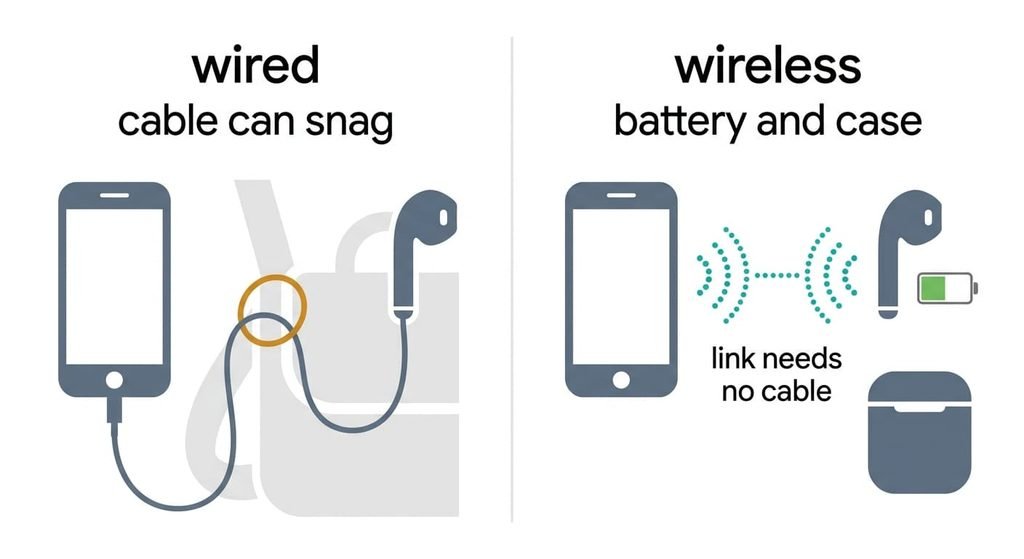
Wireless removes the cable and lets the phone ride anywhere. In exchange you take on a battery to keep charged and a bud you can lose. Each side of the comparison therefore asks a different question: can the cable reach, and will the battery last?
Head to head
| Question | Wired earbuds | Wireless earbuds |
|---|---|---|
| How the phone connects | A 1.2 m cable | A radio link with no length to run out of |
| Where the phone can ride | Within 0.8 m of the ear by cable route | Any pocket or bag within a few metres of the ear, and a desk if you leave it |
| What stops mid-journey | Nothing, because there’s no battery | The bud’s charge, about 5 h when new |
| What wears out first | The cable near the plug | The battery inside each bud |
| What a mishap does | A snag pulls the bud out of your ear | A dropped bud can vanish on its own |
| What you carry besides the pair | Nothing, unless the phone needs an adapter | A charging case, which you’ll want to keep topped up |
| Switching to a new phone | Plug in, with an adapter if the socket is missing | Pair once from the settings screen |
The battery row surprises most people, because it’s the one they worry about first when they shop. A 70-minute daily commute uses about 54 full charge cycles a year. This comparison assumes a bud fades to 80% after 500 cycles, so wear takes roughly 9 years to get there.
Where wired earbuds win for daily commutes
Wired earbuds win when the route from ear to phone is 0.8 m or shorter. A phone in a chest pocket leaves 0.4 m spare on top of the reserve, and a phone held at chest height does the same. Nothing needs charging, so there’s no morning when the pair is flat.
The second reason is the battery clock on long journeys. Ride two hours each way and you listen 4 h a day, or 920 h across 230 days. At 5 h per charge that makes 184 cycles a year, so 500 cycles arrive in 2.7 years. By then a bud that held 5 h holds about 4 h, which equals your daily listening with nothing in reserve. A cable never ages like that.
The drawback is the tether, and it’s real on a busy platform. A strap or door handle that catches the cable yanks a bud free. A phone with no headphone socket needs an adapter, which gives you another item to carry.
Where wireless earbuds win when the phone rides low
Among earbuds for daily commutes, wireless wins when the route runs past 0.8 m. A trouser pocket at 0.95 m fails by 0.15 m. Put the phone in a rucksack, well over a metre from your ear, and no cable reaches it. Leave it on the seat beside you and the result is the same, yet the radio doesn’t care.
The second reason is a short commute. At 70 minutes a day you log 268 h a year, which is 54 cycles on 5 h of charge. Reaching 500 cycles takes 9.3 years, so the battery won’t be what ends the pair. One charge covers 5 h ÷ 70 min = 4.3 days. The case tops the buds up overnight, so you’d charge them about twice a week. That’s a habit you can build in a day.
The drawback is that a bud is easy to lose, since no cable ties the pair to you. With the phone behind you, the link can also break, because your body sits between phone and ear.
When neither is right
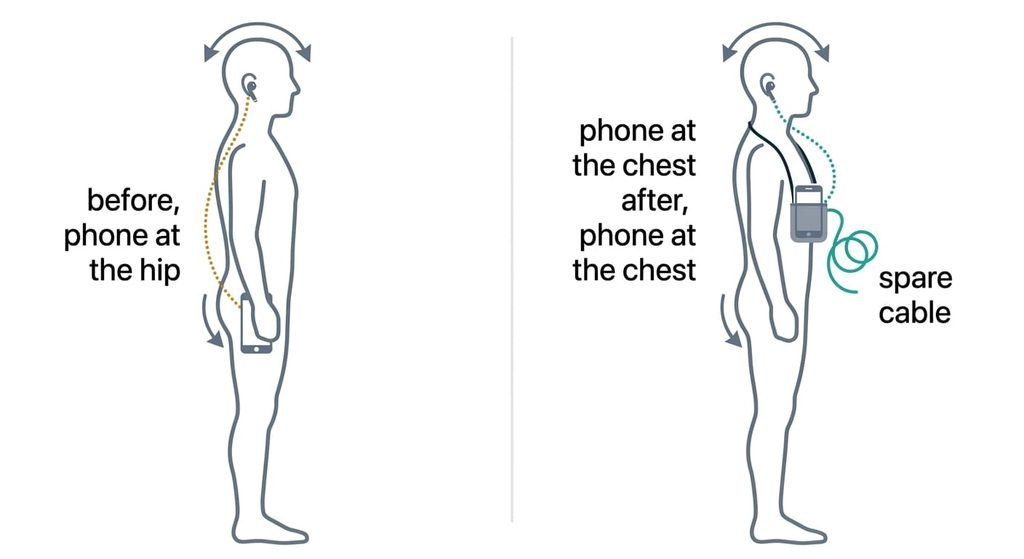
Moving the phone instead of the earbuds suits anyone whose route measures 0.95 m and who wants a cable anyway. A jacket inner pocket sits about 0.4 m from the ear, and a lanyard pouch on a neck cord lands at roughly the same height. That shortens the route by 0.55 m and leaves 0.8 m of the cable unused, double the 0.4 m reserve.
The cost is a pocket at chest height.
Many summer clothes have none, and a phone you pat constantly is a phone you’ll check constantly. A lanyard pouch or an armband puts the phone back at 0.4 m with no tailoring. Give it seven real mornings before buying anything new, because that shows whether the habit sticks. Sleeves and bag straps can still catch the cable, so run it under a layer of clothing and not over it. A pocket on the bud’s own side also spares the cable a crossing over your chest.
How to decide in thirty seconds
Hold a piece of string from your ear to the place your phone rides on an ordinary morning, then read off the length. If it measures 0.8 m or less, take the wired earbuds.
If it measures more and the phone stays where it is, take the wireless earbuds.
Then check the listening hours. A 4 h daily total pushes the answer back toward wired, and 70 minutes leaves it where it is. Jot the figure on a ticket so the battery sum has a number to use. A metre of string and one sum give you the answer, and neither costs you more than a minute.
The right pair of earbuds for daily commutes is the one whose cable fits your route. Wired earbuds hold steady once the phone sits within 0.8 m, and wireless earbuds free the phone from the cable altogether. Measure the route before you pick, because a pair that tugs at every stand-up soon gets left at home. The cable length decides far more than the sound does.
Questions readers keep asking
Is it a hassle to use wired earbuds on a commute?
Only if the phone rides low. In a chest pocket or your hand the cable has 0.4 m to spare, so you’ll barely notice it. In a trouser pocket it falls 0.15 m short. It tugs every time you stand, and that’s the real annoyance.
What usually fails first on wireless earbuds?
For a 70-minute commute, the battery takes about 9 years to reach 500 cycles, so a lost bud is likelier. With four hours of listening a day, fade arrives in under 3 years. The case keeps topping up, but a bud holding 4 h gets no margin.
Are wired earbuds better on a crowded train?
Often, yes. Standing in a crowd you tend to hold the phone near your chest. The route stays near 0.45 m, so the cable has plenty of slack. The risk is a neighbour’s bag strap hooking the cable. A phone buried in a rucksack, by contrast, favours wireless.