A fast charger sets a ceiling, and on most nights the phone never gets near it. That explains what makes a phone charge slowly overnight, and the box cable is the usual first remedy. Four things pull the power down, and only the last remedy costs money.
The figures assume a UK bedside, a 4,500 mAh battery at 3.85 V (17.3 Wh), 15% charge at bedtime and 8 hours until the alarm. Every wattage is a round example, so expect your own kit to differ. Swap in your own numbers to see which link caps you.
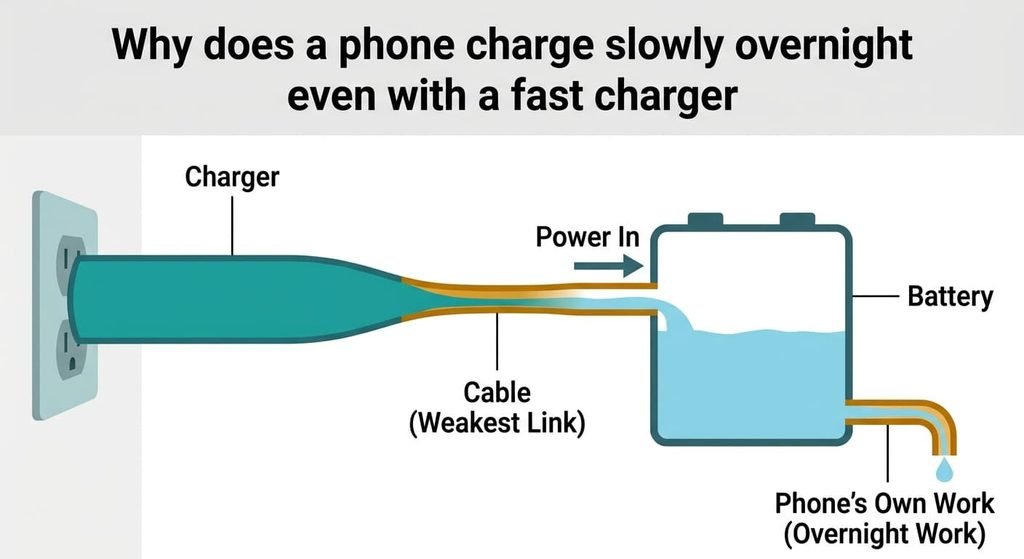
Charging is a ledger, and the weakest link between socket and battery sets the power coming in, while the phone’s own overnight work is subtracted from it. A charger may offer 20 W while the cable and the phone settle on a level of their own. The lowest offer wins. Say a sound chain delivers 15 W at the battery. A chain that falls back to the basic 5 V profile delivers 5 W.
Now take away what the phone spends. A phone idling with the screen off draws about 0.5 W. A backup running beside an app update adds about 4 W. The fallback chain therefore nets 5 − 4.5 = 0.5 W. Over 8 hours that is 4 Wh, or 23 points. The 15% you started with becomes 38% when the alarm goes.
Up to about 80%, the ledger holds. The last 20% is 3.5 Wh. It takes roughly an hour on any chain, because the phone slows its own intake as the cell fills. So the sums below count the climb to 80% and treat the rest as an hour.
The charger was fine. The chain below it was the limit.
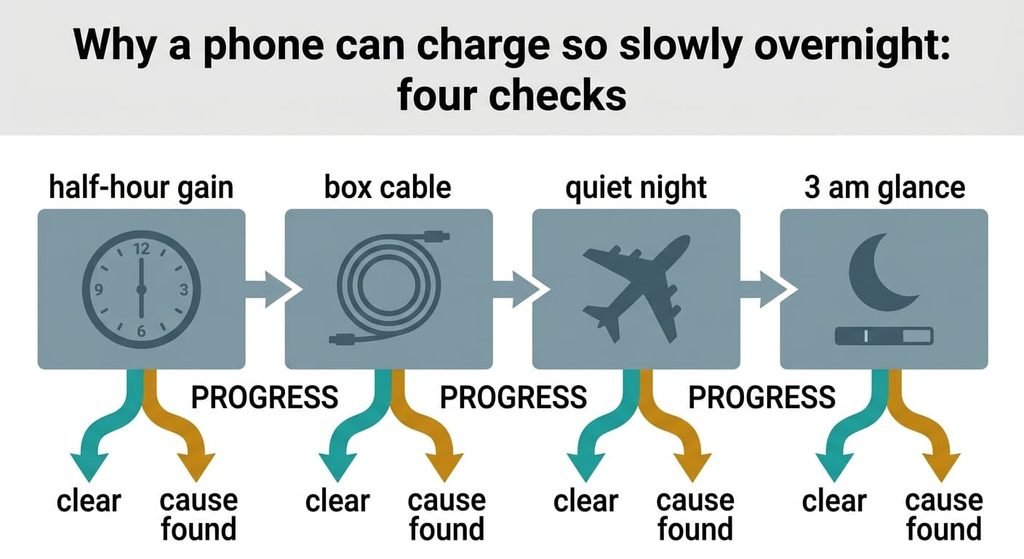
Why a phone can charge so slowly overnight: four checks
Run these on ordinary days, because each result is a number you can read off the battery screen. None needs a purchase.
First, the half-hour gain. At midday, with the battery between 20% and 50%, charge for 30 minutes with the screen off and note the gain. A sound chain nets 14.5 W, which adds 7.25 Wh, or 42 points. Near 13 points means the chain has fallen back to 5 W. Under 3 points means the phone spends almost everything it receives.
Second, the box cable. Repeat the test with the cable that came with the phone, plugged straight into the wall charger. A jump from 13 points to about 40 puts the blame on the old cable or a hub in the path.
Third, the quiet night. Switch on airplane mode before bed for one night. A morning level near 100% points to overnight work. A level that barely moves points back to the ceiling.
Last, the 3 am glance. A level parked near 80% that reaches full by dawn means the phone is holding on purpose.
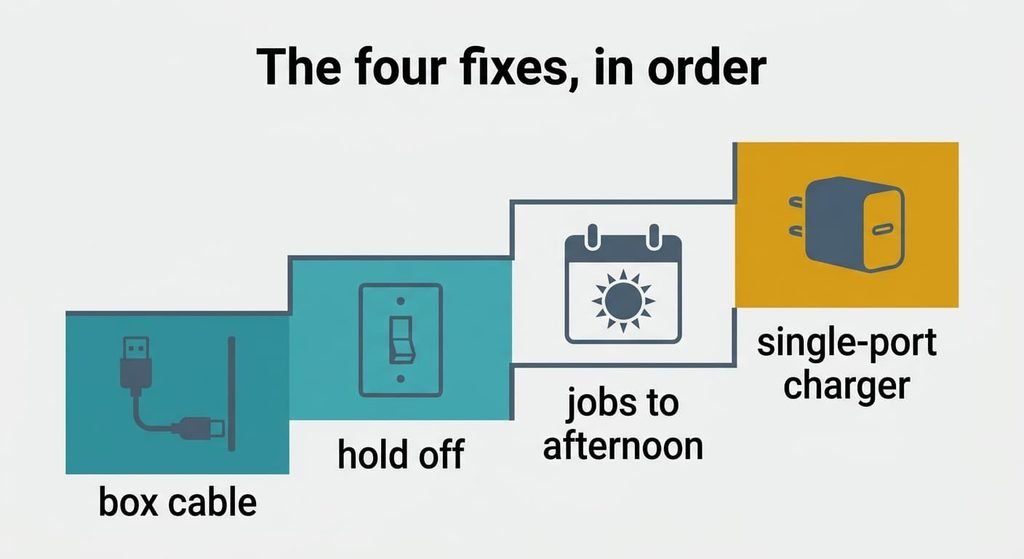
The four fixes, in order
Any one cause below can make a phone charge slowly overnight alone, so change one thing at a time and repeat the half-hour test.
Plugging the box cable straight into the wall charger restores the ceiling. It takes a minute. Delivered power rises from 5 W to 15 W, and with the night’s jobs still running the net becomes 10.5 W. Getting from 15% to 80% needs 11.2 Wh, which now takes about 64 minutes. A 3 m cable drops more voltage than a 1 m one, so a short, thick cable keeps the offer high. You lose the long cable you liked, and the phone has to sit near the socket.
Turning off the hold at 80% answers the phone’s own schedule. One battery-settings switch does it, and it takes under a minute. With the hold on, the phone parks at 80% and finishes in the last hour or two before your usual alarm. With it off, an 11 pm bedtime ends with a full phone by about 1 am. The price is hours spent at full charge, which ages the battery sooner. Keep the hold if your alarm is steady. Turn it off for a week when you need a full phone at 4 am.
Moving backups and updates to the afternoon removes the overnight draw. It needs a few schedule settings and some patience. On a 5 W chain the net rises from 0.5 W to 4.5 W. 80% then arrives in 2.5 hours, and the last stretch fits easily in the night. Pick a time when the phone sits on the charger anyway, late afternoon say. Set large downloads to Wi-Fi only. The cost is a backup that no longer finishes while you sleep.
Replacing a shared-output charger with a single-port one lifts the cap. Many multi-port chargers split a fixed total between sockets once both are in use. A 20 W unit may give each phone 10 W, so the net falls to 9.5 W before any night jobs. Check the label: a lower total for both ports in use than for one port means the unit shares. A single-port unit costs one purchase and gives up a spare socket at the bedside.
If none of that worked
Evidence beats guessing here.
Log the level at bedtime and at the alarm for three nights, plus one glance at 3 am. Note the cable and the socket you used. Try the phone on a friend’s charger and cable for one night, with airplane mode on. If a friend’s kit doesn’t make a phone charge slowly overnight, the fault sits in yours. Check the charger’s label for the output at each socket, and count what else shares the strip.
Ask a repair shop to look at the port, since pocket lint can pack the socket and stop the plug from seating. Ask them to read the battery’s reported capacity as well. If they suggest a factory reset, copy your photos off the phone first, because a reset erases everything that isn’t backed up. Photograph the charger label and the port before you go, so the technician starts with facts.
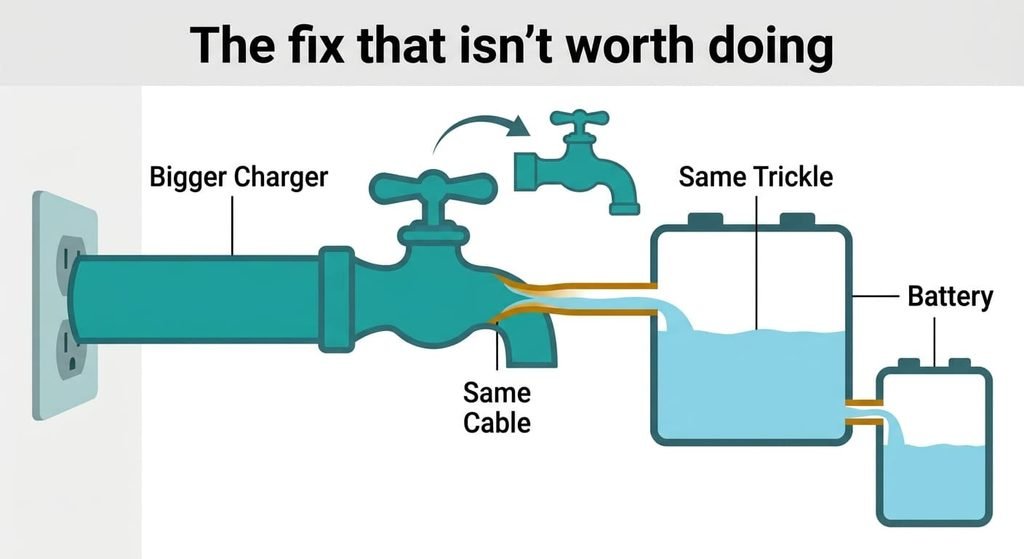
The fix that isn’t worth doing
A higher-wattage charger is the standard advice, and the chain usually ignores it. A 65 W charger on a cable that carries 7.5 W still delivers 7.5 W. Even on a sound chain, doubling from 15 W to 30 W cuts the climb from 15% to 80% from 46.5 minutes to 22.9. That saves 24 minutes of an 8-hour night, or 5%, and the final stretch takes the same time on either.
A bigger charger raises a ceiling nobody was touching. The cable is the part that decides it, because it carries the current the charger offers. A rated cable is the cheaper part.
I’d keep the money and fix the cable and the schedule first. Both sit lower in the chain, so they change the overnight result far more than a bigger number on the box.
What makes a phone charge slowly overnight is nearly always the chain below the charger and the work the phone does at night. Start with the half-hour test and the box cable, then move the heavy jobs to the afternoon if the number stays low. A bigger charger can wait. Repeat the test between changes, and stop once the alarm finds a full phone.
Questions readers keep asking
Is a slow overnight charge fixable at home?
Usually, yes. Swapping in the cable from the box and moving backups to the afternoon are both free. Between them they covered the whole shortfall in the example. Only a replacement charger costs anything, and it’s the last resort. Test after each change.
Why doesn’t a fast charger give a faster result?
The charger only sets the top speed on offer. A thin cable or a shared socket can cut that to 5 W, and overnight work subtracts from what remains. In the example, 5 W minus 4.5 W of draw left 0.5 W, so the battery gained only 23 points.
What points to a failing port or battery?
Try the half-hour test with the box cable plugged into the wall and airplane mode on. A gain under 5 points clears the chain and the night jobs. At that stage a lint-packed port or a worn battery is likelier, and a technician can test both.