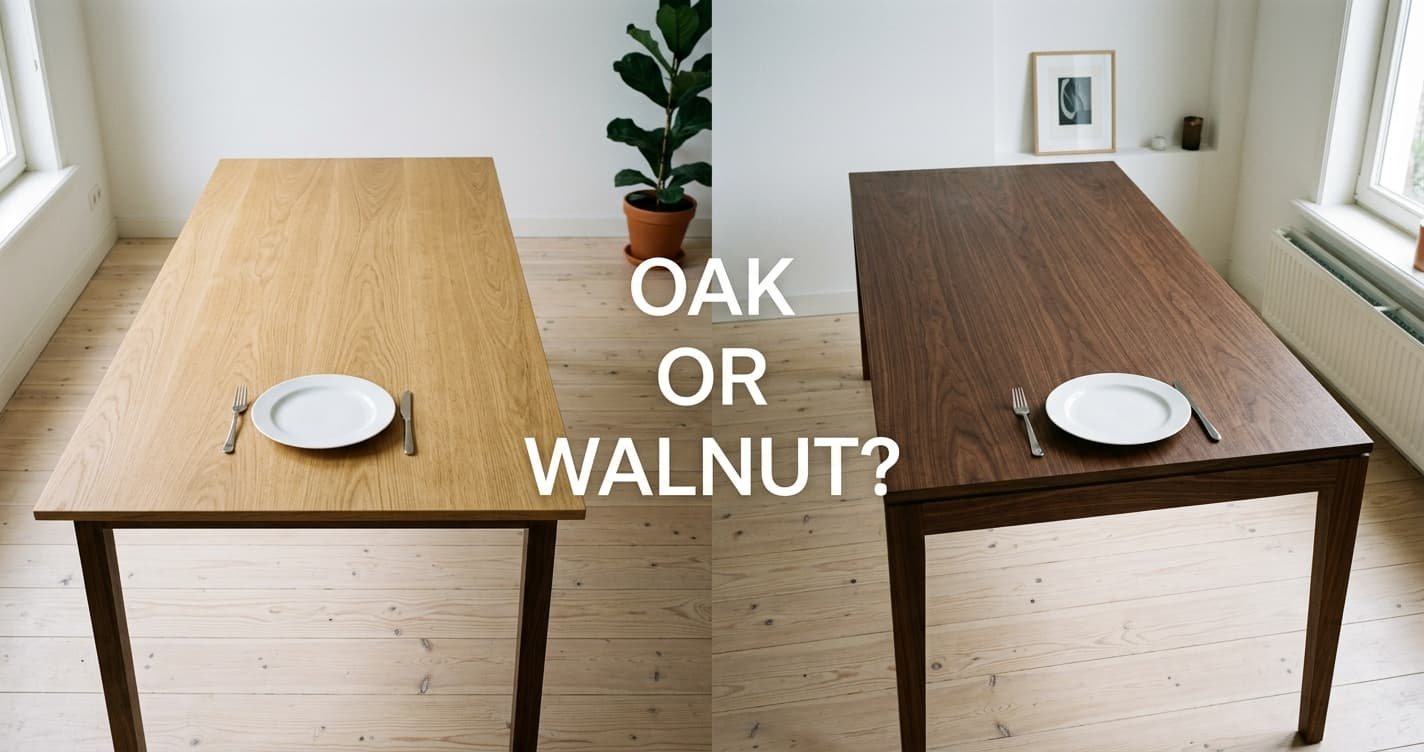
Which veneer hides a year of family dinners better? In the oak vs walnut veneer for a dining table contest, oak does. Walnut suits a calmer household in a room without direct sun. The deciding property is damage contrast, the jump in lightness between a worn spot and the surface around it.
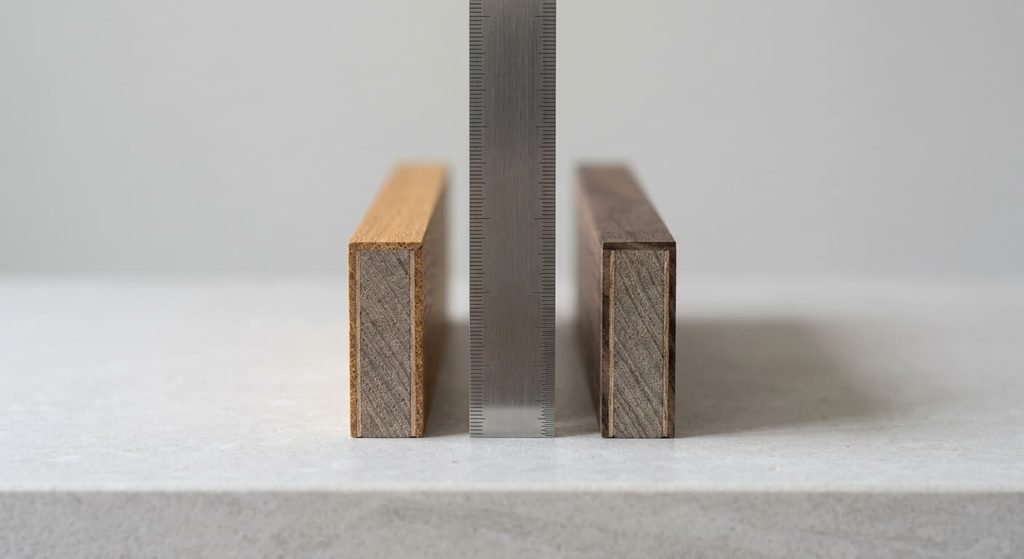
Every figure here assumes a Dutch table of 200 × 95 cm, with veneer 0.6 mm thick glued to a 19 mm board and the same finish on both woods. Round numbers stand in for readings, so hold a sample of each against your own table in your own light before you order.
The one property that decides oak vs walnut veneer for a dining table
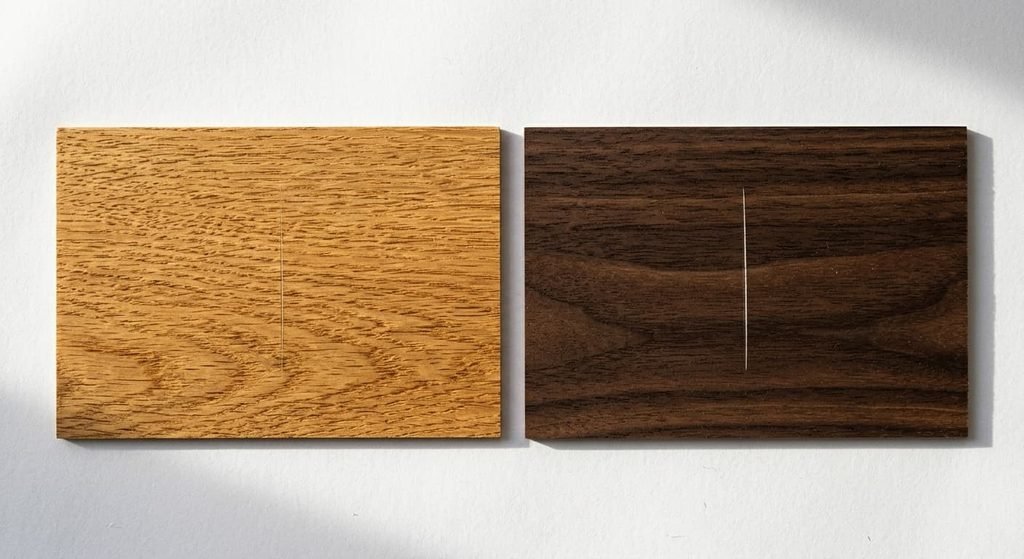
A veneer is a slice of wood 0.6 mm thick, and the finish on top of it is thinner still, around 0.05 mm. Plates and cutlery, or a child’s pencil, go through that film long before they reach the board. What you see afterwards depends on one thing: a scratch shows by how much lighter it is than the surface around it. Lightness runs from 0 for black to 100 for white. A typical oiled oak sits near 65, and the raw wood under the finish sits near 75, so a scratch jumps about 10. A typical oiled walnut sits near 35, with raw wood near 55, so its scratch jumps about 20. The eye notices a change of 2 or 3 in good light, so both woods show damage, and walnut shows it twice as strongly. That doubling is the whole story, and it’s why this article never ranks hardness.
Where the damage falls decides how often you see it. Six places of 60 × 40 cm cover 1.44 m² of a top of 1.9 m², which is 76%. Three quarters of the table meets a plate every day.
The hardness figure quoted in shops, with oak about a third harder than walnut, matters far less than it sounds. The 19 mm board under the veneer takes the dents.
Head to head
| Property | Oak veneer | Walnut veneer |
|---|---|---|
| Scratch through the finish | Lightness jump of about 10, so a scratch fades into the grain | Jump of about 20, so it reads twice as strongly across a table |
| Grain and pores | Open pores that hold crumbs, so they need a weekly brush | Fine, closed grain that wipes clean in one pass of a cloth |
| Light over the years | Tends to amber a little | Tends to pale and grey in direct sun |
| Dents on a 0.6 mm veneer | Set by the 19 mm board, so equal | Set by the 19 mm board, so equal |
| Crumbs and dust | Pale crumbs vanish into the grain | Pale dust and crumbs stand out |
| Touch-up of a scratch | A wax filler a shade off still hides in the grain | A filler must match closely or it leaves a halo |
| Room for a refinish | One light sand of 0.2 mm | One light sand of 0.2 mm |
The dents row is the one that startles people. The hardness gap shops quote drops out once the wood is only 0.6 mm thick, because the board absorbs the knock. What separates the two is how the damage looks afterwards.
Where oak veneer beats walnut for a dining table
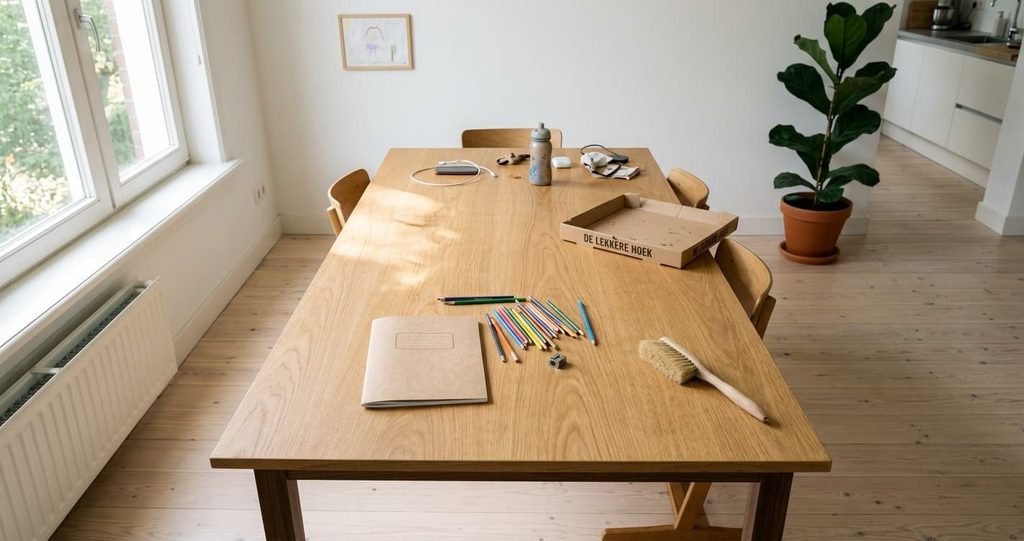
In the oak vs walnut veneer for a dining table choice, oak suits the table that gets used hard. Homework sits at one end and a pizza box at the other. A school bag gets dragged across the middle. Each scratch on oak jumps about 10 in lightness, half the walnut figure. The surface still looks even after a year of that.
Oak also forgives a sunny spot, and it doesn’t punish a lazy week. A table within 2 m of a south-facing window takes hours of direct light, and oak ambers slightly where walnut pales. It’s the unglamorous reason many households end up with oak: a scratch is cheaper and quicker to hide. A wax filler a shade off the colour sits unseen in the open grain, and a repair takes ten minutes.
The limit is the pores. Crumbs settle in them, and a soft brush along the grain clears them once a week. A pale film of flour, which is hard to see on oak at first, dulls an oak top faster than a wipe removes it. Oak holds up better under rough use, but you’ll have to brush it.
Where walnut veneer beats oak for a dining table
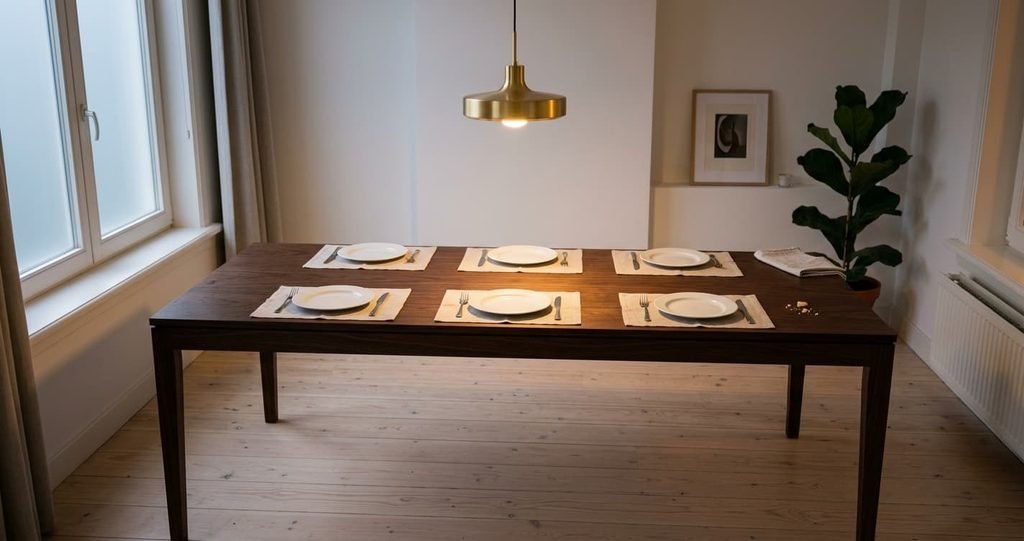
Walnut suits the table that mostly seats adults, where nobody’s bag lands on it. A dark top keeps its colour depth by lamplight, and a spill of coffee or red wine sits in a surface that’s already dark. The fine, closed grain wipes clean in one pass, with nothing to brush out of it.
The plain reason is the cloth. A damp cloth cleans walnut in seconds because the surface has almost no pores for crumbs to enter. Against a north wall, a table also keeps its tone, since light never reaches it directly. Any scratch through the finish does jump about 20 in lightness here, so a place mat under each plate matters.
The limits are dust and sun. Pale dust and crumbs show on a dark top the moment the light crosses it, and pet hair does too. In direct sun the rich brown pales and greys over the years. Walnut holds up well when the household treats the surface with care and the room keeps the sun off it.
Walnut rewards the household that takes care of it.
When neither is right
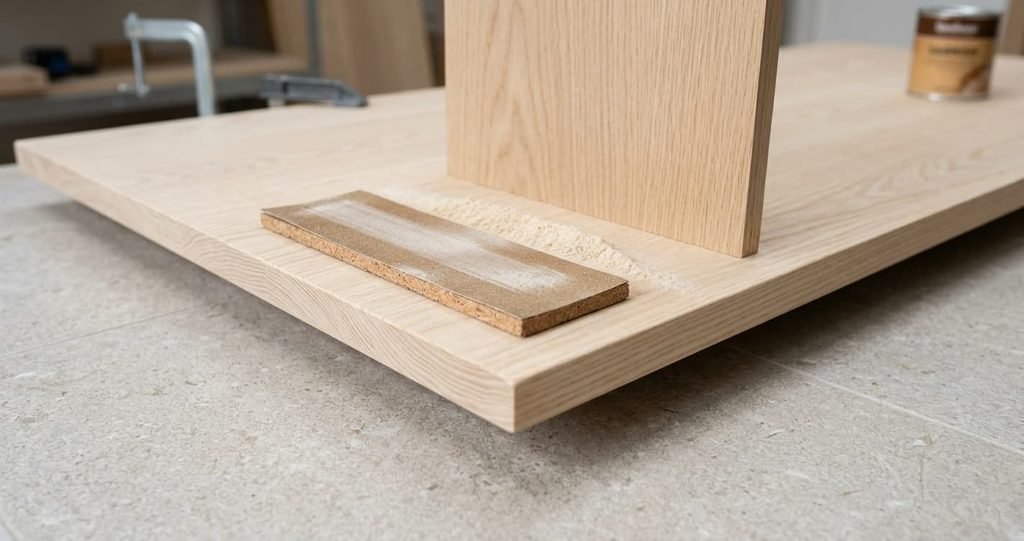
A solid timber top beats both for a table that gets hard daily use. Veneer of 0.6 mm allows one light sand of 0.2 mm before the board shows. Solid ash or beech 22 mm thick can lose 10 mm and still carry the load, which is 50 sands of 0.2 mm.
Solid wood never runs out of surface.
It costs more and weighs more, and it moves with the seasons across its width, so you’ll want a top built to allow that. If your current table is solid and only the finish is tired, keep it. A refinish costs far less than a new top. Choose this route when a household has young children, or when a table has to last twenty years. It sits outside the oak vs walnut veneer for a dining table choice. The question there is how damage looks, and a solid top lets you remove it.
How to decide in thirty seconds
If a child will do homework or crafts at the table, or the window stands within 2 m, take oak veneer. Then brush the pores once a week.
If only adults use it and the window faces north or sits beyond 2 m, take walnut veneer and add mats. Wipe it with a damp cloth after meals and expect dust to show.
Check the call with a coin. Drag its edge across a sample of each wood, then step back 1.5 m. The scratch you can still see from there is the one to avoid, and a sample costs far less than a table.
For oak vs walnut veneer for a dining table, the verdict follows the wear. With a sunny window and an active child, oak holds up longer because its scratches stay half as visible. In a quiet room that sees dinners at weekends only, walnut holds up well. It also wipes clean in one pass. Direct sun changes both woods slowly, and walnut shows the change sooner. Judge a sample in your own room.
Questions readers keep asking
Does walnut veneer scratch more easily than oak veneer?
They scratch about equally. The board and finish set the resistance. Walnut shows scratches more, since the pale wood beneath jumps about 20 in lightness against 10 for oak. A place mat under each plate removes most of the difference.
How do you clean an oak veneer dining table?
Wipe along the grain with a barely damp cloth and dry it straight away. Once a week, run a soft brush along the grain to clear crumbs from the open pores. Avoid soaking the surface. Water that reaches the 0.6 mm veneer edge can lift it, and a lifted edge won’t lie flat again.
Which veneer suits a dining table in a sunny room?
Oak. In direct light it ambers slightly. Walnut pales and greys over the years. A table within 2 m of a south-facing window takes hours of sun, so oak keeps its look longer. If you prefer walnut, move the table. A sheer curtain helps too.