Loudness has little to do with it. Timing lets a smart speaker hear you over the noise in a kitchen. Its microphones sit a few centimetres apart, so your voice reaches each one a fraction of a millisecond apart. The speaker lines those copies up until they add together. Noise from everywhere else arrives out of step and averages away.
This guide follows one spoken timer request through the whole chain, then marks the limits. It ends with a test for your own room. The sums assume an extractor fan at 62 dB and a speaker 2.5 m from you.
The short answer, and what it leaves out
A ring of six microphones records the room six times at once, and the speaker delays each copy until your voice lines up, so the voice reinforces itself while the noise averages out. That alignment is called beamforming, a way of listening harder in one direction by arranging timing alone. A second stage then recognises the phrase that wakes the device. Both stages run on the speaker itself, in a few milliseconds. A delay of a quarter second would make every request feel slow.
Two things hide inside that tidy account. The speaker has to learn where you are, and it learns that from your voice. That makes the first syllable the hardest to catch. The gain is also modest and fixed by arithmetic: six copies lift your voice 7.8 dB above uncorrelated noise, which is 10 × log10 of 6. A fan only 4 dB louder than you falls inside that margin, while a blender 20 dB louder would still win.
The speaker also hears itself, and any music it plays reaches the microphones and has to be subtracted first.
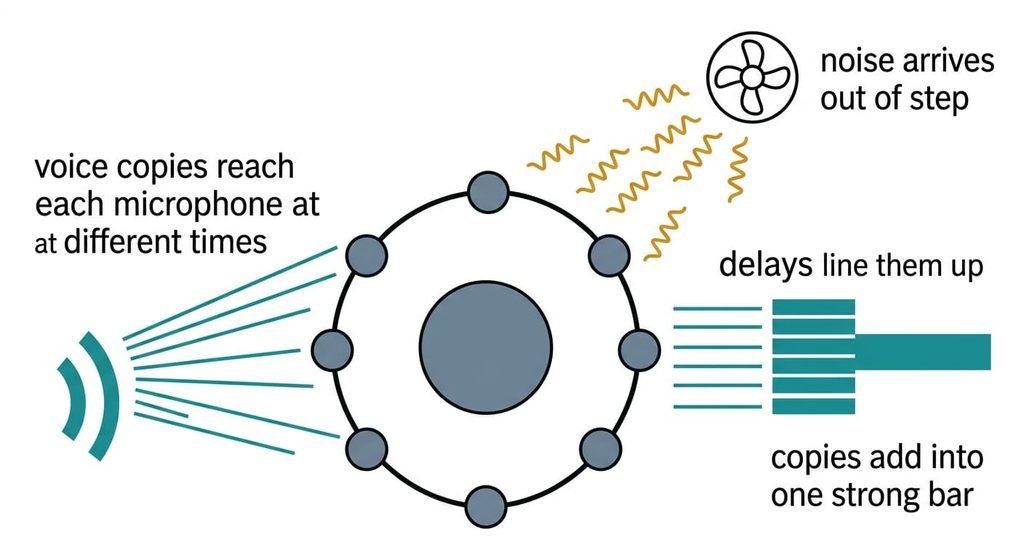
How it lets a smart speaker hear you over the noise, step by step
Take one request: you say “hey speaker, set a timer for ten minutes” from 2.5 m away. The fan measures 62 dB at the speaker. Your raised voice measures 66 dB at 1 m. Distance costs 20 × log10 of 2.5, or 8 dB, so it arrives at 58 dB. You start 4 dB under the fan, a gap that a single microphone could never close.
The first step removes the speaker’s own sound. Music is playing quietly, and the speaker knows the exact signal it sends to its driver. A filter learns how that sound reaches the microphones through the room, including bounces off tiles that last about 0.6 s. At 48,000 samples a second, that window spans 28,800 samples. The filter subtracts its prediction and leaves the fan plus you.
Next, the speaker finds you. The six microphones sit on a ring 8 cm across. Sound crosses the whole ring in at most 0.08 ÷ 343 = 233 µs, about 11 samples. For each of a dozen candidate bearings, the speaker shifts every copy by the delays that bearing would produce, then adds the copies. It scores each sum for speech-like energy. The bearing with the peak score is where you stand.
Then it commits to that bearing. Your voice copies line up and add up to 6 times the amplitude. The fan reaches the microphones in random alignment, so it adds up to only the square root of 6, or 2.4 times. The net gain is 7.8 dB, which moves you from 4 dB under the fan to 3.8 dB over it.
Last, a small recogniser on the device compares about a second of this cleaned signal with the wake phrase and scores it above its trigger line. The speaker keeps recording until you pause, then passes that clean recording on to be understood. The timer starts, and the speaker answers with a confirmation. That reply is where its own volume has to rise above the fan, because nothing changed in the air.
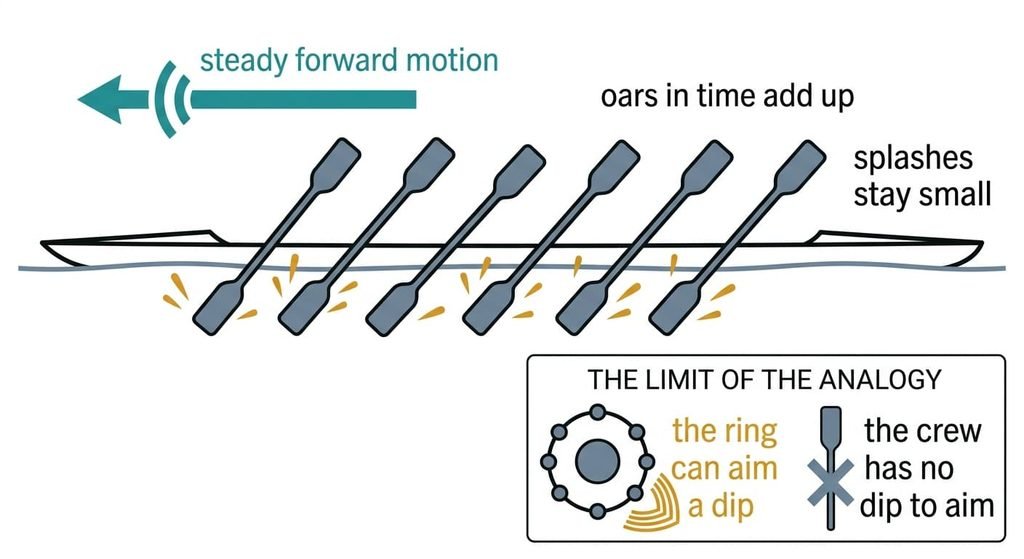
The analogy, and where it breaks
A rowing crew makes the point. Eight rowers who pull in time move the boat eight times as far per stroke as one rower. The random splashes between strokes never line up, so they stay small. The coxswain’s call is the timing, and the speaker’s delays do the same job for copies of your voice. A late oar is a delayed copy. The same idea lets a smart speaker hear you over the noise in a kitchen.
The comparison breaks in two places. Rowers can only add, whereas the array can also steer a dip toward one direction, which has no rowing counterpart. And the crew keeps one rhythm for a whole race. Your speaker re-times itself whenever you turn from the hob to the sink.
The crew has no dip to aim.
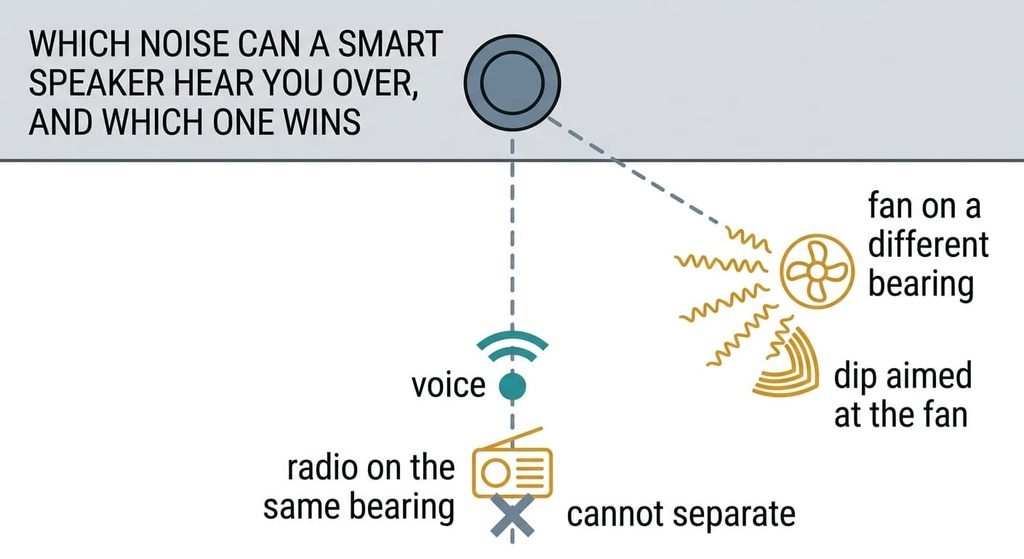
Which noise can a smart speaker hear you over, and which one wins
Most people miss one limit: the array can’t separate sounds that come from the same bearing, because their timing pattern is identical. A radio on the counter right behind you sits on your bearing. So does a television in an open-plan room when you face it. The speaker can aim a dip at the fan or the radio, but a dip aimed at the radio would also swallow you.
Two voices at once get the same treatment. The array favours the bearing that scores higher, and it can’t tell who is talking. Walls and fridge doors block the straight path, and then your voice reaches the ring only as bounces from other bearings. In a tiled room those bounces last about 0.6 s and look like extra noise sources. The array then spends part of its gain on cleaning up its own mess.
What people get wrong about kitchen hearing
One belief says that more microphones always hear better. It forms because a count is easy to print on a box. The gain follows 10 × log10 of the count, so going from 6 to 12 adds only 3.0 dB. Placement and spacing matter as much as the number.
Another belief says that speaking up helps a smart speaker hear you over the noise. It forms because shouting works across a room full of people. A speaker’s phrase model was learned from ordinary speech, and shouting changes the sound of the voice. Halving the distance from 2.5 m to 1.25 m adds 6 dB with no change in tone.
A third belief says the speaker cancels the fan the way noise-cancelling headphones do. That comes from headphone marketing. The array works on its own recording and leaves the air untouched. The reply still has to be loud enough to beat the fan.
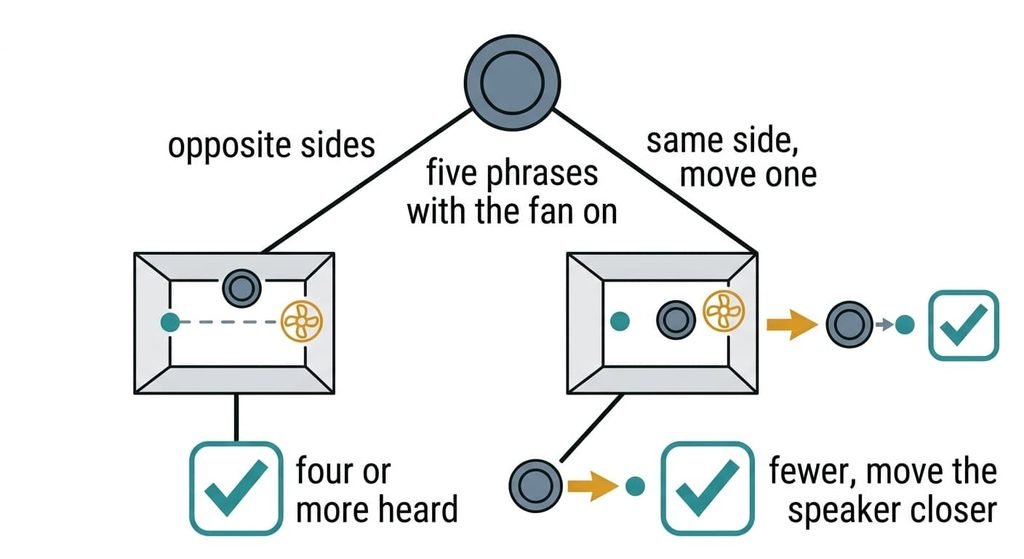
How to tell whether the noise in your kitchen will beat the speaker
Pick the position first: keep the loudest noise and your usual standing spot on opposite sides of the speaker. That gives the array the widest angle to work with. If both sit on the same side, move one of them. Then run a trial: switch the fan on, speak the phrase at normal volume from your usual spot, and repeat it five times. Fewer than four successes means you should move the speaker toward you. From 2.5 m to 1.5 m gains 4.4 dB, which is more than half of what the whole ring adds over one microphone. Keep this trial for a day when the fan runs, because a quiet kitchen proves nothing.
Delay and sum is the idea that lets a smart speaker hear you over the noise in a kitchen. The ring lifts your voice 7.8 dB over noise from all around it, and a dip can be aimed at one steady source. The limit to remember is direction. Anything on your bearing is treated as part of you, so place the speaker with that in mind before you buy anything extra for the counter.
Questions readers keep asking
Can a smart speaker hear you over a running dishwasher?
Usually, if the dishwasher isn’t on your bearing. A dishwasher is steady, so the array can aim a dip at it. A blender or a sudden clatter is harder, because its level jumps past the 7.8 dB the ring adds. Wait for a pause in that case.
Does a noisy kitchen need a speaker with many microphones?
Rarely. Gain follows 10 × log10 of the count, so each doubling adds only 3.0 dB. Placement helps more: a speaker 1.5 m from you gains 4.4 dB over one at 2.5 m. That costs nothing to try, and it works with any ring.
Is a smart speaker better than a phone at hearing you in a kitchen?
Often, in this one job. A speaker has several microphones on a ring designed for beamforming, while a phone has two or three spaced for calls held to your face. At arm’s length a phone does fine, and at 2.5 m the ring wins.