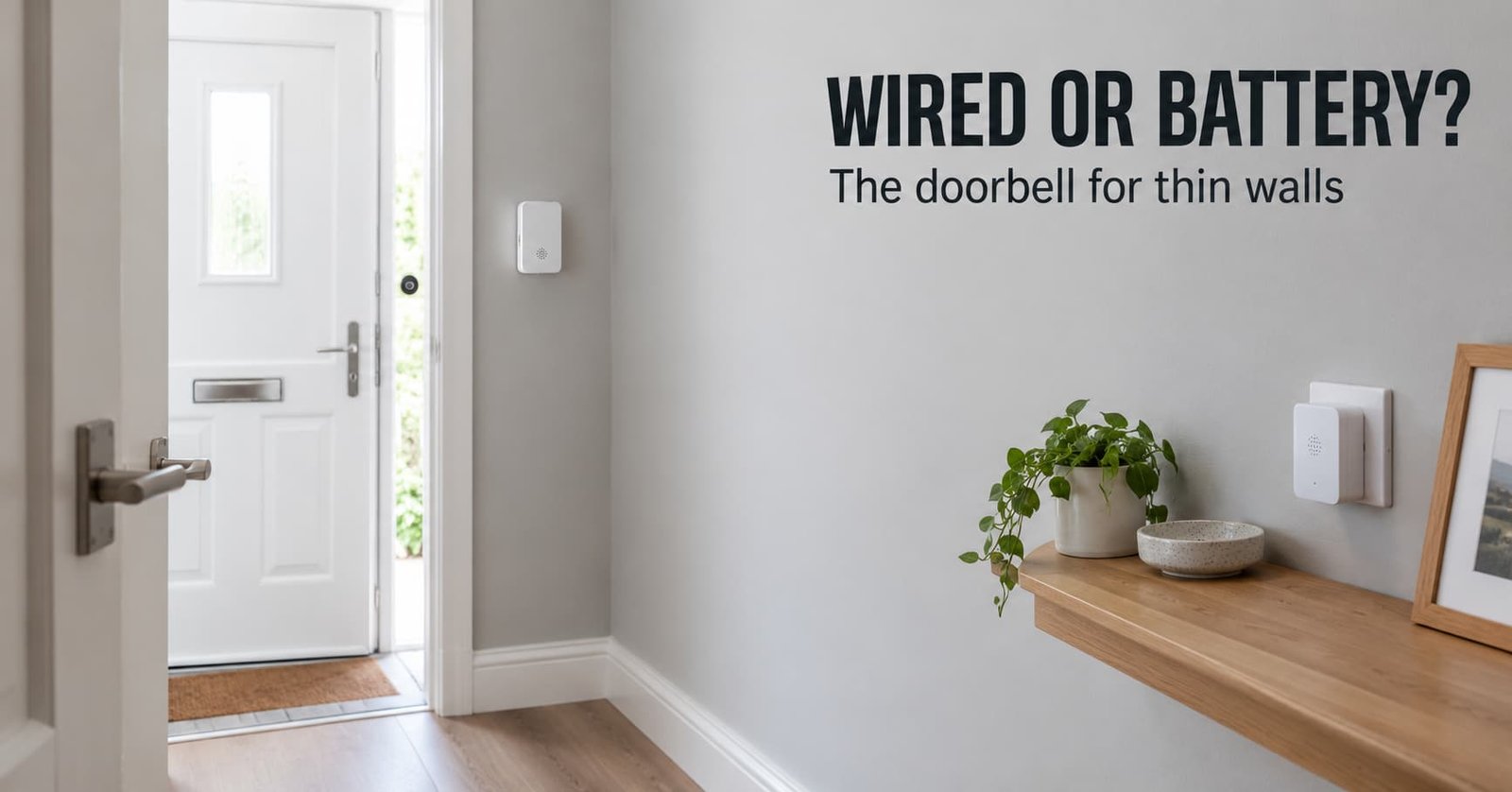
The neighbour knocks to say your doorbell is too loud, and you had no idea it carried. With a doorbell for a flat with thin walls, wired wins when the chime already hangs 3.2 m or more from the shared wall. Battery wins when it doesn’t. The deciding property is how loud each ring is on the other side.
The sums assume a UK flat, a chime that measures 80 dB at 1 m and a thin partition that cuts 35 dB. Those are round values, so take a tape measure to your own hall. Prices and brands stay out, because both date fast.
The one property that decides a doorbell for a flat with thin walls
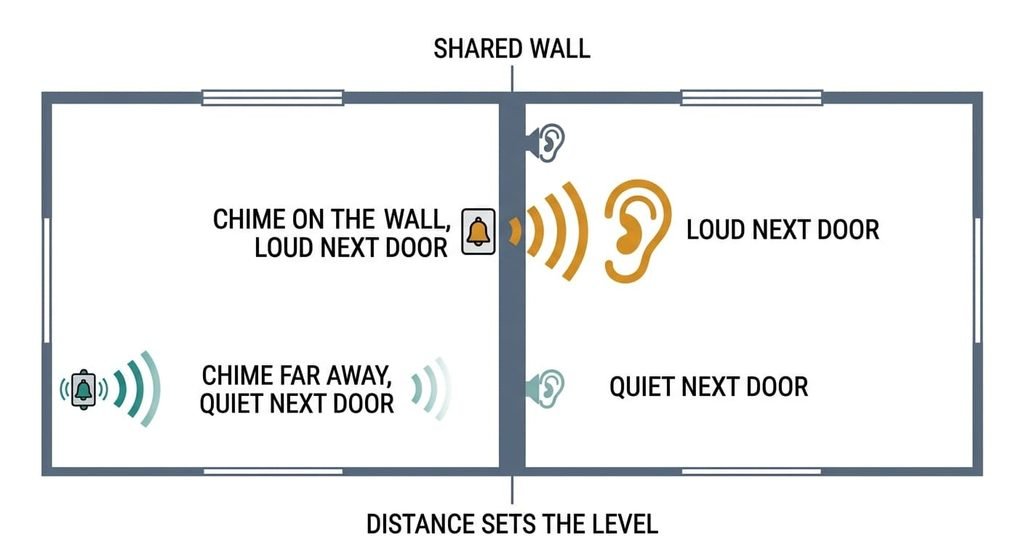
Sound leaks through a thin wall, so the chime’s distance from the shared wall sets how loud each ring is next door. Level drops 6 dB for every doubling of distance, and the partition then removes about 35 dB. Hang the chime 0.5 m from the wall and it puts 86 dB against it, which leaves 51 dB on the neighbour’s side. Hang it 3.2 m away and it reaches the wall at 70 dB, which leaves 35 dB, about the level of a quiet room.
Distance did that. Moving the chime from 0.5 m to 3.2 m lowered the neighbour’s level by 16 dB.
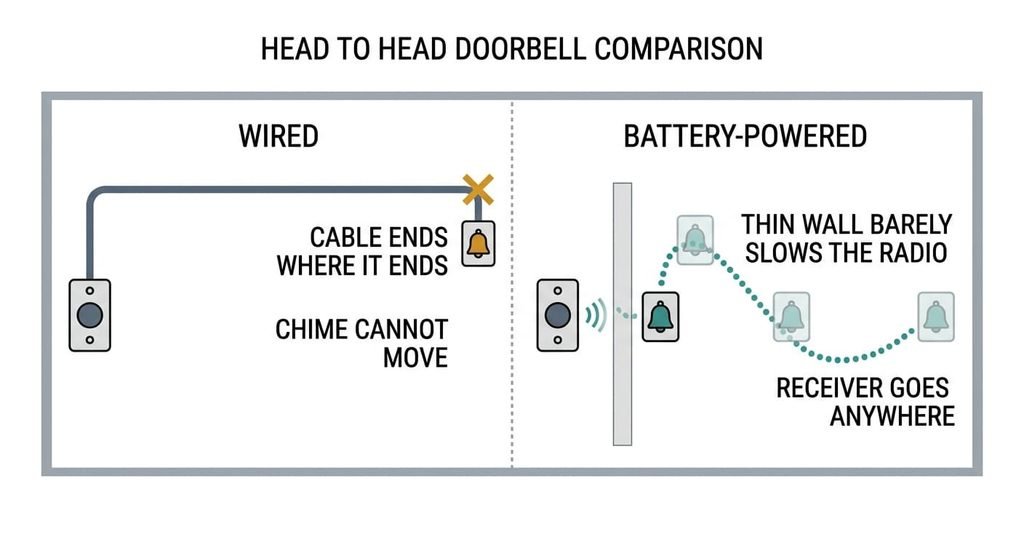
Both kits use the same chime. The wire or the radio changes one thing only: where the chime can go. A cable fixes the chime where the cable ends. A radio link lets you carry it across the flat. Everything else in this comparison hangs off that choice of position. A cable gives you one position for the life of the set, while a radio gives you as many tries as you want. The dial is a second lever, and the two combine. Volume matters as much, since 10 dB off a dial cuts the distance you need from 3.2 m to 1 m.
Head to head
| Question | Wired doorbell | Battery doorbell |
|---|---|---|
| Where the chime can sit | Where the cable ends, fixed once it’s behind the plasterboard | Any shelf or socket within radio range of the button |
| How the button reaches the chime | A cable, with no signal to interfere with | A radio link that thin partitions barely slow |
| What fails without a warning | A loose or cut cable joint somewhere in the wall | A flat cell in the button, which leaves it dead to a visitor |
| What drains the cell | Not applicable | Idle draw, with presses a small extra |
| Moving the chime later | Re-run the cable, usually with the landlord’s consent | Pick the receiver up and plug it in elsewhere |
| Leaving a rented flat | A cable and fixing holes stay behind | Everything comes with you in a bag |
| A metal-skinned front door | No effect | Can block the radio |
The radio row is the one that catches people out. A thin-walled flat is the easy case for the signal and the hard case for the sound. The partition that lets your chime through to the neighbour hardly slows the button’s radio at all. Range is never the weak point in a flat like this.
Where a wired doorbell wins in a flat with thin walls
Wired is the right doorbell for a flat with thin walls when the chime already hangs far from the shared wall. Say the chime hangs 4 m from the shared wall. It reaches the wall at 68 dB, and 33 dB gets through. Nothing more is needed.
It wins on a plain reason: there’s nothing to look after. The button has no cell to run flat on a cold February morning. No receiver needs a socket or a battery either. A wired set rings the same on the first day and the thousandth.
It also pulls ahead when the chime has a volume dial. Turning 10 dB off brings the safe distance down to 1 m, so a chime 1.5 m from the wall is enough. That rescues many halls that look too short.
The limit is position. Once the cable is behind the plasterboard, the chime stays where it ends. If it hangs on the shared wall, moving it means a new cable run. In a rented flat that also means asking the landlord.
Where a battery doorbell wins in a flat with thin walls
Battery is the right doorbell for a flat with thin walls when the chime sits on the shared wall, or when no cable runs to it. The receiver can go in a kitchen 5 m from the wall. There it reaches the partition at 66 dB and lets 31 dB through. That’s 20 dB quieter than the 51 dB from a chime on the wall.
It wins on a plain reason: it leaves no trace. You fit it with no drilling, and it leaves with you when the tenancy ends. A complaint costs you seconds: move the receiver.
Press count hardly matters to the cell. Take a coin cell of 220 mAh and an idle draw of 25 µA. Idle draw alone lasts 220 ÷ 0.025 = 8,800 hours, or about a year. A press costs 0.0007 mAh, so twenty a day add about 5 mAh over the year, or 2% of the cell.
The limit is the silent failure. A flat cell leaves a visitor pressing a dead button, so note a replacement date. A metal-skinned front door can block the radio, so ring once from the corridor.
When neither is right
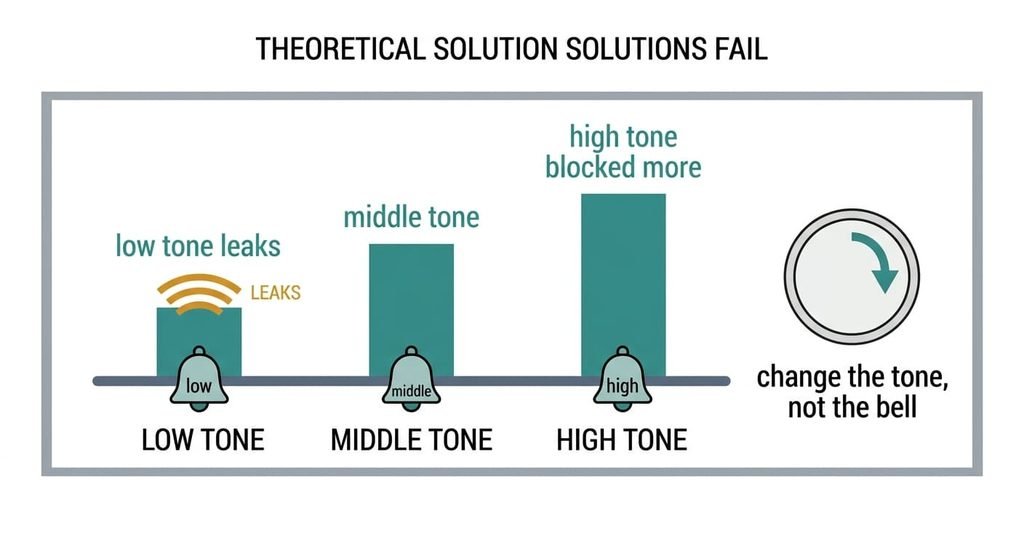
Changing the tone instead of the doorbell works when you already own a chime that works. Thin partitions let low notes through more easily than high ones, because the loss climbs about 6 dB for each doubling of pitch until it reaches roughly 2 kHz. A tone near 1 kHz loses about 12 dB more than one near 250 Hz, two octaves lower.
A tone is a free fix.
Many chimes have a selector on the back, so the change costs nothing. Take the chime that hangs 0.5 m from the shared wall, which gave 51 dB. Switching to a tone two octaves higher takes it to about 39 dB, close to the 35 dB target, with the doorbell untouched. The limit is that a sharper tone sounds sharper in your hall too. The real wall also departs from the ideal near its resonant pitch. Treat 12 dB as a ceiling and listen from next door’s side if the neighbour will help.
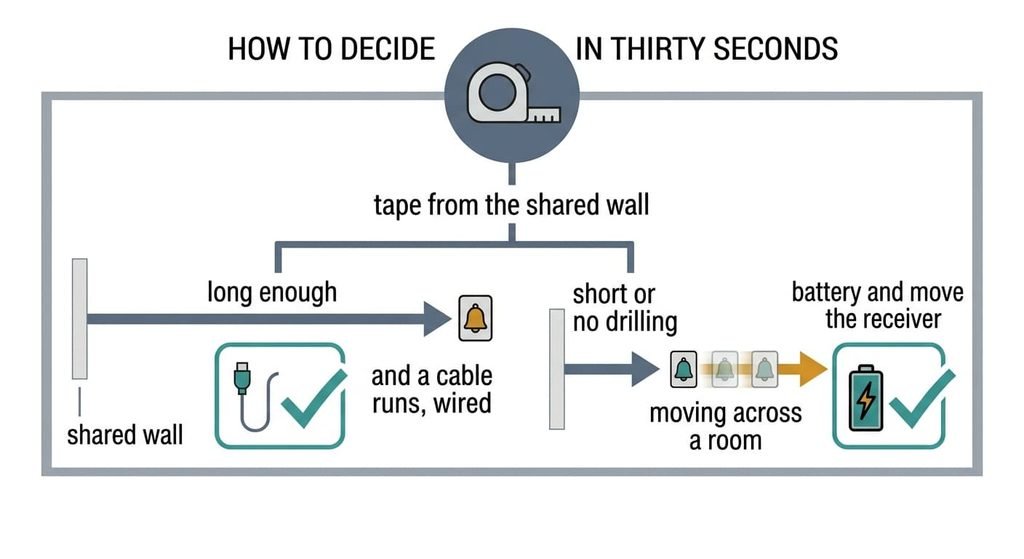
How to decide in thirty seconds
If a tape from the shared wall to your existing chime reads 3.2 m or more and a cable already runs to it, take the wired doorbell.
If it reads less, or the landlord rules out drilling, take the battery doorbell. Set the receiver across the flat from the wall. Then ring from the corridor and listen from the hall. Five minutes with a tape and the lease tell you which branch you’re in.
A tape measure and two minutes give you the answer. Keep the tone and the dial in reserve, since each takes a few seconds and costs nothing. Use them before you buy a second unit.
The right doorbell for a flat with thin walls is the one whose chime sits far from the shared wall. Wired holds the position steady once it’s right, while battery lets you put it right in the first place. Distance carries the verdict, so measure it before you order anything. A figure under 3.2 m is a reason to move the chime, never a reason to live with the complaints.
Questions readers keep asking
How long does a battery doorbell button last?
About a year on a small coin cell, assuming a low idle draw. A press costs very little, so a busy door barely changes the figure; 20 presses a day add roughly 2%. Cold weather and the cell itself shift the number, so note a replacement date.
Can a wireless doorbell signal pass through thin walls?
Yes. A thin partition slows a radio link by a few decibels at most, so range is rarely the issue. The front door matters more: a metal skin or foil layer can block the signal. Ring once from the corridor, with the receiver where you want it.
Is a wired doorbell worth the effort in a rented flat?
Only if a cable already runs to a chime that hangs 3.2 m or more from the shared wall. Otherwise the drilling and the landlord’s consent outweigh the benefit, and so does the new run. A battery set gives the same distance with no holes, and it moves with you.