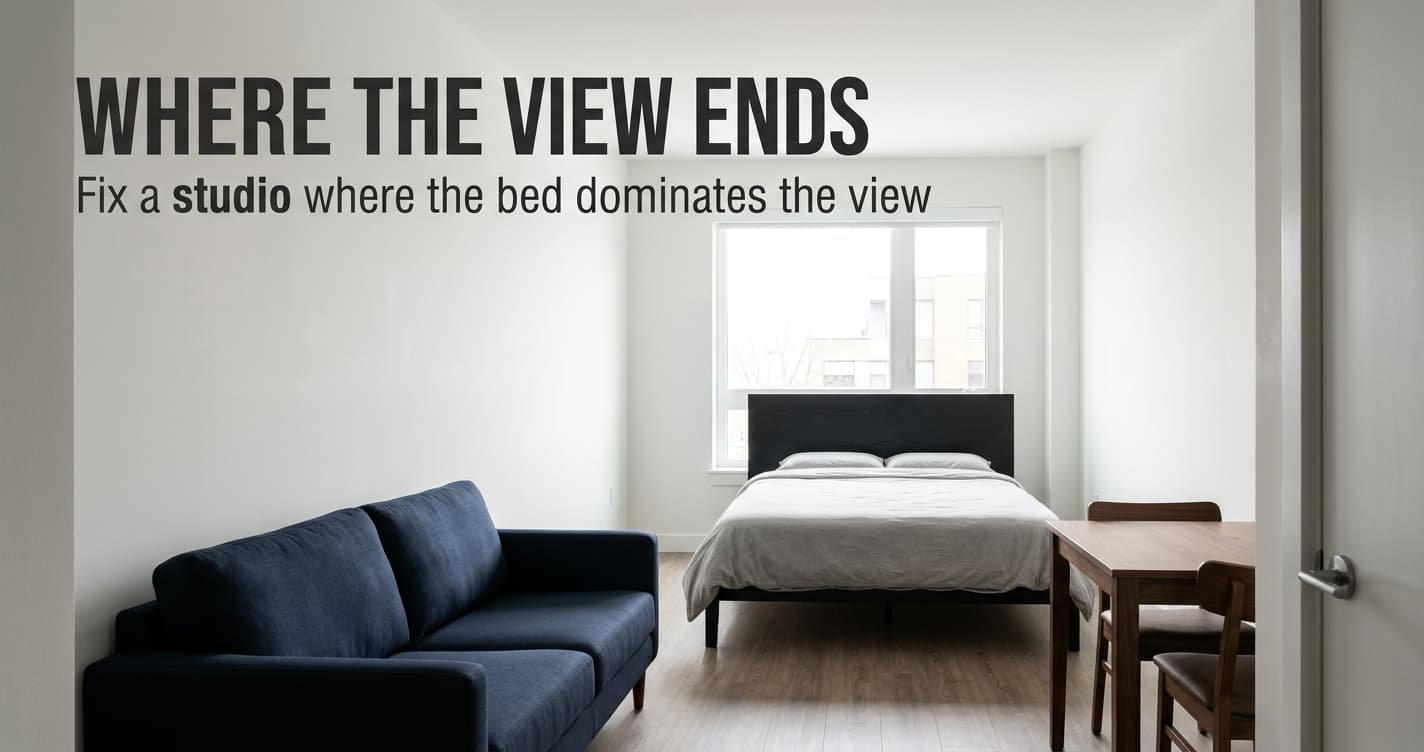
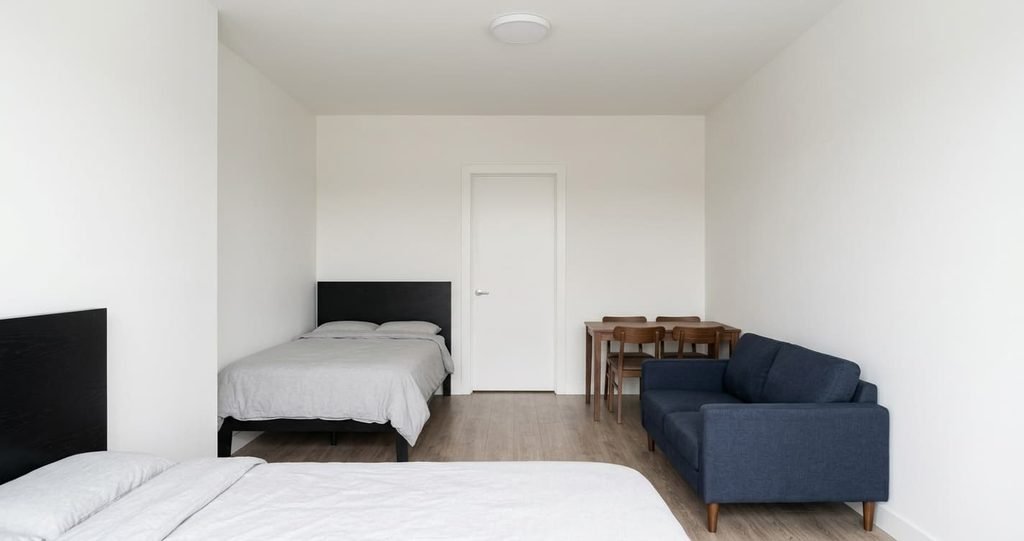
You open the door and see the bed first. The table and the sofa read like props around it. That’s what it means when the bed dominates the view, and the cause is mostly where the bed stands. The fastest fix costs nothing: slide it off the line between the door and the window.
This studio measures 360 by 590 cm (21.2 m²) and stands 250 cm high, in the Netherlands. The door and the window sit in the two short walls on one centre line. Four fixes follow in order of cost. After them come the parts of the room that no fix can change.
Why the bed dominates the view of a studio
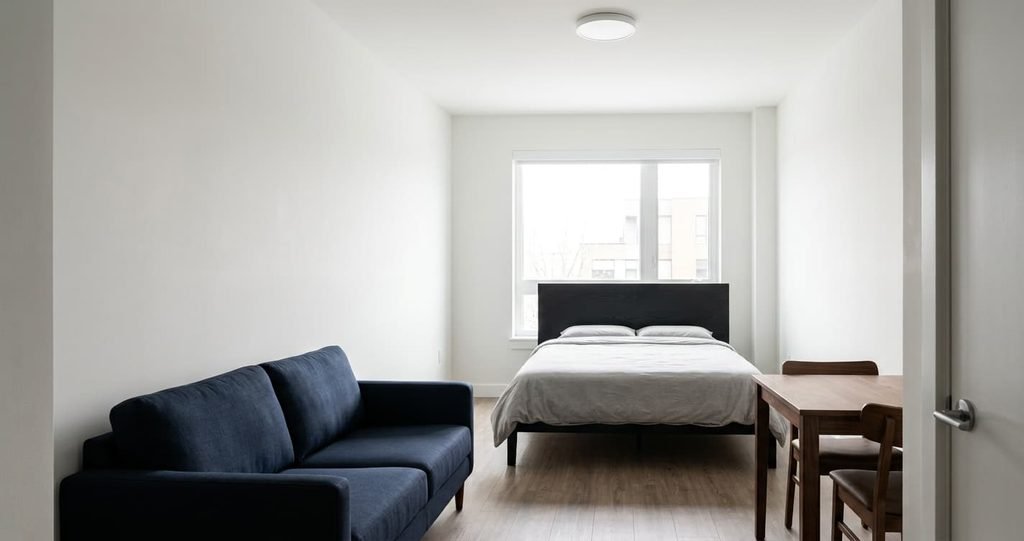
Your eye doesn’t scan a room evenly. From the doorway, at an eye height of 160 cm, it runs down the long line of the room to wherever the view ends and settles on the most prominent shape there. Four cues decide which shape wins. A bed collects all of them in a small studio, which is why it ends the view and leads the room on every cue.
The first cue is position. A bed with its head under the window ends the line of sight, and whatever ends a line gets looked at first. The second is outline height. A headboard 110 cm tall is the highest piece in the lower half of the view, 25 cm above a sofa back at 85 cm.
The third is visible mass. A base that sits on the floor reads as one solid block, while a frame on legs lets the eye see floor beneath it. The fourth is brightness. The eye goes to the lightest large rectangle, and white bedding under the ceiling light is usually that.
Each fix below breaks one cue.
Which version of the bed and view problem you have
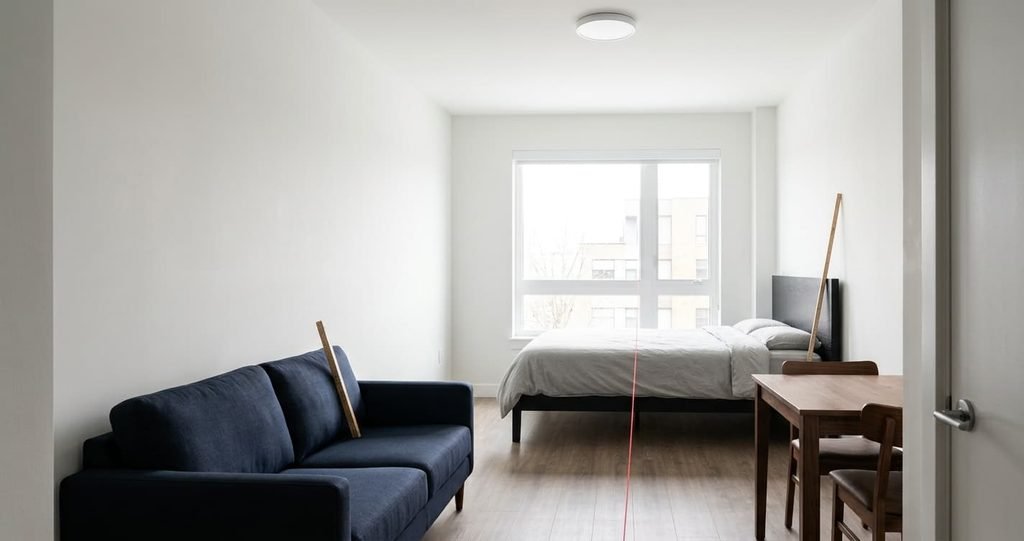
Run these four checks before you move anything. They need a tape measure and a short morning. Each one isolates a single cue, so the result tells you which fixes to skip.
– Stretch a string from the centre of the door to the centre of the window. If the bed or its headboard crosses it, position is a cue.
– Measure the top of the headboard and the top of the sofa back. A headboard more than 20 cm taller than the sofa back makes height a cue.
– Slide a ruler under the base along the floor. A base that blocks it at once puts mass among your cues.
– Measure on the floor from the point under the ceiling light to the middle of the bed. Under 100 cm is a rough figure of mine for brightness being a cue.
Most studios fail two checks. Ranking the failures decides your order, because a fix aimed at a cue that passed buys you nothing. Legs bought for a base that was never heavy are money spent on the wrong cue. Re-run the string and the tape after each fix.
The fixes, in order, for a bed that dominates a studio
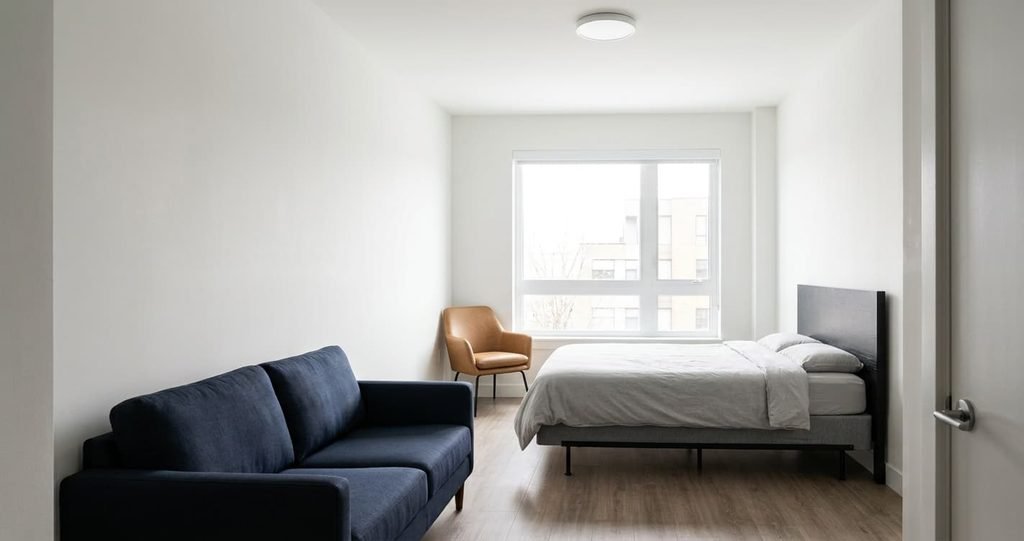
Move the bed off the line between the door and the window. This breaks the position cue, and it costs nothing. Put the bed along a long wall, with its head against the end wall, and put an armchair of 80 by 85 cm in front of the window instead. The view now ends on a chair and a window. It leaves the bed’s size and brightness alone, so the other cues remain and the bed dominates the view a little less. It also needs a long wall without a radiator or a door swing along 200 cm of its length.
Take the headboard down, or swap it for a low one. This breaks the height cue. A headboard that ends 30 cm above the mattress top reaches about 85 cm from the floor, level with the sofa back, so the bed stops being the highest outline. Removing a freestanding or bolted headboard costs nothing. A replacement is a small purchase. The limit is that your pillows then lean on the wall, and it won’t change how big or bright the bed looks.
Lift the base on legs 15 to 20 cm tall. This breaks the mass cue by showing floor under the bed. Seen from the doorway, 370 cm away, legs of 20 cm show about 53 cm of floor under the foot end, and legs of 10 cm show about 25 cm. It is a purchase, once you’ve checked that the base takes legs. The limit is storage. Boxes pushed under the frame fill the gap and the mass returns, and the mattress sits higher by the length of the legs.
Move the ceiling light’s point away from over the bed. This breaks the brightness cue, and it needs an electrician. The light falls on the white cover from above, so moving the cable run to the middle of the room lights the floor and the table more than the bed. What I can’t tell from here is whether your ceiling allows a new route for the cable, so ask before you plan around it. The limit is daylight. A move of the lamp does nothing about the window behind the bed.
What this room won’t let you change
The door and the window share one centre line, and they stay there. That line is why the view has an end at all. The room is 360 cm wide, so a bed of 140 cm leaves 220 cm beside it, which is too little to put it out of sight from any point in the room. Along the 590 cm long wall, the bed takes 200 cm, about a third.
The 250 cm of height closes off one more route. A raised platform with a sitting area beneath it needs more than 250 cm in practice, so the bed stays on the floor and in the line of sight.
A studio has one volume of air and no wall to add. The bed is therefore always in view. Every fix lowers its rank among the pieces, and none removes it.
When the bed dominates the view of one room of 21.2 m², no fix can make it vanish.
The fix that doesn’t work
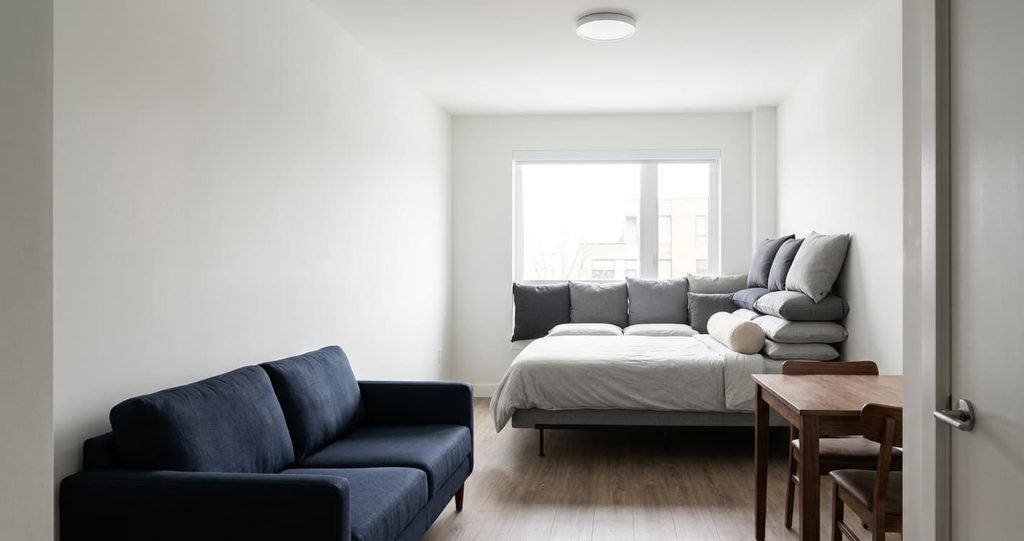
The remedy repeated most often is to dress the bed as a sofa, with a stack of cushions along the head. A bed that dominates the view gains nothing here, because stacking the bed with cushions to pass it off as a sofa feeds the height cue instead of answering it. A wall of cushions 40 cm high on a mattress top at 55 cm lifts the outline to 95 cm, which is 10 cm above the sofa back at 85 cm.
Nothing else has changed. The base still sits on the floor, the bed still ends the view, and the cover is still 140 by 200 cm of the lightest large surface. The cushions add volume at the very place where the eye already stops. A bed dressed in cushions stays a bed with a bigger outline. Photographs of the look are shot close up, but from the doorway it is only more bed.
The bed dominates the view because it ends the view and tops every other piece on four cues. Start by moving it off the door and window line, which is free and answers the position cue. Then lower the headboard, show the floor under the frame and move the light. What you get is a bed that is one object among several instead of the one that owns the view.
Questions readers keep asking
Is it possible to hide the bed in a studio?
Not in a single room of this size, and the fixes aren’t meant to. The bed always stays in view. What you can change is its rank, by moving it off the door and window line and lowering the headboard. Showing floor under the frame helps too.
How much do these fixes cost for a studio?
Two of the four fixes cost nothing: moving the bed and removing or lowering the headboard. Legs are a small purchase. Moving the ceiling light’s point is the one that needs an electrician, and the price depends on your ceiling.
Why does a white bed stand out so much in a studio?
White bedding is usually the lightest large rectangle in the room, and the eye goes to that first. A bed under the window also ends the line of sight. Both cues act at once, so changing the bedding alone helps less than moving the bed.