The usual complaint about a sharp-cornered sofa in a small living room is that its corner juts into the route across the floor. That explains why curved sofas are replacing sharp-cornered ones, and the shift is real, though smaller than the photographs suggest. Rounding the corners gains about 10 cm of passage. Curving the back loses 0.2 m² of floor. Act on it only when you’re replacing the sofa anyway.
The numbers use a Dutch living room of 320 by 400 cm, which is 12.8 m², and a sofa of 200 by 90 cm. They describe geometry rather than showrooms, so they stay true as the look moves on.
Where the curve came from
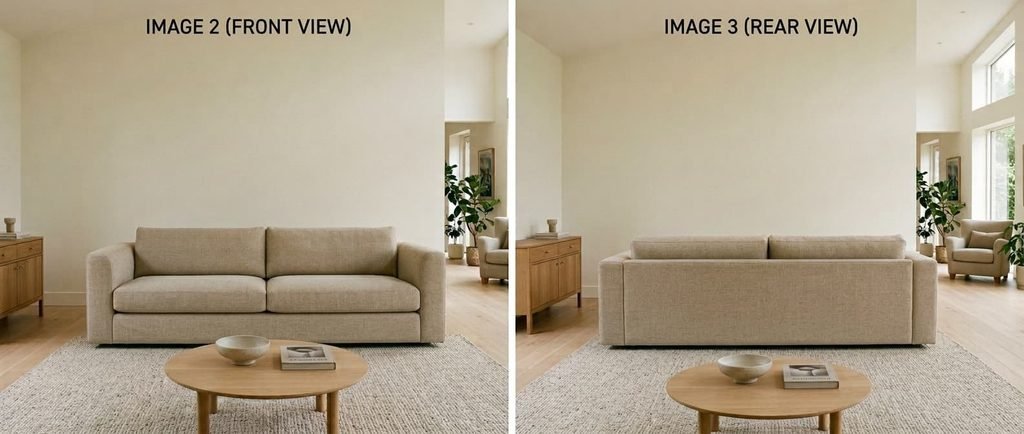
Through the 2000s the default sofa was a box. It had a straight back and square arms. Its corners had a radius of 2 or 3 cm, and you could draw its plan with a ruler. That suited a sofa pushed against a wall. Only its front and one end were ever seen.
Then living rooms took on more jobs. A desk corner and a dining spot joined the seating, so the sofa moved out from the wall to divide the room. A floating sofa shows all four sides, and a hard corner at each end became a visible feature. Rooms also stayed small, which turned each corner into a place where people brushed past furniture.
The softening came in stages. Small radii of around 10 cm arrived first, then rounded arms. In the past decade, full pebble shapes with radii of 45 cm joined them. Each stage traded a little floor for a softer outline, and each was easier to accept than the one before it.
What actually changed as curved sofas are replacing sharp-cornered ones
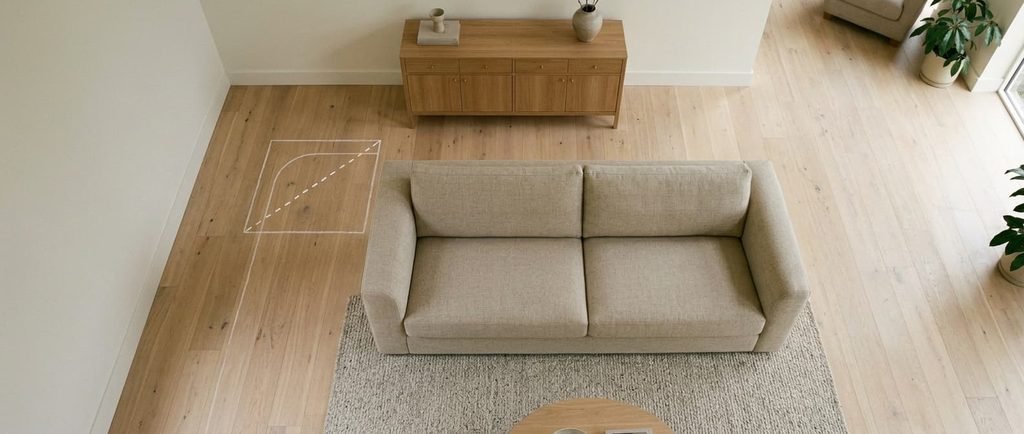
The change is a radius. A radius is the distance from the centre of a curve to its edge, so a larger one means a rounder corner. The corner radius has grown from about 3 cm to 25 cm or more, and it runs up to 45 cm on the roundest pieces.
Three sums show what that buys, and two of them are gains. First comes plan area. A sofa of 200 by 90 cm covers 18,000 cm². Rounding each corner to 25 cm removes (1 − π/4) × 25², which is 134 cm² a corner and 537 cm² for four. That’s 3% of the plan. At 45 cm it reaches 1,738 cm², or 9.7%. The footprint barely moves.
Second comes the diagonal. Someone turning into the gap beside the sofa end cuts the corner at 45°. A rounded corner pulls its nearest point back by R × (√2 − 1), so 25 cm gives 10 cm and 45 cm gives 19 cm. A gap of 70 cm to a sideboard then behaves like 80 or 89 cm at that turn.
Third comes the back. Some curved sofas bow the back as well. A 200 cm back with a bow of 15 cm has a radius of about 341 cm. Against a wall it leaves a wedge of 2/3 × 200 × 15 = 2,000 cm², which is 0.2 m² of floor that nobody can use.
Two of those effects help and one costs you.
Who it suits, and who it doesn’t
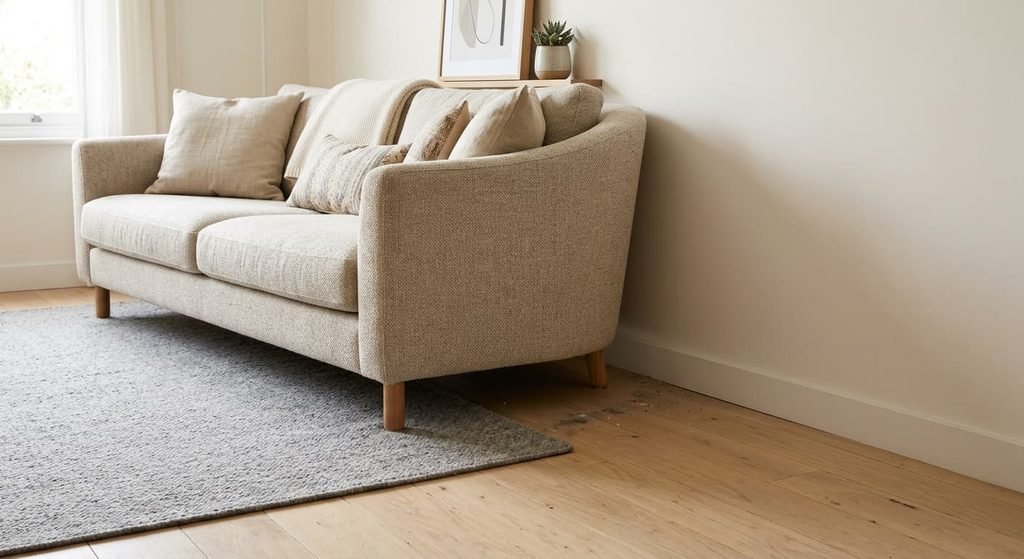
Where curved sofas are replacing sharp-cornered ones, the curve suits a sofa that floats with one end on a route. Suppose the route from the door to the window passes the sofa end and a sideboard 70 cm away. Rounding the corner to 25 cm opens that turn to 80 cm. The standard for a main route is 90 cm, so it helps without solving everything. It also suits a room where the sofa’s back is seen from the door, because the arc then reads as a shape rather than a wall of fabric.
It doesn’t suit a sofa pressed against a wall. A bowed back leaves the 0.2 m² wedge behind it. The wedge gathers dust and can’t hold a plant or a lamp. Under an arc, a rectangular rug leaves two bare triangles, and the curve then looks like a mistake.
Narrow rooms are the other poor fit. At 320 cm wide, a sofa 100 cm deep and a 40 cm gap take 140 cm. A 50 cm table and a 60 cm walkway take 110 more, which makes 250. A deeper pebble shape of 110 cm leaves only 60 cm spare.
The variable is where your route runs in relation to the sofa end. If the route doesn’t pass the sofa end, the 10 cm gain buys nothing.
Replacing sharp-cornered ones: are curved sofas worth it
Replace a sofa with a curved one only when you’re replacing it anyway and its end sits on a route. A working sofa has years left, and the gain is 10 cm of passage. The cost is a day to move the old one and a day to bring the new one in, plus the money, which is the largest in a living room. Weigh 10 cm of passage against two days of carrying. A tape template tests the same gain in ten minutes.
Reversal is expensive for a different reason. A sofa isn’t fixed to the wall, yet it’s heavy. A shape built to float suits one layout. If you move, the curve may fit the next room worse than a box would.
What dates is the extreme version, which the next section covers, while the moderate shape keeps its geometry.
The version that will date fastest
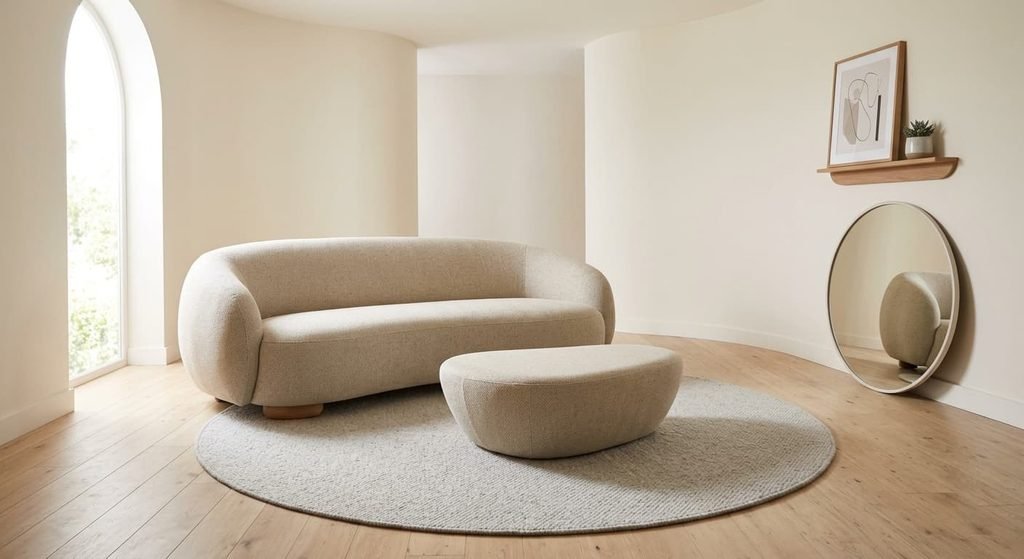
As curved sofas are replacing sharp-cornered ones, the far end of the trend is a sofa with no straight edge, with corner radii above 45 cm and a back bowed on a radius near 340 cm. Its marks are a bean or pebble outline, a coffee table with the same curve and a rug that echoes it. Everything repeats one shape.
Three things age it. A single curve fits one wall and one layout, so the sofa can’t move to the other side of the room. It can’t be extended, because a bow doesn’t continue in a straight line. The 0.2 m² wedge also returns whenever it meets a wall.
My view is that the matching curved coffee table does the most damage. It copies the sofa’s radius, so the room reads as one gesture.
The moderate version keeps a straight back and corner radii of 20 to 25 cm. It gives the 10 cm of passage, costs 3% of the plan and meets a wall cleanly.
How to try it without committing
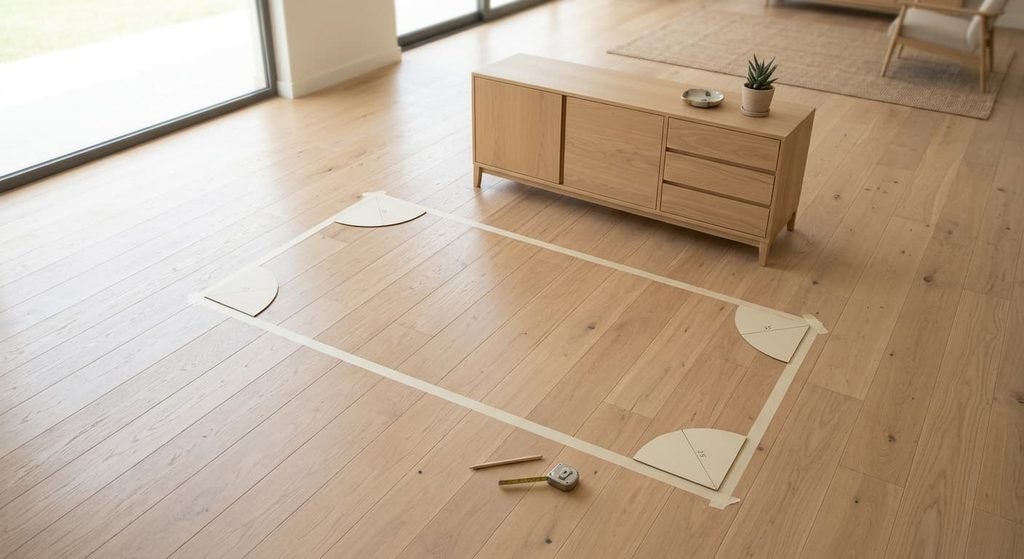
Lay the outline on the floor in masking tape for a week. Mark the sofa’s 200 by 90 cm plan, then round each corner with a 25 cm cardboard quarter-circle as a template. Walk your route each day and count how often you clip the corner. If the count falls toward zero, the gain is real in your room. For a second test, swap the angular coffee table for a round one, since it shows the same effect cheaply. To judge a bowed back, lay a 200 cm string along the wall and bow it 15 cm into the room, then look at the wedge behind it.
Curved sofas are replacing sharp-cornered ones because a floating sofa shows every corner and a small room feels each one. The gain is real but modest, about 10 cm of passage for a 25 cm radius. Buy the moderate shape when you need a sofa anyway. Keep the back straight, and tape the template before you commit to anything.
Questions readers keep asking
Is it worth swapping a square sofa for a curved one?
Only if you need a new sofa anyway and its end sits on a route. Rounding the corners to 25 cm gains about 10 cm at a diagonal turn. For a working sofa that’s a small return. Keep it and tape a template first.
Does a curved sofa suit a narrow living room?
Usually the rounded-corner kind does and the bowed-back kind doesn’t. At 320 cm wide, a deep pebble of 110 cm leaves only 60 cm spare after the table and walkway. A straight back with 25 cm corners keeps more floor.
Will curved sofas go out of style?
Nobody can forecast that. The moderate shape rests on geometry that doesn’t date: a corner radius of 20 to 25 cm and a straight back. What ages quickest is the full pebble, because it fits one layout and one wall, and a move to another room usually breaks both.