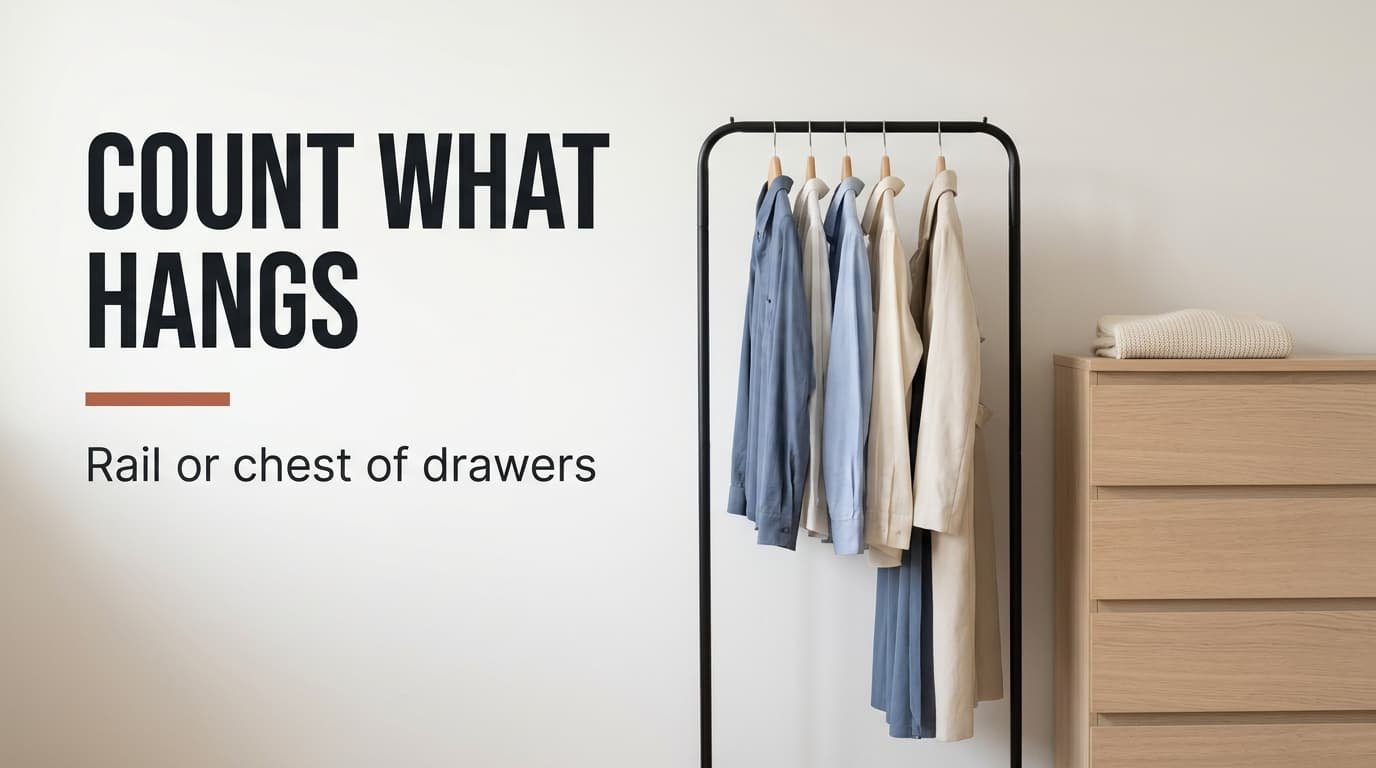
Which holds more of a real wardrobe: a wardrobe rail or chest of drawers? For each square metre of floor zone, the chest wins by more than three to one. Yet 18 of the 88 items in the example need hanging. The 10 long ones among them decide the answer for a rented bedroom of 280 × 340 cm. Choose the rail if most of your clothes hang. Choose the chest if most of them fold. The sums assume a 100 cm rail and a four-drawer chest, so put in your own measurements first. Every count here is an assumed illustration and not a catalogue figure.
What decides a wardrobe rail or chest of drawers
Looks don’t decide this one. What settles things is the share of your clothes that must hang, because folding ruins some garments and hanging wastes space on others. That share is a count you can make in ten minutes with the wardrobe open.
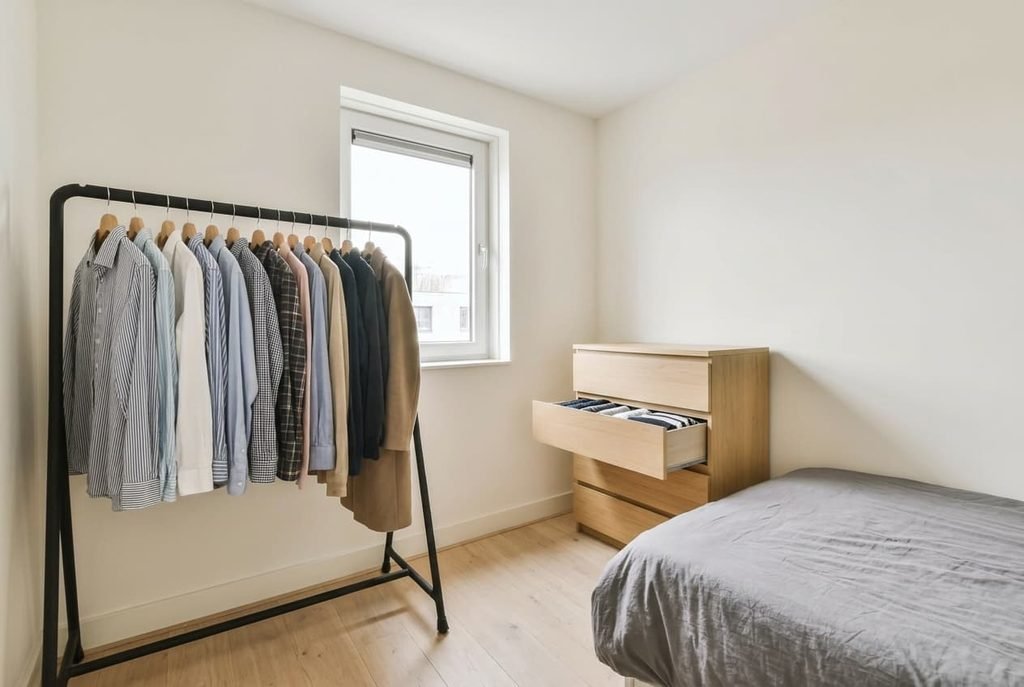
Start with the floor. The bedroom covers 9.52 m². A freestanding rail of 100 cm needs a zone 55 cm deep so garments can hang clear, which is 0.55 m². Assume each hung garment takes 4.5 cm of rail, so the rail holds 22 items. That’s 40 items per square metre.
A chest of 80 × 45 cm needs 45 cm of pull-out space in front. Its zone then measures 80 cm by 90 cm, a total of 0.72 m². Assume each drawer holds 24 folded items, which gives 96 over four drawers. That’s 133 items per square metre.
The example wardrobe holds 88 items: 18 hang and 70 fold. Ten of the 18 are coats and dresses, and a folded one eats two slots because it bulks up. The other 8 are shirts and jackets, which fold flat enough to count as a single slot each. Those two groups are what the later sums keep separating.
One sum counts what fits, and the other counts what survives.
Wardrobe rail or drawers across a typical set of clothes
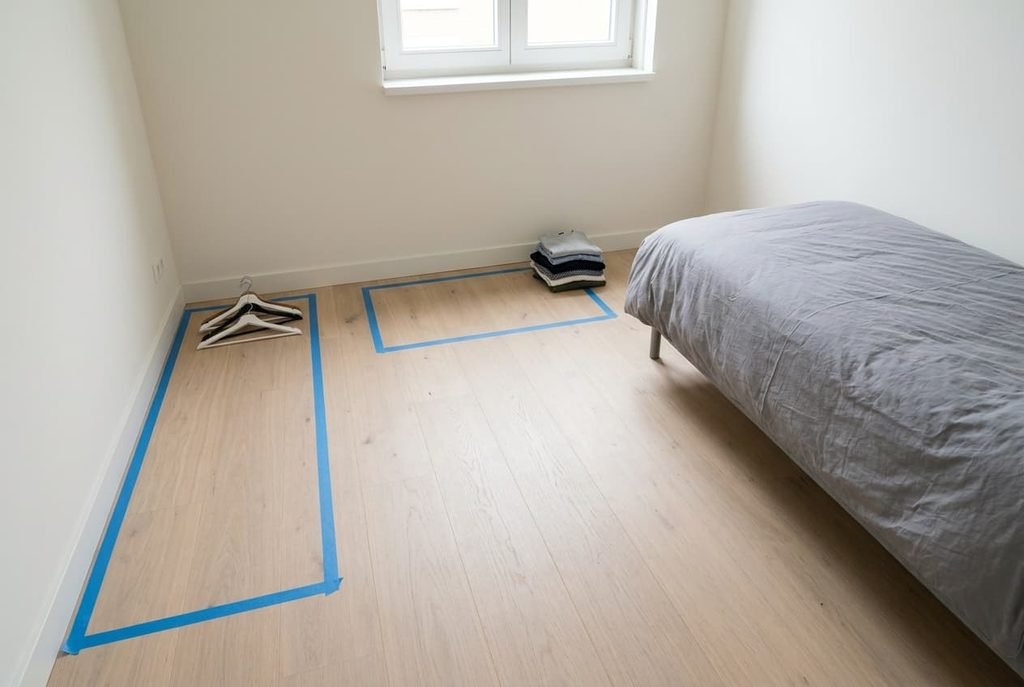
Test each row at home with a roll of masking tape. Mark the 100 × 55 cm rail zone on the floor. Next, mark the chest zone, which is 80 cm wide and 90 cm deep. Stand in each for a minute as if dressing, and note which one you’d trip over first. The rail zone is wider than it looks. A shirt hangs 50 cm across and a coat 60 cm, so garments swing out beyond the frame.
| Check | Rail | Chest of drawers |
|---|---|---|
| Items per square metre of zone | 40 | 133 |
| Floor zone | 0.55 m² | 0.72 m² |
| Long coats and dresses | Hang free, no creases | Fold into two slots each |
| Seeing everything at a glance | Yes | No, one drawer at a time |
| Dust on the clothes | Open to the room | Enclosed |
| Fixings in a rented wall | None, if freestanding | None |
Density isn’t the whole story.
The density row looks decisive, and it isn’t, because the table counts items and not what happens to them afterwards. The chest holds 133 against 40. Yet the 10 coats and dresses at two slots each push the example from 88 slots to 98. That’s 2 more than the 96 the chest offers. Paper fits become bulging drawers.
Where the rail wins
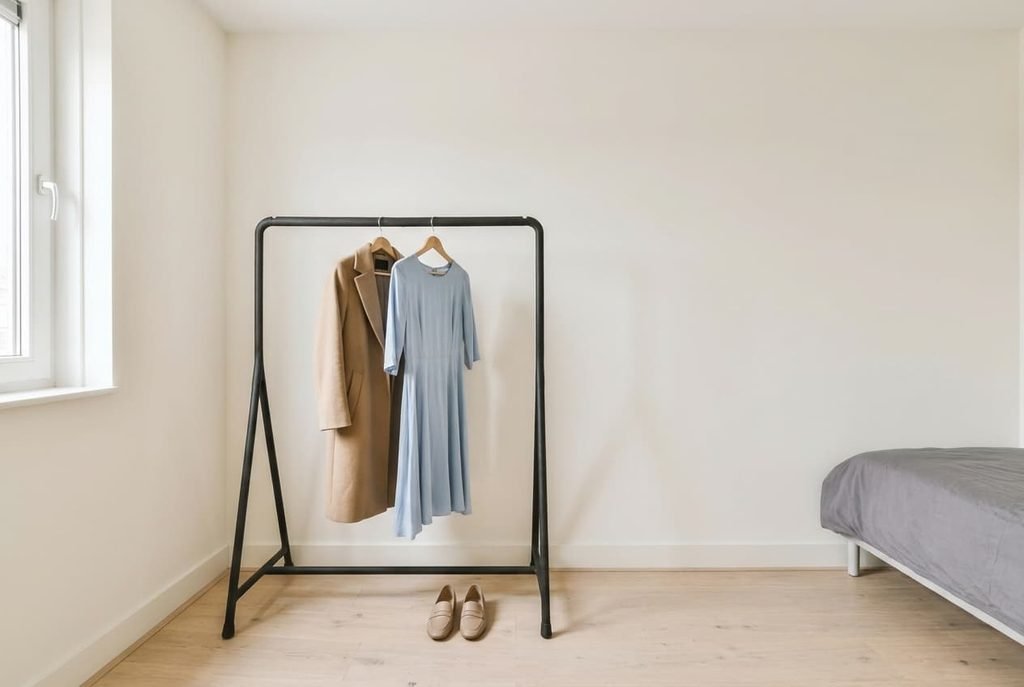
A wardrobe rail or chest of drawers has to cope with the garments that can’t be folded. The rail never asks you to fold them. Hung from the bar, a 110 cm coat drops straight and stays crease-free. A folded coat arrives at breakfast with a line across the chest.
The rail is also fast. You see 22 items in one glance and take any of them without moving another, so a morning search takes seconds and not minutes. Nothing hides at the bottom of a pile. It costs 0.55 m² of floor, which is 5.8% of the 9.52 m² room. It needs no drilling when the frame stands on its own feet. Moving out means folding the frame flat in a minute.
The rail’s weakness is volume. Hang all 88 items and you need 396 cm of rail, nearly four metres, which swallows 2.2 m² of floor, or 23% of the room. Hanging only what must hang keeps the rail small and honest.
Where the chest wins
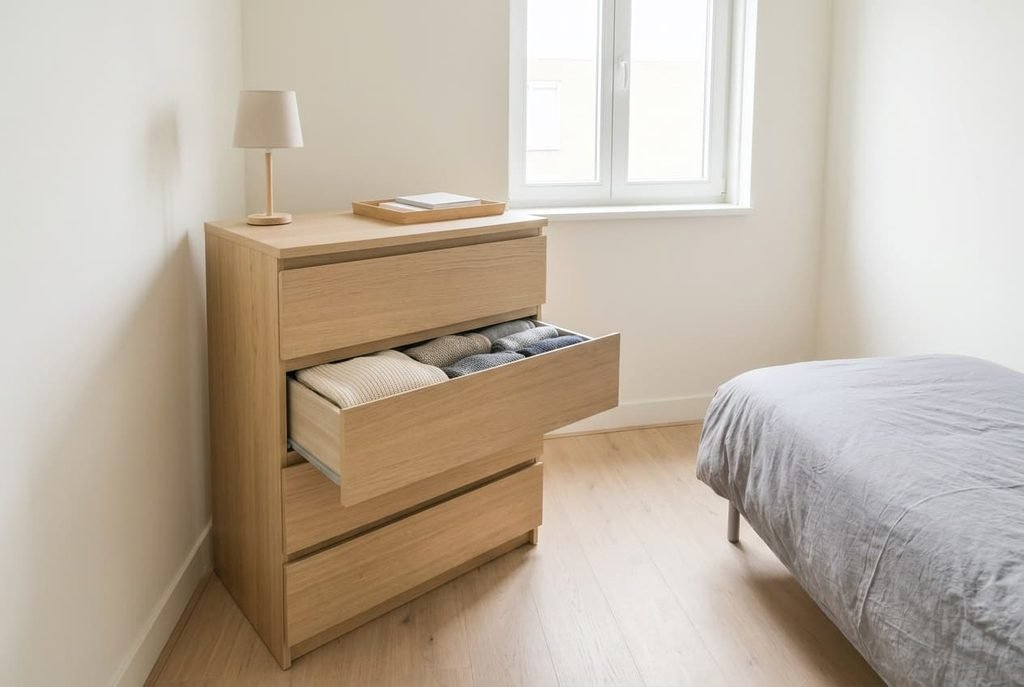
The chest’s strength is density. Its 133 items for each square metre is over three times the rail’s 40, and the drawers hide everything behind a flat front. Dust stays out, and the room looks calm even when the clothes aren’t.
The chest also suits knitwear and T-shirts, which stretch on a hanger and keep their shape when folded. Of the 70 foldable items, the chest takes them all with room to spare: 70 of 96 slots is 73%. Its top, at 80 × 45 cm, adds 3,600 cm² of useful surface for a lamp or a tray. That surface also gives a small bedroom somewhere to put a book down, which the rail never does.
Its weakness is the long items. Ten coats and dresses push the total to 98 slots, 2 over the limit, so a four-drawer chest alone overflows. You’d need a fifth drawer or a second small chest, and that costs the floor you saved. A wardrobe rail or chest of drawers is a poor match only when the clothes are mostly long.
A third route: a rail above the chest
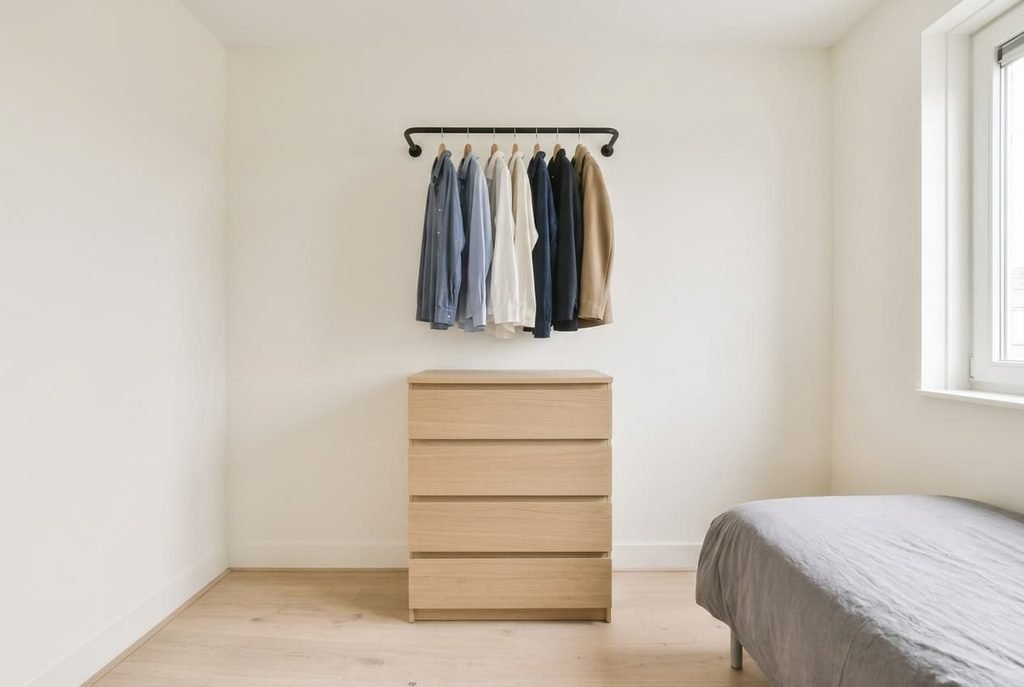
Stack the two, and the rail above the chest shares one floor zone. A wall rail at 185 cm height above a four-drawer chest of 80 × 45 × 85 cm leaves a drop of 100 cm. That clears shirts of 75 cm and jackets of 85 cm, though not dresses of 120 cm. The pair use a zone of 80 × 90 cm.
Count the stack. The rail takes the 8 shirts and jackets that hang. The chest takes the 70 folded items plus the 10 long ones folded at two slots each, so 90 slots against a four-drawer limit of 96. Everything fits in 0.72 m² of floor, well under the 1.27 m² that a separate rail and chest would need. The cost is a drilled rail, so check your lease first.
If you’d rather keep what you have, add under-bed boxes. Two boxes of 100 × 40 × 18 cm hold about 72 L each, and the clothes stay where they are.
Which branch fits your bedroom
Begin with the long coats and dresses, since they set the slot total. The chest needs one slot for each ordinary item and two for each long one. With 88 items and a four-drawer limit of 96, the chest copes with up to 8 long garments and no more.
If 9 or more of your items are long coats or dresses, choose the rail, because the chest overflows. The drop also saves you from folding bulky pieces. If 8 or fewer are long, choose the chest, because the density wins and a single hook by the door can take the odd coat.
Your own wardrobe will differ from the example. Replace 88 with your total and 96 with your drawer count times 24, then rerun the sum. The answer to wardrobe rail or chest of drawers is one subtraction away. Do it tonight with the wardrobe open and a pencil to hand, and write the result on the door. The answer takes ten minutes and saves a return trip.
Questions readers keep asking
Does a rail outlast a chest of drawers?
Both outlast the clothes they hold when the frames are solid wood or steel. The weak points differ: a rail’s joints can loosen under weight, and drawer runners can wear after years of daily pulling. Check the runners and the joints before you buy.
How do I stop clothes creasing in a chest of drawers?
Fold them in thirds and stand them upright in rows instead of stacking them, so each item can be seen and lifted without disturbing the rest. Keep heavy knitwear at the bottom and light tops above. Anything with a structured shape, such as a blazer, belongs on the rail.
Which suits a small rented bedroom better?
The rail, when more than half your clothes hang, and the chest otherwise. A small room of 9.52 m² rewards the stacked route most, since it saves 0.55 m² compared with two separate units. Choose by counting items, not by the style of the furniture.