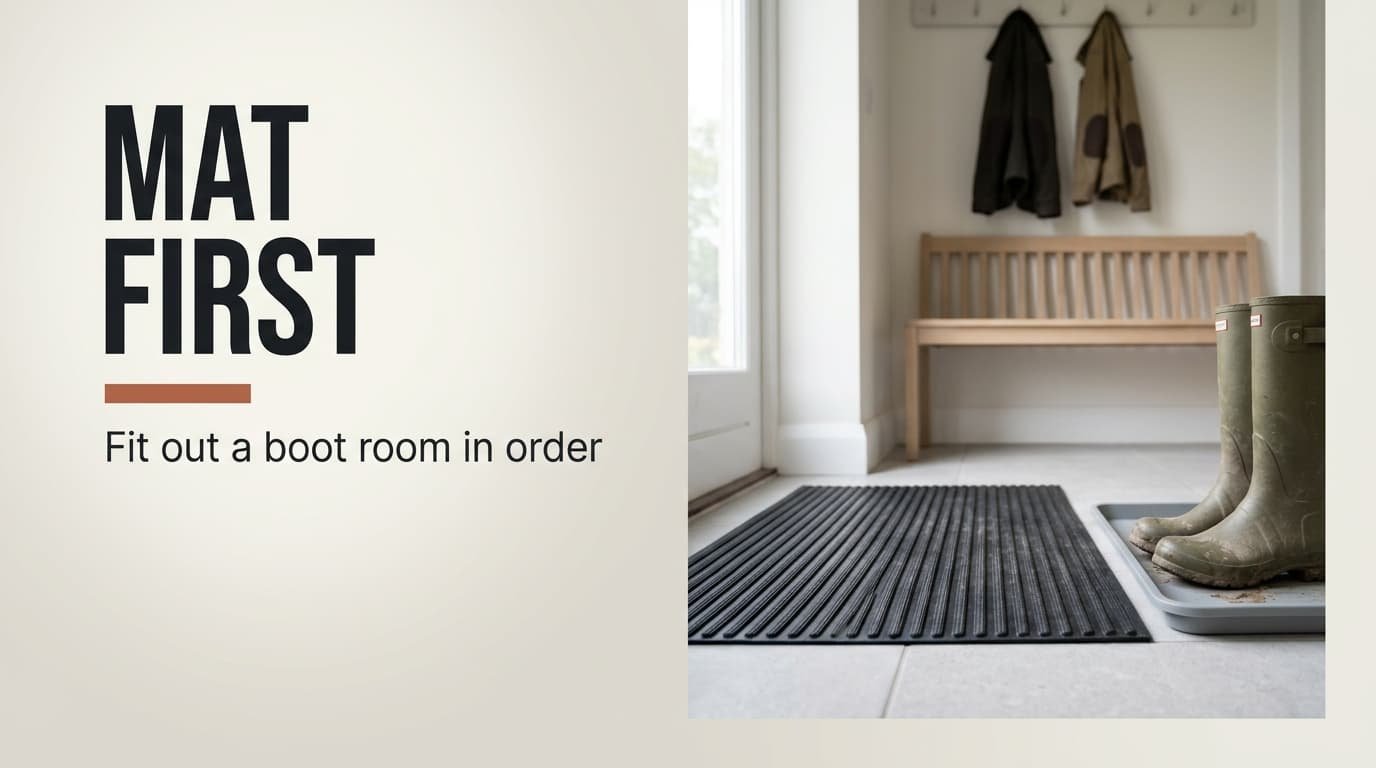
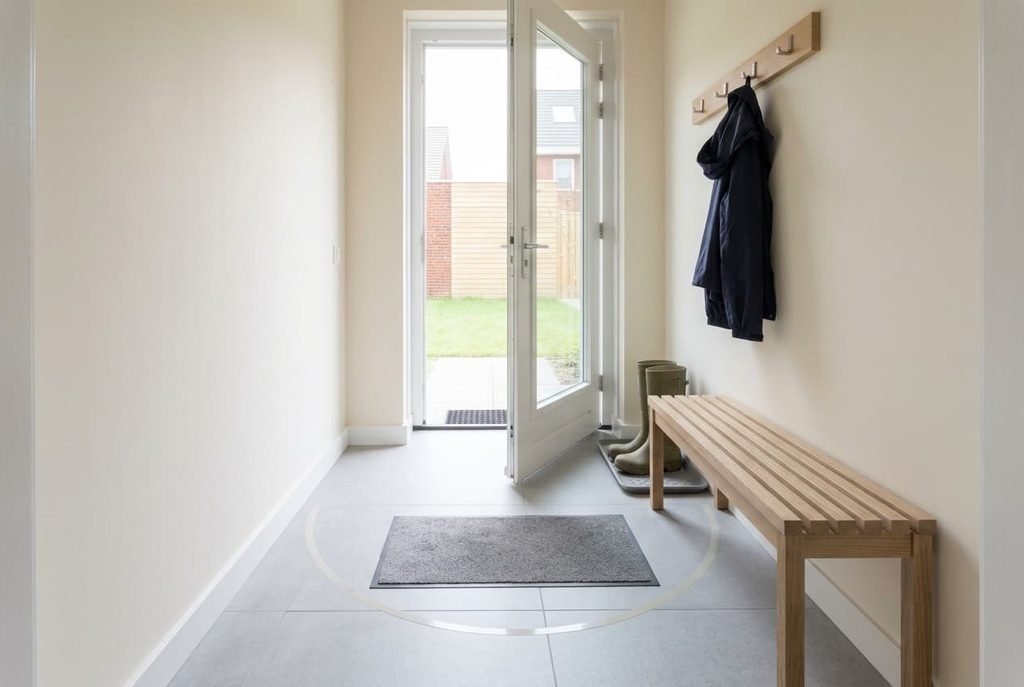
How much mud does one pair of boots drag over a threshold? Take 20 g as a working figure. A household of four with eight pairs by the door then brings in 160 g on every wet day. That number sets the order of buying for a boot room by the back door, since your first purchase must stop the dirt before anything else gets soaked. Our test lobby sits in a made-up Dutch flat. It runs 110 cm wide by 200 cm deep, so 2.2 m² of tiled floor. All sizes are placeholders for your own. You won’t find brands or prices here.
The rule that decides the order for a boot room by the back door
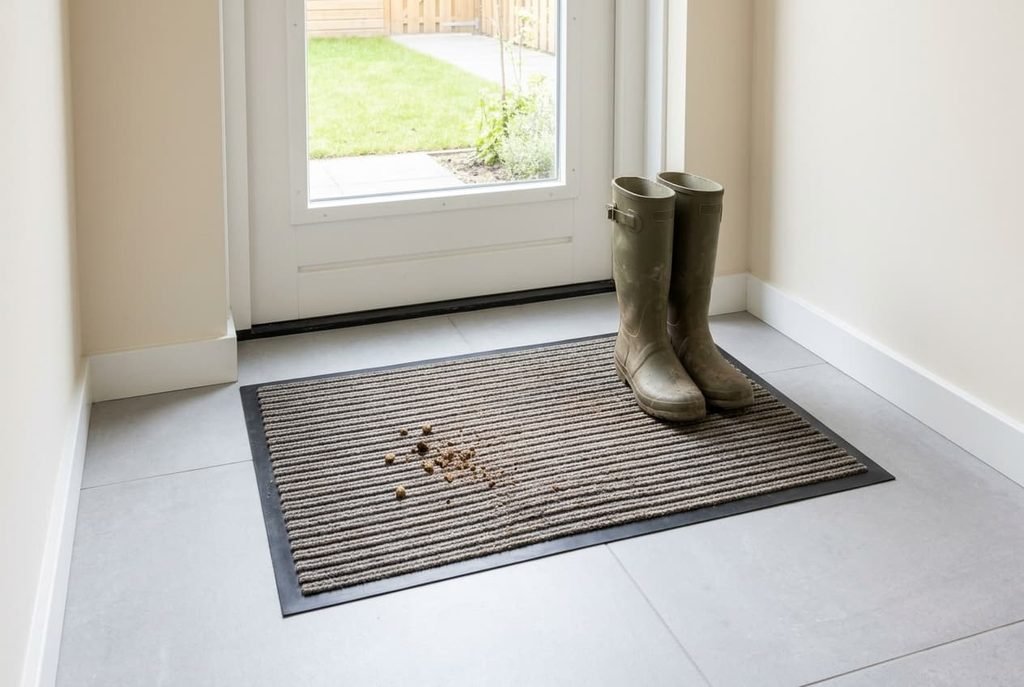
Benches look like boot rooms, so most guides open with one. I’d open at the floor, because a boot room by the back door succeeds when the dirt stays outside. Try the arithmetic. Say every sole contact on a mat strips off 25% of the mud still clinging there. A mat 100 cm deep gives each foot three contacts, so 0.75 × 0.75 × 0.75 = 42% of the 20 g survives and 58% is gone. A 50 cm mat gives one contact and removes 25%. Length beats thickness, because only contacts count. Set the mat just inside the door so the final scrape happens on the way in. One that stops short of the far wall still works, since all three contacts come before the bare tile.
Adopt one rule and spend first on whatever stops dirt crossing the threshold. Things that hold wet gear come next. Things that only look tidy come last. A weak hook can be replaced in a minute, while a weak mat costs you a mopped floor every day. Don’t buy anything until you’ve stood in the lobby with the door open and counted your steps from the doorstep to the far wall, because that count is your mat length.
Five buys to fit out the back-door boot room, in order
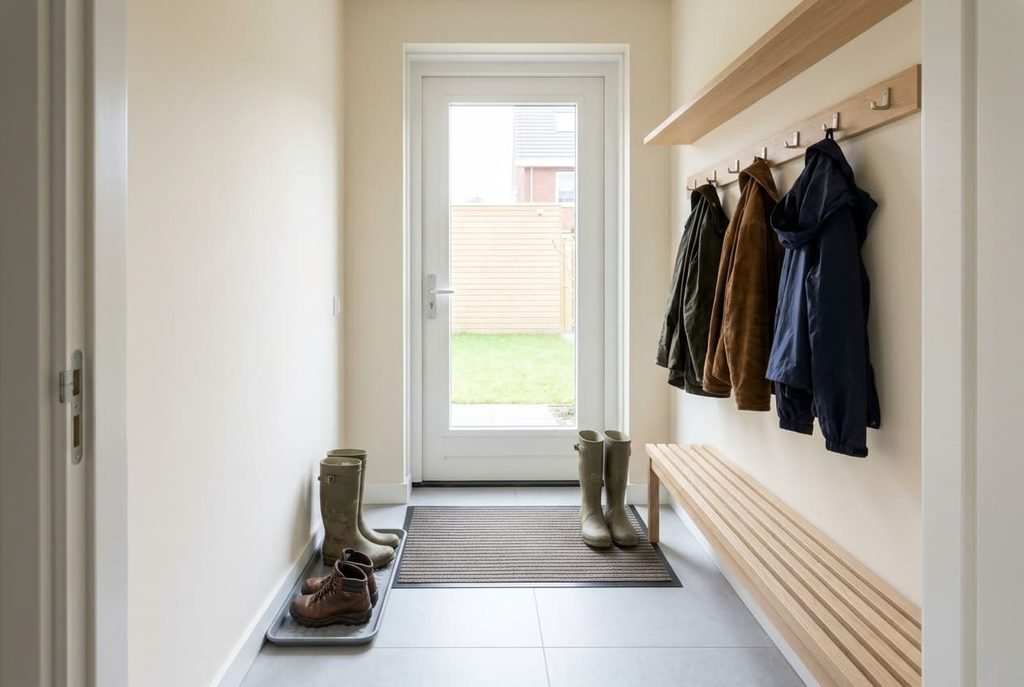
1. A scraper mat of 100 × 60 cm with stiff ridges on a rubber base, bought first because it removes 58% of the mud: three contacts leave 8.4 g of the 20 g on each pair, so 67 g arrives on a wet day instead of 160 g. Tier: BUY MID. A moulded rubber base keeps its shape on wet tile. The fault is loose fibre glued to thin card, which sheds crumbs into the lobby inside a month.
2. A boot tray measuring 80 × 35 cm, with a 3 cm lip. It goes second because whatever the mat misses drips here and stays off the floor. Assume eight pairs shed 30 g of water each, 240 g a day, while that footprint filled to 1 cm holds 2.8 L, nearly twelve wet days between emptyings. Tier: BUY CHEAP. One moulded piece has no joint that can leak. The fault is a tray built from two parts, which weeps along the join.
3. A hook rail 90 cm long carrying six hooks 15 cm apart, fixed at a height of 160 cm. It ranks third since a coat hung on a hook dries in the air, whereas one thrown over a chair drips on the tile. Six coats at an assumed 2.5 kg wet weigh 15 kg, so each of three fixings holds 5 kg. Tier: BUY ONCE. A rail cut from one length of hardwood shares the weight. The fault is hooks pressed into particle board, which tear out under a wet coat.
4. A slatted bench with a 90 × 35 cm seat set 45 cm off the floor. It comes next since you can finally sit to pull boots off, and a 45 cm seat puts the knee near a right angle. Tier: BUY MID. Gaps of 5 mm between the slats let water run through and the wood dry. The fault is an upholstered seat, which stays wet a full day after one pair of boots.
5. A 90 × 20 cm shelf, fixed at 175 cm above the hook rail. It closes the list because hats and gloves can wait a month. Tier: BUY CHEAP. One board with a rear upstand stops things sliding off the back. The fault is a shelf on two thin brackets, which sags under a full load.
Where the money goes, and the bench to scale down
The mat and the hook rail take the money, because a mat that sheds crumbs and a rail that tears out of the wall both fail slowly and waste the whole purchase. Everything else can be swapped later for a modest sum.
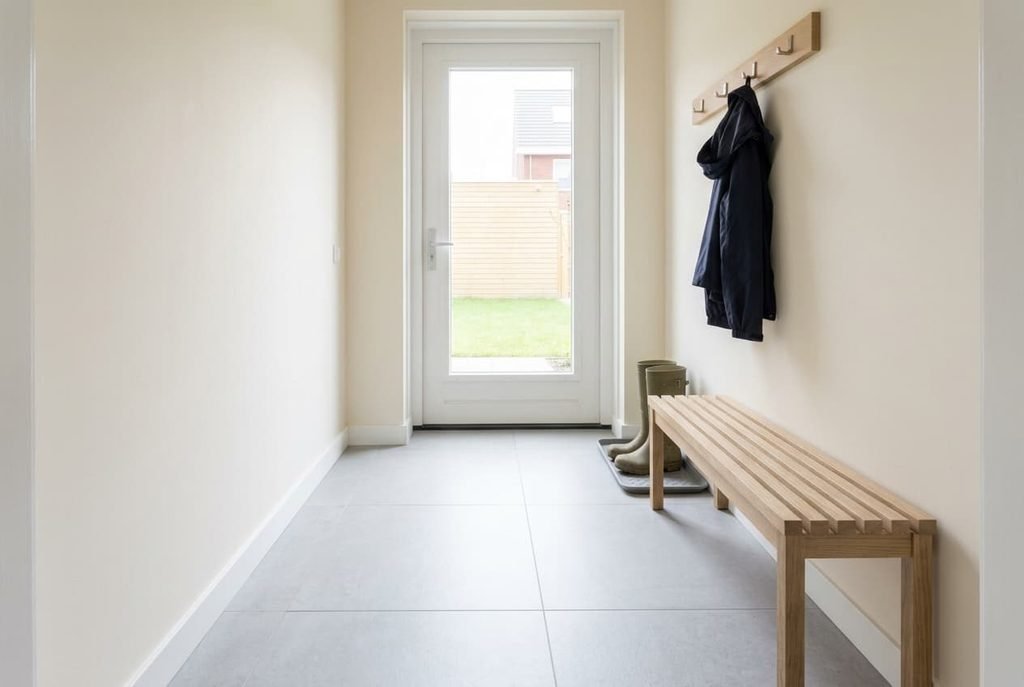
Then scale the bench down from 45 cm deep to 35 cm, which looks too narrow on paper. The sums disagree. A 45 cm bench leaves 110 − 45 = 65 cm of walkway, and a 35 cm one leaves 75 cm. Assume someone carrying a bag needs 70 cm, and only the second figure gives it. A seat needs close to two thirds of the thigh, which for a thigh of 45 cm is 30 cm, so 35 cm still holds you. The slimmer bench also needs 900 cm² less board, which is 22% less to buy.
A bench should seat you and leave the lobby alone.
The saving costs you something. Tall boots can’t stand beneath a 35 cm bench, so they’ll stand on the tray. Leave the tray where it is and keep only two pairs of tall boots there. With four pairs, add a second tray before you widen the bench.
What this order assumes, and when it breaks
The order suits a boot room by the back door that has an outward-opening door and a tiled floor. It also assumes a family of four and a lobby of 2.2 m². Carpet moves the mat even further up, since carpet holds what tile lets you sweep away.
An inward door redraws the plan. A door 90 cm wide sweeps 90 × 90 = 8,100 cm², or 0.81 m², and that’s 37% of the 2.2 m² floor. Lay the mat inside that arc and tuck the bench tight to the wall behind the hinge, so the door clears both.
In a lobby only 90 cm across, a 35 cm bench leaves a 55 cm walkway. Drop the bench and keep the tray and a rail. Sit on the stairs or in the kitchen to pull boots off.
Read the lease before you drill. A rail needs three holes, and some tenancies allow only a clip-on rail.
What to skip entirely
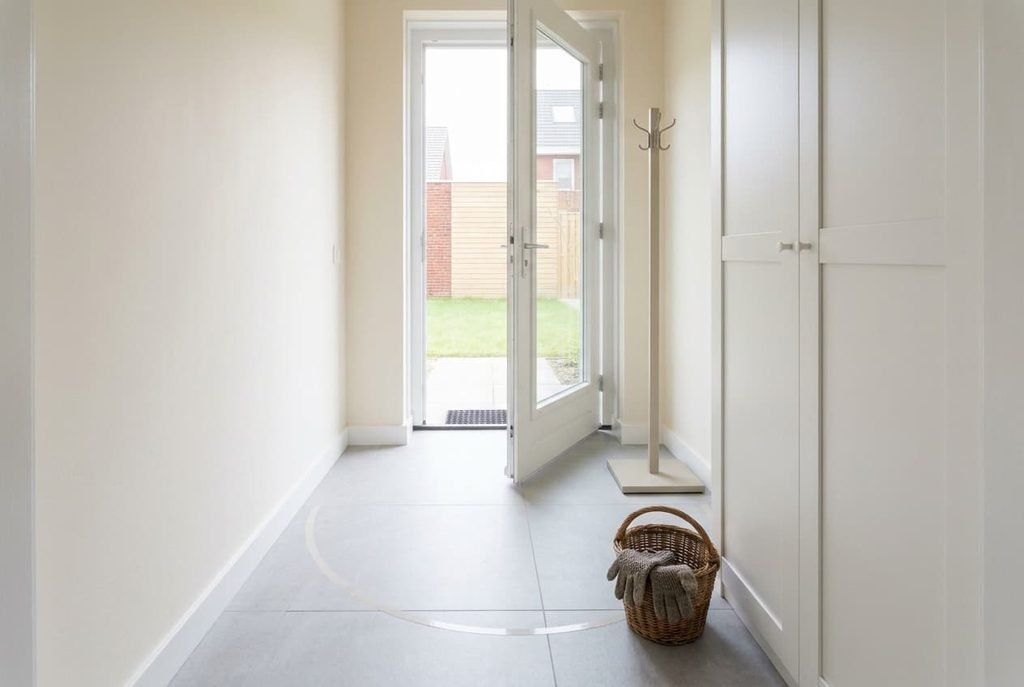
A closed shoe cabinet with doors tops the skip list. Wet boots shut in a box stay damp for days, and a cabinet that’s 40 cm deep takes 36% of the 110 cm width before a single shoe goes in. Second on the list is a coat stand, whose 40 × 40 cm base uses 1,600 cm², or 7% of the floor, for hooks the rail already supplies. Runners of carpet soak up water and dry slowly on tile. Next, a full-length mirror 40 cm wide takes a third of the wall you need for hooks. Last, a wicker basket under the bench keeps wet gloves damp for a week. Skip them all and the budget goes to the mat.
Each of these costs space or time you’ve already spent.
The mat leads because it decides how much mess reaches everything else, and each later piece exists to cope with what’s left. Buy the mat, then the tray. Fit the rail, then the bench. The shelf comes last. Live with a boot room by the back door through a fortnight of wet weather before you add anything, and write the order on the door frame to keep yourself honest. Two weeks teach more than a dozen shop visits. After that, buy the next piece.
Questions readers keep asking
How many pieces do I need to start?
Two: the mat and the tray. Between them they stop 58% of the mud and catch the water that follows, and they cover under 0.5 m² of floor. The rail comes third. Add the bench and shelf only when a real annoyance appears. This lobby holds five items, and anything extra deserves a second look.
Should I buy storage boxes before the furniture?
Storage can wait. The mat and tray decide whether the floor stays clean, and boxes would only hide that problem. Run the lobby for two weeks, then fit boxes into whatever gaps remain. The mat and tray use 0.6 m² of the 2.2 m², leaving roughly 1.6 m² free for storage.
How do I judge a scraper mat in a shop?
Bend one corner and watch the ridges. Stiff ridges that spring back will scrape properly, whereas a floppy fibre pile only brushes the surface. Turn the mat over and check that the base is one moulded sheet rather than card. Reject any mat that sheds fibre when you rub it with your palm.