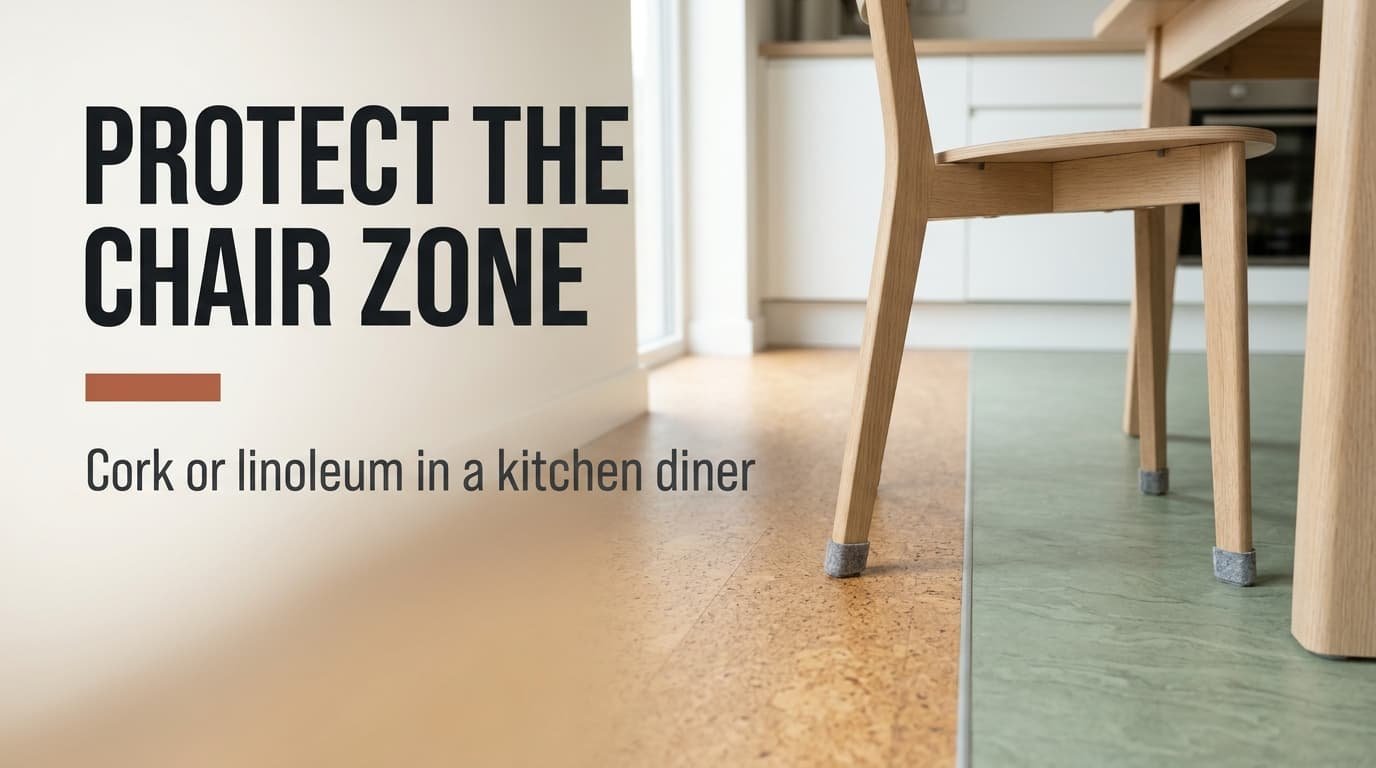
Within a year, the strip of floor at the table looks tired, and that patch decides cork or linoleum flooring. Take linoleum if the chairs move several times a day and water reaches the floor. Take cork if you stand at the worktop for long stretches and every chair wears felt. Cork and linoleum part ways once the top film has worn through.
Our room is a made-up Dutch kitchen diner, 340 by 520 cm and 250 cm high, with a table used for meals and homework. Wear rates in the sums are assumptions I picked, so redo them for your own household and your own chairs.
What decides cork or linoleum flooring: the layer under the wear
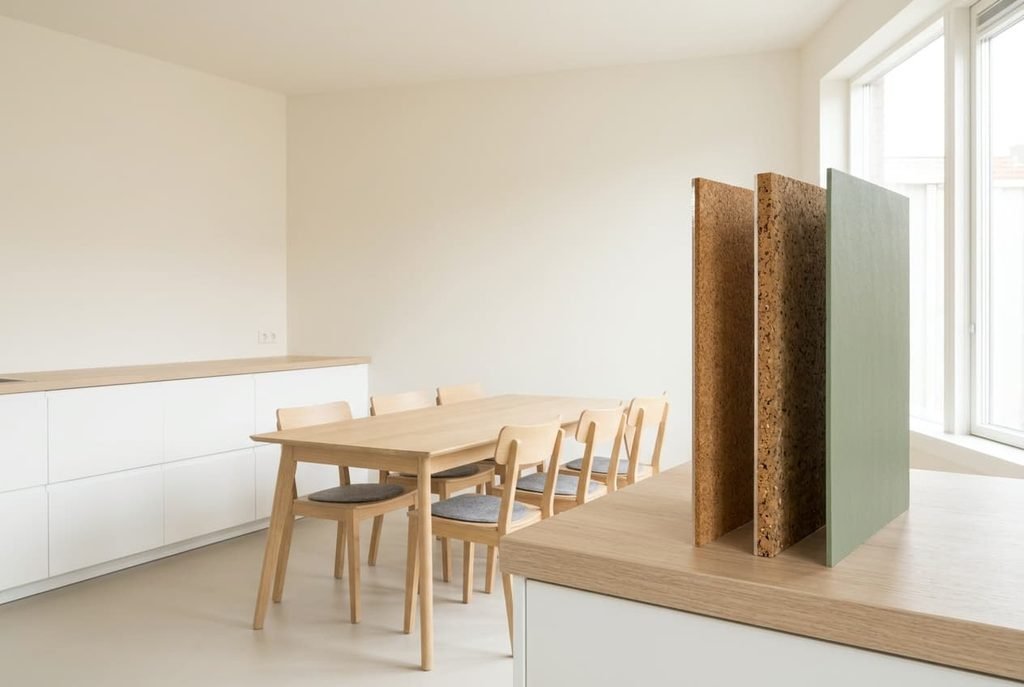
Every floor has a top film and a body beneath it. On cork the film is a varnish or wax coat, assumed here to be 0.1 mm thick. Under it sit compressed bark granules, which soak up liquid like a sponge. On linoleum the body is a dense, set mix of oxidised linseed oil and wood flour, bound by resin. It measures about 2.5 mm and keeps the same colour all the way down. The property to compare is how the floor behaves after the film is gone.
Floor area is 340 × 520 cm, or 17.68 m². A cabinet run along the short wall takes 340 × 60 cm, or 2.04 m², which leaves 15.64 m² of floor. A 180 by 90 cm table, with chairs pulled back 60 cm on every side, needs a zone of 300 × 210 cm, or 6.3 m². That’s 40% of the floor.
Four people sit down twice a day, and each seat is pulled out and pushed in once per sitting. That makes 4 × 2 × 2 = 16 drags a day, or 5,840 a year. Assume the zone loses 0.02 mm of surface annually. The cork film lasts five years, and after that bare cork meets every spill. Linoleum holds 2.5 mm of body, so thickness never runs out inside a tenancy.
Thickness is a reserve, and cork’s is thin.
Head to head across a year of dinners
You can test every row in a shop with one sample and a jug of water. Neither floor takes every row, and the rows that matter most depend on what your household does at the table.
| Situation | Cork | Linoleum |
|---|---|---|
| Chair legs dragged across it | The film scuffs first, then bare cork shows | Scratches stay shallow, with the same colour beneath |
| Water left for an hour | Seeps in at the joints of click planks | Beads on the face, with the seams as the weak spot |
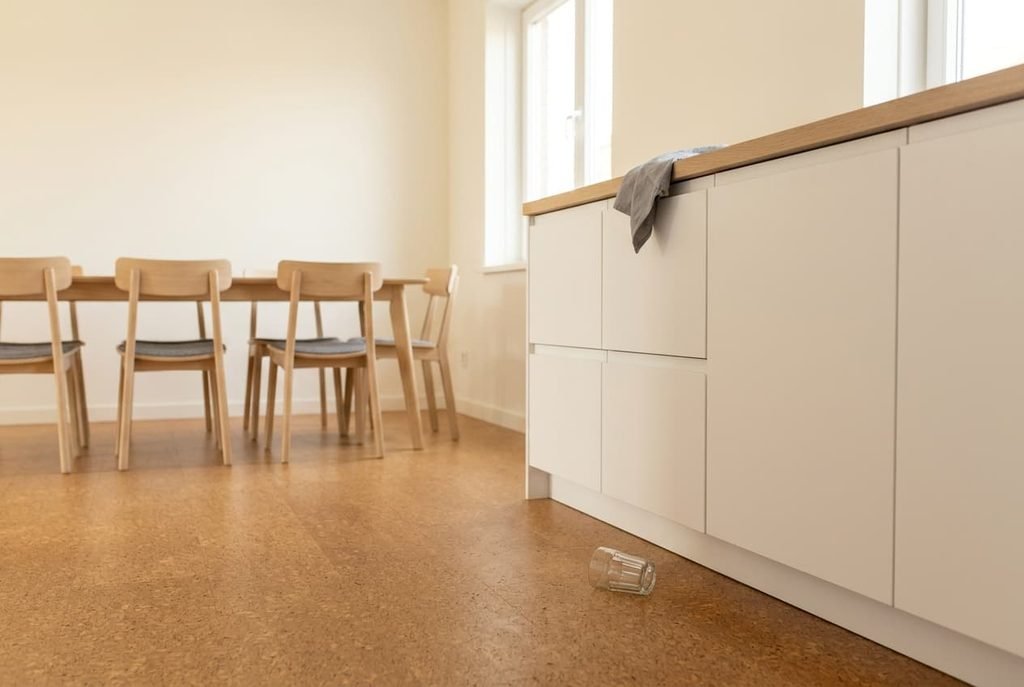
| Dropped glass | Often survives, because the surface gives | Often breaks on the firm face |
| Sound of a chair scrape | A muffled thud | A sharp rasp |
| Uneven sub-floor | Floating planks bridge small dips | A thin sheet shows every ridge underneath |
| A table leg standing for months | Leaves a dent that springs back in part | Leaves a smaller dent that stays |
| Years of daylight | Fades and lightens | Yellows in the dark and bleaches back in light |
The last row surprises people most. Linoleum left under a rug or a cabinet turns yellow as its linseed oil oxidises with little light, and the patch usually fades once daylight reaches it again, so a yellow stripe under a lifted mat is a passing change in the floor and no sign that it has failed.
Where cork wins
Cork wins wherever people stand and the floor must stay quiet. A cook at the worktop for an hour feels the surface give a little, and that give also saves a dropped tumbler. In an upstairs flat the downstairs neighbour hears every chair scrape, and a 6 mm resilient layer takes the edge off each one. It’s warmer underfoot in winter too, since cork carries heat away from a bare foot slowly. A dropped pan lid thuds instead of ringing.
Weighing cork or linoleum flooring for a flat above someone else’s ceiling, that muffling often settles it before wear does. Installation is the second reason. Floating click planks ride over a screed that dips by a couple of millimetres, where a glued sheet would show the dip
.The unglamorous reason is repair. Keying the surface lightly and rolling on a fresh coat takes one weekend, and it restores the reserve. Checking the zone once a year keeps cork going for decades. Only a spill that reaches a joint before then does real damage, so wipe fast.
Where linoleum wins
Linoleum wins where chairs move daily and water arrives. In our zone of 6.3 m², 5,840 drags a year take surface off the floor, and a body that is the same all the way down shrugs that off. A scuffed patch can be buffed and polished, and a spill sits on the face until a cloth arrives.
Underfloor heating gives it a second advantage. Assume cork of 6 mm with a conductivity of 0.08 W/mK, which resists heat flow by 0.006 ÷ 0.08 = 0.075 m²K/W. Linoleum of 2.5 mm at 0.17 W/mK resists 0.0147. If the heating system accepts a covering up to 0.15, cork uses half of that limit and linoleum a tenth.
Seams are the price. A 200 cm roll laid in two drops of 520 cm buys 20.8 m² to cover 15.64 m², so about a quarter ends up as off-cuts and one 520 cm seam crosses the room. Welded or sealed seams keep water out. The screed beneath must be smooth first, because a thin sheet repeats every ridge.
When neither floor is right
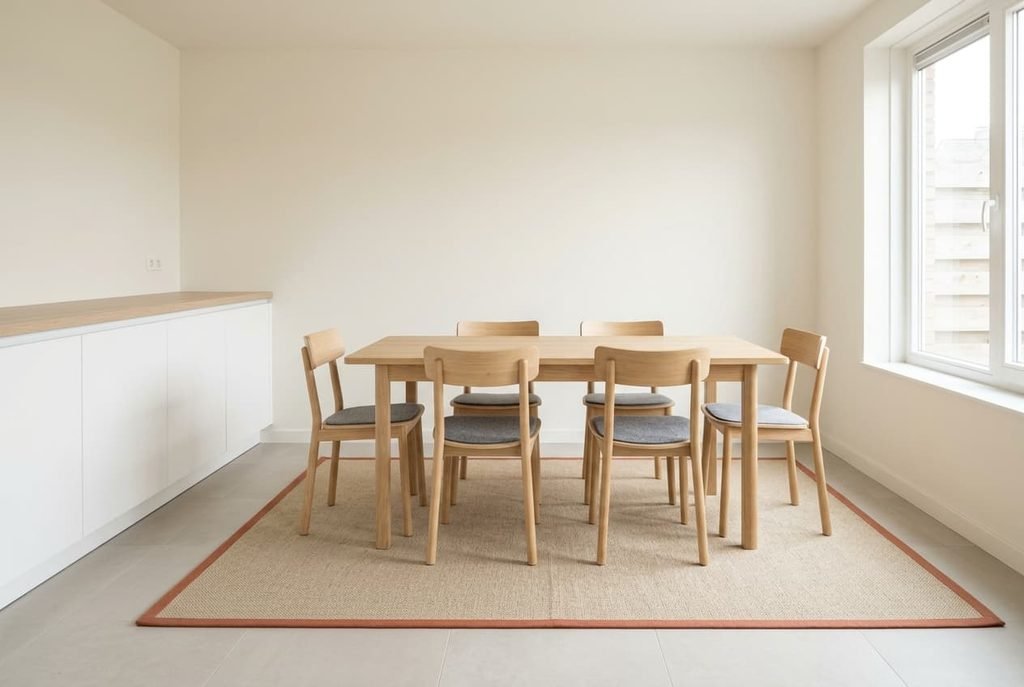
Keep the floor you have if it is sound, and protect the one zone that wears. A rug cut to the 300 × 210 cm chair zone takes the 5,840 drags a year and leaves the other 9.34 m² untouched. Choosing cork or linoleum flooring to cure a 6.3 m² problem means paying to replace 15.64 m². I’d argue most households would be happier with the rug.
Size the rug so no chair leg leaves it as the seat slides out. That’s why the zone extends 60 cm past the table on each side. Pick a flat weave, so chair legs don’t catch an edge, and lay it on a non-slip underlay. Check that the rug lies flat before the first dinner, because a curled corner catches chair legs. A rug also moves when it’s vacuumed, so square it up to the table afterwards.
A cracked or loose floor stays that way under a rug, so lift the worst section first.
How to choose linoleum or cork flooring in thirty seconds
Drag a chair leg across a sample 50 times. Drip water on the cut edge and leave it for an hour. Flip the sample and look at the back. A swollen edge or a stained back tells you more than a brochure does.
If the chairs move daily and the kitchen takes water or underfloor heating, take linoleum with sealed seams. If you stand at the worktop for long stretches and the flat has a neighbour below, take cork with a fresh film every few years.
Whether the screed is flat to within 2 mm over a 2 m straightedge is something only you can check. A sheet needs it and click planks forgive it.
The choice comes down to the layer under the wear, a deep body against a thin film. Linoleum carries a deep body that never runs out, while cork carries a thin film that needs attention. Pick the floor whose weak point matches how your household really behaves. Decide on cork or linoleum flooring only after the sample test, and keep a spare offcut for later checks.
Questions readers keep asking
Which floor is easier to keep clean in a kitchen diner?
Linoleum, by a small margin. Spills sit on its face until you wipe them, and a damp mop is enough. Cork needs its film intact. Wipe fast and avoid soaking it. Neither wants harsh chemicals, and both reward a mat at the back door.
Will a cork floor survive a dishwasher leak?
Only if you find the leak quickly. Water seeps into the joints of click planks and swells the edges, and a floor that’s soaked for hours rarely recovers. A glued linoleum sheet with welded seams copes better, because the water has nowhere to go but across the surface.
Can I lay linoleum over underfloor heating?
Yes. A thin sheet passes heat easily, so the floor warms quickly and uses little of the heating system’s limit. Check the maker’s guidance for the glue and the maximum surface temperature, and let the screed dry fully before the sheet goes down.