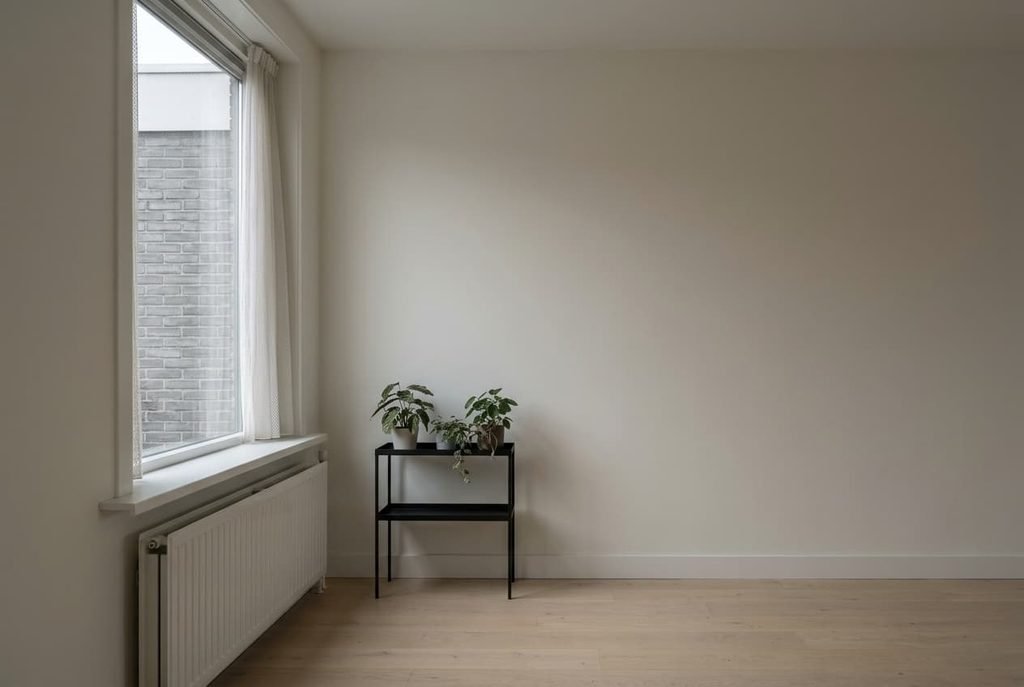
Buy the stand first, since the gap between leaf and glass can’t be changed afterwards. For a plant corner by a north-facing window, the order ends with the plants, and everything that prepares their place comes before them. They can’t survive a bad shelf while you shop for the rest. Our invented Dutch front room is 3 by 4 m with 2.5 m of height. Its north window measures 120 by 150 cm, with the sill at 80 cm and 12 cm deep. All light readings are assumptions, so take your own around noon.
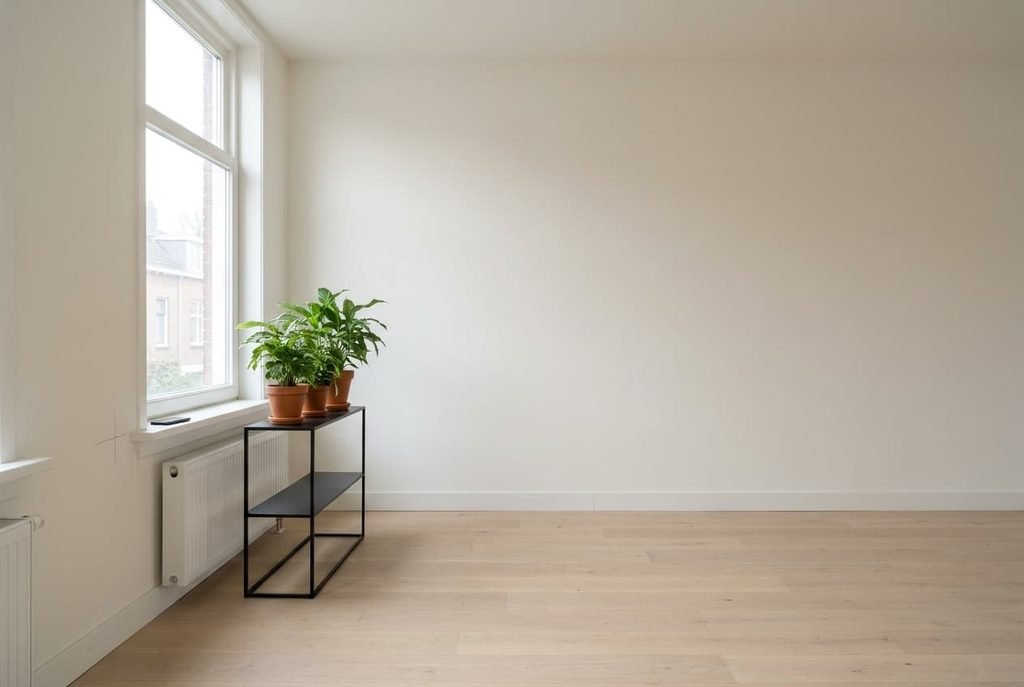
The rule that sets the order in a plant corner by a north-facing window
Light halves every 50 cm you move away from the glass, and that fact sorts every purchase. In June at noon we assume 2,400 lux at the glass and 1,200 at 50 cm. That falls to 600 at 100 cm and 150 at 200. December gives a third of it: 800 at the glass and 460 at 40 cm. We’ll treat 1,000 lux as the working level a foliage plant needs, so only the first half-metre by the glass qualifies in summer and none of it does in winter.
The rule that follows is to spend only where a piece changes light or distance, and pay as little as possible for the rest. The stand passes, because it sets how far the leaves sit from the glass. Next comes the lamp, which adds the missing winter lux. Pots qualify only through their drainage, and a pot’s glaze is decoration. Order follows when you’d first regret the gap: the stand on day one, the lamp before November, the plants once both exist. A plant corner by a north-facing window also drifts out of balance quickly, since the window gives no direct sun to correct a mistake. Point a phone light meter at leaf height where the stand will go, then pencil the number on the wall.
Plan the buying order: a plant corner by a window facing north
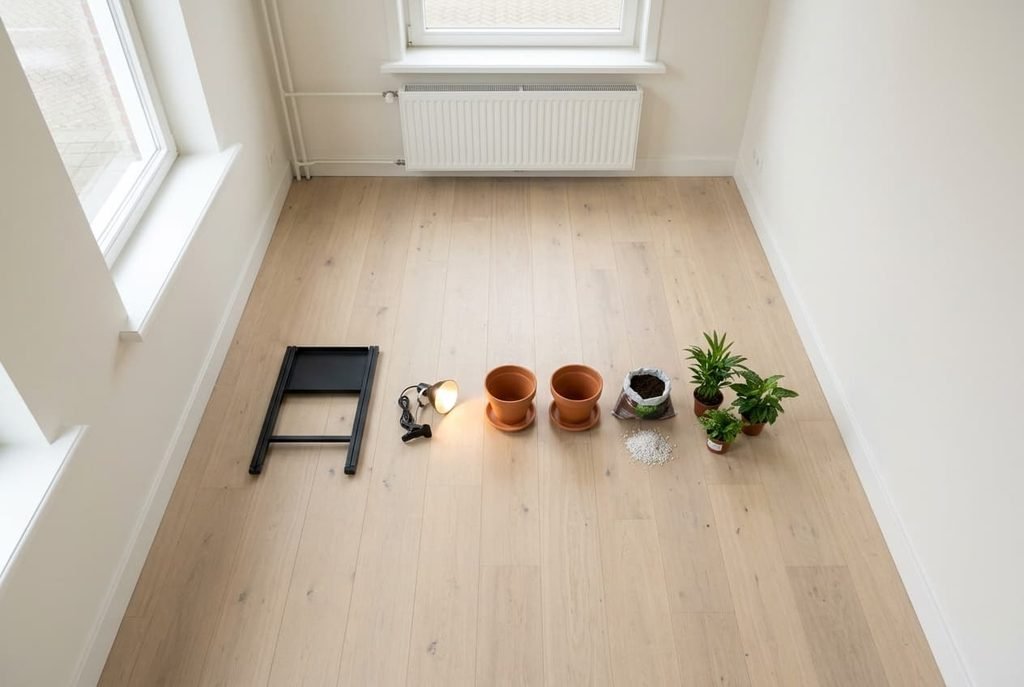
1. A plant stand 70 cm wide and 35 cm deep, with two tiers at 40 and 85 cm, bought first because its depth keeps the leaves no further than 40 cm from the glass, where June gives about 1,380 lux. It also leaves 25 cm clear at each side of the 120 cm window. Tier: BUY ONCE. Choose steel tube of 20 mm with welded joints, since each weld carries load without a bolt to loosen. The fault is wobble at a bolted joint, and it shows when you press a top corner.
2. A clamp lamp with an E27 fitting and a plug-in timer, holding an 800 lm warm-white bulb. It comes second because December leaves the glass at 800 lux and the leaves at 40 cm on 460. The bulb adds about 707 lux at 30 cm, which takes the leaves to roughly 1,170. Tier: BUY CHEAP. The clamp and the socket are plain parts. The fault is a clamp with a thin plastic jaw, which cracks when tightened on the stand’s 2 cm tube.
3. Four pots of 14 cm with drainage holes, each with a watertight saucer of 16 cm. They rank third because roots rot in standing water. A rented sill can’t take a stain either. Tier: BUY CHEAP for the pots, MID for the saucers. A glazed saucer holds water on a flat base. The fault is an unglazed saucer, which weeps onto the surface below within a day.
4. A 10 L bag of potting compost with about one third perlite. It ranks fourth since it’s heavy and only needed once the pots stand ready. Tier: BUY CHEAP. A mix that crumbles in the hand drains well. The fault is a peat-heavy bag that packs down into a wet block after two waterings.
5. Three foliage plants in 12 cm pots, each tolerant of low light. They come last because everything above prepares their place, and the remaining budget should be spent by then. Tier: MID. Lift the root ball free and inspect the roots: they should hold the compost together without circling. The fault is a tangle of roots pushing out of the drainage holes, which means a plant that has outgrown its pot.
Where the money goes, and the lamp to scale down
The stand takes the biggest share, because leaf height can’t be corrected after delivery and a lamp can be swapped in a minute. Spend on the weld, not on the finish.
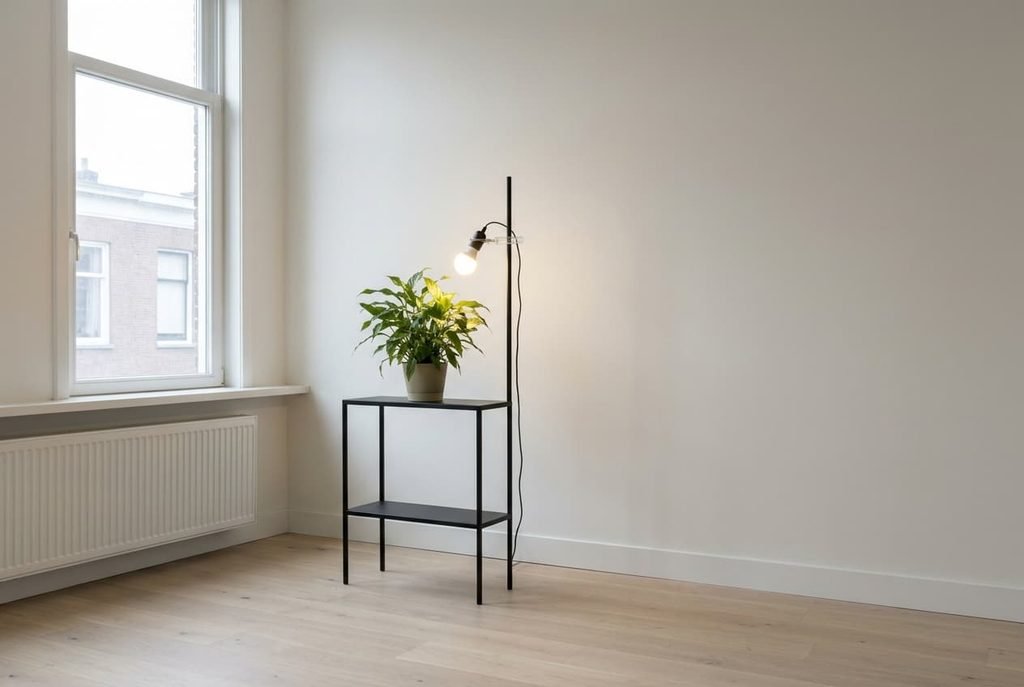
Then scale the lamp down from a purpose-made grow light to an ordinary bulb, which a buying guide seldom says. An 800 lm bulb is 63.7 candela if its light spreads in every direction. At 30 cm that gives 707 lux, and at 50 cm it gives 255. A foliage plant at 30 cm therefore gets what it needs from a bulb costing a fraction of a dedicated unit. The price of the saving is range. The bulb lights one tier, whereas a bar covers a shelf.
A bulb doesn’t need to be pretty.
Run it on a timer for 8 hours in the evening, so it extends the day without competing with the window at noon. Plants that flower or fruit would need more, and this advice stops at foliage. Hang the clamp so the bulb sits 30 cm above the highest leaf, and move it up as the plants grow. A bulb in a clip also shades nothing, so the window light still reaches the lower tier.
What this order assumes, and when it breaks
The order suits a plant corner by a north-facing window with a clear sky, a sill at 80 cm or lower and a socket within 120 cm of the stand. Confirm each point before spending a cent. A neighbour’s wall 3 m away cuts the sky by about half, which takes the glass reading from 2,400 to 1,200 lux. In that case the stand stays the same and the lamp rises to number one.
A window with reflective glazing loses roughly 20% of the light, and a net curtain takes another tenth. Take the curtain off the glass during the test. If your radiator sits under the window, the stand must clear it by 20 cm. Warm dry air rises there and hits the leaves, which may then drop.
An east window makes the lamp optional and puts the plants first on the list. Check your window at noon and again at four before committing.
What to skip entirely
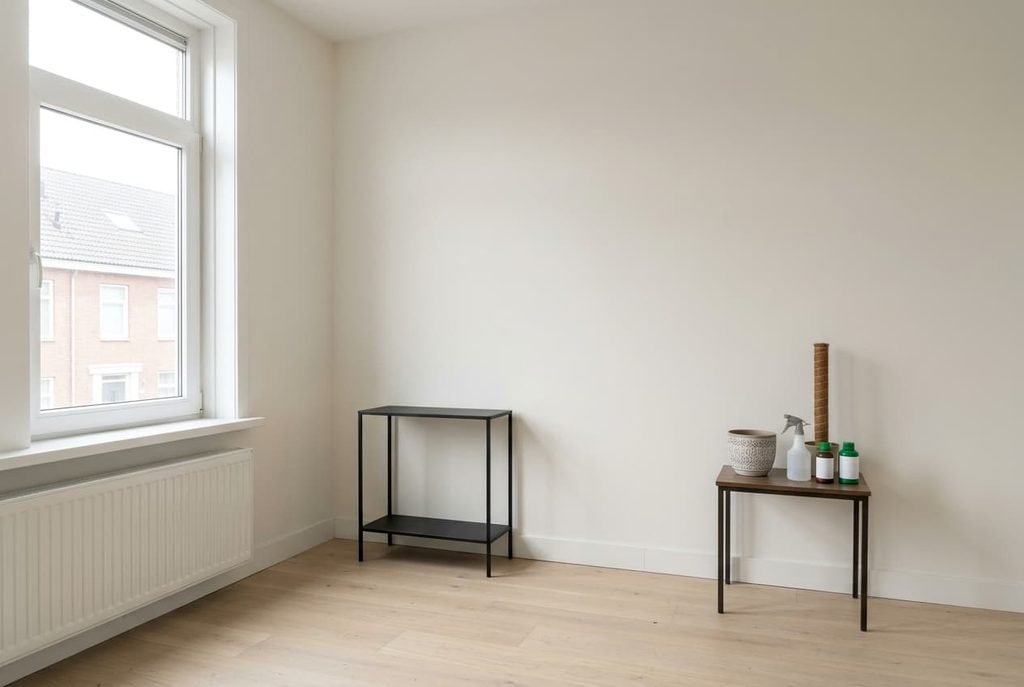
Decorative cache pots without a hole top the skip list, because they hide a saucer of standing water you can’t see. A misting bottle changes humidity for minutes, so skip it. A set of plant food bottles adds nothing in winter, when growth stops. Moss poles suit climbers, and this corner has none. A misting bottle gives no lasting change, because the air in a room dries again in minutes. Winter feeding is wasted effort too: leaves don’t grow in 460 lux, so any fertiliser sits unused in the compost. Skip all four, and leave no gap on the stand for any of them. Money saved here pays for the weld on the stand, which carries every pot you own.
Each of these answers a question the corner hasn’t asked yet.
The stand goes in first because the glass sets the rest, and the plants arrive when light is waiting. Buy the stand first. Fit the clip lamp next, then set out the pots. The rest can wait for a month of watching the corner with a phone meter in your hand. That month teaches more than a garden-centre trip, and a plant corner by a north-facing window rewards patience. Keep the sequence on a note by the window and cross each item out.
Questions readers keep asking
How many pieces do I need for a plant corner?
Five. The list runs from the stand to the plants, and nothing else is needed. Everything beyond it is optional. If money is tight, buy the stand first, then the lamp, then add plants as the budget allows, one at a time.
Should I buy the plants or the stand first?
The stand. Plants bought first have nowhere to stand and sit on a table in the dark, where they lose leaves within weeks. With the stand in place, the leaves already stand 40 cm or less from the glass on the day they arrive.
How do I judge a plant stand’s quality?
Press down on a top corner. A well-made stand with welded steel joints stays still, while a bolted one rocks. Check that each tier carries 5 kg without bowing and that the feet are level on your floor. The weld is the part to inspect before you pay.