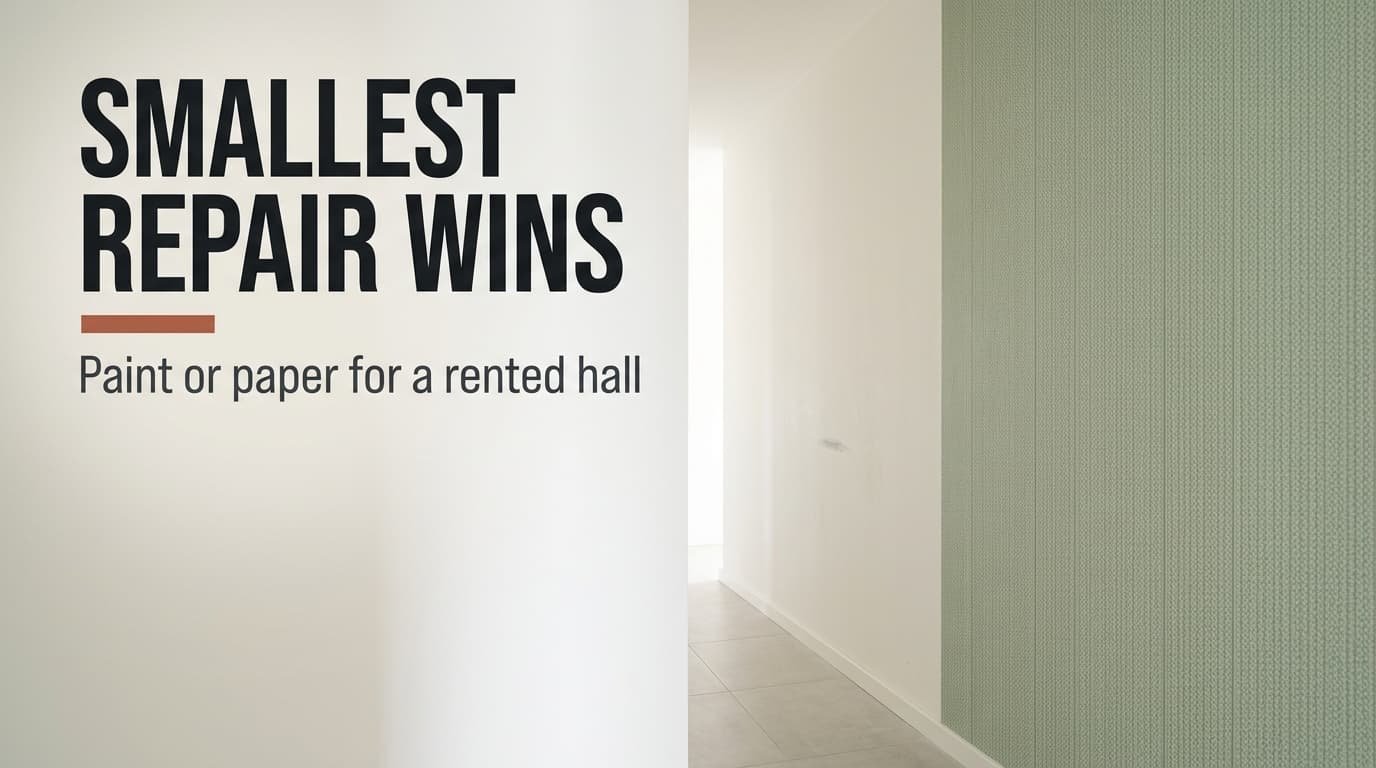
Wall paint or wallpaper: what will the first scuff cost you? In a small rented hallway, paint suits a landlord who wants white walls back, and wallpaper suits one coat wall that will be marked often. What settles it is the repair unit, meaning how much wall you must redo to hide a single mark.
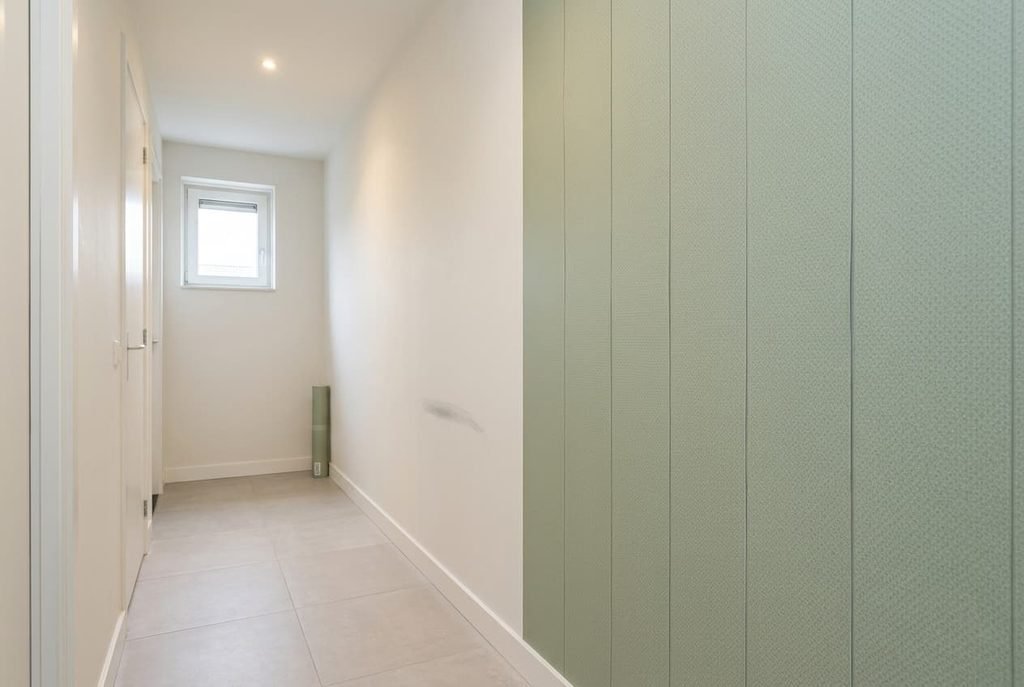
The hallway here is a rented one in the Netherlands. It’s 450 cm long and 105 cm wide, and its ceiling is 250 cm high. All figures are worked examples; use your own measurements. This guide carries no brand or price, as both go out of date fast.
The one property that decides wall paint or wallpaper
Marks in a hallway gather where bags brush past, at about 80 to 140 cm up the wall. The coat-side wall measures 450 cm by 250 cm: 11.25 m². The area you must redo to hide one mark, the repair unit, is what separates the two finishes.
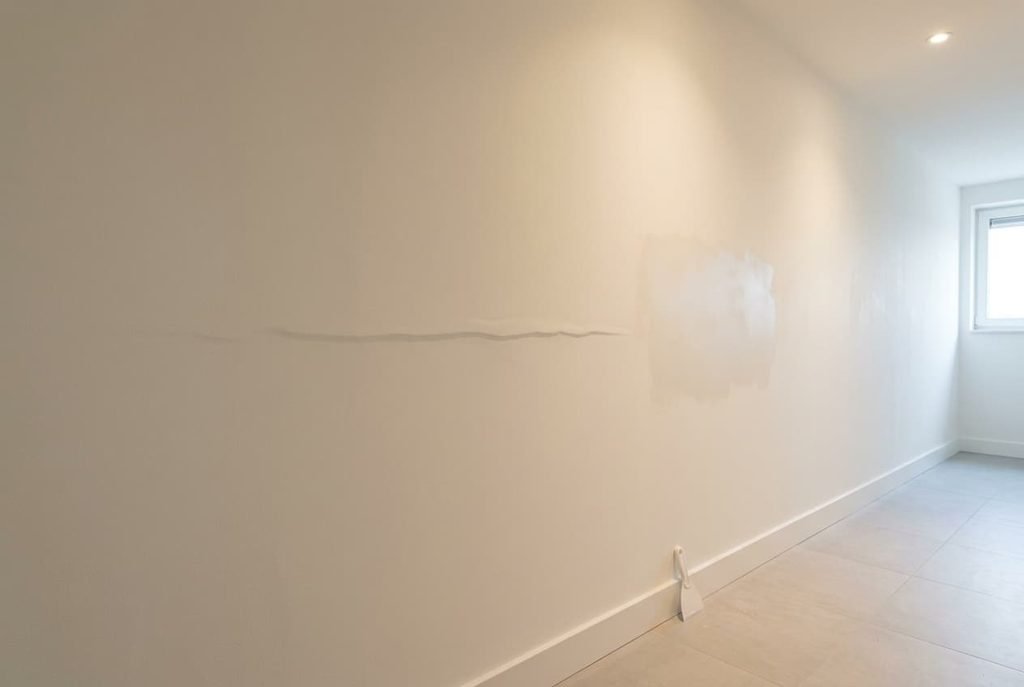
Paint can rarely be patched without a trace. A fresh patch has a different sheen and a different roller texture from the older coat around it, and a hallway’s skimming light shows the edge. So the honest repair unit for paint is the whole wall, corner to corner: 11.25 m².
Paper repairs by strip. A 53 cm roll with a 32 cm pattern repeat needs a strip cut to 282 cm, which covers 1.49 m². That repair unit is 7.5 times smaller. One spare roll of 10.05 m yields three such strips, and each one is a mark you can erase.
Sheen sharpens the problem. A satin coat catches a little more light at a grazing angle than a matt one, so a patch outlines itself. On a matt wall the same patch reads as a faint cloud. Neither vanishes, which is why tradespeople repaint to the nearest corner. After eighteen months in a hallway the old coat has dulled and yellowed, and the gap between old and new only widens.
The advantage holds only if you kept the spare roll.
Head to head
| Question | Wall paint | Wallpaper |
|---|---|---|
| Area redone after one scuff | The whole wall, corner to corner | One strip, about 53 cm wide |
| Wiping off fingerprints | Matt marks easily, satin wipes | Vinyl-faced wipes, uncoated paper stains |
| Hiding a rough wall | Poorly until filled and sanded | Heavy non-woven covers hairline cracks only |
| Removal at move-out | Repaint in the landlord’s white | Peels dry if labelled strippable and the plaster is sound |
| Preparation | Filler, sanding, two coats | A smooth wall in sound condition, plus a spare roll |
| How it ages | Dulls and yellows slowly and evenly | Seams can lift at corners, colour holds |
| Changing your mind later | Paint over it in a weekend | Strip it first, then fill the wall |
The row that catches most tenants out is the rough wall. Thin paper follows the surface. A 0.5 mm ridge lit by a downlight 20 cm out and 120 cm up, an angle of about 9.5°, casts a 3 mm shadow along its length. Filler removes that ridge for good, which is why wall paint or wallpaper isn’t a contest on old plaster until the wall has been levelled. Paint then hides the repair under its own coat. Paper asks for the same sanding first, so its smaller repair unit comes with a larger set-up job.
Where wall paint wins
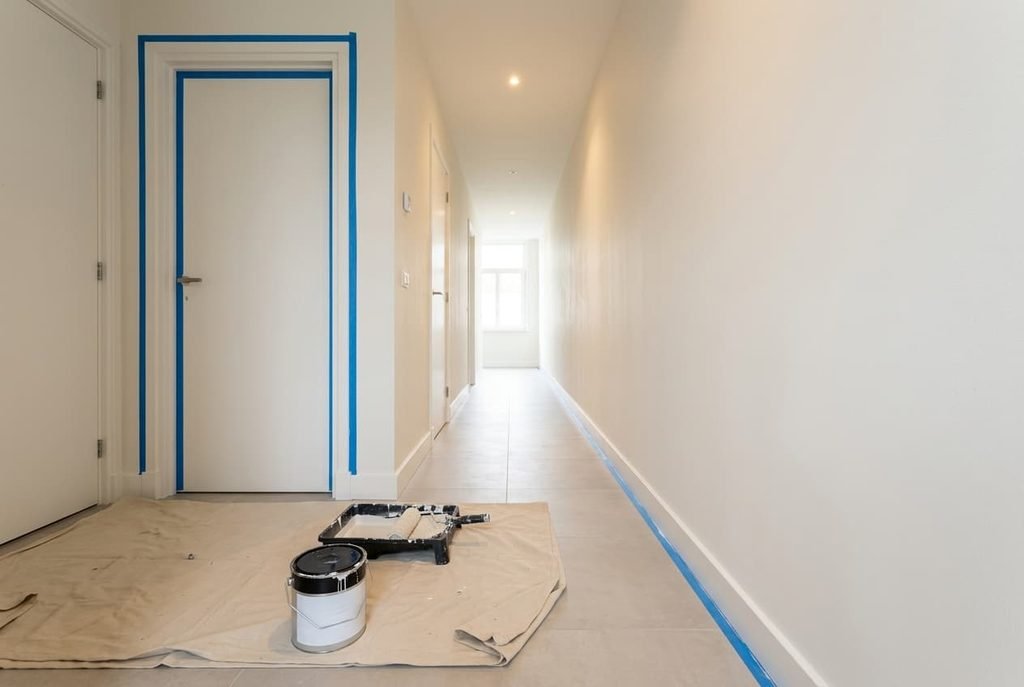
Between wall paint or wallpaper, paint wins on a wall that’s far from flat, and on any tenancy that asks for the original white back. Both cases turn the question into a single job at move-out. Two coats over 11.25 m² mean 22.5 m² of rolling, perhaps a morning’s work. Nothing needs matching, because the whole wall gets the same tin.
Paint has an unglamorous advantage as well. A mistake with paint is a wet cloth away from a fix. A crooked paper strip bubbles and creases, then has to come down before the paste sets. Paint forgives a first-timer, and a hallway is a poor place to practise on a pattern.
Doors punctuate a hallway wall, so the paper has to be cut around frames at several points. Paint runs straight past them with a brush. Marks spread along both walls make the repair-unit argument weaker too, since you’d be re-papering strips on each side. If the landlord’s agreement names the colour, matt white in a tin is also the easiest thing to explain.
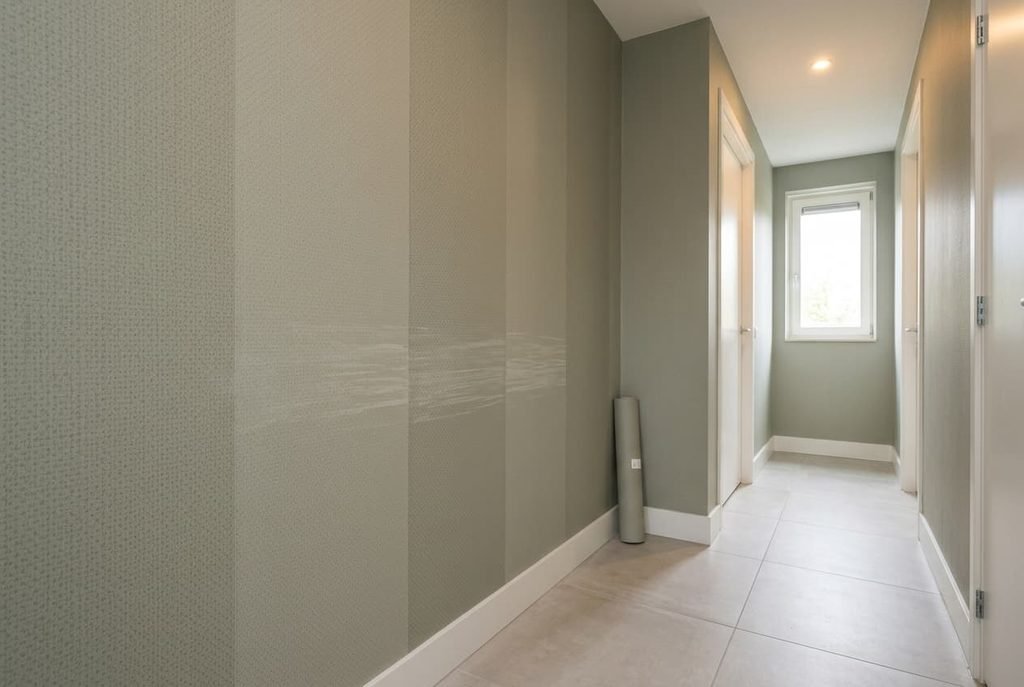
Where wallpaper wins
Wallpaper wins on a hallway where one wall takes nearly all the wear. Marks cluster in a band about 60 cm high, and a 450 cm wall holds 9 strips of 53 cm. Two strips cover a typical cluster, which is 2.98 m² against the 11.25 m² a repaint demands. A busy pattern hides faint scuffs as well, so many marks never need a repair.
The quieter reason is time. A vinyl-faced paper wipes down quickly, and the tenant skips the weekend of repainting a wall because of one brushed bag strap. If the spare roll lives in a cupboard, a damaged strip takes about an hour to swap.
Two conditions apply. First, the tenancy agreement has to allow it, which the landlord has to answer. Second, the plaster has to hold. On an old wall with many coats a peel can take paint with it, and only a test corner behind the door shows how yours behaves.
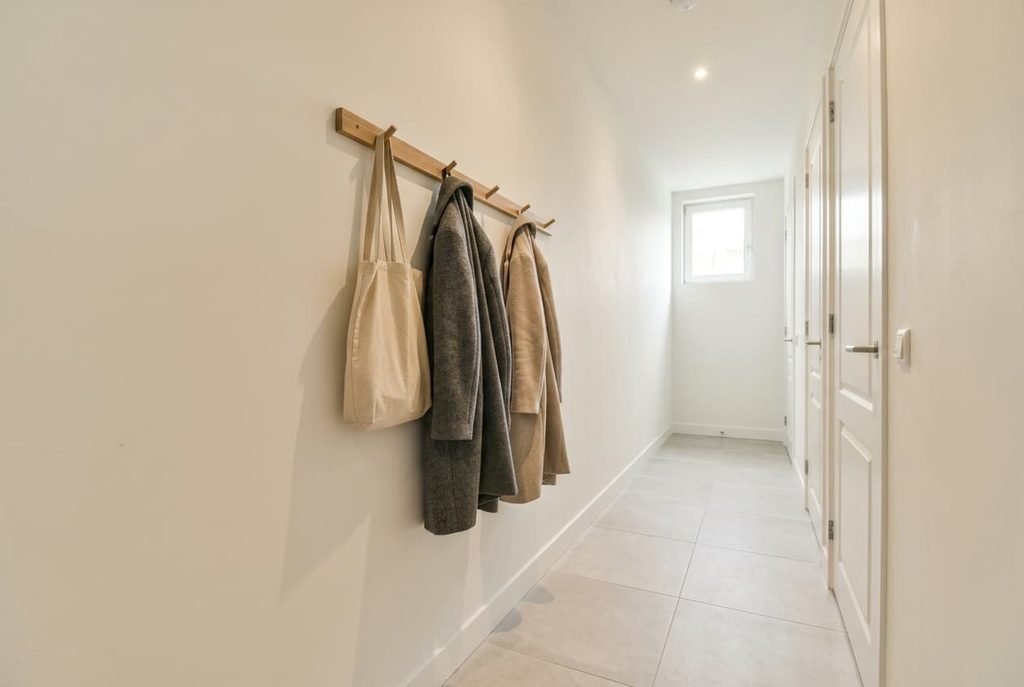
When neither is right
Keep the landlord’s walls and move the coats onto a rail, because with either wall paint or wallpaper most hallway marks come from fabric and straps, not from the wall itself. A rail with hooks fixed at 160 cm lifts bags clear of the 80 to 140 cm band. A coat hanging flat takes about 15 cm of the 105 cm width. That leaves 90 cm, the width of a walkway you can use with a shopping bag in hand.
This route costs no repainting and no peeling at move-out. It suits a wall whose present coat is sound and plain. On a wall with old damage it fails, since a rail hides nothing. A freestanding rack 30 cm deep would cut the walkway to 75 cm, so only a rail screwed to the wall keeps the width. Fixing it means two screw holes. Clear them with the landlord before drilling, and close them with filler at move-out.
Check this route by watching where a strap lands for a week.
[IMAGE 6 HERE – replace this box with the generated image]
How to decide between paint and wallpaper in thirty seconds
Tape a 60 cm band at hip height along each long wall, then count how many 53 cm strips each band crosses. One wall with two or three strips means the marks are concentrated. Two walls with six or more between them means they’re spread out. Count strips, because a strip is the unit you’d actually replace.
If one wall takes most of the marks and the tenancy agreement allows paper, take the wallpaper and keep a spare roll in the flat. If the marks run along both walls, or the agreement asks for the white walls back, take the paint and plan one repaint at move-out.
The repair unit is the whole argument: 11.25 m² for paint and 1.49 m² for a strip. Choose by the size of the job you’ll face in a year. Pattern and colour come second. Test the plaster in one corner behind a door before ordering. A roll that can’t be peeled off is the costliest mistake on this page. A hallway is short enough that the wrong finish shows within a month.
[IMAGE 7 HERE – replace this box with the generated image]
Questions readers keep asking
Does wallpaper last longer than paint in a hallway?
On a wall that’s hit constantly, a vinyl-faced paper often looks tidy for longer, because the surface wipes clean and a pattern masks small scuffs. Paint dulls evenly and stays easy to renew. Neither survives repeated knocks from bags, so both do better with a rail.
How do you clean a scuffed hallway wall?
Use a soft damp cloth with a drop of mild soap on satin or vinyl-faced surfaces, and test a hidden corner first. Matt paint marks if you rub, so dab it. Uncoated paper shouldn’t be wetted at all. Wipe scuffs soon after they appear, before they set.
Which suits a rented flat with a narrow hallway?
Paint suits most rentals because it’s easy to undo and ask for permission on. Choose paper only if one wall takes the wear and the landlord agrees. In a corridor 105 cm wide, a pattern also draws the walls inward, so favour a light, small repeat.