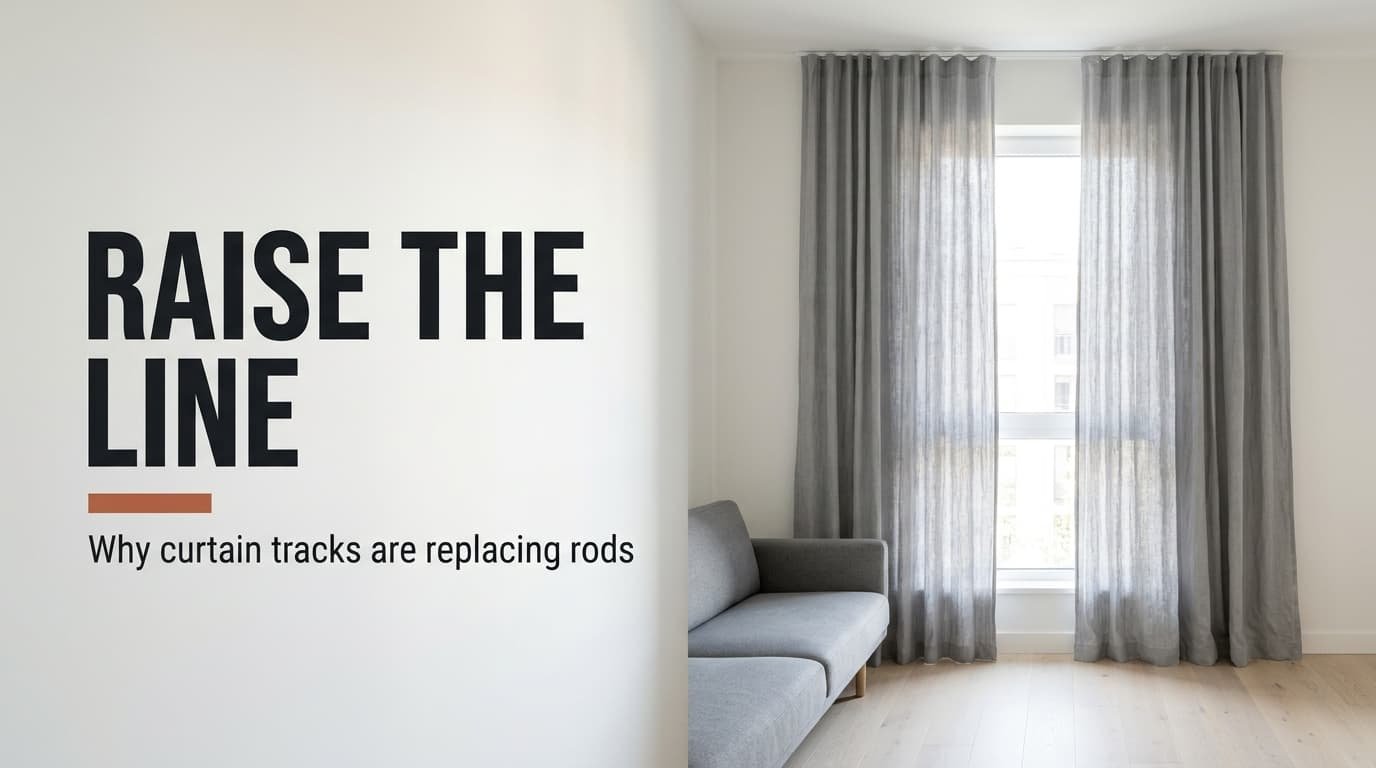
A curtain should hang from the highest point the wall allows. Curtain tracks are replacing rods in small Dutch living rooms because a track fixed to the ceiling gets there and a rod doesn’t. The sums use a window 220 cm wide in a lounge whose window wall runs 340 cm, under a ceiling at 250 cm. Every drop and stack is assumed, and so is each fabric weight, so check your own walls first. No brand is quoted. No shop or price appears either. Figures like those go stale long before a ceiling does. The rule is blunt on purpose, so try it on your own ceiling.
Where rods came from before curtain tracks
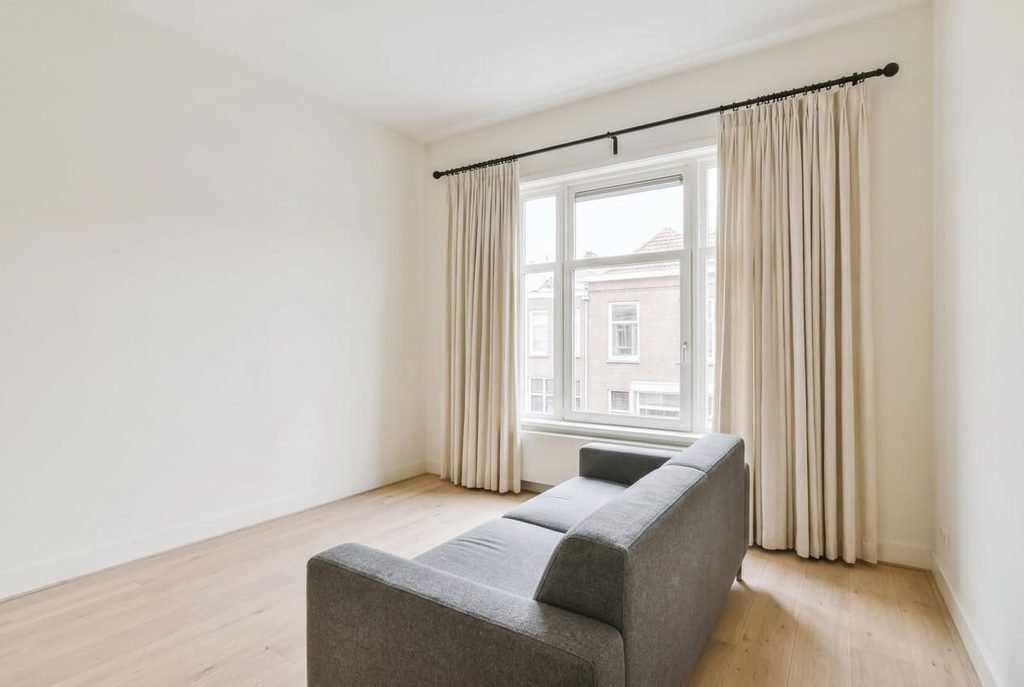
A rod won its place by being simple. One metal tube with two brackets will carry a curtain across almost any window once rings are threaded on. Nearly every hardware aisle has stocked the parts. Fixing is quick, since the brackets go into the wall just above the window frame. Finials at each end give the rod a finished look, and the rings let a heavy curtain be pulled by hand.
Tracks have long served places where a curtain must travel a long way smoothly. The fabric hangs from small runners inside a channel and the channel is fixed along the ceiling. What moved the track into living rooms is the channel itself. Slim versions are only a couple of centimetres wide, and the runners are quiet.
In our model the rod sits 10 cm above a 210 cm window frame, so it’s at 220 cm. Brackets project 10 cm, and finials add 8 cm per end. That geometry is the starting point for the counts below.
What actually changed now curtain tracks are replacing rods
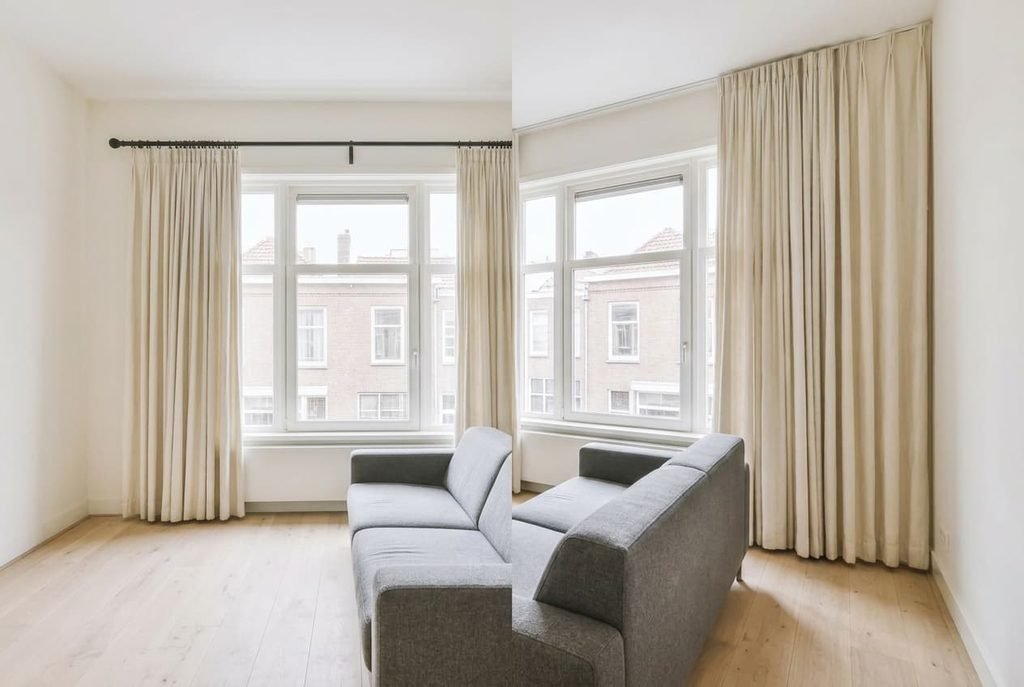
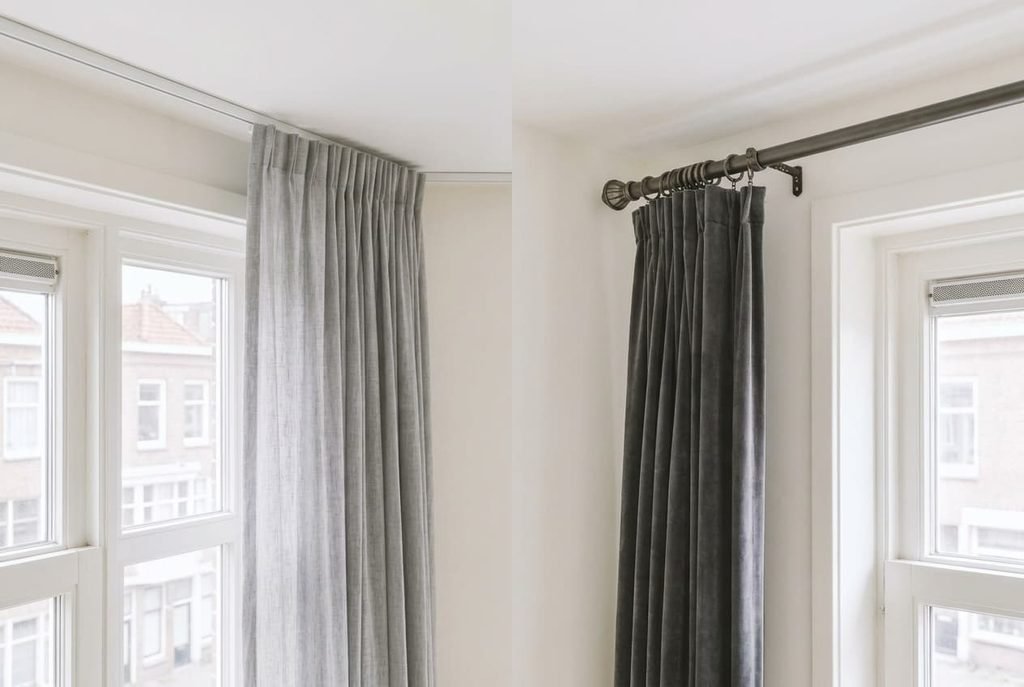
The swap alters three measurable things on the same 340 cm wall. Height comes first. The rings hang the fabric 3 cm below the rod, so the top edge sits at 217 cm. With 2 cm left above the floor, the drop is 215 cm. A track fixed to the ceiling puts the top edge at 247 cm, so the drop is 245 cm. The drop grows from 215 cm to 245 cm, while the bare strip above the fabric shrinks from 33 cm to 3 cm. That’s 14% more curtain and 91% less strip.
The second is the hardware you see. We assume the rod spans 280 cm so the open curtains clear the glass. Finials add 16 cm, which makes 296 cm of metal at eye-catching height. Four brackets stand out from the wall as well. A ceiling channel is a 2 cm edge, and a drawn curtain hides it from the sofa. From the sofa, the rod reads as a horizontal line that crosses the wall below the ceiling, and the eye stops at it.
The third is the glide. A 280 cm rod needs a bracket at least every 120 cm. That means four brackets, and two of them stand where the rings must pass. Each catch stops the pull for a moment, so a full draw includes two stops. A track has nothing in the path, so the count falls to zero, and a full draw becomes one continuous pull.
The track removes the stops without adding a single sound.
Who a ceiling track suits, and who it doesn’t
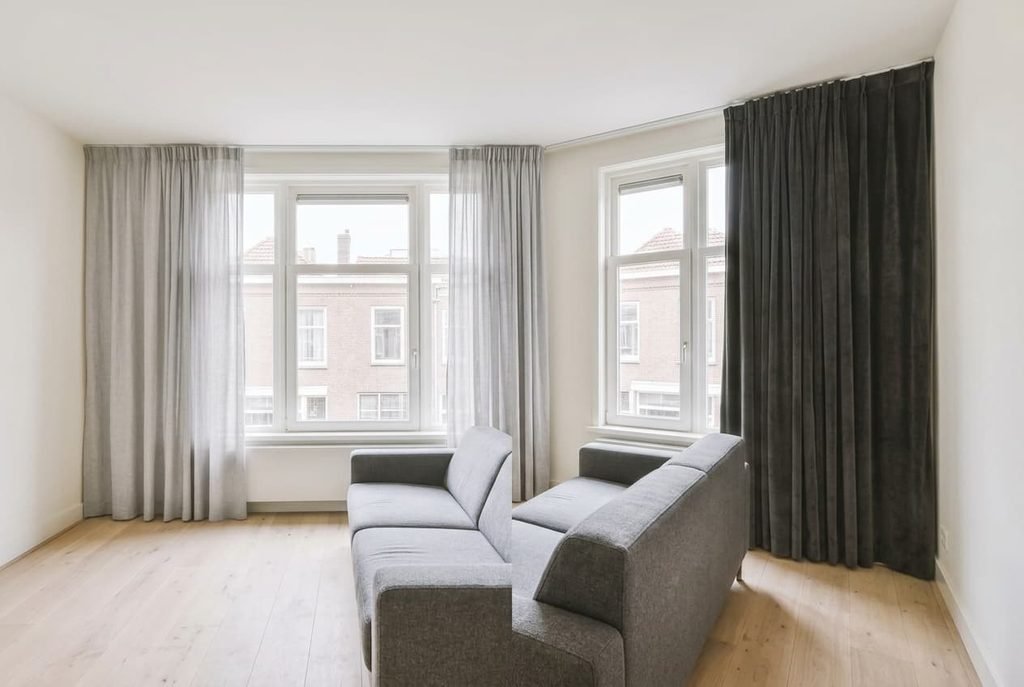
A low ceiling shows the gain best. At 250 cm, the extra 30 cm of drop is 12% of the wall height. It suits a wide window too. A 160 cm window needs a 220 cm rod and three brackets, which leaves one catch, while our 220 cm window leaves two. The wider the window, the more a track tidies.
Curtain tracks are replacing rods first in rooms where the curtains are drawn every day, because a daily glide is where a catch costs most. It suits anyone who dislikes seeing hardware at all.
It suits poorly a curtain that’s heavy. Our panels measure 2.15 m by 1.98 m, so a pair covers 8.5 m², and a lined fabric at 0.8 kg/m² weighs 6.8 kg. An interlined fabric at 1.2 kg/m² weighs 10.2 kg, which can exceed what a light track is rated to carry. Check the rating on the pack.
A dipping ceiling gives it away. Because the top edge follows the ceiling, a dip of 1 cm over 340 cm will show as a slope. Fans of finials will also miss them, since a rod is part of the look.
The ceiling is the line your eye compares everything against.
Are curtain tracks beating rods, and is it worth the change
Put a number on each gain. The glide is the small one. Each draw has two catches, and there are two draws a day. With each catch costing 3 s, that makes 12 s a day, or 73 minutes a year, so smoothness is no reason to switch. Height is the real gain, though it also means 14% longer panels to buy and hang. The drop grows by 30 cm and the bare strip falls to 3 cm.
Our advice is that a track earns its place where the window wall is wide and the ceiling low, and it adds little under a high ceiling. If your rod works, keep it. A short window under a high ceiling gains the least, so the rod stays the cheaper answer there, and the saving goes toward better fabric. Replace it on the day you redecorate that wall, because the old bracket holes need filling then anyway.
The version that will date fastest
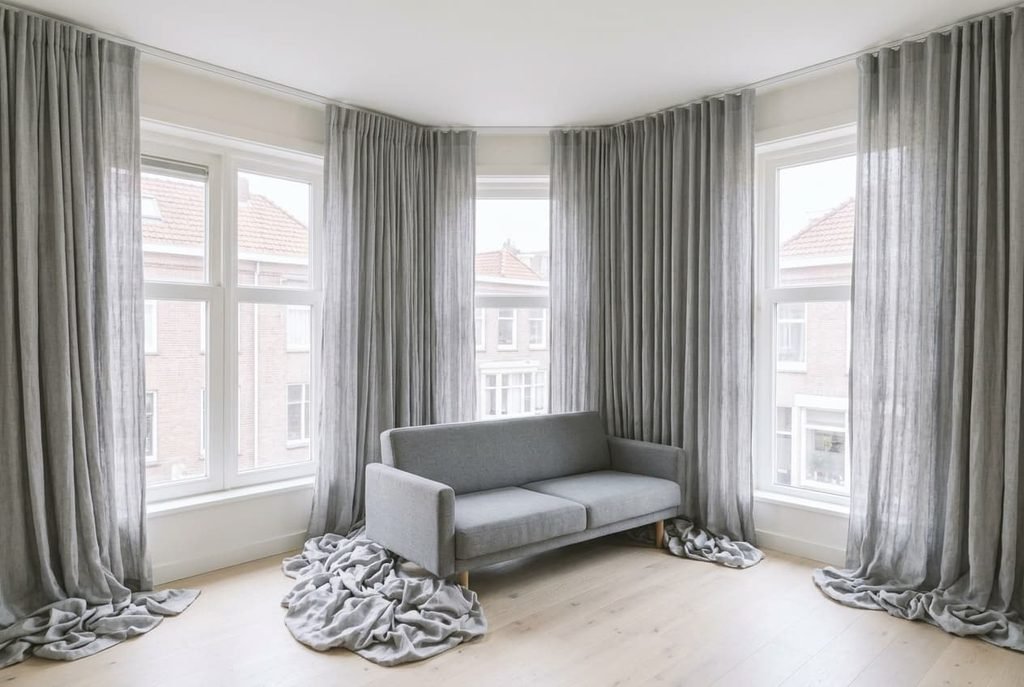
The extreme version is ceiling tracks on every wall of the room, with the fabric pooling on the floor. Our room measures 340 by 480 cm, so the perimeter is 16.4 m. At 1.8 times fullness that’s 29.5 m of fabric. With a 255 cm drop it covers 75 m² and weighs about 23 kg at 0.3 kg/m². Fixing clips every 60 cm means about 28 holes in the ceiling.
The sign that curtain tracks are replacing rods too far is a room with no bare wall left for a shelf or a frame. Pooling is the weak point, because fabric lying on the floor wears at the hem and gets caught by feet. It also can’t be undone cheaply, since a track along 16.4 m means 28 holes to fill.
The moderate route is one window wall. At 3.4 m of 16.4 m, that’s 21% of the perimeter, which is enough to see and leaves the other walls free.
How to test a track before you commit
Run painter’s tape along the window wall at 217 cm and again at 247 cm. Sit on the sofa and look at each line for a minute, then judge which one makes the wall feel taller. Pin a bedsheet to the upper strip for a week if you can, since a sheet shows how the fabric reads from the room. Check the ceiling line too, because a dip of 1 cm over 340 cm shows against a straight curtain top. Photograph both tape lines from the sofa with the same zoom, then compare the two pictures on one screen. The better line is usually obvious within seconds.
Curtain tracks are replacing rods because they buy 30 cm of height and take the hardware out of sight, not because the glide matters. Run the tape test before you spend anything. Keep a sound rod. Choose a track when you redecorate the wall, and decide with the tape in front of you. Two strips of tape cost almost nothing, while ceiling holes are slow to undo.
Questions readers keep asking
Should I replace a sound rod with a track?
Not just because it’s fashionable. A working rod still hangs a curtain, and the glide gain in our sums is worth about 73 minutes a year. Replace it when you’re redecorating the wall anyway, since the old holes need filling either way. Do it only if you’d see the extra 30 cm of height from the sofa.
Who does a ceiling track suit?
Rooms with a window wall wider than 200 cm and a ceiling near 250 cm, where the extra 30 cm is 12% of the wall. It suits curtains drawn daily. It suits poorly a ceiling that dips, and curtains over 10 kg.
How long will the look last?
The height gain won’t date, because a taller curtain is simply a taller curtain. What dates is the exaggeration, such as fabric pooling on the floor. Pick the quiet version: a 2 cm channel, a drop of 245 cm and 2 cm clear of the floor. Nobody can date a taste, but that version avoids the extremes.