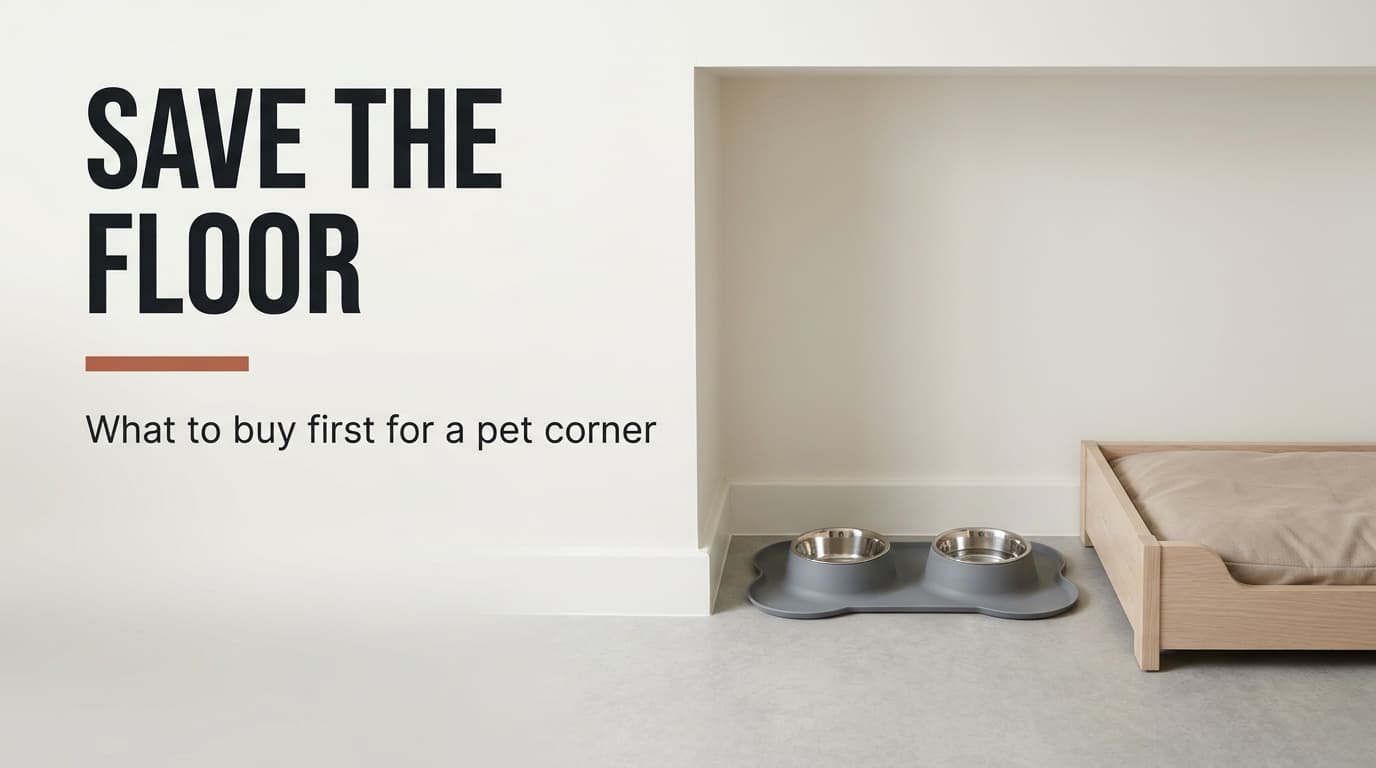
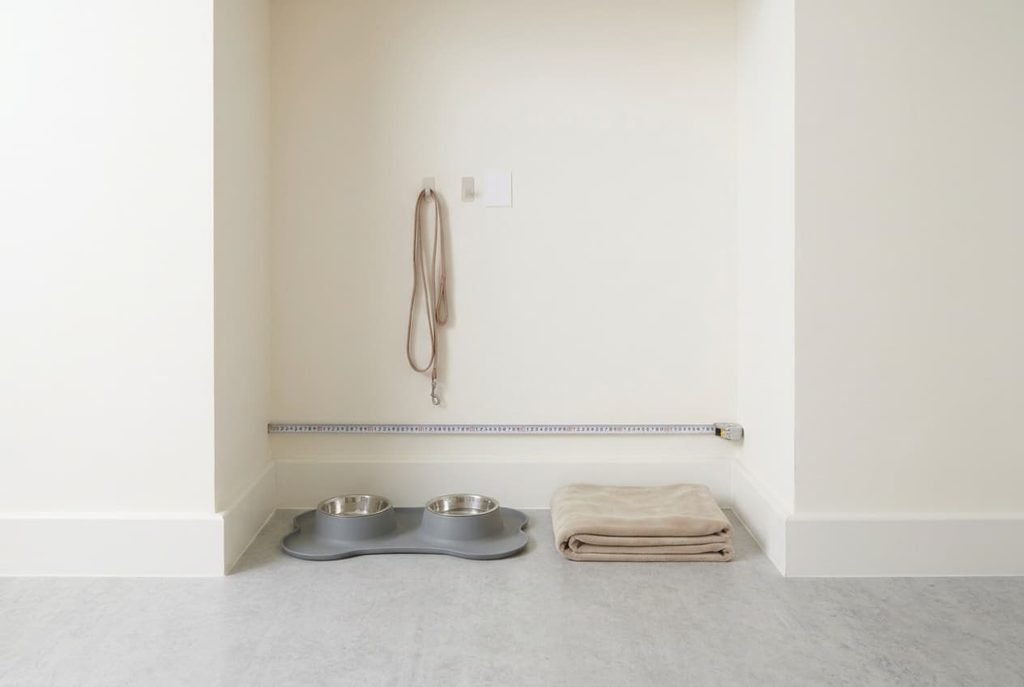
The water bowl slops across the floor again, and the bed has drifted into the walkway. A pet corner in a small rented flat needs its first purchase to protect the landlord’s floor, because a mess there costs more than any cushion saves. The example flat is Dutch, with an alcove of 130 × 90 cm off the hall and a vinyl floor that isn’t yours. The pet is a 15 kg dog, and each size below stands in for yours. Five buys follow in order, then the one to shrink and four to skip.
The rule that decides the order for a pet corner in a small rented flat
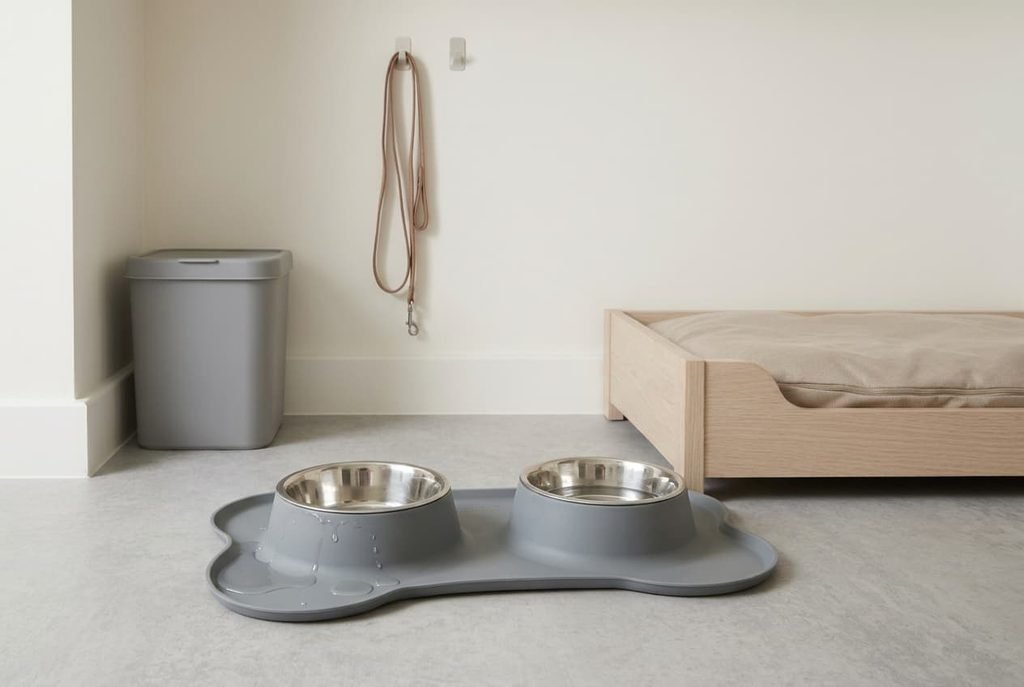
Most shopping lists open with the bed, since beds look like the corner. A pet corner in a small rented flat is better ordered by damage. Assume 12 drinks a day with 5 mL lost each time. That is 60 mL a day and 22 L a year. A floor of vinyl planks has edges that swell when water sits in the joins, and the damage appears slowly, so the cost hides until the deposit is settled. A 60 × 40 cm mat with a 2 cm raised edge holds 60 × 40 × 2 = 4.8 L, which is 80 times a day’s splash.
So spend first on whatever keeps water and food off the floor, then on what the pet uses every day, and last on what only looks tidy. A poor bowl is replaced within minutes, but a leaking mat can cost you a deposit. Stand in the alcove with a tape and note its width and depth before you shop. Those two numbers decide everything that follows. Write them on your phone, because shop aisles make every bed look the right size and every mat look generous. A bed that fits in the aisle can still block a hall.
Five buys for a small rented flat pet corner, in order
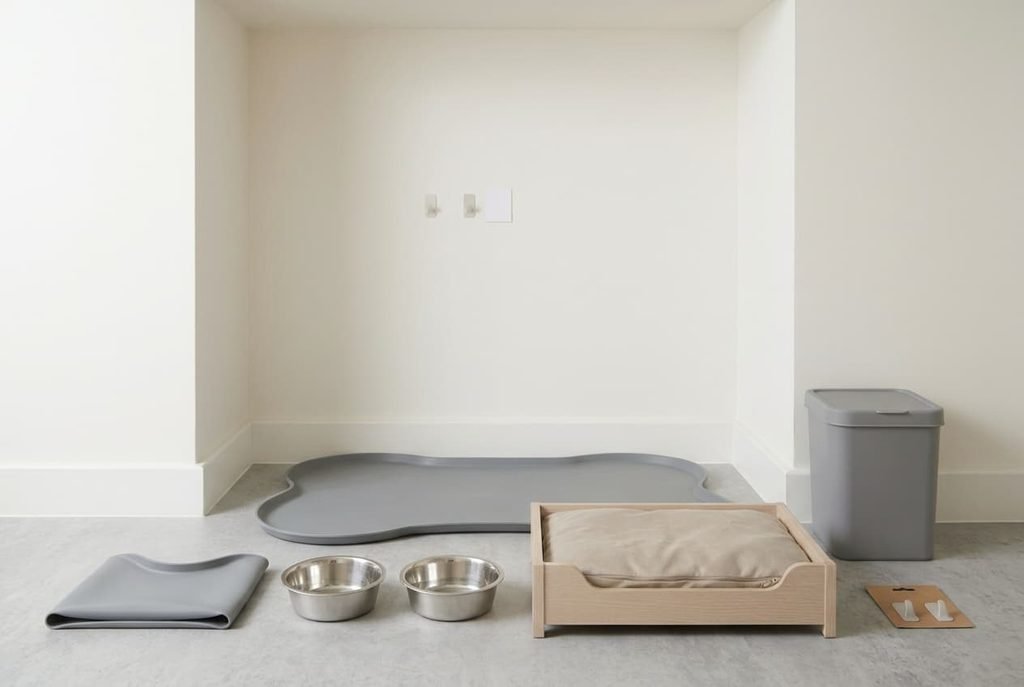
1. A moulded silicone feeding mat, 60 × 40 cm with a raised edge, bought first because it catches the 60 mL a day. Tier: BUY MID. A single cast piece leaves no seam for water to creep along. Fault to avoid: a fabric mat with a rubber back, which wicks water straight to the floor.
2. A pair of stainless bowls, 18 cm wide, with a weighted base of about 600 g. They come second because they sit inside the mat’s footprint. A full bowl holds 1.5 L, and 600 g of base stops a dog pushing it across the lip. Tier: BUY CHEAP. Pressed steel is pressed steel, so extra money buys nothing. Fault to avoid: a bowl with a hollow base, which tips.
3. A bed of 80 × 60 cm with a zipped cover over a 5 cm foam slab. It ranks third since the dog uses it for most of the day. A curled 15 kg dog needs about 55 × 40 cm, so 80 × 60 leaves 25 cm to spare. Tier: BUY ONCE. Dense foam keeps its shape for years, and a zip lets the cover go in the wash. Fault to avoid: a sewn-in cover, which can’t be washed.
4. A lidded bin of 20 L. A 5 kg bag of food is about 14 L at a density of 0.35 kg a litre. The bin takes fourth place because it protects the bag from spillage. Tier: BUY CHEAP. A cast tub with a clip lid leaves little to fail. Fault to avoid: a bin with a hinge on a thin plastic strip, which snaps.
5. Two adhesive hooks rated for 1 kg each, on the alcove wall at 130 cm. They finish the list because a lead and a towel weigh 0.4 kg together. Tier: BUY CHEAP. A clean wall is the only real requirement. Fault to avoid: hooks used on textured paint, where the adhesive fails within weeks. Press each one for 30 seconds and wait a day before hanging anything, since the bond keeps strengthening.
Where the money goes, and the bed to scale down
The mat and the bed take the money, since one protects the deposit and the other is used all day. In a pet corner in a small rented flat, the other three buys can be replaced for little.
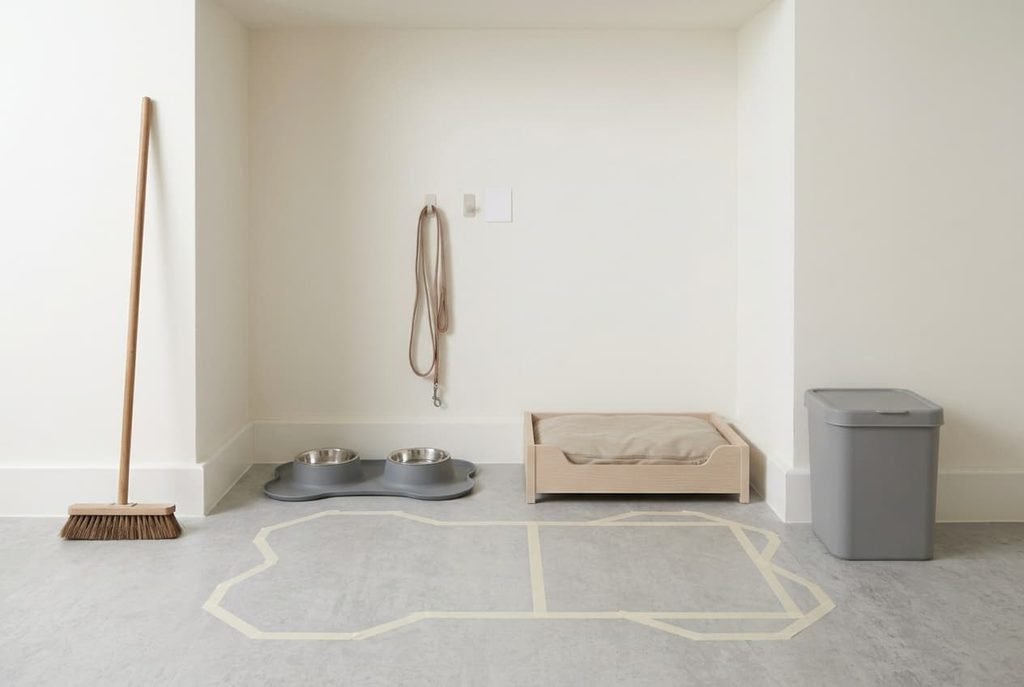
Then scale the bed down from 100 × 70 cm to 80 × 60 cm, which looks small. The alcove is 130 cm wide, and the mat turned to 40 × 60 cm needs 40 cm of that width. A 100 cm bed leaves 130 − 100 − 40 = −10 cm, so it doesn’t fit. An 80 cm bed leaves 10 cm, and the dog still has 25 cm beyond its curled length of 55 cm. The smaller bed also uses 2,200 cm² less foam, 31% less to buy, and the 10 cm gap lets you sweep between mat and bed.
A bed should fit the dog and leave the alcove alone.
A dog that stretches out flat needs more than 80 cm, so it will hang over the edge onto the mat. Leave the mat where it is and watch for a week. A dog that stretches off the bed daily needs one size up.
What this order assumes, and when it breaks
The order suits one 15 kg dog and a hard floor. It also assumes the alcove is 1.17 m², with room for a mat and a bed side by side. Carpet moves the mat down the list, since carpet holds what vinyl lets you wipe.
Two dogs change the sums. Splash doubles to 120 mL a day, and the mat still holds 4.8 L, but the bowls need a second pair and the alcove needs a second bed. At that point 130 cm is too tight, so use a hall wall of 200 cm instead, so tape it out first.
An alcove only 100 cm wide takes the mat and a bed of 55 cm. Keep the mat and bowls, and put a folded blanket in place of the bed until you can move.
Read the tenancy before you stick anything to a wall. Adhesive hooks suit most agreements, but some ban any mark.
What to skip entirely
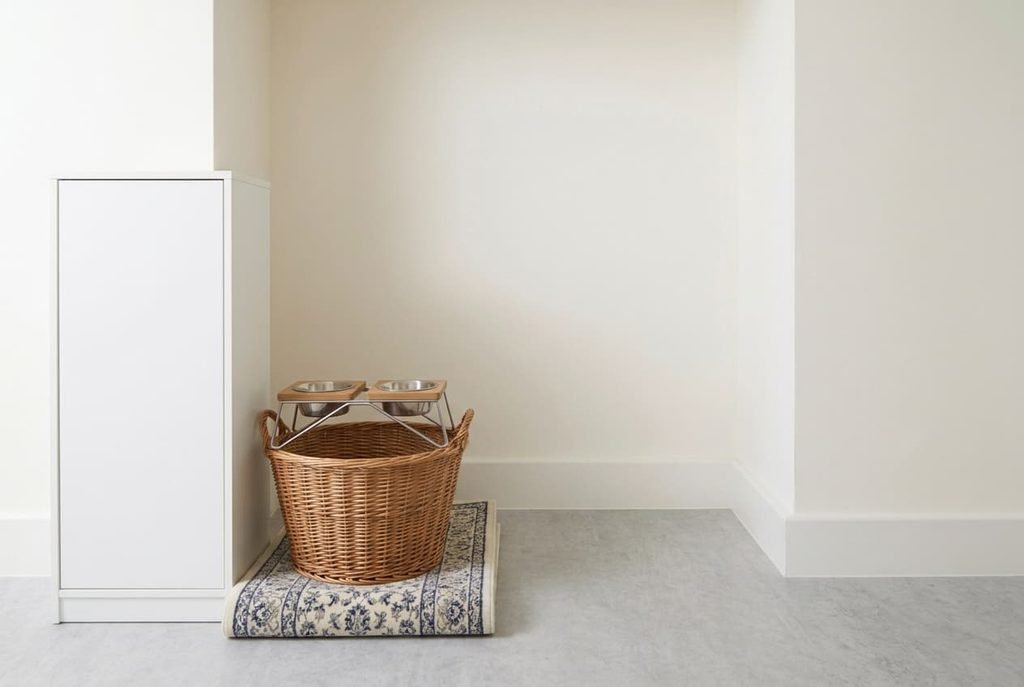
A closed pet cabinet with a door tops the skip list. A cabinet 60 cm wide takes 46% of the 130 cm width before the dog has a place to lie, and a damp dog in a closed box makes a poor bed. Second is a raised bowl stand, which uses 30 × 40 cm of floor and lifts water 15 cm higher before it spills. Wicker baskets soak up any splash and dry slowly. A rug laid under the corner traps hair and hides spills the mat should show. Skip all four and the money goes to the mat. A pet corner in a small rented flat rarely needs more than the five buys above, and every extra object adds something to wipe around.
Each of these costs floor you’ve already counted.
Order is the whole plan: mat, bowls, bed, bin, hooks. Each piece copes with whatever the one before it let through. Pin that sequence to the hall wall and live with the corner for a fortnight before any extra purchase. A dog’s habits show in days, long before a shop’s catalogue shows its prices. If a seventh item tempts you, ask which of the five it would protect, and put it back when the answer is none.
Questions readers keep asking
How many pieces do I need to start?
Just two items, the mat plus the bowls. Together they stop 60 mL of splash a day and cost almost nothing to replace. Add the bed next, then the bin. This alcove holds five items, and a sixth deserves a second thought before you buy it.
Should I buy a bin before the bed?
Only if food is spilling. The mat and bowls settle whether the floor stays dry, and a bin only protects the bag. Use the bag’s own seal for two weeks, then add a bin once you know how fast it empties. The mat and bowls use 0.24 m² of the alcove’s 1.17 m².
How do I judge a feeding mat in a shop?
Press down on the lip and feel for a firm, springy wall at least 2 cm high. Flip it over. You want a single cast sheet, and the underside should show no stitched or glued fabric. Reject any mat that smells strongly of chemicals when you hold it close.