Each wet week the airer blocks the room, and the clothes still need three days. The cause is usually where the rack stands, and you can settle it with a measuring tape in one afternoon. In a utility room that also has to dry the washing, the layout decides how fast the air moves past the clothes. The test room, Dutch, measures 190 × 240 cm, and each size is a placeholder for yours. Fill in your own numbers first. A rack shifted by guesswork usually creeps back to where it began. The aim is a layout you won’t need to rethink every wet week.
What sets the layout of a utility room that also has to dry the washing
A load of 5 kg of dry laundry leaves the spin cycle holding about 2.5 kg of water. That water has to go into the air. The room is 4.56 m² with 250 cm of headroom, so 11.4 m³. Assume the air sits at 18°C and 60% humidity, which leaves room for about 6 g more water in each cubic metre. The room holds only 68 g of spare capacity, so the result turns on how fast the air is replaced. A utility room that also has to dry the washing needs a clear path more than it needs storage.
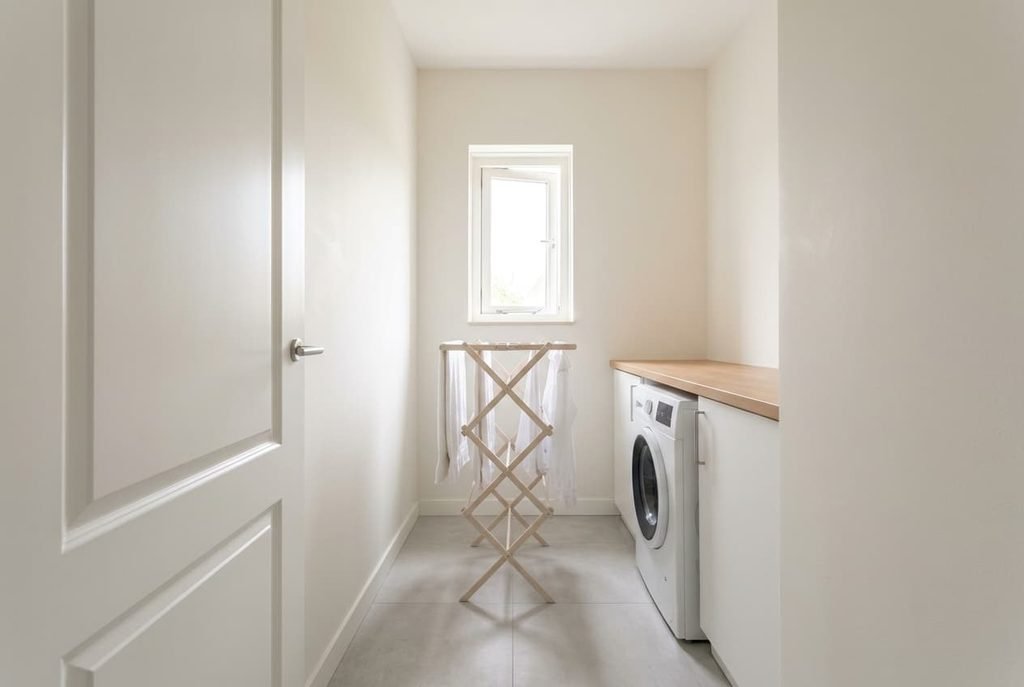
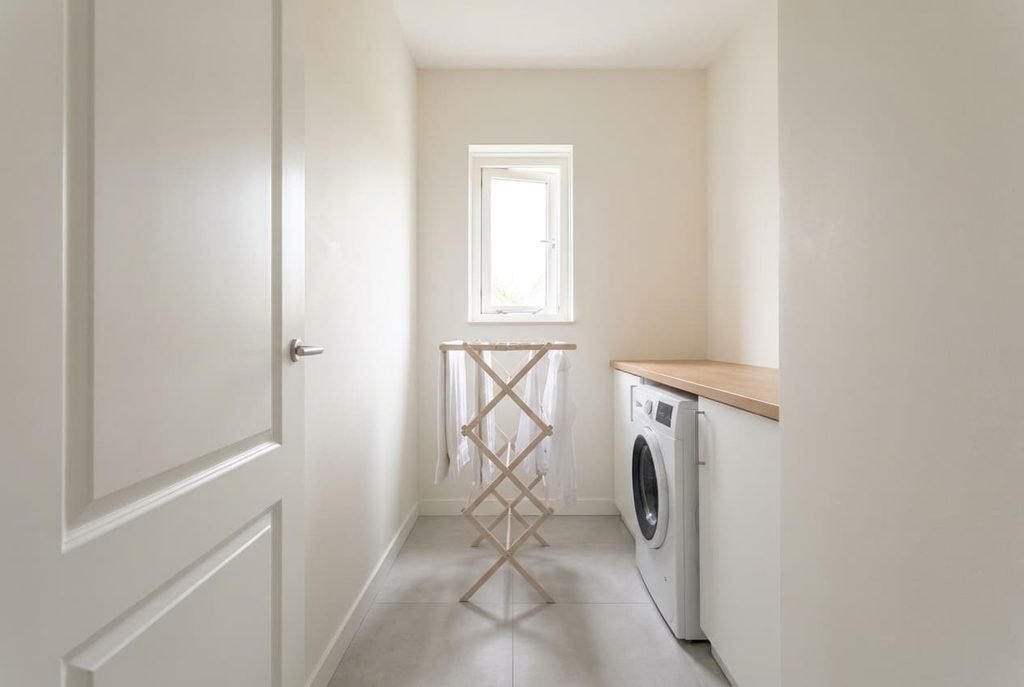
At one air change an hour, the room absorbs about 68 g an hour, and 2,500 g takes 37 hours. With four changes an hour it absorbs 274 g an hour, which is 9.1 hours. Set the airer on the straight line between window and door gap, with 40 cm clear on both long sides, because that line is where the air moves. The window stands halfway along the north wall. At the south end sits the door, so the line runs down the left side of the room. The machine takes the east wall at 60 cm, leaving 130 cm of width. A 50 cm deep airer then leaves 40 cm of air at each side.
Dry air arrives at one end and leaves at the other.
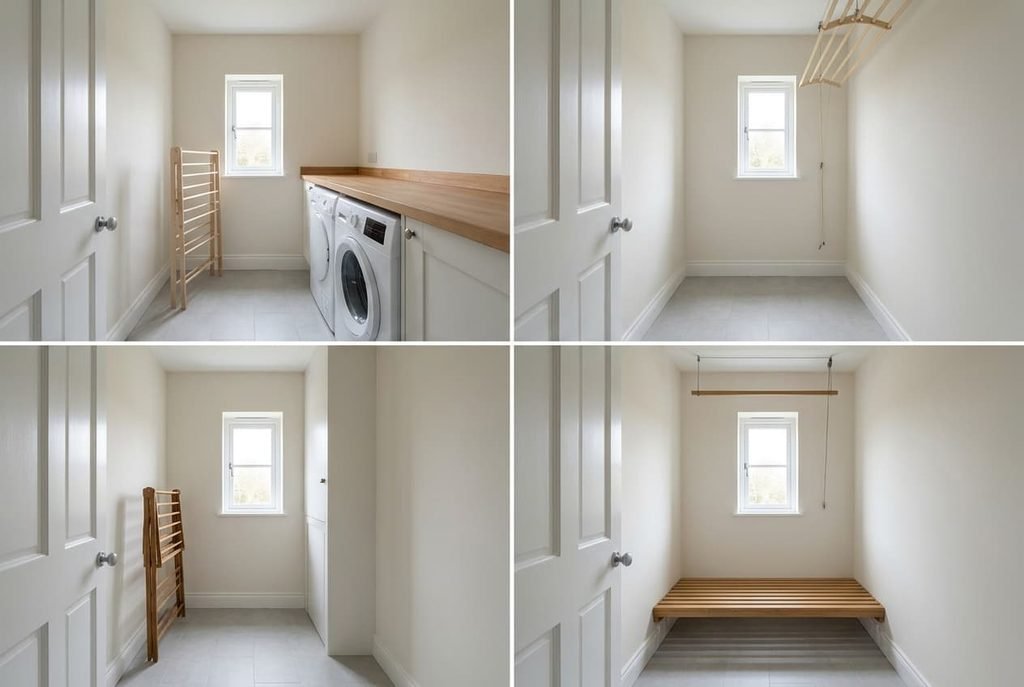
Four layouts for a utility room that has to dry the washing
– Rental-friendly, 190 × 240 cm: a front-loader in the east corner below a 60 cm square beech worktop at 90 cm. A freestanding ash concertina airer of 160 × 50 cm stands on the window-to-door line. A clip-on vent, a slatted crate for pegs and a 30 cm shelf at 150 cm for powders complete it. Nothing is drilled into the walls.
– Tight footprint, 150 by 200 cm: a pale pine pulley airer, 140 by 40 cm, hangs at 200 cm. It rises out of the way between loads. A wall-hung folding board, 60 by 40 cm, sits at 95 cm. The floor stays clear, so the space ahead of the machine door survives.
– Awkward shape, 210 × 160 cm with a 60 cm boiler cupboard on one wall: leave the cupboard alone and keep 40 cm of floor clear before its door. A teak-oiled airer of 150 × 50 cm stands parallel to the opposite wall. A 25 cm shelf runs above the machine.
– Full furnish, 240 × 300 cm: a machine and a dryer side by side under a 130 × 60 cm oak worktop at 90 cm. A slatted oak platform measuring 120 by 60 cm catches drips beneath a drop-down rail at 190 cm. A wall-hung linen basket and a pale tiled floor finish the room.
Where people go wrong with the airer
Each error here comes from a distance nobody measured, and a utility room that also has to dry the washing punishes all of them. A tape finds every one in a minute.
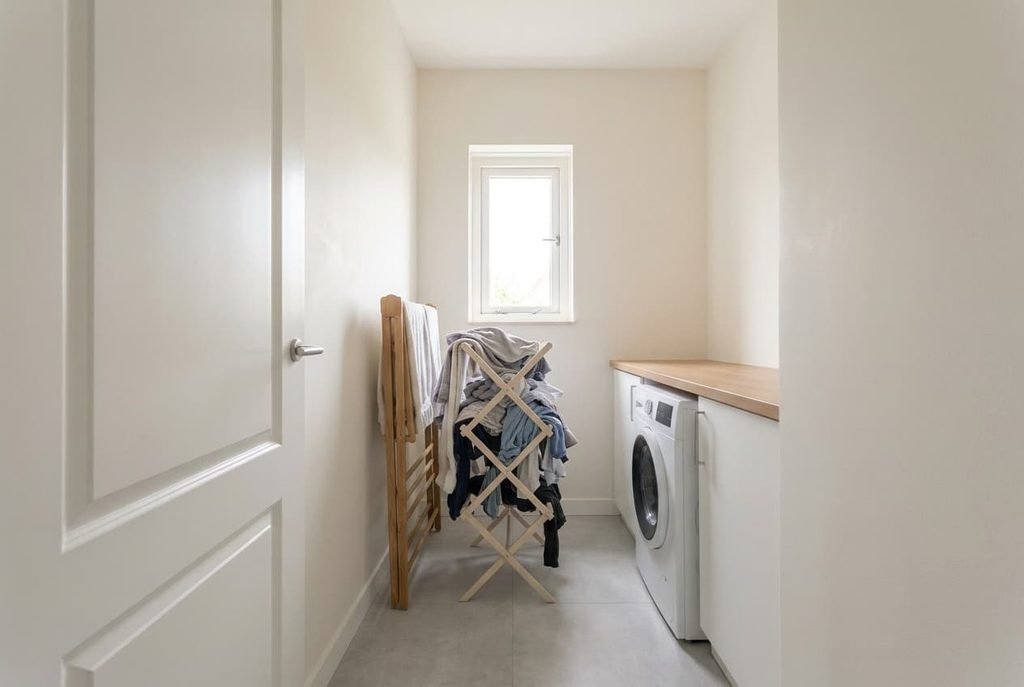
Pushing the airer into the corner. One face of the rack then touches a wall, so only half its surface meets moving air. Expect the 9.1 hours to stretch towards 14. You’ll also find the face against the wall still damp when the other side is ready, and that’s the sign.
Shutting the door to keep the room warm. A closed door and a closed window cut the air changes to about one an hour. That 9.1 hours becomes 37. The same load then takes a day and a half. The room feels warmer, but the clothes can’t tell, since they only respond to moving air. Crack the window instead, even in winter. Keep the door ajar too.
Loading the rack past 5 kg. An 8 kg load packs garments within 5 cm of each other. The gaps that carry moisture away disappear. The time roughly doubles, so split the load across two evenings. Most people overload because the rack looks big enough. It’s the spacing that does the work, and an extra evening costs less than a damp morning.
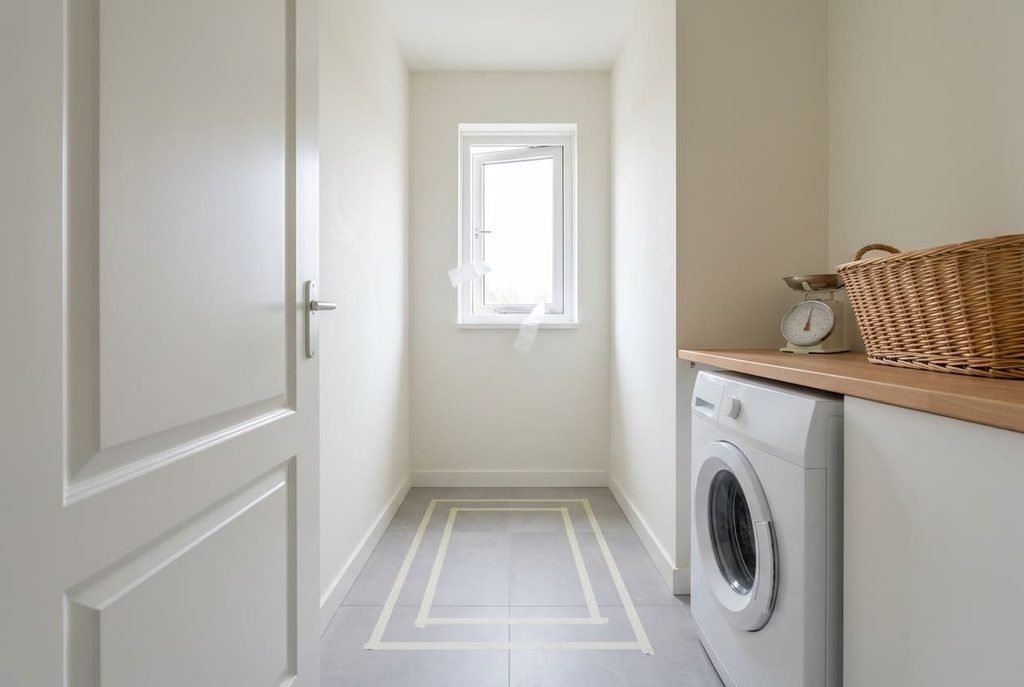
Standing the airer inside the door arc. An inward door of 80 cm covers a quarter circle of about 5,030 cm², which is 11% of the 45,600 cm² floor. The rack then has to move every time someone enters. It drifts back into the corner. Draw the arc on the floor in tape before you place anything. You’ll see what the door claims before the rack does.
When the obvious utility room layout is wrong
Standard advice for a utility room that also has to dry the washing is to keep the centre clear and push the airer against a wall. It sounds sensible. A 130 cm gap beside the machine leaves an 80 cm walkway when the rack sits against the wall.
The tidy layout looks generous on paper and works against the washing.
Argue the other way and I’d back an airer at the room’s centre over one pushed against the wall. The rack then has 40 cm of air on both sides, though the walkway narrows to the same 40 cm. That is tight, but the rack only stands there on wash days. Three loads a week at 9.1 hours each is 27 hours, or 16% of the week’s 168 hours. Folding the rack away takes about 20 seconds. The narrow passage is a few hours of inconvenience, and it buys a drying time cut by a third.
Your room may differ, because the line moves with the window and the door. A window in the corner pulls the line towards that wall. Measure before you decide.
Three things to try this weekend
1. Find the air line. Use a strip of tissue held at the window gap and then at the door gap. Tape a line on the floor between the two spots where it flutters most, and mark a strip 40 cm wide along both sides.
2. Tape the airer’s 160 by 50 cm footprint along that line, then swing the door through its arc. If the arc touches the tape, shorten the rack. Failing that, shift it 10 cm towards the machine.
3. Hang one 5 kg load. Weigh a spare basket of the same clothes dry for comparison. Weigh the hung load again after 6 hours, using the same scale. A loss near 1.6 kg means the line is working. Under 1.2 kg means the rack needs moving closer to the line or the window needs opening 5 cm further.
Treat the first load as a test of the room, since the clothes are only the measuring tool. A drying room earns its keep when the air has a clear path through the rack. Every tape line above exists to protect that path. Leave the tape on the floor until the habit sticks. After a fortnight of wash days, fix the layout with a spirit level and a few screws.
Questions readers keep asking
How much clearance does an airer need?
Leave 40 cm clear on both long sides so air can move past the clothes. A 50 cm deep rack then fits a 130 cm gap exactly. Allow another 60 cm ahead of the machine door, and keep the rack out of the arc of any inward door.
Where should the airer go in a small utility room?
Stand it on the straight line from window to door gap, because that is the route the air takes. Avoid corners, where one face of the rack touches a wall. Fold it away between loads if the passage narrows, which takes about 20 seconds.
Does wall colour change how fast washing dries?
No. Drying speed follows air movement and humidity, so paint makes no difference to it. Pale walls only help you see what you’re doing in a small room. Put your effort into the air line and the 40 cm clearances before you pick a colour.