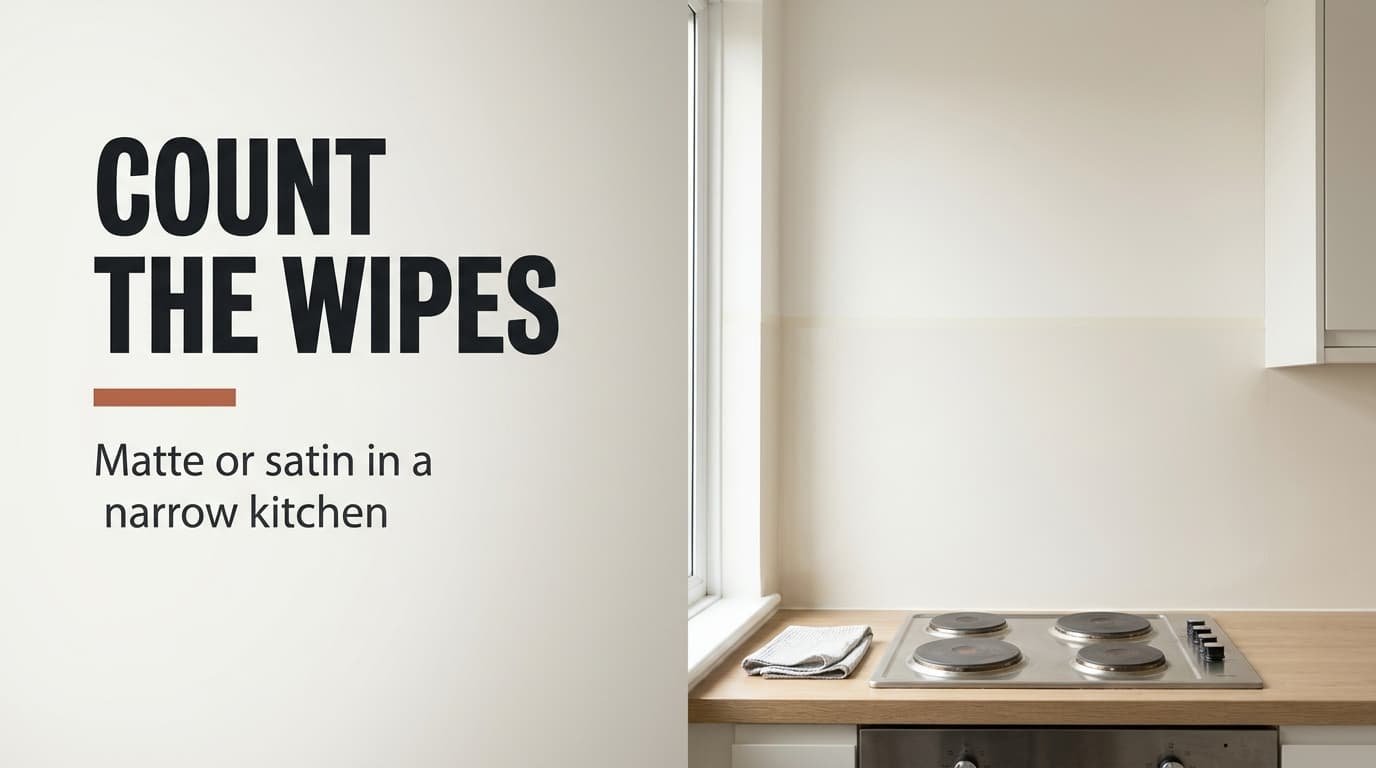
Matte or satin paint: which finish survives a year of wiping in a narrow rented kitchen? Satin, if you cook at the work wall most days. Matte, if the kitchen sees little grease and the walls carry the flaws a tenancy leaves behind. The decisive measure is the burnish budget, that is, how many wipes a finish takes before the rubbed patch turns shiny.
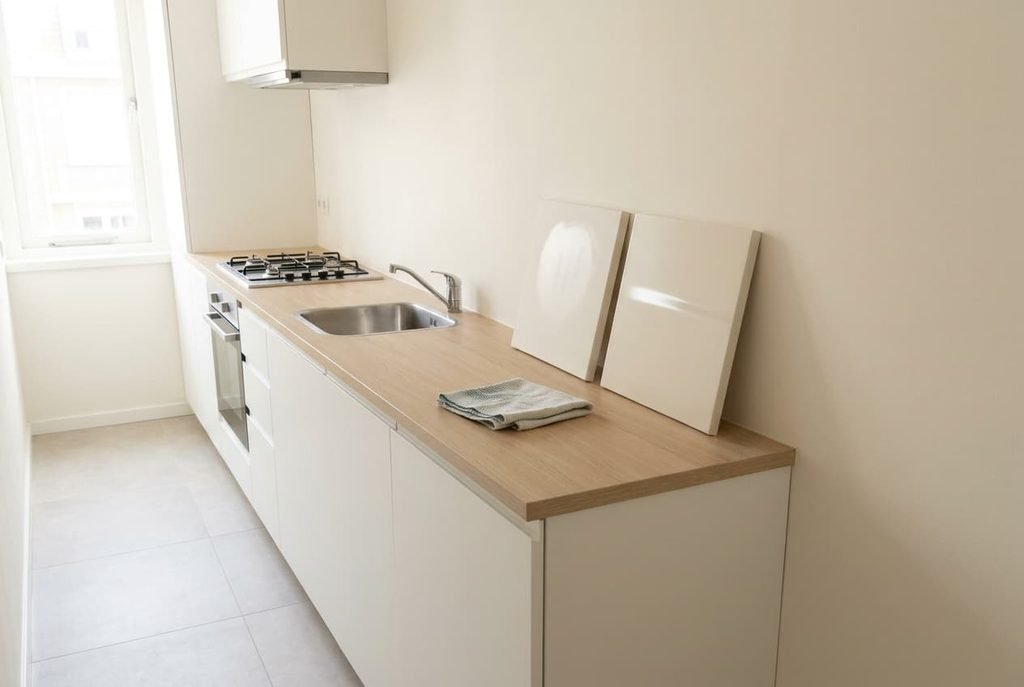
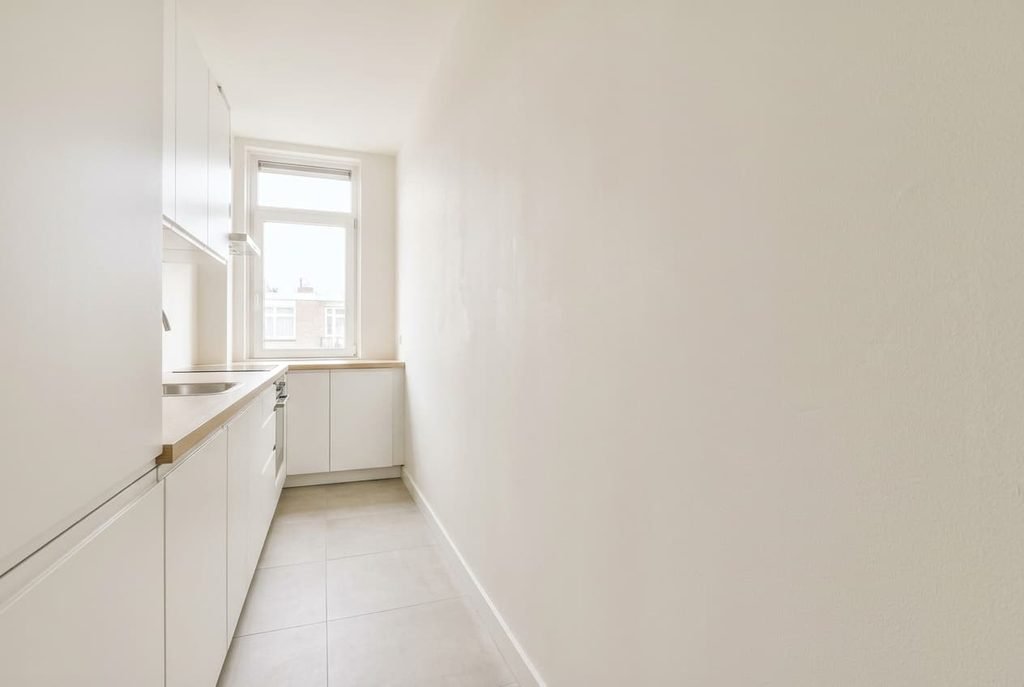
The kitchen here is a rented Dutch galley, 220 by 420 cm, with walls 250 cm high. Every figure is a worked example, and two are flagged as assumptions. This guide names no brand and quotes no price.

What decides matte or satin paint: the burnish budget
A matte film is rough at a microscopic scale, and that roughness sends light off in all directions, so the wall looks flat. Rubbing it flattens the high points. The rubbed patch then reflects light more evenly and turns shiny, which is burnishing. A satin film carries more binder, sits smoother from the start, and shows no change when rubbed.
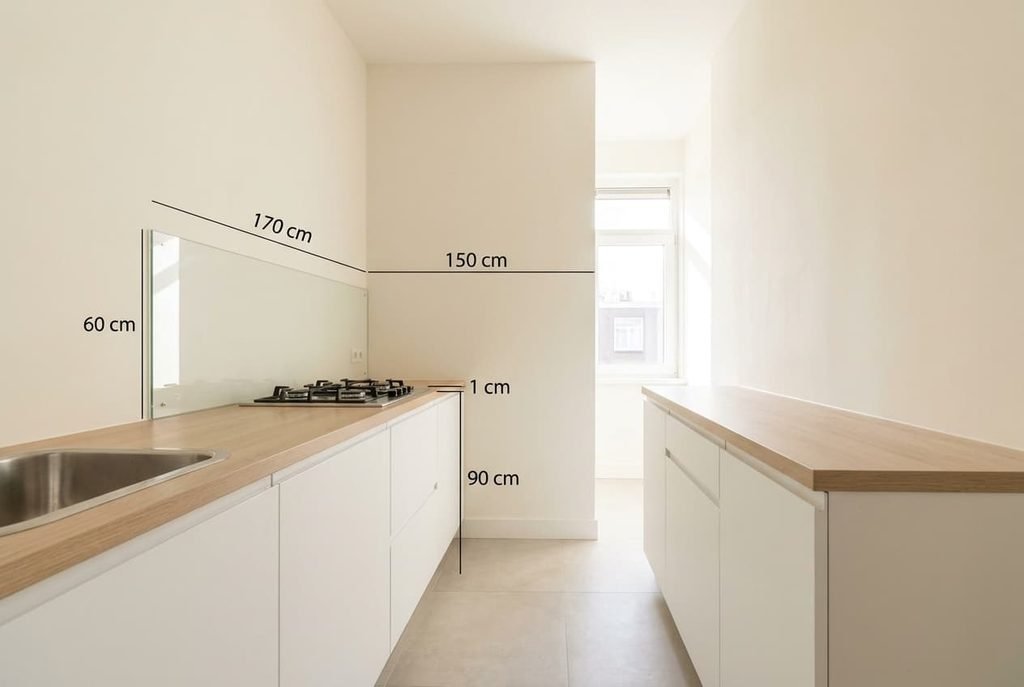
The burnish budget is the number of wipes a finish takes before a patch shows, and it’s the number to compare. Take the strip behind the hob and the sink. It measures 170 cm by 60 cm, running from 90 to 150 cm above the floor. That’s 1.02 m². It’s wiped once a week, so 52 times a year.
Assume matte burnishes after 60 wipes and satin after 400. These two numbers are assumptions, and section G replaces them with a test on your own tin. Matte then lasts 60 ÷ 52, or 1.2 years, at the hob. Satin lasts 7.7 years.
The painted walls total 28.9 m² after the door and window. The strip is 3.5% of that. Elsewhere the walls are wiped about four times a year, and matte would take 15 years to burnish there.
Head to head
| Question | Matte | Satin |
|---|---|---|
| Hides an uneven wall | Well | Poorly |
| Shows roller marks in low sun | Rarely | Often |
| Wipes clean of splashes | Slowly, with some smearing | Quickly |
| Changes when rubbed | Burnishes into shiny patches | Stays even |
| Light from an under-cabinet strip | A soft glow | A narrow bright streak |
| After a year of cooking | Pale patches near the hob | An even sheen with a thin film |
| Colour in daylight | Deep and velvety | A little lighter and livelier |
The fourth row deserves a second look. Matte is sold as the forgiving finish, yet it’s the one that changes when you clean it. That reverses the usual advice on matte or satin paint: the finish that hides flaws on the first day is the one that shows your cleaning habits in year two. A tenant who wipes often gets more from satin, while a tenant who rarely wipes gets more from matte, provided the wall is flat enough for satin not to matter. Neither verdict holds if the hob wall takes spray from frying every evening, because grease on the film is a second variable beyond the burnish budget. In that case the cleaner finish wins the argument.
Where matte wins
An uneven wall favours matte. A rented kitchen often carries patched holes and old filler, plus the faint ridges of a previous roller, and a film that scatters light hides most of them. Satin lights each one from the side.
Matte also suits a kitchen where little is cooked. Cooking twice a week and wiping once a month gives 12 wipes a year, so matte reaches its assumed limit of 60 only in 5 years, longer than any tenancy you can count on.
Unglamorous advantages count too. A matte wall forgives the person who rolls it in an afternoon and finds a thin patch the next morning, because a second coat disappears into the first. It also leaves the dark corner behind the fridge looking like a wall and not like a reflection of the one lamp. A budget of 60 wipes is generous for a kitchen that sees one hot meal a day.
Pick matte when the walls are the problem.
Where satin wins
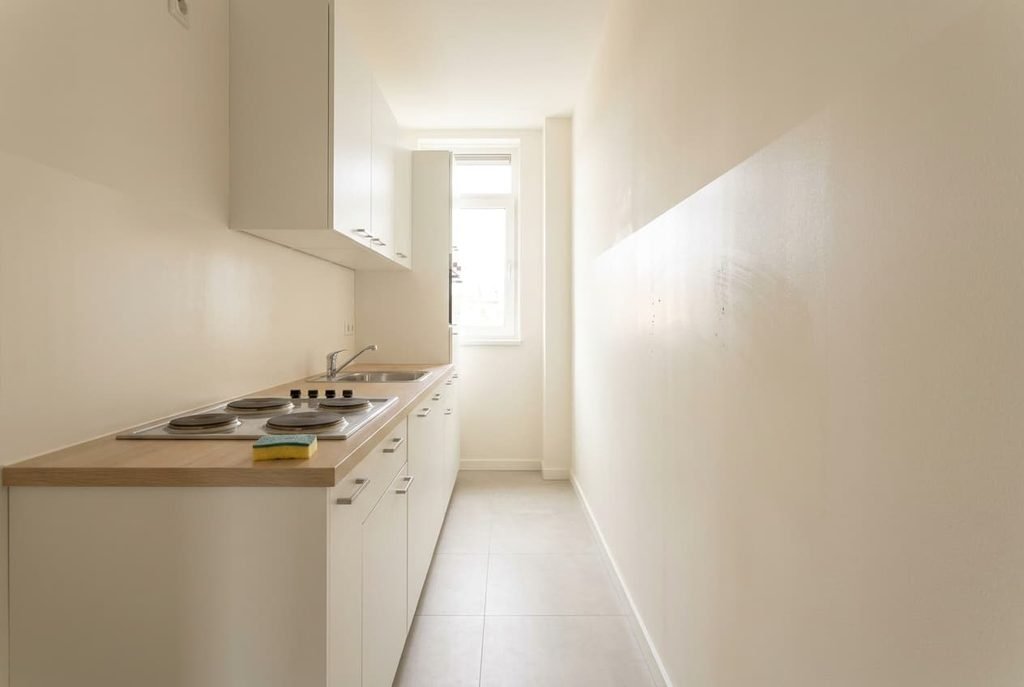
Satin wins where the wall takes the abuse. A lane 220 cm wide puts both walls within 110 cm of you at the hob. Elbows and bags brush the surface at 90 to 140 cm. A smoother film wipes clean in a single stroke, and a wipe leaves no polished patch behind.
It wins on tenancy length as well. A three-year lease at one wipe a week is 156 wipes at the hob. Matte, at its assumed 60, burnishes in the second year, while satin at 400 outlasts the lease with more than half its budget left.
Time is the second reason. A sponge and a minute remove most splashes from a satin wall, and nobody scrubs. In the same minute, the same splash on matte needs a second pass.
Satin has one condition. The wall needs to be filled and sanded first, since the sheen will light every ridge. If the plaster is poor, the cleaner finish becomes the more visible one.
When neither is right
A wipe-clean panel behind the hob and sink takes the problem out of the paint. A sheet of glass or a run of tile covers the 170 by 60 cm strip, which is the 1.02 m² that carries the heavy cleaning. Then the paint only has to look good, and matte becomes the easier choice everywhere else. The panel is a different decision, because it needs the landlord’s consent if it’s fixed to the wall. A freestanding sheet leaned against the wall asks for no consent, though it must be cut so it can’t slide behind the hob. Measure the strip first, and allow a gap at the worktop so a cloth can pass.
Keep the existing paint when it’s sound and the wall is wiped a dozen times a year. Spending on matte or satin paint to avoid a handful of marks costs a weekend and returns almost nothing.
Test the panel idea first by taping a paper template over the strip for a week.
How to choose between matte and satin for a narrow kitchen in thirty seconds
Paint a 30 by 30 cm sample of each on a spare board and let both cure for a week. Wipe each one 20 times with a damp cloth, then look along the surface from a low angle in daylight. A patch that shines has begun to burnish, and the count of wipes you used is your own burnish budget. Sheen names vary between makers, and two tins both labelled satin can differ by ten gloss units or more, so the board is the only fair comparison.
If you cook at the work wall more than three times a week, or the tenancy runs past a year, take satin. If you cook there rarely, or the wall is uneven, take matte.
The burnish budget is the whole argument: 60 wipes against 400 in our example, with a hob strip that gets 52 a year. Choose by the number of wipes you’ll really make, and let the colour follow. A kitchen that sees a lot of cooking pays the price of matte within the year. Confirm the sample before buying a full tin of matte or satin paint.
Questions readers keep asking
Does satin paint last longer than matte in a kitchen?
At the hob, yes. A satin film stays even when rubbed, while matte burnishes into shiny patches. In our example the budget is 400 wipes against 60. Away from the cooker, where walls are wiped three or four times a year, both outlast a tenancy.
How do you clean a matte wall without leaving marks?
Dab instead of rubbing. Wring a cloth almost dry and add one drop of mild soap. Press and lift. Rubbing burnishes the paint into shiny patches. Test a hidden corner first, and wipe splashes soon after they land, before they dry onto the film.
Which finish suits a narrow kitchen with little daylight?
Satin helps by bouncing a little more light along the room, but it shows every ridge in the plaster. Choose it only on a flat, filled wall. On an uneven wall, matte hides the flaws. Brighter lamps make up for the lost reflection.