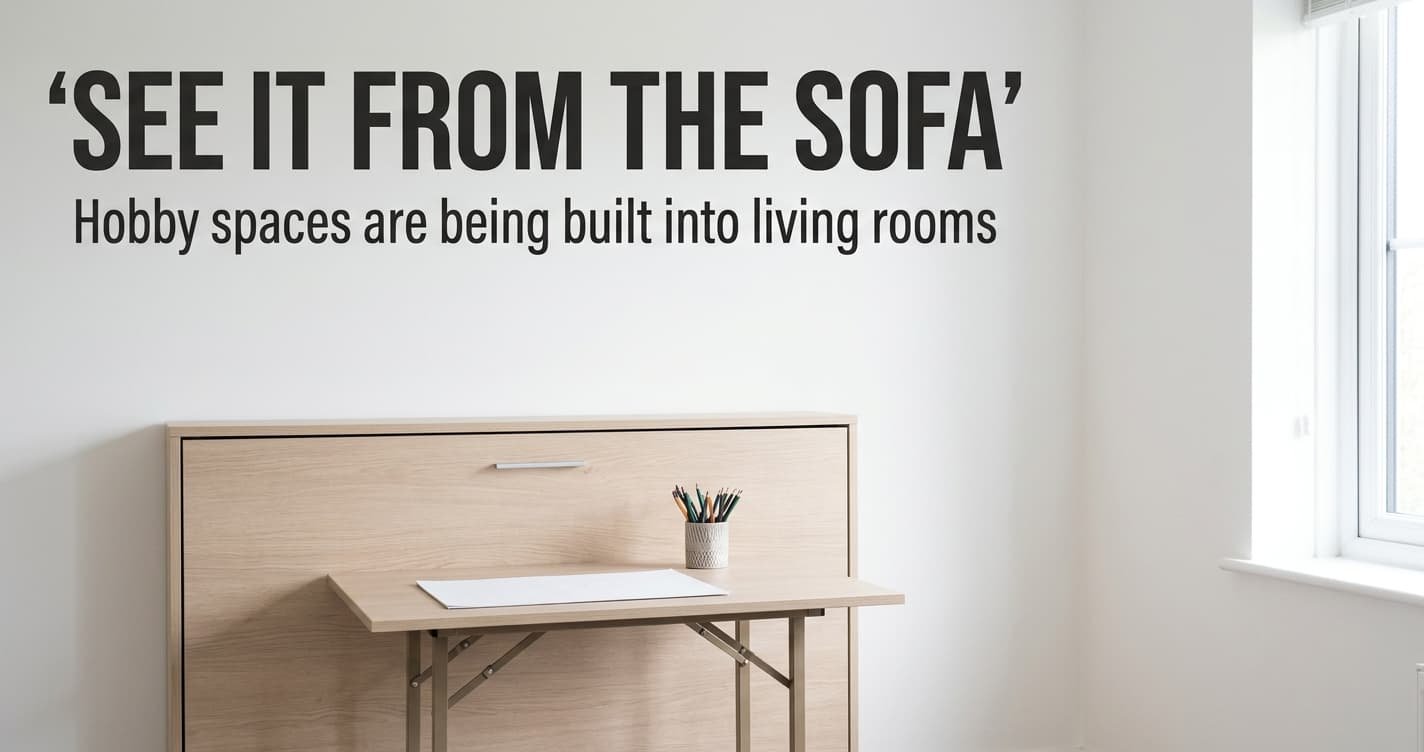
A common complaint about the spare-room hobby table is that it stays tidy because nobody sits at it, while the real project lands on the coffee table. That explains why hobby spaces are being built into living rooms, and for quiet, flat-lying hobbies it’s worth copying. It fails for hobbies that are noisy or wet, and for tall ones.
One test sorts the two cases, and it’s the view from your sofa. Supplies stay below about 90 cm behind closed doors, and the work lies flat. This article measures that in a living room of 420 by 500 cm, about 21 m².
Where the hobby room came from, and why it shrank
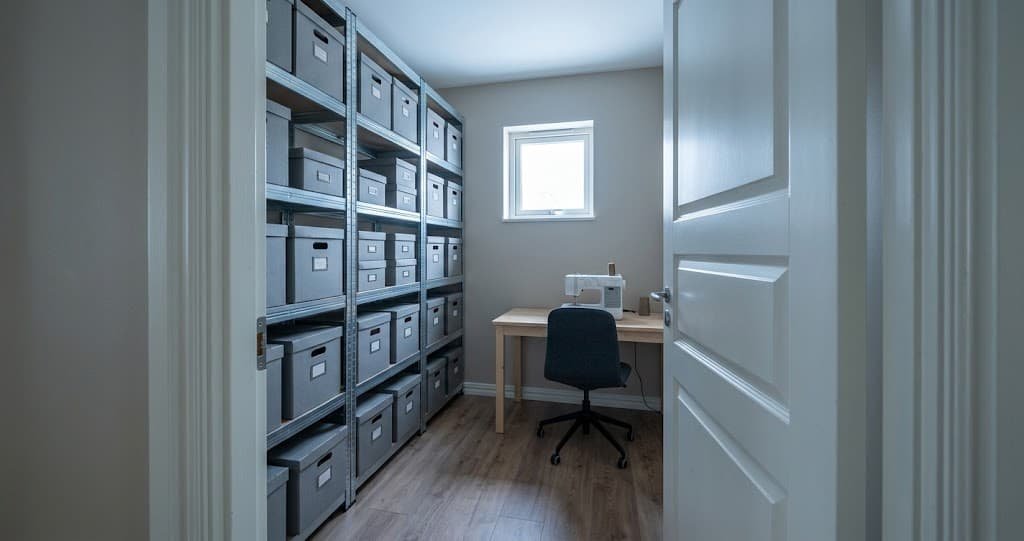
For years, the usual advice was to give a hobby a room of its own. A sewing machine and a 120 cm table needed floor, as did the boxed stock, and a spare bedroom was the cheapest place to put them. A room of 10 m² held a hobby that ran a few hours a week, which is about half the floor of a 21 m² living room. The door closed on the mess, which was the point: nobody saw it, so nobody had to tidy it.
Two changes loosened that. Spare rooms turned into desks and guest beds, so the hobby lost its room first. Storage with closed fronts also became an ordinary living-room purchase, which gave supplies somewhere acceptable to live. Meanwhile the living room usually kept the largest window and the longest evenings, so the hobby followed the light and the company. Tables that fold flat and lighter tools helped, because the kit no longer needed a floor of its own.
What changed as hobby spaces are being built into living rooms
The change is one of height and line of sight, and you can verify it from your own sofa. Say your eyes sit near 105 cm in a relaxed seat (a 43 cm sofa seat plus roughly 60 cm), about 3.5 m from the wall. Measure your own, because the numbers below shift with it.
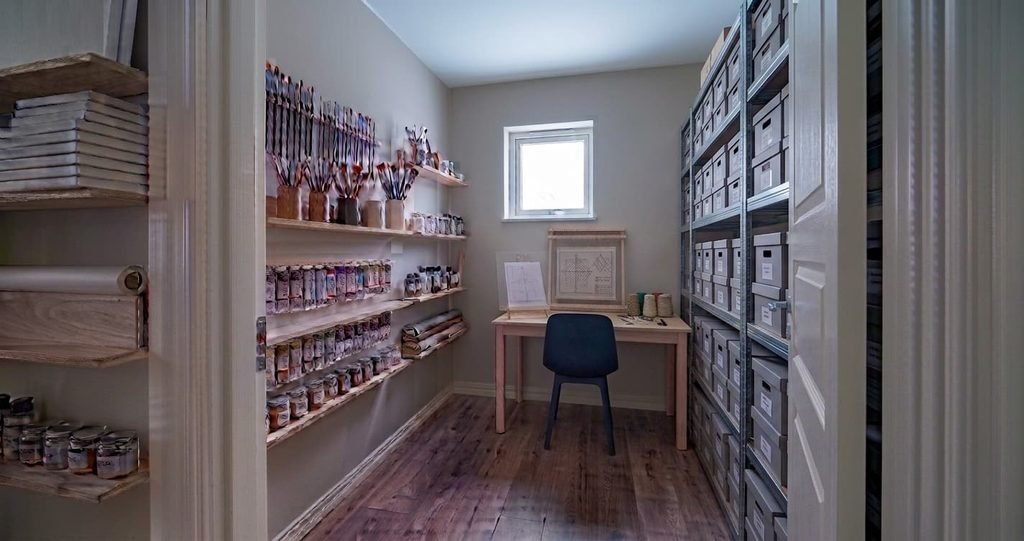
A spare-room hobby kept its supplies on open shelves up to 200 cm, because nobody looked at them. A run of 160 cm of that shelving shows 3.2 m² of stock face-on. The move is from open shelves up to 200 cm to closed fronts below 90 cm, with the work lying flat on a 75 cm table. The same wall then shows 160 by 85 cm of plain door, about 1.4 m², and no stock at all.
Flat work disappears from a sofa for a geometric reason. A table top at 75 cm lies 30 cm below your eyes, so from 3.5 m you see it at under 5 degrees, and a 120 by 60 cm top shows about 0.06 m² of its 0.72 m². Upright things don’t shrink that way. A sewing machine 35 cm tall lifts its top to 110 cm. That’s level with your eyes, so you see its whole side.
The room also changes scale. A hobby that took 10 m² now takes 3 m², and it sits at the edge of the room where the household looks past it. The zone stays modest. A 60 cm table plus 90 cm to pull the chair back makes a zone 200 by 150 cm, which is 3 m² of a 21 m² room, about 14%.
Who it suits, and who it doesn’t
Where hobby spaces are being built into living rooms, the hobbies that suit are the quiet, dry, flat ones. Drawing and hand sewing qualify. So do knitting and journals, along with small kits. They make no noise over a film and shed nothing on a rug. Each stows in a lidded box 45 cm long and 30 cm deep. It also suits a living room with 200 cm of wall free of doors and radiators. A wall to the side of the seating is ideal, because the work then sits outside the main view.
It doesn’t suit a machine that runs. A sewing machine competes with the television for sound, and its top sits at eye level. Wet work doesn’t suit it. Neither does dusty work, since sanding dust travels into soft furnishings. Tall work such as an easel of 150 cm or more stands above the eye line and can’t be hidden.
Pets and small children treat a low flat top as theirs, so loose work needs a lid. Room size decides the rest.
In a living room of 12 m² the same 3 m² zone takes a quarter of the floor, which is too much.
I can’t see how far your sofa is from the wall. At 2 m the same table top shows about 0.11 m², nearly twice as much, so a closer sofa means a tidier top.
Is it worth it once hobby spaces are built into living rooms?
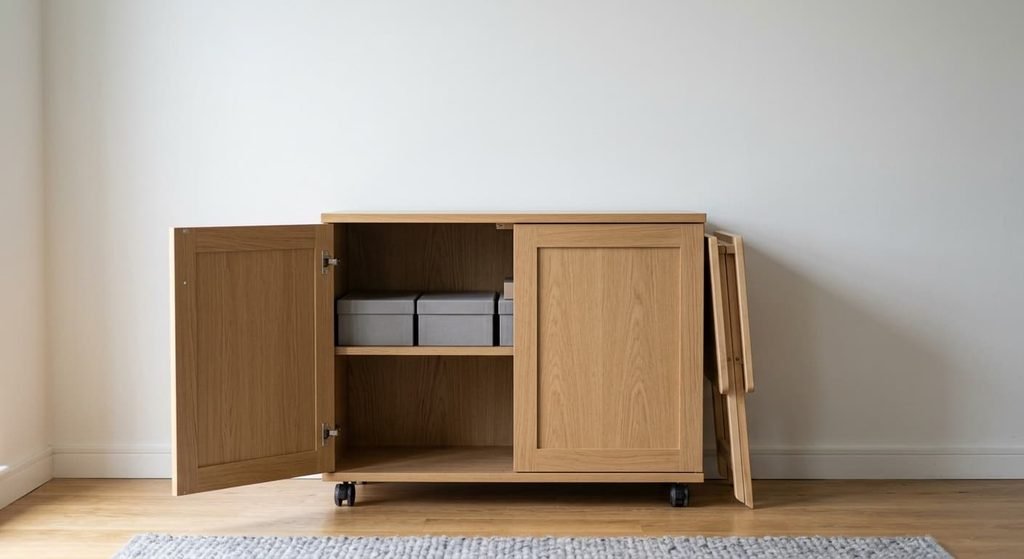
The verdict is worth doing with furniture you can move. A closed-front unit about 85 to 90 cm high and 40 cm deep, plus a 120 by 60 cm table, can come out again in an afternoon. A unit 40 cm deep takes boxes 30 cm deep with room for the doors to close, and one 160 cm wide holds three boxes of 45 cm across a shelf. The spare room then goes back to being a bedroom or a desk, which is often the larger gain.
Building work is the commitment that costs. A built-in with a cut-out for one machine, or a rail at one height, ties the room to this year’s hobby. Undoing it means filling and repainting a wall. If reversing a change takes longer than a day, treat it as a commitment.
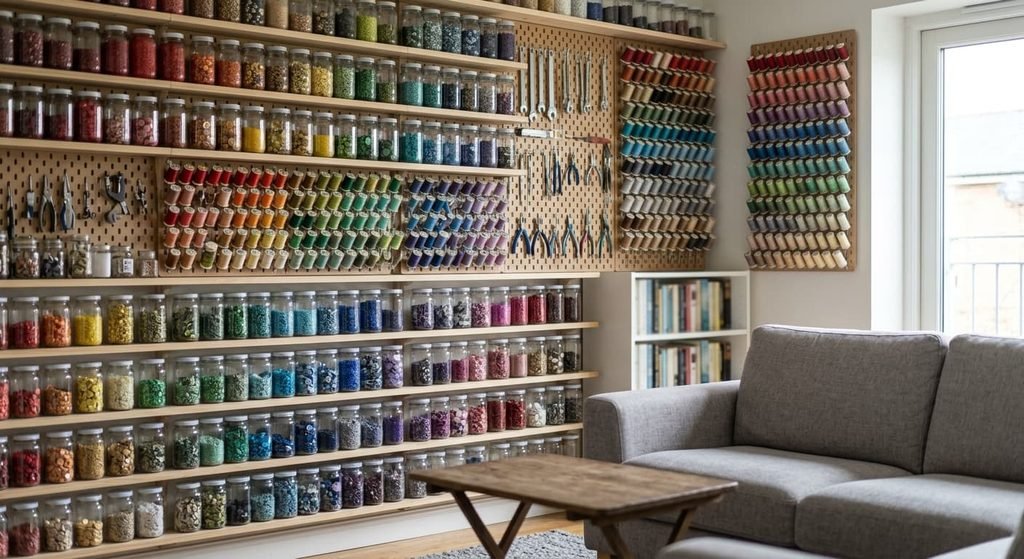
The version that will date fastest
The extreme version is an open craft wall of colour-sorted stock from floor to ceiling. Its marks are matched jars and spools on pegs, along with labels in one font. At 160 by 240 cm it puts 3.8 m² of stock in front of the sofa.
Four things age it. Stock changes when the hobby does, so the wall turns into a shop display of something you no longer make. Open shelves collect dust. Every jar added or removed changes the wall, so the look needs upkeep that a closed door never asked of you. Dyed thread on a rack facing the glass usually fades on the side that looks outward.
My firmest view is to show the finished work and hide the stock.
The moderate version is a closed unit with one upright element, such as a pinboard of 70 by 50 cm for the current project. That’s 0.35 m² on view, and it changes when the project does.
How to try it without committing
The trial is to move one project in a single lidded box for two weeks. Use a box 45 cm long and 30 cm deep, and a folding table that shuts flat. Count the trips back for something you forgot. Two or fewer means the box holds enough. More than that means you’ve learned what the box should hold. Fold the table whenever you stop, since a table left open is the version that fails. This weekend, sit where you usually sit and check the height of your eyes: anything of the hobby that stands above 75 cm and isn’t behind a door fails the test.
Hobby spaces are being built into living rooms because the sofa gives you light and company, and the view stays calm if supplies sit low and the work lies flat. Adopt it with furniture you can move, and tidy the table top before you stand up. Leave the stock behind doors. Anything loud or wet stays in the spare room, along with the tall hobbies.
Questions readers keep asking
Should I move my craft supplies out of the spare room?
Start by moving one project. Hobby spaces are being built into living rooms in small steps, and a lidded box 45 cm long and 30 cm deep plus a folding table is the smallest step. Try it for a fortnight. If you rarely walk back, move more; if you often do, leave the stock where it is.
Does a hobby corner work in a small living room?
Only up to a point. The zone needs about 200 by 150 cm, which is 3 m². In a living room of 12 m² that’s a quarter of the floor. Quiet, flat hobbies on a table that folds shut can still work if you reclaim the space after each session.
How long does a living-room hobby corner stay useful?
As long as it’s furniture. A closed unit and a table move with you and suit the next hobby. Built-ins cut to one machine or one rail height last only as long as that hobby does, and removing them means repairing and repainting the wall.