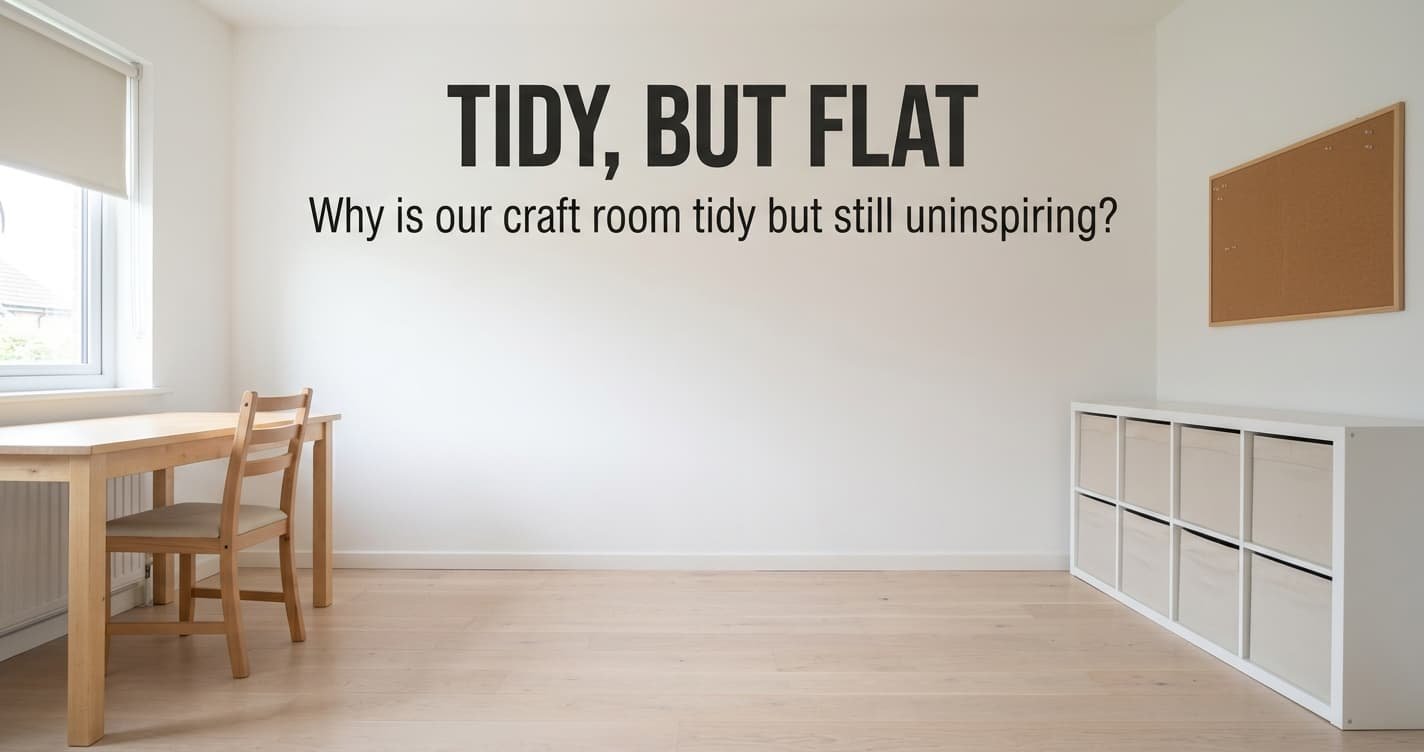
Why does an afternoon of sorting leave you with less urge to make anything? Every box is squared and every surface is clear, and what remains is a craft room tidy but still uninspiring, a room that looks finished and doesn’t invite anything.
The cause is sameness. Tidying evens out sizes and finishes and pushes everything to the walls. The eye finds life in exactly those differences, so the fault is one of scale and surface that you can measure. That fault sits in the room, which can change. Every sum below uses a space of 340 by 410 cm in the Netherlands, about 13.9 m².
What is happening in a craft room tidy but still uninspiring
Tidying works by removing differences. You match the boxes, so every size is the same. Wipe-clean surfaces make every finish smooth. Pushing the furniture against the walls puts the whole room in one layer. Each move is sensible on its own. Together they delete the three steps a room needs, in size, texture and depth. None of them is a lapse in judgement, since each is what tidying asks for.
A step is a difference big enough to see from the doorway.
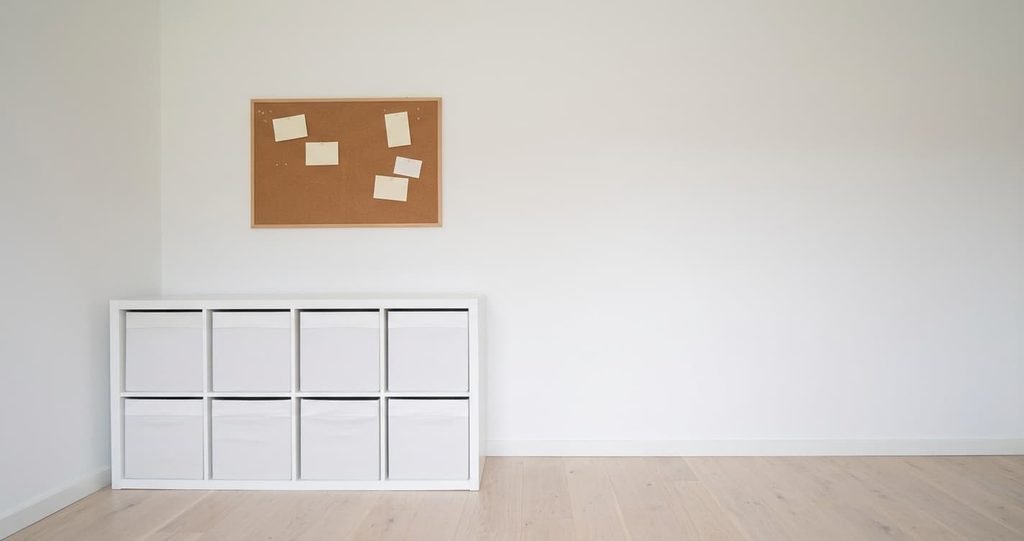
It gives the eye somewhere to land and a reason to move on. That’s how a room gets read. Take the steps away and the room becomes one beat repeated, however clean it is. A low unit 160 cm wide with eight identical boxes of 40 cm shows it. The eight beats are equal, spaced at 40 cm, with nothing to pause on.
The usual diagnosis is that the room needs more colour. Colour changes the hue, and that’s all it changes. Ten hues on eight identical smooth boxes still make eight identical beats, so the flatness stays. Extra paint or cushions add cost without adding a step.
How to tell why your craft room is tidy but still uninspiring
Three looks separate the causes, and each takes under a minute with a tape measure and your own eyes. First, measure the widest thing on the wall above the storage. Divide it by the width of the storage underneath. A result under 50% means the display is small for its furniture, which is a scale fault. The second look is from the doorway: count the surfaces where you can see weave or grain from there. Fewer than three means the finishes have merged, and that’s a texture fault. Third, from the same spot, look for any piece of furniture standing more than 75 cm from every wall. If none does, the room sits in one layer, which is a depth fault. Photograph the doorway view as well. A photo flattens a room the way a glance does, which makes the layers easier to count. Note the three results on a card, because one room can score badly on every look and the card shows which fix to start with.
More than one result is normal, and the fixes below follow the same order.
The three faults, diagnosed
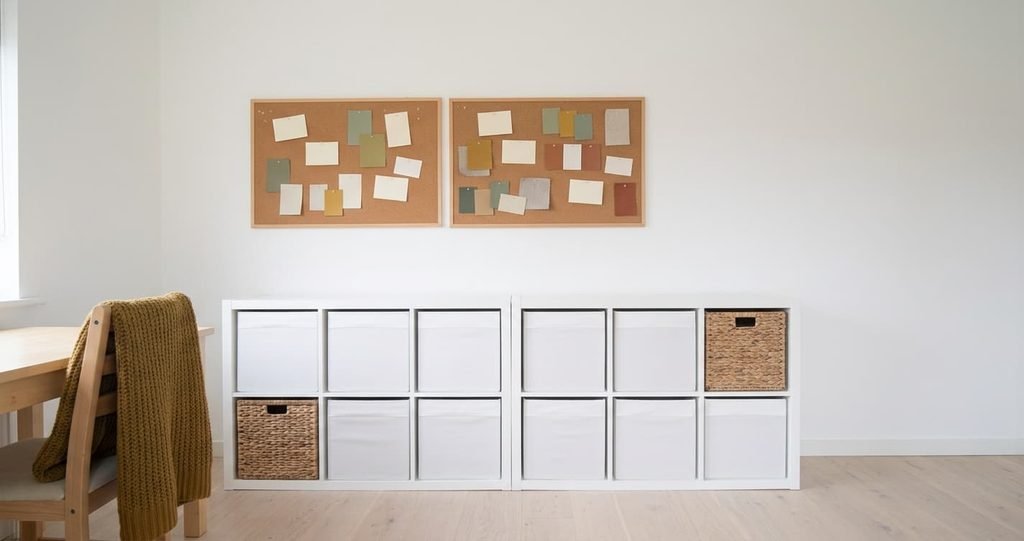
The wall display looks tiny. Take a corkboard of 60 by 40 cm above a unit 160 cm wide. It spans 38% of the unit, and the eye compares the two edges at once. A display spanning 60 to 75% of the furniture beneath it (96 to 120 cm here) is a proportion many people find settled. Gather the loose postcards and swatches from the other walls. Pin them in one block 110 cm wide with gaps of 2 cm, and you reach 69% for nothing. A second board 50 cm wide hung beside the first gives 110 cm for the price of one board.
Nothing in the room looks touchable. A normal eye resolves detail of about 1 mm at 3 m, and only at strong contrast. The fine grain on laminate and vinyl reads as one smooth surface from the doorway. Painted board does the same. Relief of 5 mm or more still shows at that distance. A chunky knit has it, and so does a basket weave. Carry a knitted throw from another room onto the chair first. Then swap two of the eight white boxes for baskets you already own. Only after that buy two woven baskets, 40 cm square to match the boxes. The first two steps cost nothing. Open weave collects lint within weeks, so you’ll want to run a brush vacuum over it monthly.
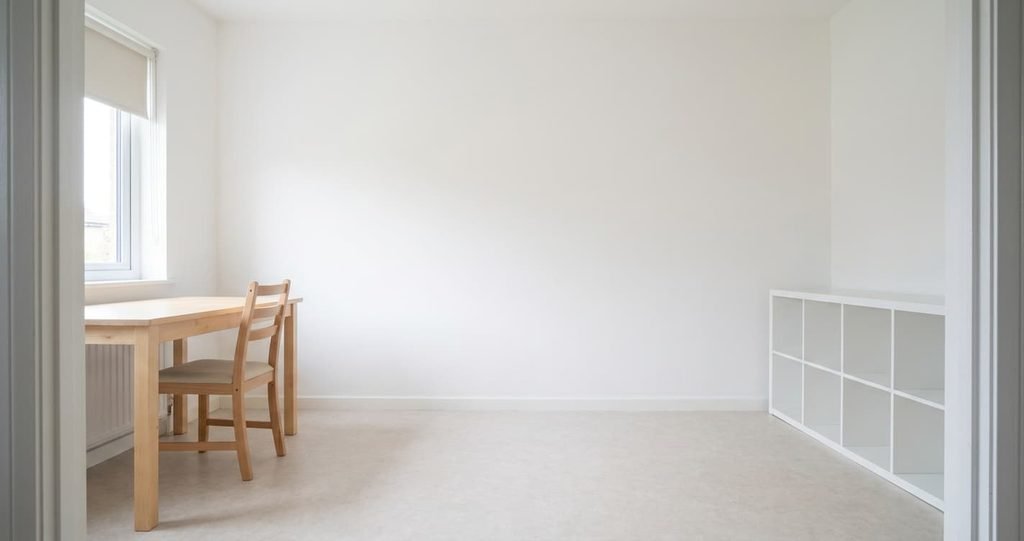
The room feels like a corridor. Nothing stands more than 75 cm from a wall. The middle 190 by 260 cm, about 4.9 m² or 35% of the floor, carries nothing. Turn the table so its short end meets the left wall and its 160 cm runs into the room. It then reaches 85 cm into the empty middle. The walkway beyond it is 140 cm (340 minus 160 minus the 40 cm of the unit). A chair needs about 90 cm behind it to pull out and stand, a clearance people underestimate. Each side of the table keeps about 167 cm. Check your sockets and the door swing first, because a table end that blocks either won’t last the week. This costs an afternoon, plus a socket strip if the cable no longer reaches.
What to check before you add anything else
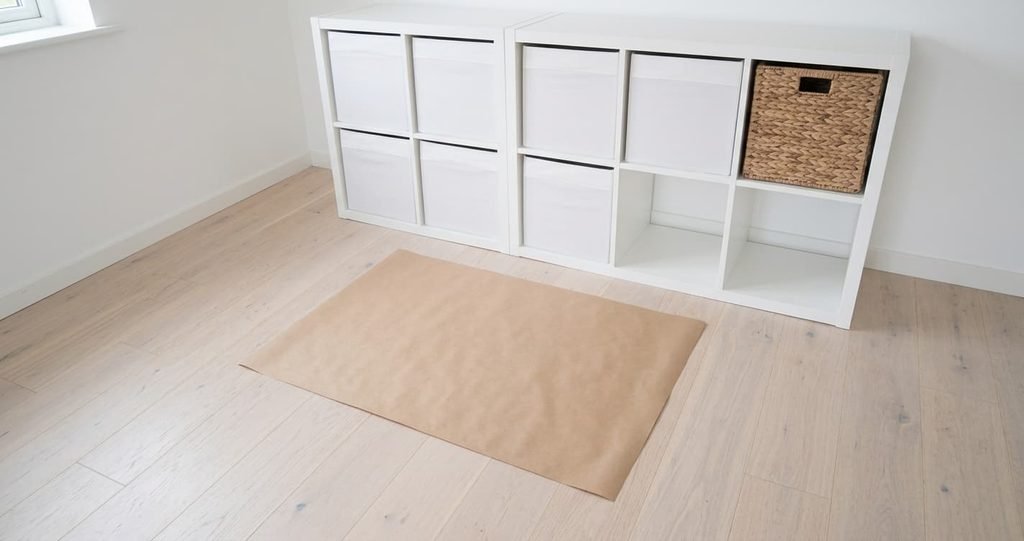
Before the next purchase for a craft room tidy but still uninspiring, cut a paper template at the footprint of the piece and lay it where it would stand. Then ask three things of it. Is it at least 1.5 times the width of its neighbour (a working threshold)? A ninth box of 40 cm adds a ninth equal beat. A basket of 60 cm beside the 40 cm boxes adds a step. Does its surface show relief the neighbours lack? Does it stand in a layer that holds nothing yet?
A shelf pushed against the wall once more adds no depth. The same shelf set 90 cm out from it becomes a divider. A piece that answers none of the three questions is one more beat, whatever it costs. A template shows that before you spend anything, and a day in place is enough.
The fix that isn’t worth doing
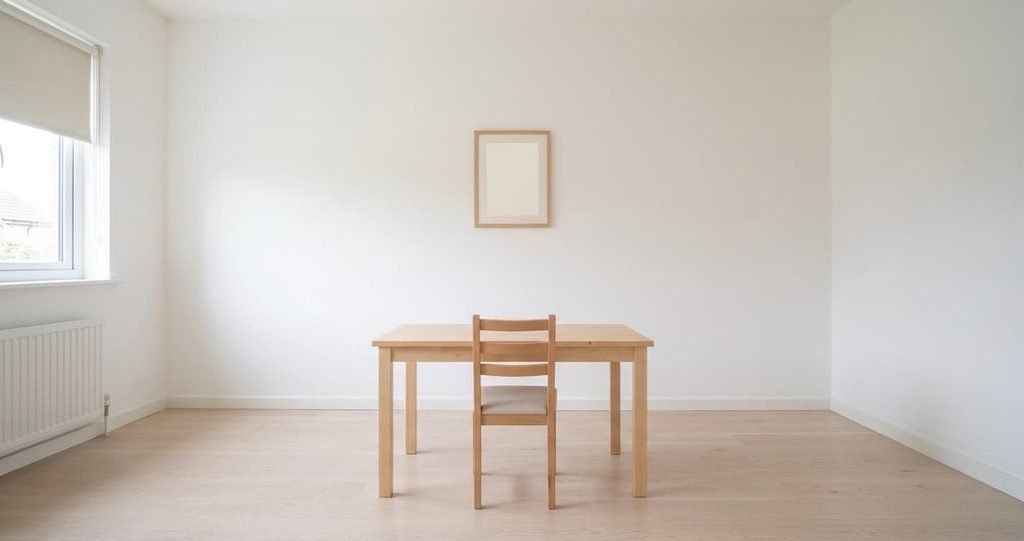
The popular remedy is a motivational print or sign above the table. A print of 50 by 40 cm covers 0.2 m² of a wall 410 by 250 cm. That’s 2% of it. It hangs flat on the wall, so it adds no step in depth. On smooth paper it adds no step in texture, and at the postcards’ size it adds none in scale. What it does add is words. A line of text is read once or twice before it becomes a pale rectangle. The print also draws the eye to a wall that was already fine. Nothing else in the room changes. My position is plain. No sentence on a wall does the work of a size step, and 110 cm of pinned work lifts a room further than any slogan.
A craft room tidy but still uninspiring has lost the steps that give the eye somewhere to land; no colour or slogan restores them. The check that catches it fastest takes a minute: measure the display against the unit beneath it, then count the textures you can see from the doorway. Fix the free items first and repeat the three looks after each change, because every fix moves the numbers for the next and a rearrangement changes the most for the least. Anything you buy afterwards should differ from its neighbour in width or surface, or it adds one more equal beat.
Questions readers keep asking
Why does my craft room look boring when it’s clean?
Cleaning removes the differences the eye reads: mixed sizes and rough finishes, plus furniture standing off the walls. What remains is a single size and a single smooth finish in one flat layer against the walls. Measure the wall display against the unit below it, then count the textures you can see from the doorway.
How can I make my craft room feel more inspiring in an hour?
Gather the small things pinned around the room into one block. Make it about two thirds as wide as the furniture below it. Then put a woven basket or a knitted throw where the surfaces are smooth. Both use things you already own. Turn the table off the wall afterwards if your sockets allow it.
Can a plain craft room feel more inspiring without redecorating?
Yes. A craft room tidy but still uninspiring responds to the width of a display and the texture of two objects, plus the position of a table. None of that needs paint or building work. All of it moves in a weekend, and the table can go back where it was.