Why won’t the towels ever quite dry? The room carries the water away too slowly, and the remedy that most often works is to run fresh air through it for an hour after the last shower. That is the pattern in a bathroom where towels never quite dry, and the sections below measure it.
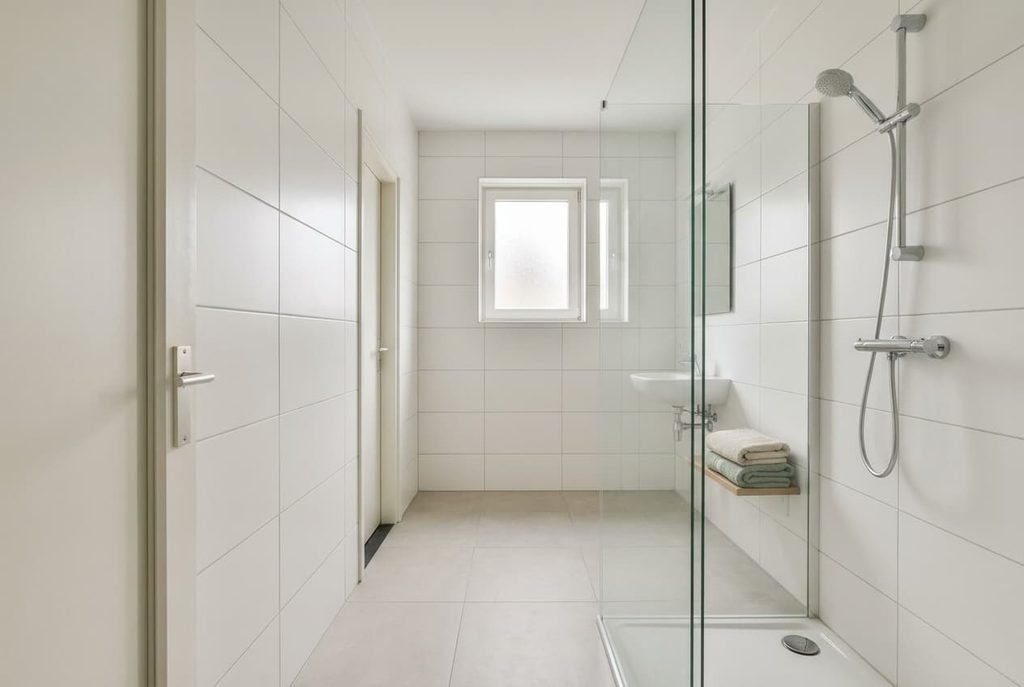
The model bathroom measures 220 by 200 cm, with 250 cm to the ceiling, so it holds 11 m³ of air. Four people shower in it each morning, back to back. The water loads and air-change rates are my guesses, so replace them with measured ones if you have any.
What is actually happening in a bathroom where towels never quite dry
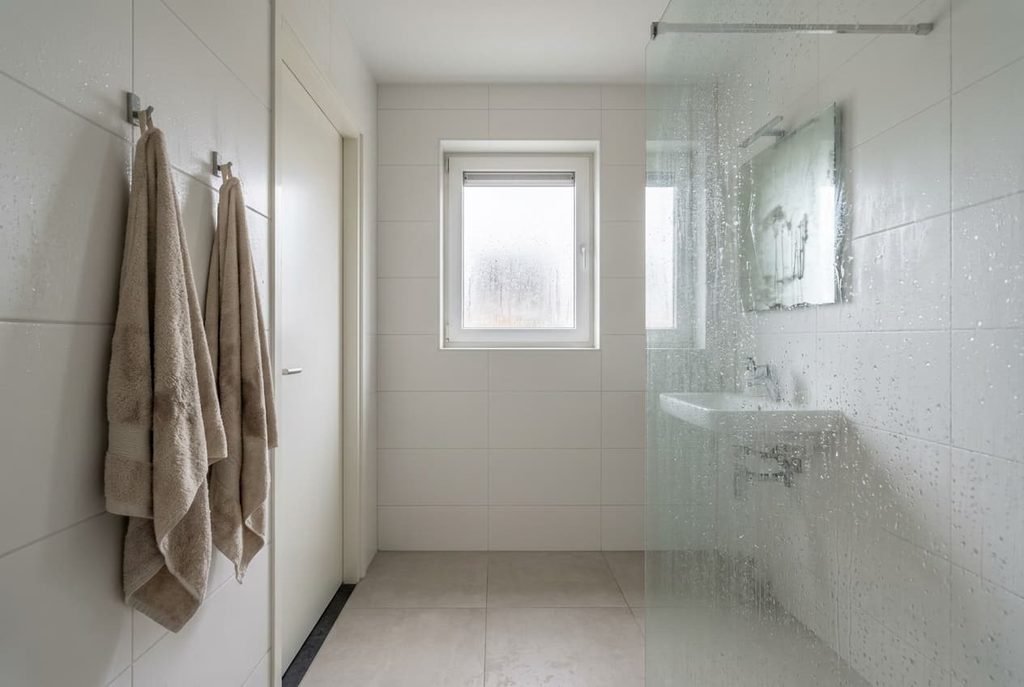
Drying moves water from the towel into the air, and air can only take so much. At 20 °C, air holds at most 17.3 g of vapour per cubic metre. Air elsewhere in the house at 60% humidity already carries 10.4 g, so each cubic metre arriving can accept only 6.9 g more. A towel’s drying time is set by how many cubic metres of arriving air can take its water.
Assume each shower puts 250 g of vapour into the room, and each used towel holds 200 g. Four showers in a row leave 4 × 250 + 4 × 200 = 1,800 g to remove. At 6.9 g per cubic metre, that needs 260 m³ of arriving air. The room holds 11 m³ and swaps it about once an hour without help, so the job takes 23.6 hours. By the time the last towel is dry, the first is wanted again.
Two further things shift the figure. A towel folded over a bar shows about half the surface of one hung open, so it gives up water at roughly half the rate. And warm air takes more: at 24 °C the limit is 21.8 g, which lifts the spare capacity to 11.4 g.
The room dries towels only as fast as it swaps its air.
Confirm which version of a bathroom where towels never dry you have
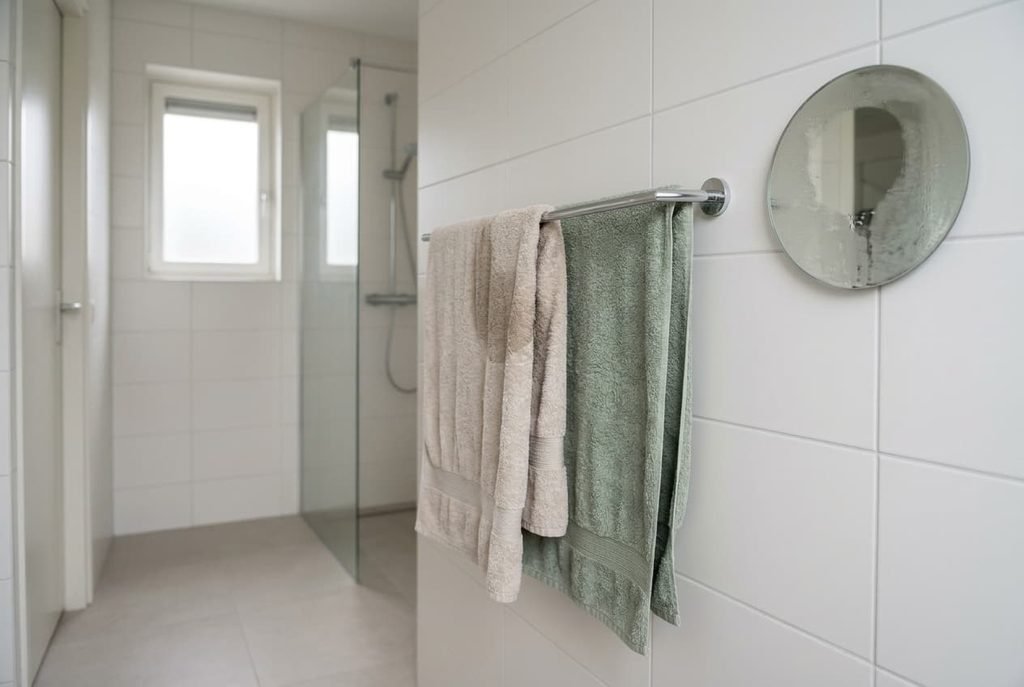
Three small checks separate the causes. Watch the mirror after the last shower. If it’s still fogged after 20 minutes, the air is staying put. That makes it the air-exchange version. If it clears in five minutes while the towels stay damp, look at how they hang.
Next, put one damp towel in a bedroom overnight, beside its twin in the bathroom. A dry bedroom towel and a damp bathroom one point at the bathroom’s air. Two damp towels point at a humid home, and no change in this room will cure that. In that case, the checks below still help you rule out the bathroom.
Last, feel the fold. A towel that’s wet only along the seam where it doubles over the bar has the contact version, which is the habit-based one. Dampness all over means the air is the limit.
Most households find both, and the order of fixes below follows the mechanisms more than the budget. Work from the top until the towels dry overnight, and the last fix is needed only if they still don’t.
The fixes, in order
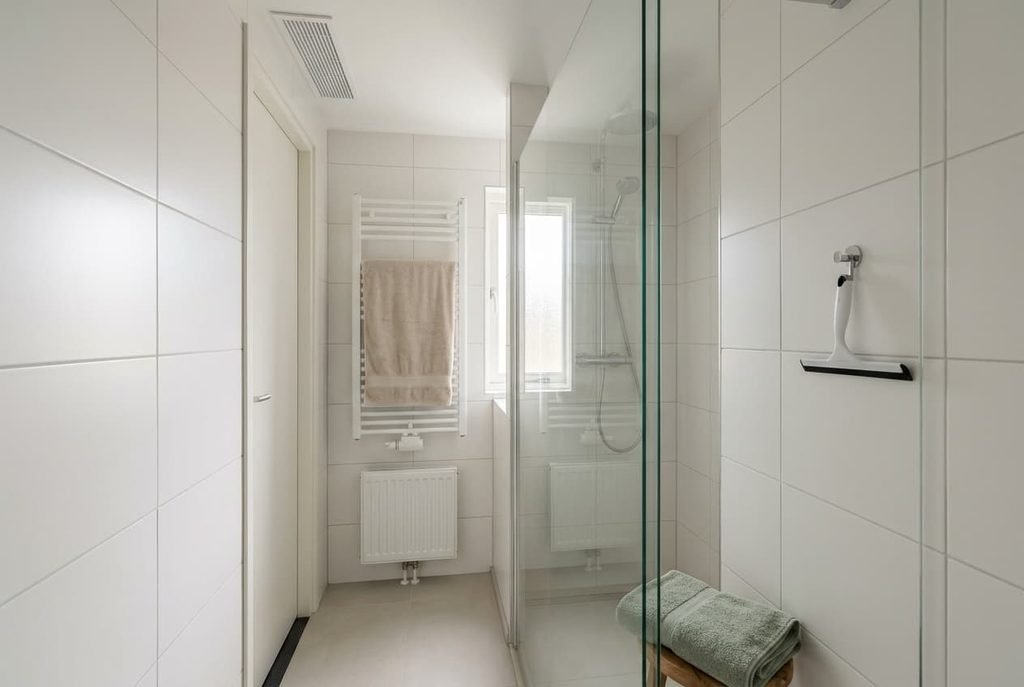
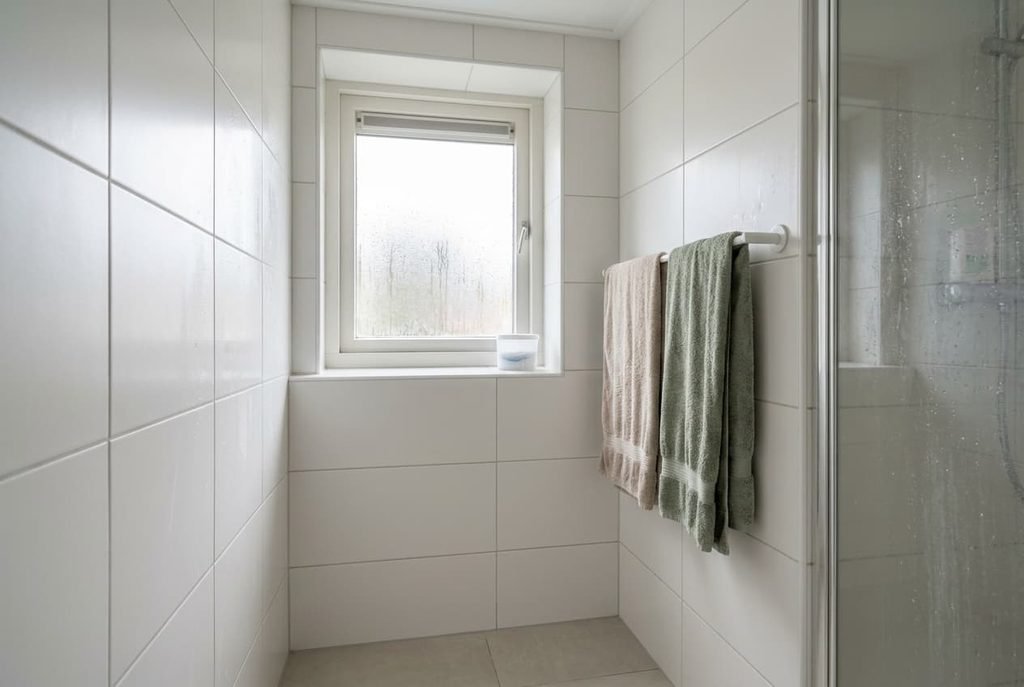
Hang each towel open, with a hand’s width of space behind it, which addresses surface exposure. A 70 × 140 cm towel shows both faces when open, which is 1.96 m², and about 1.0 m² when draped over a bar, because the halves touch. It is free and quick. A rail with a clear gap behind it works the way a hook does, so choose the position by the gap and not the style. It won’t help until the air can keep up. Assume 4 hours to dry open against 8 folded. A bathroom where towels never quite dry needs 23.6, so this fix changes little until the air fixes below arrive.
Wipe the tiles and the glass after every shower, which addresses the vapour load, because most of the 250 g sits as a film on hard surfaces. Assume wiping removes 100 g per shower with a squeegee or with a cloth wrung into the drain. The 1,800 g falls to 1,400 g. The air needed falls from 260 m³ to 202 m³, or 18.4 hours. It costs a minute a shower, and a squeegee if you want one. Do it while the glass is still warm, because the film runs off easily then and sticks once it cools. It can’t touch the water already in the air, so the towels still wait most of a day.
Fit a heated towel rail on a timer, which addresses temperature. Warmed to 24 °C, each cubic metre accepts 11.4 g, so 1,400 g needs 122.8 m³ and the time falls to 11.2 hours. It costs a purchase plus the energy of the hours it runs. A timer matters because heat that runs all day warms the room without drying anything extra. It can’t remove the water it releases. Where no air is exchanged, that water lands as condensation on the coldest wall.
Get an installer to fit an extractor fan switched by humidity, which addresses air exchange. At four changes an hour, or 44 m³, the 122.8 m³ passes in 2.8 hours. It needs a tradesperson, and in a rented home the landlord’s consent. The catch is a duct route to the outside. Where none exists, a fan is only noise. It won’t help a folded towel either.
What this bathroom’s own architecture means for you
The room holds 11 m³ and can’t be made larger. At 20 °C it can store at most 17.3 × 11 = 190 g of vapour in total, while a morning’s load is 1,800 g. That is almost ten times what the air can hold. No arrangement of towels can store that water, so it has to leave.
Two other fixed features set the pace without help. The small window, 50 by 60 cm, opens only a little. The 70 cm door passes air only as fast as a draught moves. In a bathroom where towels never quite dry, these decide the baseline air change. Paint colour and furniture can’t touch them. Plan around the fan and the rail, and treat the window as a bonus. The wall behind the door gives a clear 90 cm, which is the only place a rail with a gap behind it fits.
The fix that doesn’t work
A tub of moisture-absorbing crystals on the windowsill is the favourite shop-bought answer, and it misses the mechanism that matters. Assume the tub absorbs 300 g across its whole life. One morning needs 1,800 g removed, so a full tub covers a sixth of one morning, and then it’s spent.
Worse, it sits at one point while the water is released across the towel’s 1.96 m² and the tiles. Air still has to carry that water to the crystals. I’d argue the tub gives comfort without drying anything, since it tries to store water in a room that can only get rid of it by exchanging air.
By the same reasoning, piling the towels on a radiator in another room fails too. Moving the towels shifts the water to another room, and the air there faces the same 6.9 g allowance.
Towels need air that isn’t already full.
Move the water out of the room, because the room has no way to store it. That sums up the mechanism. Fixes one to three shrink the fan’s job. A bathroom where towels never quite dry needs air exchange most. Wipe the tiles tonight, and hang each towel open tomorrow morning. Both cost nothing, and both shorten the wait before the next shower. Keep the extractor for last.
Questions readers keep asking
Can a bathroom with no window ever dry towels properly?
Yes, with a fan. A window helps, but it isn’t the only way to move air. An extractor switched by humidity, ducted to the outside, changes the air without anyone remembering. Without a duct route, use a heated rail. Wiping the tiles helps too.
Is a heated towel rail worth the cost?
It helps by raising the air’s capacity, yet it works best with airflow. On its own it lifts water into the air, and the coldest wall collects it. Put the free fixes first and add the rail when the air is already moving.
Why do towels still smell damp after a full day?
Usually because they hung folded. The seam stays wet long after the surface feels dry. The halves touch, and that traps water. Hang each towel open with a gap behind it, and wash it before it has stayed damp for days.