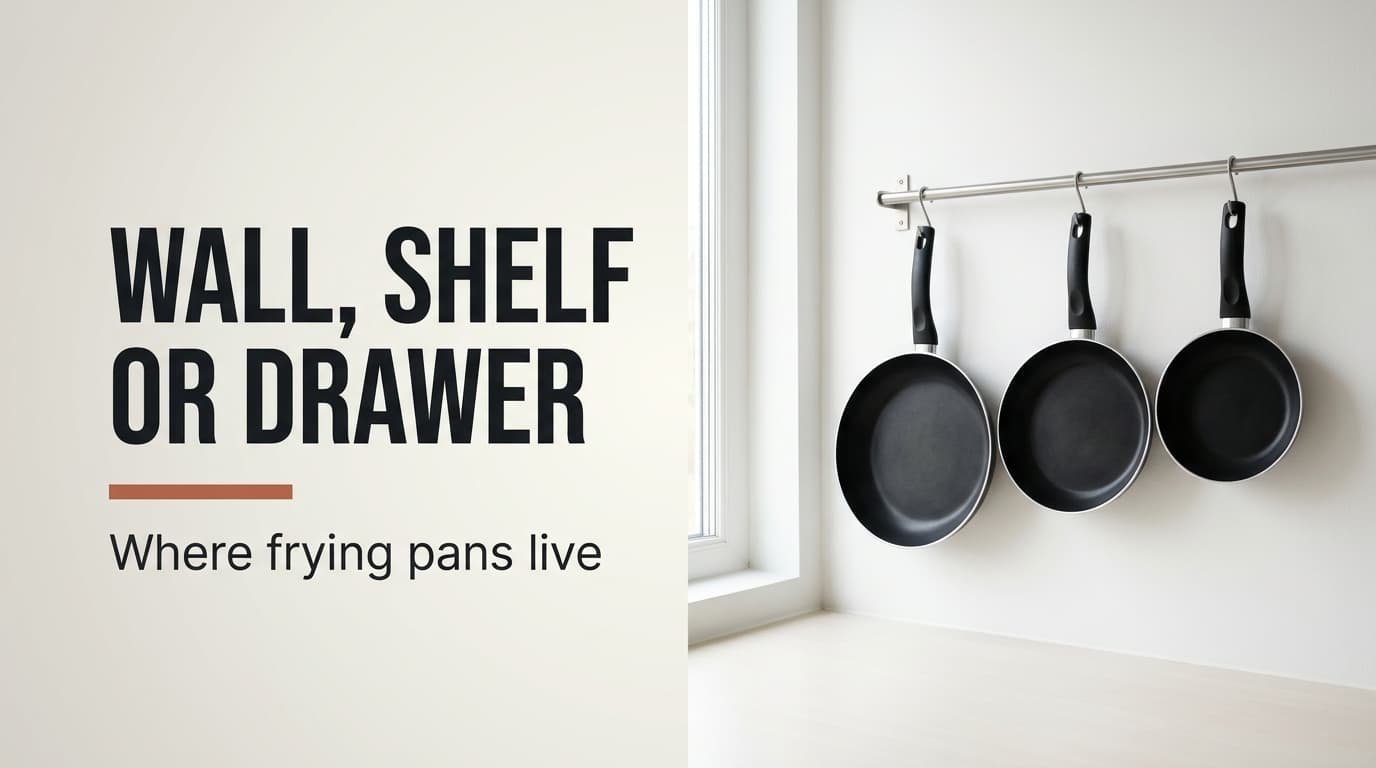
Three pans can fill a cupboard that was meant for plates. This page compares a hanging rail with a standing rack for frying pans in a small kitchen. It judges them on space and wear, then on what each asks of your wall. Expect a table up front and a section on each option. A no-purchase alternative and a closing rule finish the page. The sums use one Rotterdam kitchen and three pans, the smallest 20 cm across and the largest 28 cm. Use your own measurements instead, since a tape beats any average and the job takes five minutes.
What Storing Frying Pans in a Small Kitchen Has to Solve
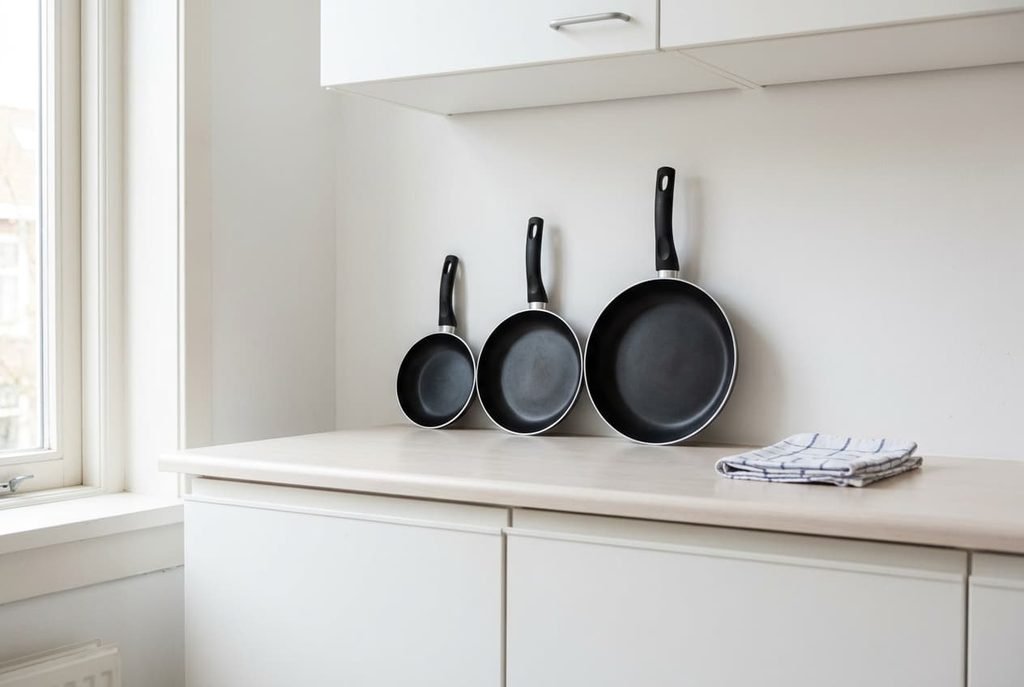
Ours range from 20 to 28 cm across, with a 24 cm pan between, and the largest has a 22 cm handle. Together they weigh 2.9 kg, the two smaller ones 0.7 and 0.9 kg. Storing frying pans in a small kitchen means carrying that load while keeping every pan within reach and unscratched.
The deciding measure is how much wall or cupboard each option uses, set against what the kitchen can spare. Our free wall beside the window offers 9,000 cm² (90 × 100 cm). The base cupboard has a clear shelf of 56 × 55 cm with 34 cm of height, which is 104.7 litres.
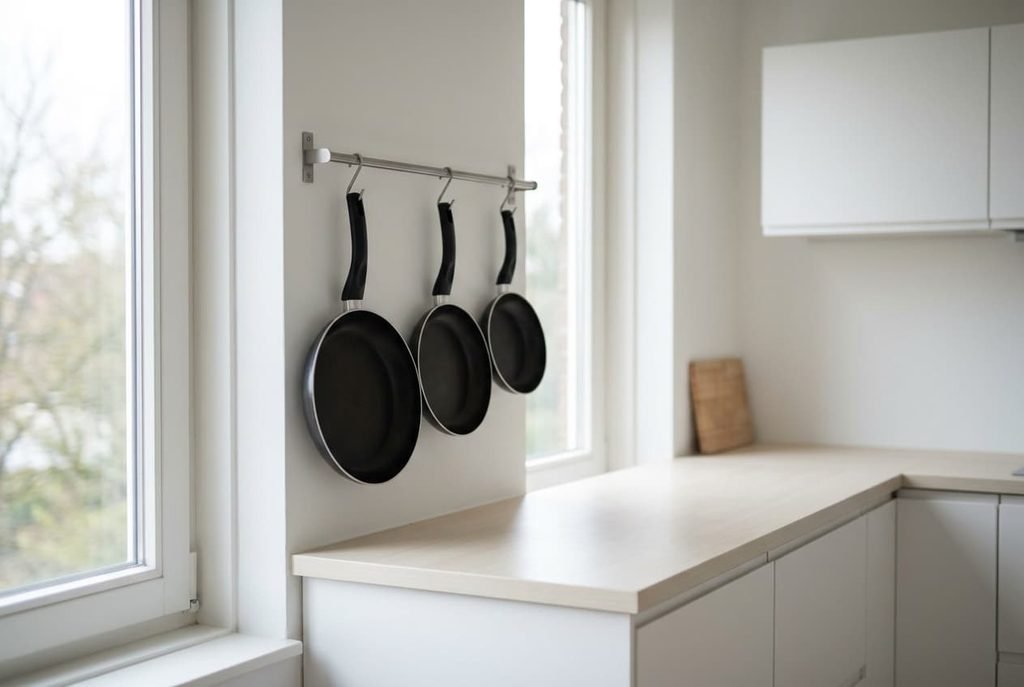
A rail hangs the pans by their handles. In a row they need 20 + 24 + 28 = 72 cm of width, plus two gaps of 5 cm, so 82 cm of rail. The largest pan hangs 22 + 28 = 50 cm below its hook. That takes 82 × 50 = 4,100 cm² of wall, or 46% of the strip.
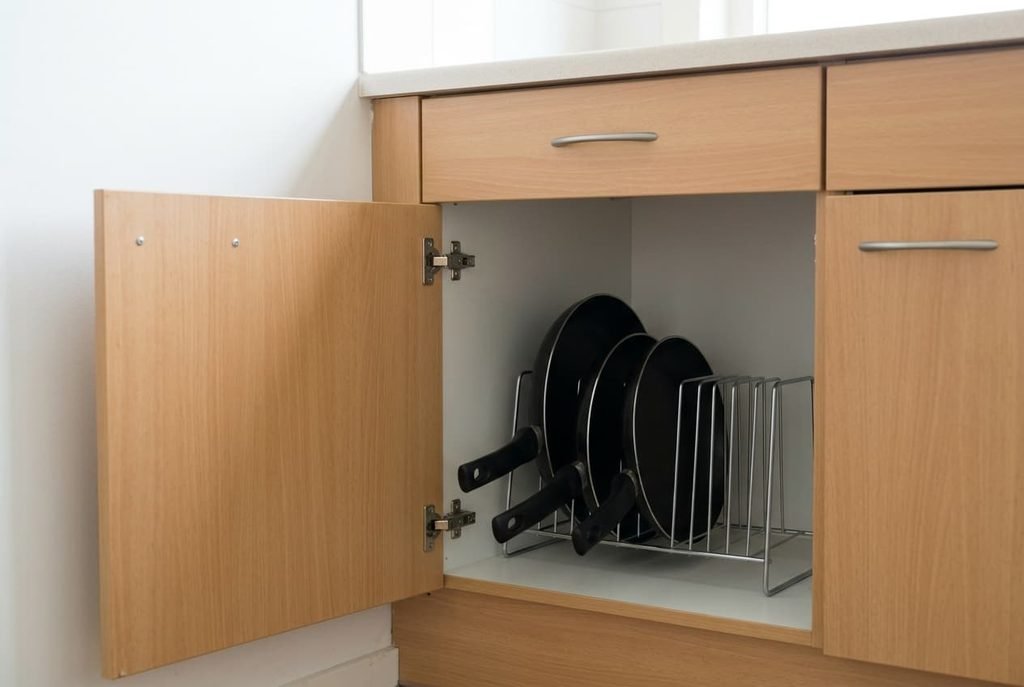
A rack stands the pans on edge in slots 7 cm apart. Three slots take 21 cm of width, while the 28 cm pan with its handle pointing out needs 28 + 22 = 50 cm of depth and 28 cm of height. The block comes to 21 × 50 × 30 cm = 31,500 cm³, or 31.5 litres, which is 30% of the cupboard.
Two Ways to Store Pans Compared Row by Row
Every number below was taken from the kitchen measured above: a wall strip of 90 × 100 cm and a cupboard shelf of 56 × 55 × 34 cm. Both columns hold the same set of pans, 2.9 kg in total.
| Point | Hanging pan rail | Cupboard rack |
|---|---|---|
| Space used | 4,100 cm² of wall, 46% of the strip | 31.5 litres, 30% of one cupboard |
| Load carried | 3.0 kg including hooks, on the wall fixings | 2.9 kg on the shelf |
| Fixing | two screws, plus consent in a rental | none, it stands on the shelf |
| Coating | pans never touch | pans sit about 1 cm apart |
| Reaching a pan | lift a handle off its hook at 160 cm | open the door and slide a pan out |
| Grease and dust | settle on the pans, so wipe them | stay out behind the door |
| Setting up | about 20 minutes with a drill and a spirit level | about 2 minutes to place the rack |
You can verify each row using a tape and kitchen scales. Give extra weight to the rows where your own kitchen is tightest, and the column with the fewest weak points there is your answer.
Where a Hanging Rail Suits Pans in a Small Kitchen
Choose a rail when the cupboards are full and the wall is free. It uses 4,100 cm² of our 9,000 cm² strip, which leaves 4,900 cm² for a clock or a spice shelf. Hooks sit at 160 cm, so the lowest pan hangs at 160 − 50 = 110 cm and clears the 90 cm worktop by 20 cm.
Hanging has quiet advantages. Pans never touch, so a non-stick surface stays unmarked. Air reaches both sides after washing, and each pan lifts off with one hand. You don’t dig through a stack to find the 24 cm one.
The wall only needs two fixings.
Three limits apply. The fixings must carry 3.0 kg, so check what lies behind the plaster before you drill. A rented flat usually needs the landlord’s consent for two 6 mm holes. Pans near the hob also gather a film of cooking grease, so hang the rail beside the hob, keeping at least 50 cm between the two. A wipe takes about 30 seconds per pan every two weeks.
Where a Cupboard Rack Is Enough for Everyday Pans
A rack makes sense where a shelf is spare and holes are off the table. It stands on the shelf and leaves no marks. Since nothing’s fixed, the rack can be lifted out when you leave. Behind the door the pans stay clean, and the slots hold each one upright so nothing scrapes.
Depth is the first check. A 28 cm pan with a 22 cm handle needs 28 + 22 = 50 cm, and our shelf offers 55 cm. A pan with a 30 cm handle would need 58 cm and wouldn’t fit. Height comes second: the 28 cm pan stands 28 cm tall under a 34 cm clearance, so it passes with 6 cm to spare.
Cupboard space is the cost. The 31.5-litre block takes 30% of the shelf, so whatever it displaces must live elsewhere. Reaching also asks more effort. Opening the door and bending down come first, then you slide a pan forward by its handle. Dry each pan fully before it goes into a slot.
The Third Option Is the Drawer You Already Own
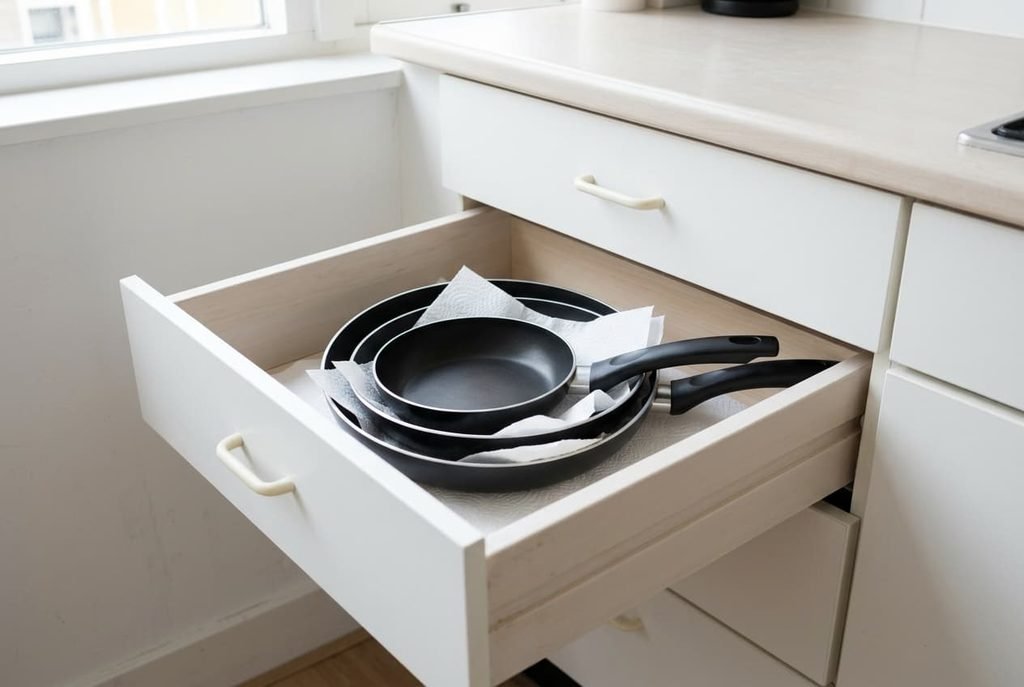
Before you buy a rail or a rack, measure your deepest drawer. Ours is 56 cm wide and 52 cm deep, with 18 cm of clear height. Nested pans need 28 + 22 = 50 cm of depth, which fits with 2 cm to spare. The stack stands 7 cm for the largest pan plus 2 cm for each pan nested in it, so 11 cm. A sheet of kitchen paper between pans adds about 1 cm in all, which still leaves 6 cm of height.
Storing frying pans in a small kitchen this way costs almost nothing and needs no drilling, provided the drawer is 52 cm deep and 13 cm clear. Put the pan you use most on top. The 28 cm pan sits at the bottom, so reaching it means lifting two pans weighing 0.7 and 0.9 kg, or 1.6 kg together.
Measure the drawer first, because a handle that overhangs the front stops it closing.
Which One to Pick
Only two situations really matter, and the drawer covers everything else. If your cupboards are full and 82 × 50 cm of wall stays free, choose the rail. You’ll see every pan at once and the coating stays safe, at no cost in shelf space, provided the fixings carry 3.0 kg.
If a shelf offers 34 cm of height and 50 cm of depth and you can’t drill, choose the rack. It keeps the wall intact and the pans clean. Count the 31.5 litres it will take from the cupboard before you commit. If neither describes your kitchen, use the drawer from the section above.
Whichever way you lean, hold the pans against your tape before ordering anything. Storing frying pans in a small kitchen comes down to what is scarcer in your kitchen. The measurements answer it in minutes. Try your choice for a fortnight, and if you keep reaching around it, move it. The set weighs only 2.9 kg, so changing your mind costs little, and the pans stay the same either way.
Questions Readers Keep Asking
Which one is kinder to non-stick coatings?
Both beat a loose pile. A rail keeps pans apart completely, while a rack holds them about 1 cm apart in slots, so only a stray handle can touch. Scratches usually come from pans stacked rim to base. Whichever you choose, nothing should press on a cooking surface.
How do I keep a hanging rail clean?
Wipe each pan and the rail with a damp cloth every two weeks, which takes about 30 seconds a pan. Keep the rail 50 cm clear of the hob, because cooking grease settles on whatever hangs closest. Pans hung over the hob need wiping much more often than ones beside it.
Which suits a kitchen where I can’t drill?
The rack, since it stands on a shelf and the wall stays untouched. Check that the shelf is 34 cm clear and 50 cm deep. If it isn’t, nest the pans in a drawer with paper between them. That needs no fixing at all, and you lose nothing but a little speed.