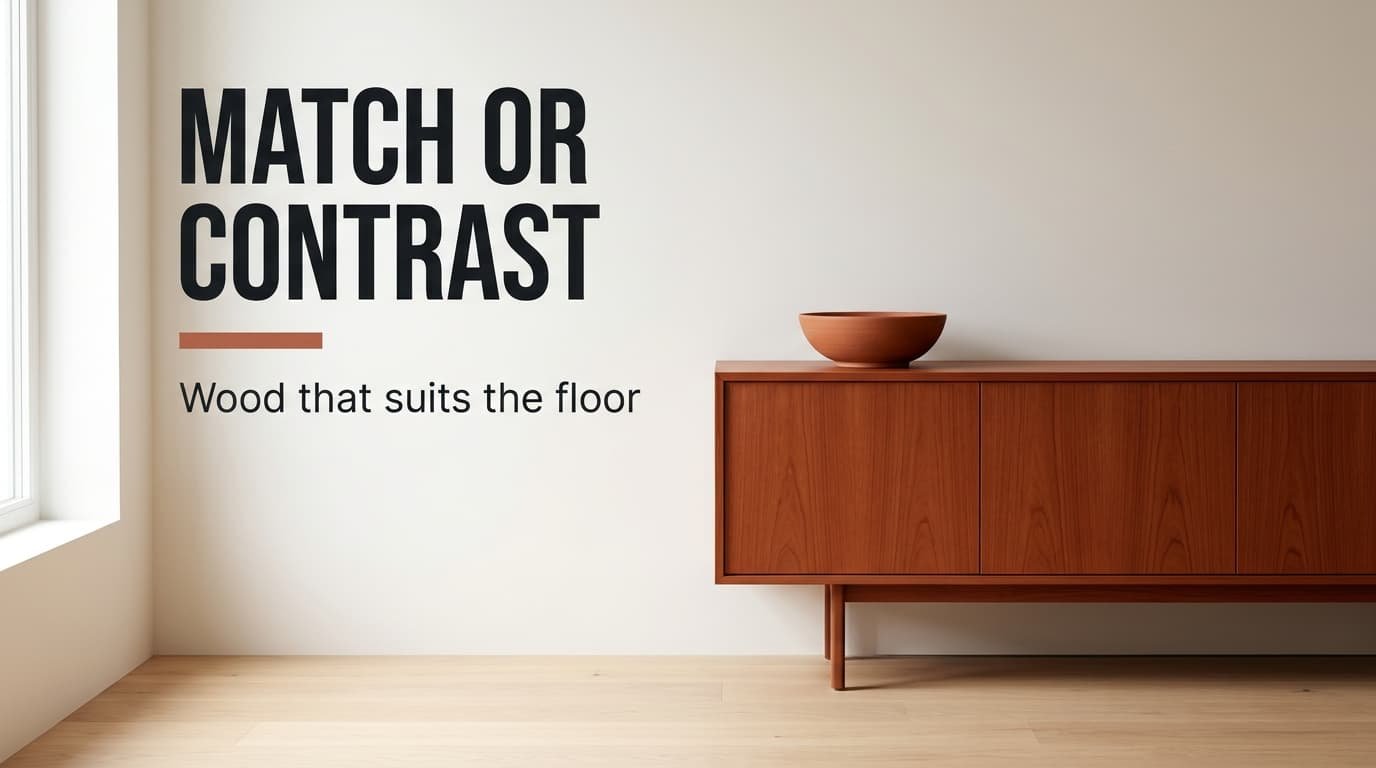
Look where the sideboard’s plinth meets the boards. Two warm woods touch along 160 cm, and the seam feels wrong even though both are good timber. When pieces clash with the oak floor, the furniture is seldom at fault on its own. Our example is a living room of 4.2 by 3.6 m in an Utrecht flat, with a natural oak floor and four wooden pieces bought over ten years. A five-step doorway check opens the diagnosis. Three faults come next, and every fix runs from free to a purchase. Each figure describes this one room, so measure yours before changing anything.
Why Wood Pieces Clash With the Oak Floor
Every wood carries two qualities at once. Value is how light or dark it reads. Undertone is the hint of colour under the brown. Most woods lean towards yellow or red. A few lean grey. Natural oak sits fairly light and leans yellow.
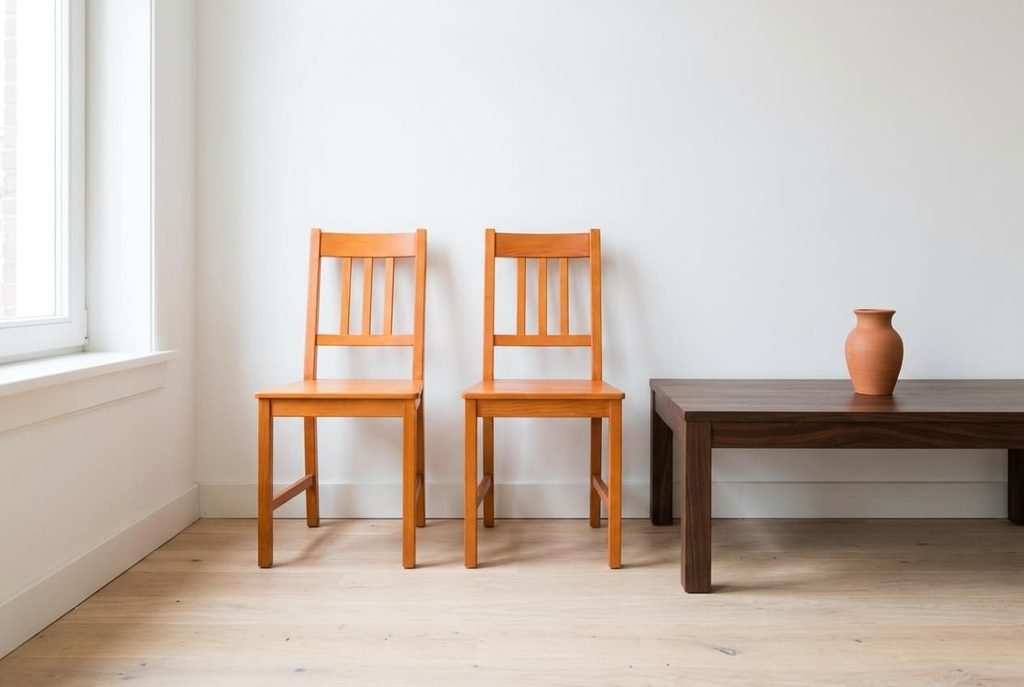
Two woods sit happily together when they differ clearly in value, or when they share an undertone. Trouble starts between those two cases. A chair nearly as light as the floor that leans orange reads as a failed match, the way a navy sock beside a black one does. The eye forgives a strong contrast and punishes a near miss, because an almost-match reads as an accident while a contrast reads as a choice.
Most owners blame the number of woods and start replacing furniture. That misreads the problem. A room can hold three woods comfortably when each has a clear role, while two woods can jar badly when they nearly match. So any clash with the oak floor comes down to two questions: how close each piece sits to the boards in value, and whether its undertone turns up anywhere else.
Value and undertone explain almost every clash you’ll see.
A Doorway Check of Every Wooden Surface
Take a blank white A4 page and your phone to the doorway. Work through the five points below in order.
1. Count: how many different woods can you see from here? Ours shows five, counting the floor.
2. Undertone: hold the page against each wood and name the colour it leans towards beside the white. Our floor leans yellow and the sideboard red. The bookcase looks pinkish, while the chairs have gone orange.
3. Value: set the camera to greyscale and shoot the room. Rate each wood from 1 (white) to 10 (black). Our floor and bookcase both score 3. The chairs reach 3.5, the sideboard 6, the coffee table 8.
4. Repeats: does each furniture wood appear at least twice in the room? The red sideboard appears once.
5. Seams: does any piece meet the floor along a long unbroken line? The sideboard’s plinth does, for 160 cm.
A piece scoring less than two steps from the floor’s value with a different undertone is a near miss. Ours has two of them.
Three Faults That Make Wood Clash With an Oak Floor
The chairs almost match the floor, and that almost is the trouble. They score 3.5 against the boards’ 3, yet years of lacquer have pushed them orange beside a yellow floor. Start free: move two of the four chairs to the bedroom, which halves the near miss on show. To rearrange, set the remaining pair against the dark sideboard, where they’re judged by a gap of 2.5 steps instead of by the floor. The purchase is a pair of chairs with black or painted frames, the largest outlay of the three faults. Seat pads in a deep colour are the cheaper half-measure, though they leave the orange legs touching the boards. Check the greyscale shot again before you buy anything.
The bookcase repeats the floor’s value with the wrong undertone. It scores 3 like the boards but leans pink, and at 80 by 190 cm it’s the largest wooden face after the floor itself. For nothing, carry it into the hall, where it stands on tiles and the comparison disappears. If it has to stay, load the shelves so books cover most of the wood and leave the frame as a thin outline. Buying white shelves is the final step, at a moderate cost, because it removes one wood from the count entirely. A bookcase this tall needs fixing to the wall wherever it ends up, so allow ten minutes for that.
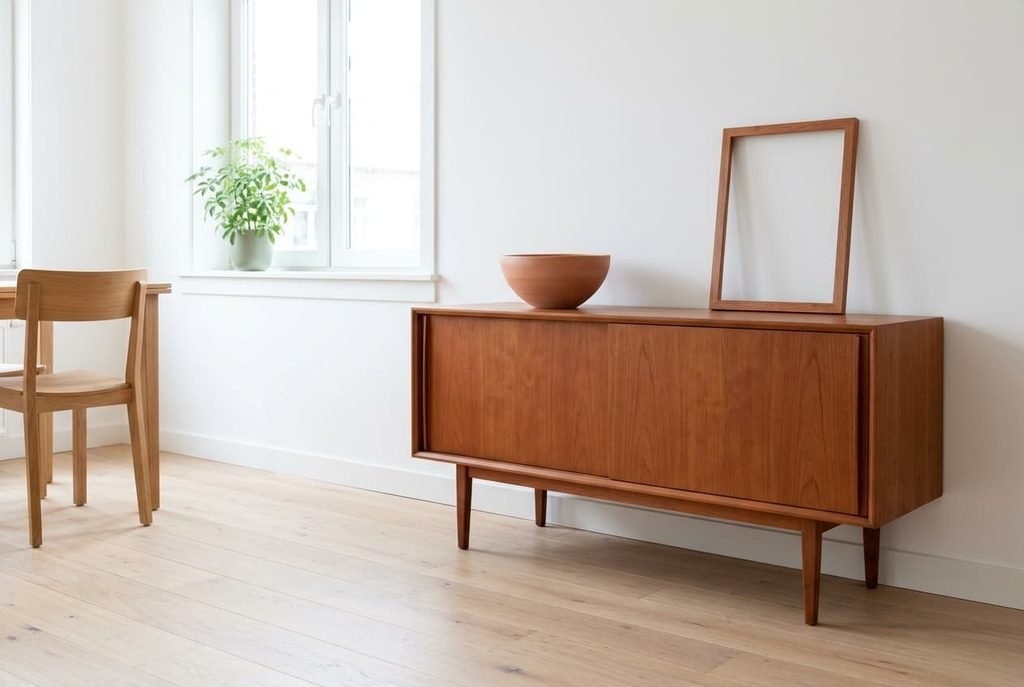
The sideboard’s red stands alone, joined to the floor by a single long seam. No other piece shares its undertone, which leaves it looking like a visitor. Free: bring two red-leaning objects from other rooms. A cherry frame and a terracotta bowl would do, placed across the room. Rearranging means a low rug in front of the plinth so the seam is broken. The purchase is a set of legs 15 cm tall. They lift the plinth and let the floor run underneath in shadow, a dark line that separates the two woods for a modest price. A plinth glued to its carcass needs a joiner rather than a screwdriver, so check the underside first.
How to Buy Wood That Sits Well From Now On
Take the floor with you. A phone photo shifts colour. Carry an offcut or a spare board instead, since a strip of card painted to match is only a fallback. Hold it against any piece you’re considering, with the white page beside both. Apply one rule: match the floor exactly, or differ from it by at least two steps of value. Anything in between is a near miss waiting to happen. A shop’s warm spotlights also hide undertone, so judge the sample by a window.
Limit the room to three woods including the floor. Make each one appear at least twice. A walnut table can echo a walnut frame, and a black chair leg can repeat a black lamp base. That way no wood will clash with the oak floor by standing alone.
Write the scores down before you shop.
Sanding the Floor to Match: A Fix Not Worth Paying For
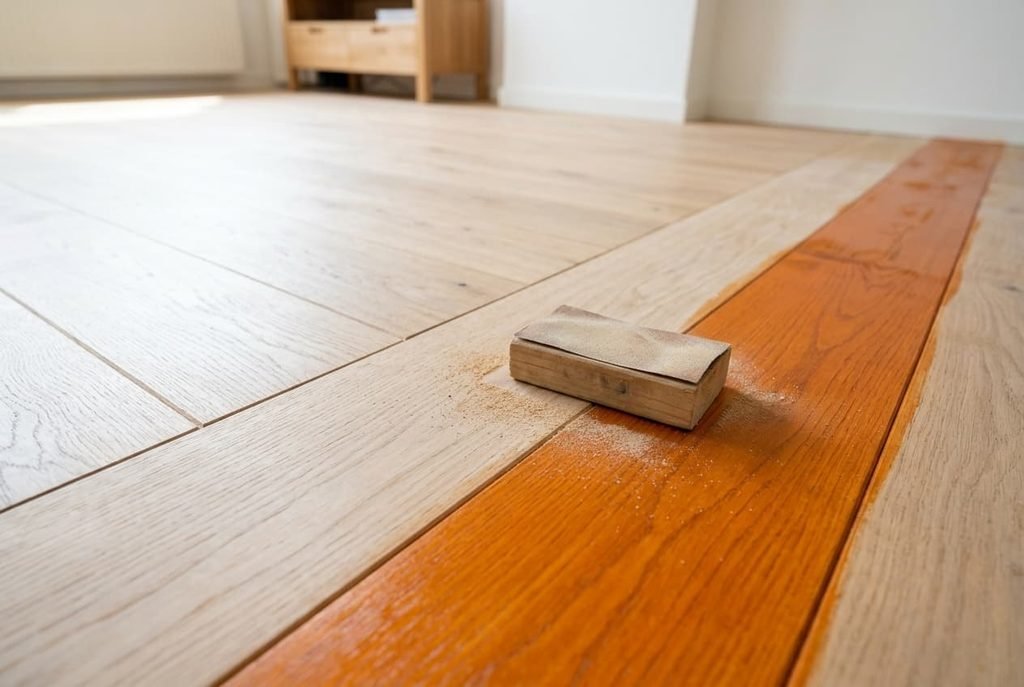
The tempting cure is sanding and staining the whole floor to suit the furniture, and it rarely pays. A stain lies over the oak’s own yellow, so a red stain on yellow wood turns orange and brings a fresh near miss with it. Sanding 15 m² fills the flat with dust for days, and renters must ask their landlord before starting. Each coat takes a day to dry, so the furniture lives in another room for most of a week.
Painting every wooden piece white is the opposite mistake. It removes the clash and the warmth together, turning the lounge into a show flat. Pale paint on old furniture also chips along its edges inside a year, and the wood showing through brings back the contrast you were hiding. Legs under one sideboard would have done more for far less.
Begin with the free steps this evening. Shoot the room in greyscale first. Next, carry the bookcase into the hall and move two chairs to the bedroom. Then shoot again from the doorway, standing where you stood before. Lay both pictures next to each other. If a piece still seems to clash with the oak floor, go back to its value score. Its undertone matters just as much, because the next fix follows from those two readings. Repeat the shot by daylight tomorrow, since evening bulbs warm every undertone and can flatter a near miss. Keep both pictures, and hold any future purchase up against them before paying.
Questions Readers Keep Asking
What usually causes woods to look wrong together?
A near miss. Two woods of almost the same lightness with different undertones look like a failed attempt to match. Clear contrast and shared undertones both read as intentional. Test with a greyscale photo and a white page, and the piece causing the trouble usually shows itself within a minute or two.
What can I change tonight without spending anything?
Move the pieces that nearly match the floor out of view, or set them against something dark so they’re judged by contrast. Bring in an object that repeats any wood appearing only once. Then photograph the room again from the doorway. Most rooms improve noticeably before any purchase is made.
Can I fix it without replacing the floor?
Yes. The floor is the anchor, and the furniture adjusts around it. Moving pieces and repeating undertones both work without touching the boards, as does breaking a long seam with a rug or legs. Sanding and staining seldom land on the colour you wanted, so leave the floor alone.