The terminal beeps and the tea is paid for, yet the shop never saw your card number. What does a shop actually receive when you pay by phone? A stand-in number, a code made for that one tap and the amount. Your real card number stays with the card network and your bank. This explainer follows a single tea, priced at 2.40, through the exchange, from first tap to final approval. All numbers here are invented. Your own bank and phone will differ. You can redo each sum with your own figures, and the limits come after the trace.
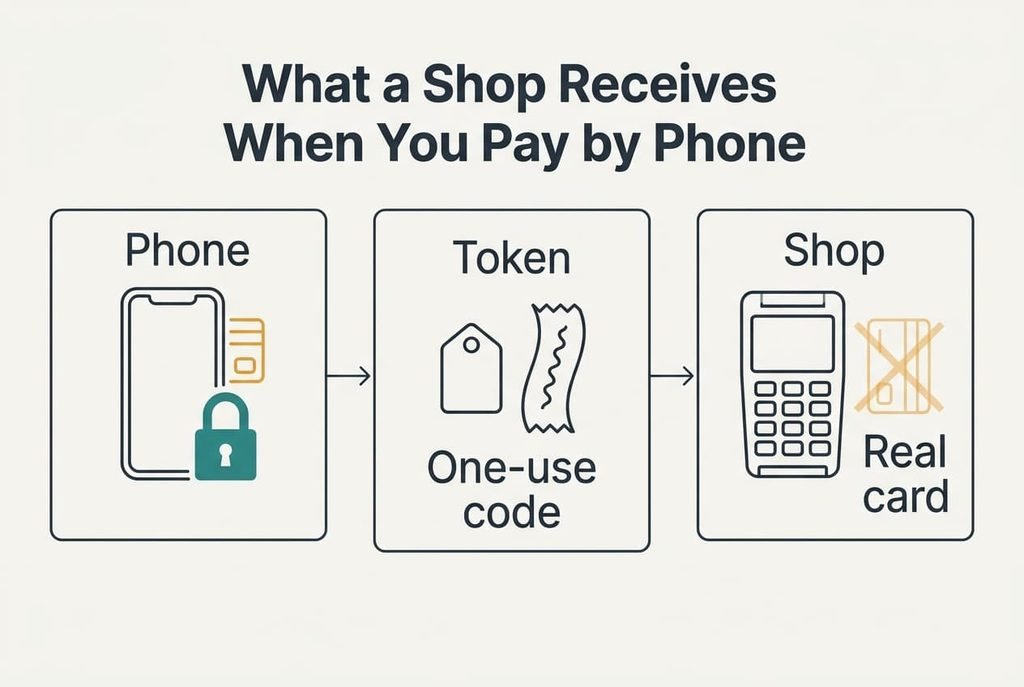
What a Shop Receives When You Pay by Phone
The shop receives a stand-in number and a one-use code, along with the amount and the time. It doesn’t receive the 16 digits printed on your card. That’s the short answer, and it leaves out how the stand-in is made and why a copied code is useless.
When you add a card to a phone’s wallet, the card network issues a token. A token is a 16-digit number that looks like a card number but maps to yours only inside the network’s own systems. The phone keeps it beside a secret key in a protected area of its hardware. That key never leaves the chip.
At each tap the chip mixes the key with a running count of payments to make a short code, the cryptogram. Terminals forward the token and the code, plus the amount, to the network. Next, the network swaps the token for the real number and asks your bank for approval. Between phone and terminal the radio link runs at 13.56 MHz and works over a few centimetres only. Nothing more reaches the till when you pay by phone.
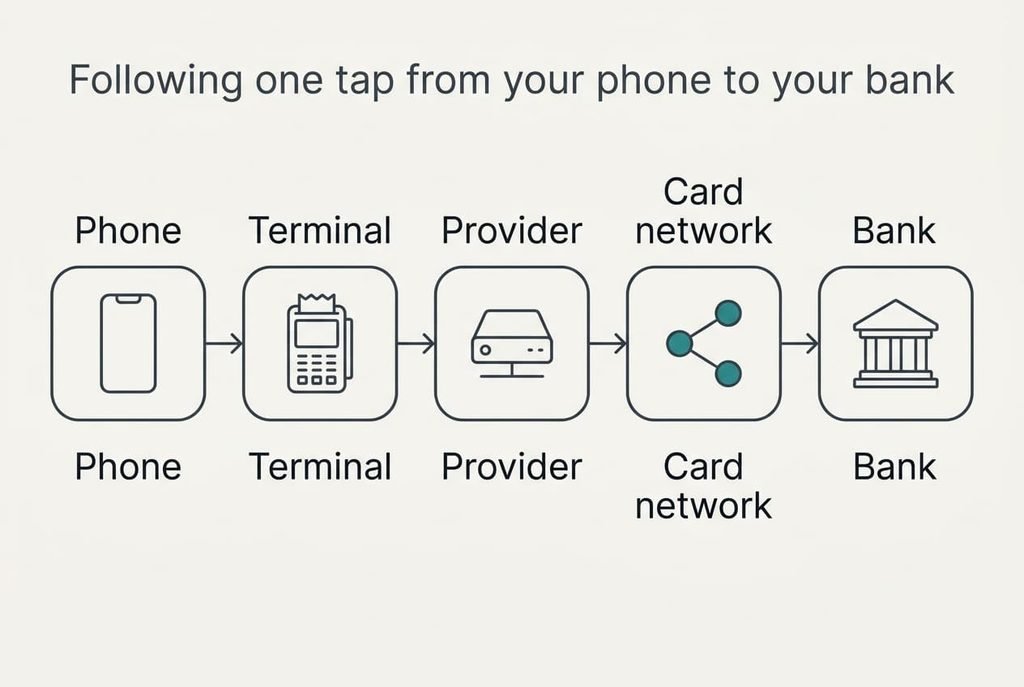
Following one tap from your phone to your bank
Take a tea priced at 2.40. Assume the real card number ends 4821 and the token ends 7305. The chip’s payment counter reads 112.
First, you wake the phone. Then you hold its back roughly 2 cm away from the terminal. The terminal’s coil sends out a 13.56 MHz field, and the phone’s coil picks it up. Second, the terminal asks which payment applications the phone holds and sends the amount, 2.40, with a random number of its own. Third, you confirm on the phone with a fingerprint or a similar check. The chip raises the counter to 113 and computes the cryptogram from the secret key, then folds in the counter. The amount and the terminal’s random number go in too.
Fourth, the phone answers with the token ending 7305 and its expiry date. The cryptogram comes with them. Assume about 300 bytes in all. At the slowest radio rate of 106 kbit/s that takes 300 × 8 ÷ 106,000 = 0.0226 s, or 22.6 ms.
Fifth, the terminal forwards everything to the shop’s payment provider, which passes it to the card network. That network knows the key and expects counter 113, so it can check the cryptogram. It then looks up token 7305 and finds the real card, ending 4821. The request goes to your bank, which approves it after its own checks.
Assume the chip needs 0.15 s and the network round trip 0.8 s. A whole tap therefore takes 0.0226 + 0.15 + 0.8 = 0.9726 s, so about a second. Radio makes up only 2.3% of that.
Digits ending 4821 never reach the shop at any point.
Its receipt carries the token ending 7305 and the amount, with a timestamp. Suppose someone recorded the exchange and replayed it tomorrow. The counter has moved past 113 and the terminal’s random number will differ, so the network would refuse it.
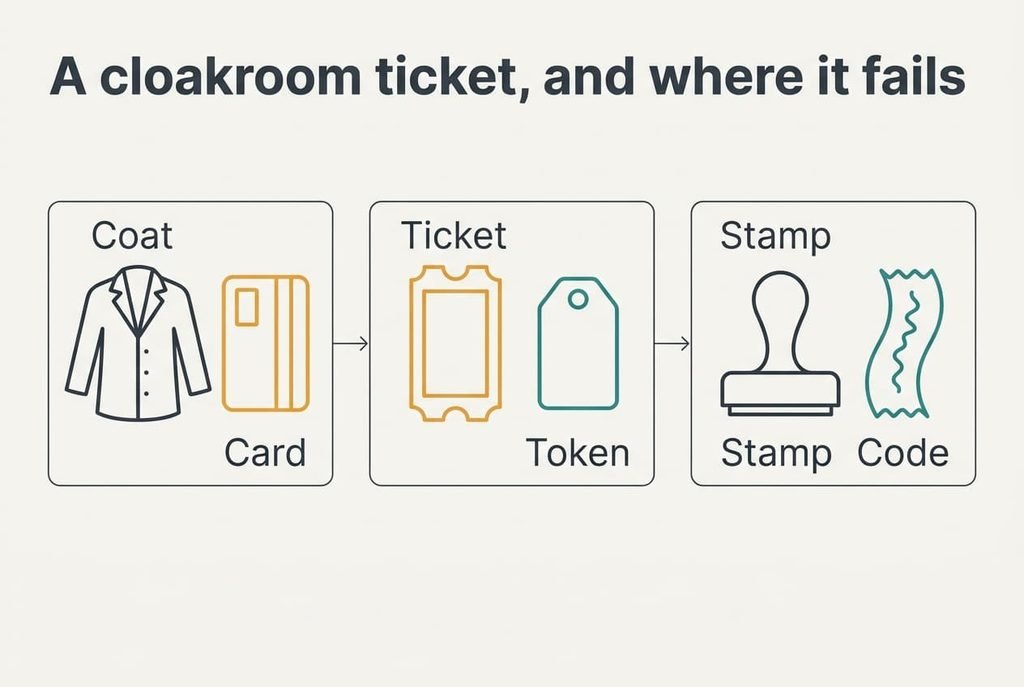
A cloakroom ticket, and where it fails
Picture a theatre cloakroom. You hand over a coat and receive a numbered ticket. Staff in the hall see only the ticket. The coat stays in the cloakroom, and the cloakroom alone knows which coat belongs to it. A stamp on the ticket changes every visit.
In this picture the card is the coat, the token is the ticket and the cryptogram is the stamp. The card network plays the cloakroom.
It fails twice. A paper ticket works for whoever holds it, whereas the token is tied to one phone and works only with a fresh cryptogram from that phone’s chip. And a coat can be fetched again with the same ticket, while a tap can’t be repeated, because the counter has already moved.
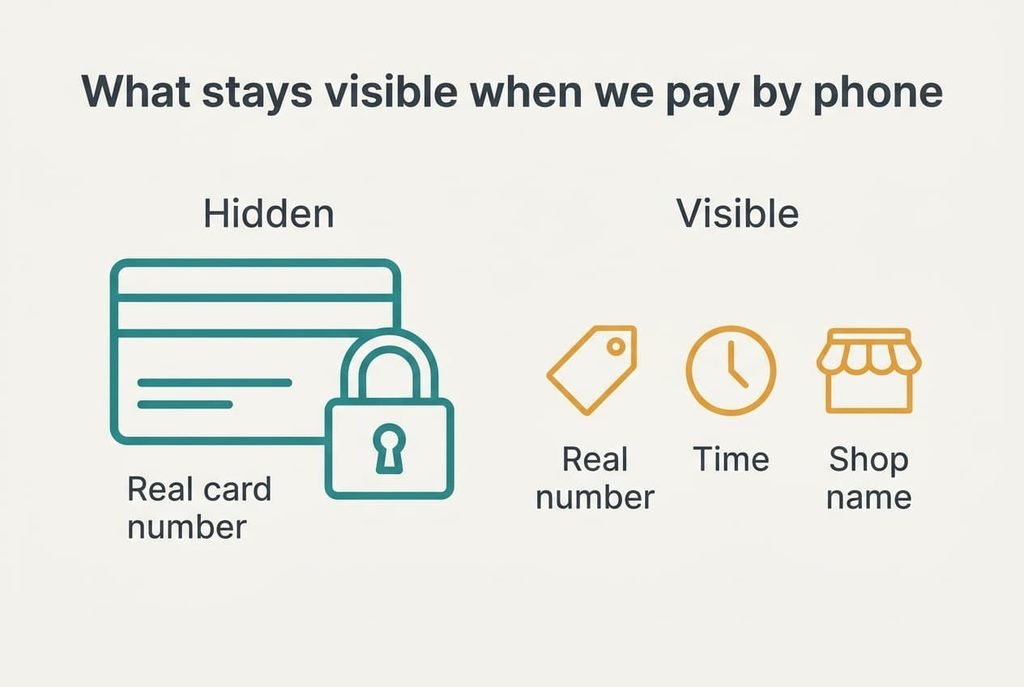
What stays visible when we pay by phone
Hiding the number doesn’t hide the purchase, since the shop still learns the amount and the time, and your statement still names the shop. Your bank and the card network also hold the real number. A token protects the link between the shop and your account, and nothing else.
The phone’s lock is the main gate. Whoever can open your phone can pay with it. Some phones offer an express mode for transport gates that skips the check, and that’s a setting you choose.
Range is the second limit. Near a coil, the field falls off roughly as distance cubed. Moving from 2 cm to 4 cm leaves one eighth of the strength, since (4 ÷ 2)³ = 8. That’s why a terminal wants the phone almost touching.
Range is a protection in itself, and it needs no setting.
Refunds are the awkward case. The shop holds the token, so a refund reaches your card only because the network maps it back.
Beliefs about tapping a phone that don’t hold up
Three beliefs travel with phone payments. The first says that when you pay by phone, a thief with a reader can lift your card number by brushing past. It formed because demonstrations showed plastic cards being read through bags. Yet a phone sends a token and a code that works once, and the field is too weak beyond a few centimetres to start a read, so a thief gains nothing reusable.
The second says the wallet keeps a picture of your card, so the real number sits on the phone. It formed because the wallet shows the card artwork and four digits. Those four digits usually belong to the token and can differ from the ones on your plastic card.
The third says the shop gets your name. It grew from the days of magnetic stripes, which carried it. A phone payment usually leaves the name out. That’s why a shop assistant can’t greet you by it.
Choosing between phone and plastic at the till
Count what each choice exposes when you pay by phone. Use the phone when it locks behind a biometric check or a PIN, because then the shop gets only a token and a code that works once. Keep the plastic card as your backup for a flat battery.
If a terminal ignores the phone, hold the centre of its back flat against the reader for a second. The coil sits there on many phones. Move slowly, because the field is weak.
When you query a payment later, quote the last four digits shown in the wallet, because they come from the token. They help your bank trace the payment.
A phone can pay without handing over your card number because the card network swaps it for a token and the chip adds a code that works once. That pair explains the rest. The shop sees a stand-in while the bank sees the real card, and the phone’s lock decides who may tap. Leave the lock on and the tap exposes less than a plastic card does. Check the last four digits next time a receipt looks wrong.
Questions readers keep asking
Can someone steal my card number by standing close to me?
That’s very unlikely with a phone payment. The phone sends a token and a code that works once, and the field fades to one eighth of its strength when the distance doubles from 2 cm to 4 cm. A thief would have to hold a reader almost against the phone, and the stolen code would be useless afterwards.
Do I need to pay by phone at all?
No. A plastic card serves the same purpose at the till. The difference is what it sends: the card’s real number with a one-use code, whereas the phone sends a token. If your phone locks properly and you carry it everywhere, paying by phone exposes a little less and saves you reaching for the wallet.
Is paying by phone different from tapping a plastic card?
Yes, in what the shop receives. A plastic card sends its real number and a code that works once, while a phone sends a stand-in. A phone also asks you to confirm, but a card needs no check for small payments. The radio part of the tap is the same.