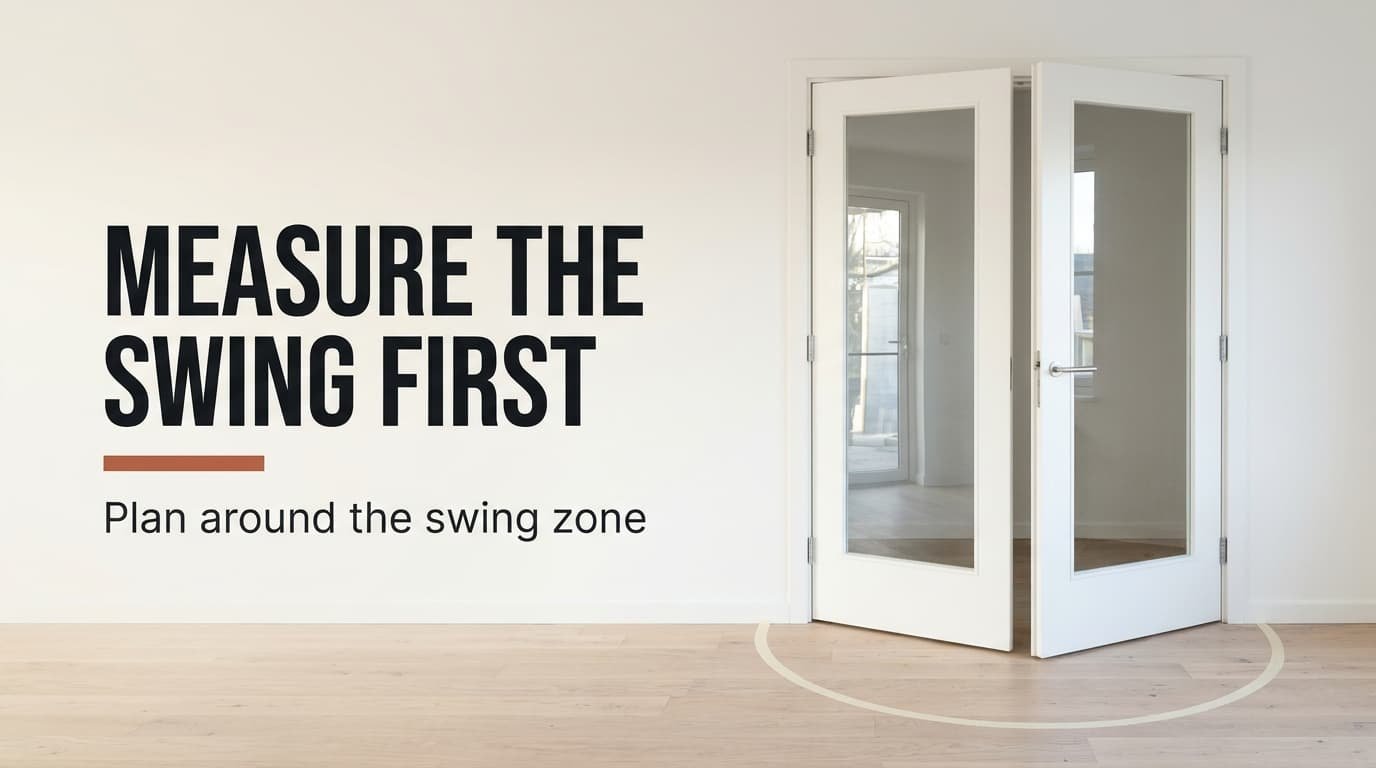
Pull the doors open and a leaf strikes the sofa. Shut them and the television shows a bright, mirrored sheet of glass. Both faults trace back to one patch of floor nobody measured. A living room with French doors lets the swing of the leaves decide where everything else can stand, and an afternoon with a tape settles it. Our room is a Haarlem flat of 460 by 340 cm, and every size below is a sample you’ll replace. Record yours before shifting a single piece, since furniture moved by eye tends to wander back.
What Sets the Layout of a Living Room With French Doors
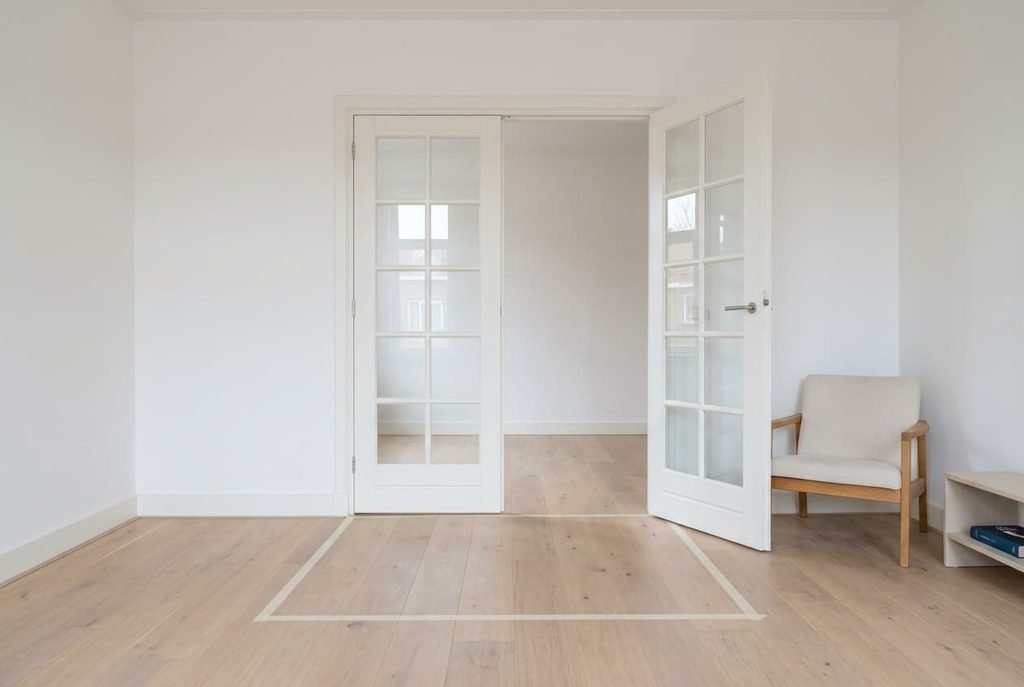
Each leaf traces a quarter of a circle, and furniture has to stay outside it. Here two leaves of 70 cm fill an opening 140 cm wide, hinged at the outer edges to open inwards. One leaf covers π × 70² ÷ 4, about 3,848 cm², so the pair covers 7,697 cm². Taping a 140 × 70 cm box (9,800 cm²) is easier and contains both arcs. It takes 6.3% of the 156,400 cm² floor.
Glass is the second constraint. Doors 210 cm tall bring in more daylight than a window of equal width. A screen opposite them mirrors a bright sheet of up to 140 × 210 cm by day and your own lamps after dark, so the picture washes out.
The walking route comes third. Visitors cross 390 cm from the hall door to the rectangle, so a 90 cm lane takes 35,100 cm². Rectangle and lane together claim 44,900 cm², or 29% of the floor, before any furniture arrives. A living room with French doors therefore starts with 111,500 cm² to furnish, not the 156,400 cm² on the plan. Two numbers matter in practice. The leaf length sets the depth of the box, and 90 cm fixes the lane’s width.
Furniture gets whatever the doors leave behind.
Four Layouts for a Room With French Doors in Its Short Wall
These four plans share one rule: keep the swing rectangle and the lane clear. Use your own sizes.
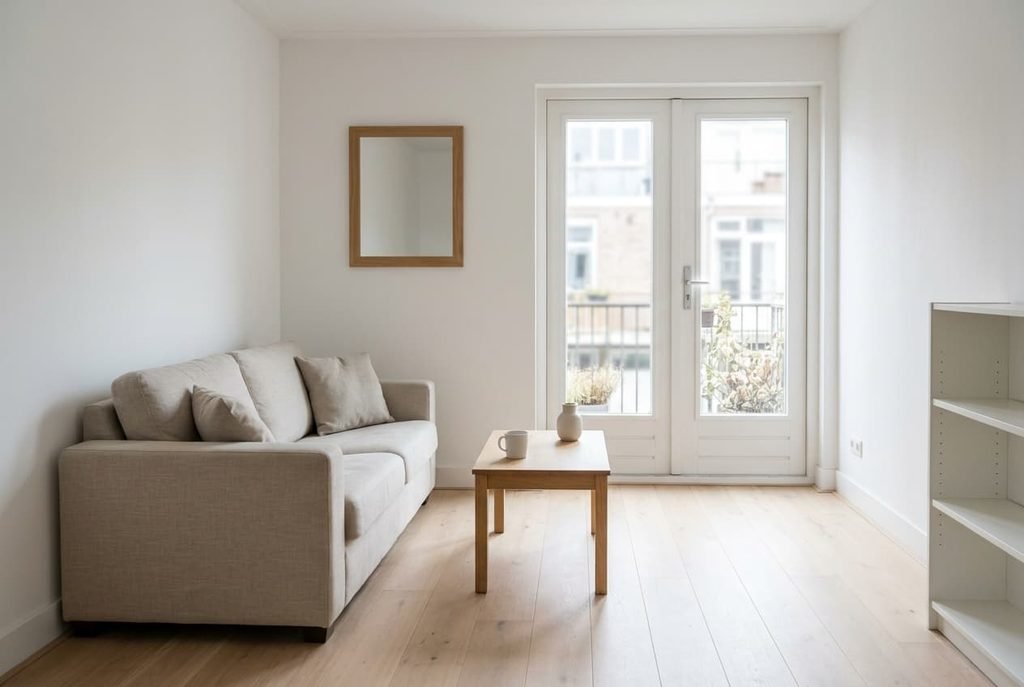
– Rental-friendly, 460 × 340 cm: a linen sofa measuring 210 × 90 cm sits against the wall on your left as you enter, starting 80 cm from the glass. An oak coffee table 100 cm wide and 50 deep stands 40 cm from the seat edge, and a media unit 40 cm deep faces them from the right-hand wall. The lane keeps 120 cm, and nothing needs drilling.
– Tight footprint, 380 × 300 cm, doors 120 cm wide: a grey sofa 170 cm wide and 85 deep takes one side, plus a round birch side table 60 cm across. The rectangle shrinks to 120 × 60 = 7,200 cm², 6.3% of the floor again, while the lane stays at 90 cm.
– Awkward shape, doors 40 cm from the right wall: the open right leaf then stands 40 cm short of that wall, so a walnut shelf unit 30 cm deep and 100 cm high suits it. A 10 cm gap remains beside the leaf, and the sofa goes across to the left.
– Full furnish, 520 × 400 cm: an oak table of 1.6 × 0.9 m, seating four, stands 160 cm clear of the glass, which is 70 cm of swing plus 90 cm of walkway. A sofa of 240 × 95 cm sits beyond it, with a wool rug about 200 × 290 cm under its front legs.
Where People Go Wrong Around the Swing Zone
Four slips recur. A tape exposes all of them in ten minutes.
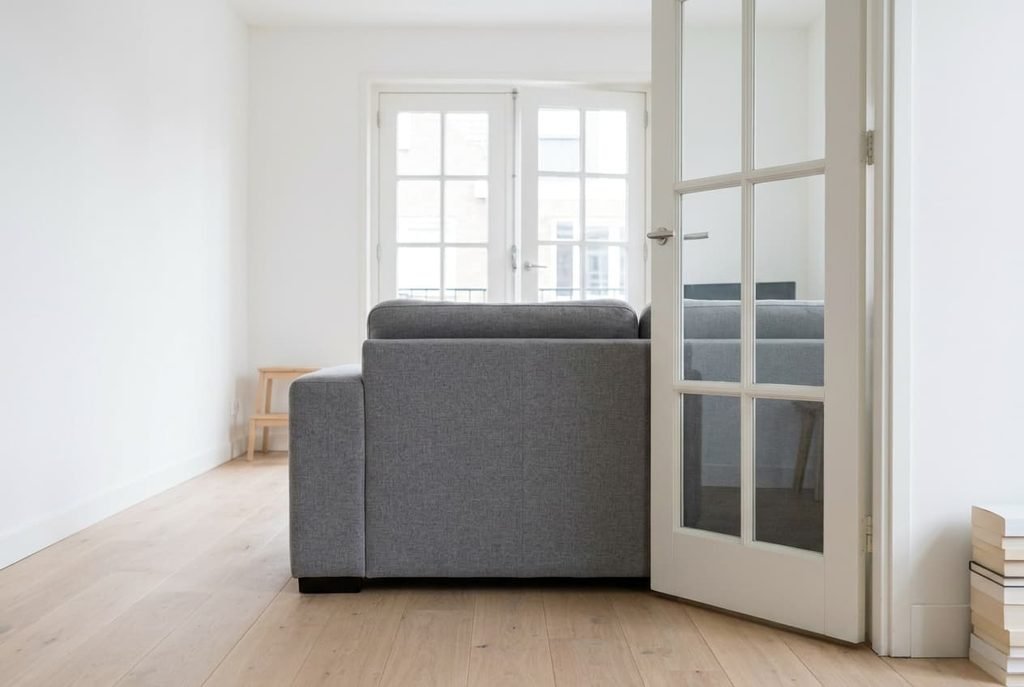
A sofa 20 cm from the glass lets its back meet the leaf tip after only asin(20 ÷ 70) ≈ 17° of travel. That leaves a gap of about 20 cm, enough for a hand. Owners don’t bother with the second leaf, so the 140 cm opening halves to 70. The free fix moves the sofa to a side wall, while floating it 80 cm out with a narrow console behind rearranges the room instead.
Curtains on a track no wider than the opening stack their folds right where the leaves swing. Each leaf then drags the fabric or snags on it. Tying the curtains back before every opening is free, and you won’t need new fabric. A track 180 cm long is the purchase, because the folds then rest 20 cm beyond each side of the opening.
A television opposite the glass holds that bright sheet by day and your reading lamp by night. Shifting the unit to a long wall is free, and the sofa follows. A dark matt curtain over the glass is the purchase, taking the daylight away with the glare.
A plant pot or floor lamp inside the rectangle is easy to miss, since a pot whose near edge stands 30 cm from the glass stops a leaf at about 25°. Tape the 140 × 70 cm box and give whatever stands in it a home along a side wall. A wall-hung planter is the purchase.
When Keeping the Swing Zone Empty Is the Wrong Call
The usual rule keeps the whole 140 × 70 cm rectangle bare. Count how often the doors really open before you accept that. Here they open about six times a week for roughly 20 seconds, which is two minutes out of 10,080. For the other 99.98% of the week the rectangle sits empty at the brightest spot in the room.
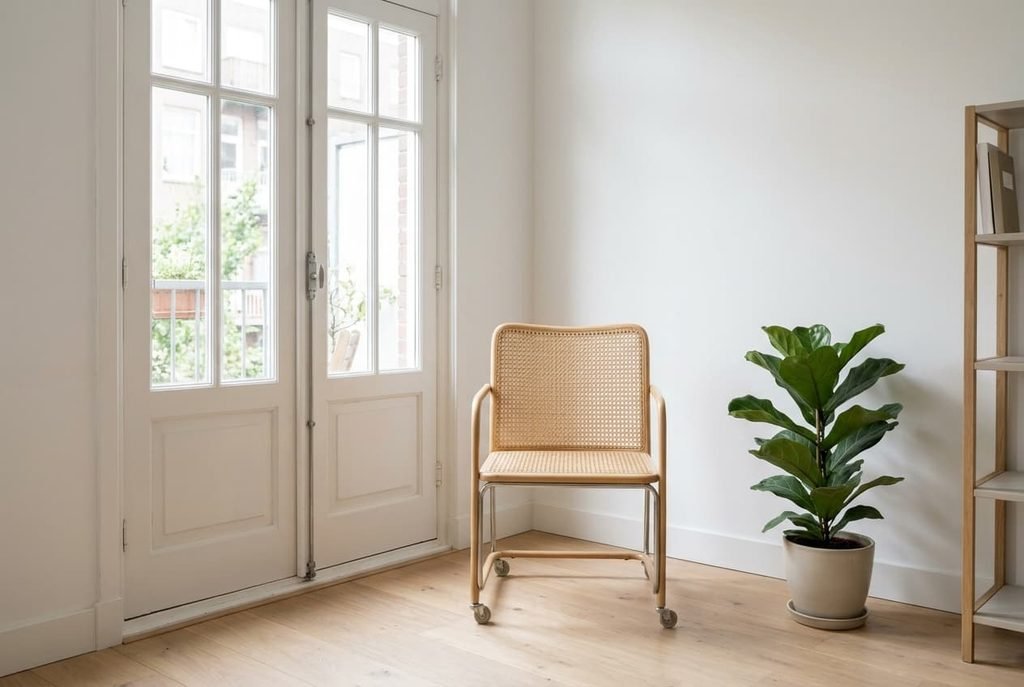
I’d lean towards a light chair or plant trolley on castors inside the rectangle over leaving it bare. A cane chair weighing 4 kg slides clear in five seconds, and in between it offers a reading seat beside the best light. The lane stays open, which outranks the rectangle. That’s a lot of idle floor put to work.
Two conditions apply. Doors used daily to reach a balcony garden need the rectangle empty, since shifting a chair twenty times a week wears out any enthusiasm. A deep rug traps castors, so the chair then blocks a leaf. Keeping a living room with French doors flexible suits households that open them rarely, and it’s the cheapest compromise.
Count the openings before you clear anything.
Three Jobs for This Weekend
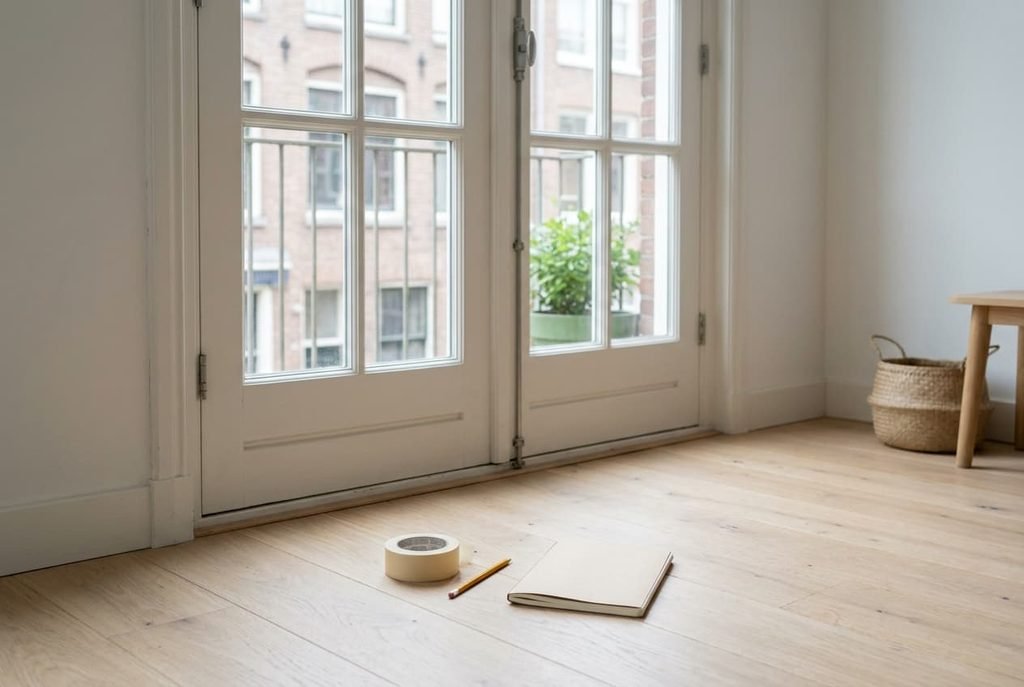
1. Tape the rectangle. Lay a line 140 cm long along the glass and another 70 cm deep, close the box, then open both leaves fully and move anything they touch. Confirm each leaf reaches its stop without scraping the floor or the tape.
2. Walk the lane. Mark 90 cm clear from the hall door to the tape, then carry a laundry basket along it once, turning as you would with a tray. Whatever snags the basket can’t stay.
3. Check the glass at five in the afternoon. Sit where the sofa will go and study the switched-off screen. If the glass shows bright in it, shift the unit to a long wall and turn the seating around. Take a second look at noon, then compare the two.
A good plan for a living room with French doors guards two shapes: the swing rectangle and the walking lane. Furniture takes whatever remains. Keep the markings on the floor for a fortnight before you drill or buy anything. If a piece still misbehaves after that, hold it against the rectangle first, because the doors set the limit and the room simply follows. Most layouts improve once that is done.
Questions Readers Keep Asking
How big a sofa can I put near French doors?
Up to 210 cm wide and 90 deep in a room like this one, provided it starts 80 cm clear of the glass beside a side wall. It then clears the open leaf by 10 cm. A deeper sofa squeezes the lane below 90 cm, so measure the lane before you buy.
Can the sofa stand with its back to the glass?
Yes, if it floats at least 80 cm out so the leaves swing freely behind it. A narrow console, 30 cm deep, can fill the gap. Pushed to 20 cm from the glass, the back stops each leaf after about 17°. Float it or move it, but don’t leave a hand’s width.
Will curtains make the room too dark?
Not with a track 180 cm wide. The fabric then stacks 20 cm beyond each side of the opening, so all 140 cm of glass stays clear by day. Pale sheer cloth keeps the room light in the evening. Add a heavier layer later if you want one.