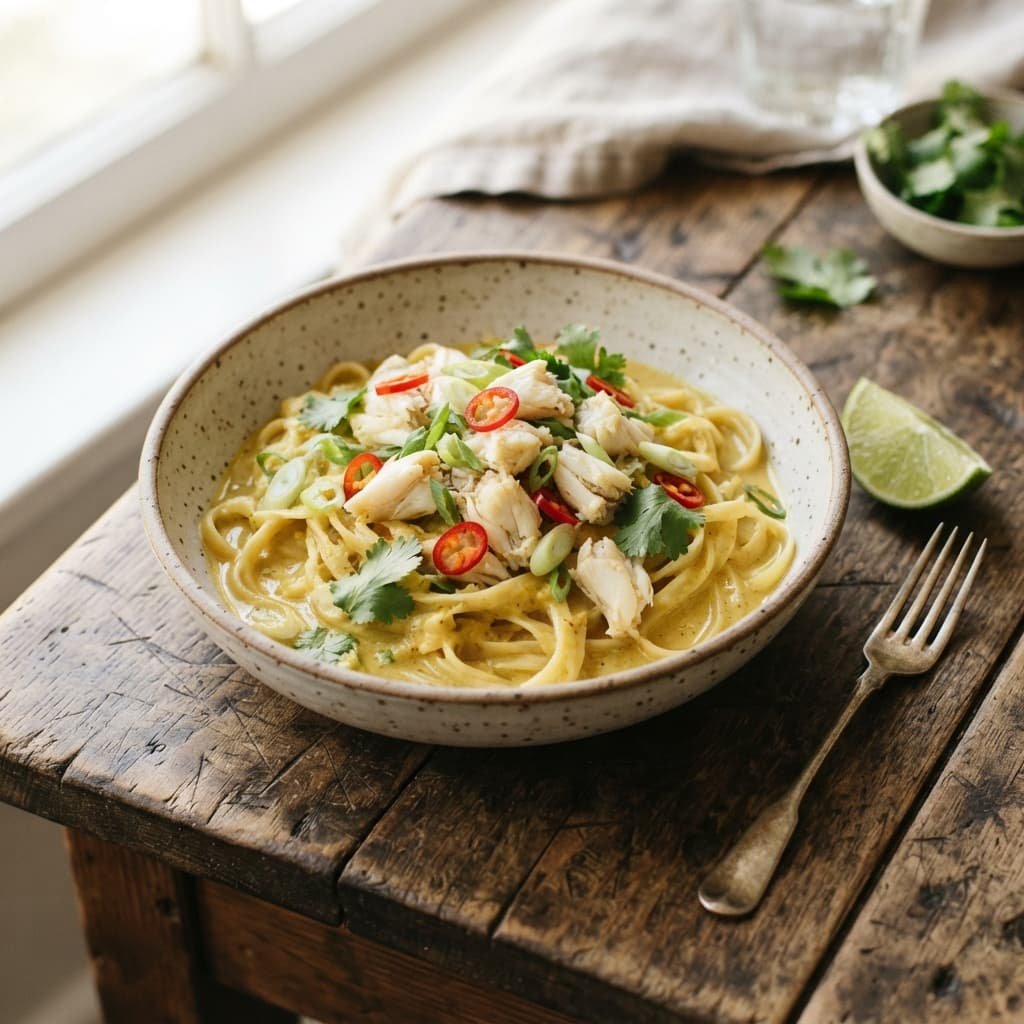
Crab meat is sold already cooked, which changes what the cook is actually doing: the job is not to cook it but to warm it without ruining it. Crab protein is delicate, and the longer it sits in hot liquid, the more it tightens, dries, and shreds into stringy threads instead of staying in sweet, juicy lumps. Creamy Coconut Curry Crab Pasta is built around that fact. The sauce is finished completely before the crab goes in, and the crab only spends about a minute in it, just long enough to warm through.
The combination is well documented. Crab simmered in coconut milk is the basis of curries across South and Southeast Asia, from Thai crab curry served over noodles to Kerala-style coconut crab curries. Coconut curry pasta is a published idea too, usually made with shrimp, and crab pasta with coconut cream appears in a published recipe. This version uses a Thai-style red curry paste, full-fat coconut milk, and lump crab over linguine.
| Prep Time | 10 minutes |
| Cook Time | 20 minutes |
| Total Time | 30 minutes |
| Servings | 4 |
| Difficulty | Easy, with one gentle-heat step |
Key Techniques for Coconut Curry Crab Pasta
The dish takes about 30 minutes. Fry the curry paste in oil for 2 minutes until it darkens and smells toasted, simmer the coconut milk for 6 to 8 minutes until it thickens, and fold in the crab for only 1 minute at the very end, off a rolling boil.
Frying the curry paste first matters because many of its flavor compounds, from chilies, lemongrass, and galangal, dissolve in fat rather than water. Cooking the paste in oil until it darkens and separates releases them and removes the raw, harsh edge of the garlic and chili. Adding coconut milk straight onto unfried paste leaves the sauce tasting flat.
Coconut milk is an emulsion of oil droplets held in water by coconut proteins. A gentle simmer thickens it by evaporating water. A hard boil agitates the droplets enough to merge, and the oil can separate into a visible slick. Some separation is normal in a curry, but in a pasta sauce a smooth, coating texture is the goal, so a low simmer and a splash of pasta water to re-emulsify keep it silky.
Ingredients
This serves 4.
For the Sauce
- 2 tablespoons (30ml) neutral or coconut oil
- 3 tablespoons (50g) Thai red curry paste
- 3 garlic cloves, minced
- 1 tablespoon (6g) grated fresh ginger
- 1 can (13.5 oz / 400ml) full-fat coconut milk
- 1 tablespoon (15ml) fish sauce
- 2 teaspoons (8g) brown sugar or palm sugar
- 2 tablespoons (30ml) lime juice, plus wedges for serving
For the Pasta and Crab
- 12 oz (340g) linguine or spaghetti
- 8 oz (225g) lump crab meat, picked over for shell
- 2 scallions, thinly sliced
- 1/4 cup (10g) fresh cilantro, chopped
- 1 red chili, thinly sliced (optional)
Some curry pastes and fish sauces vary widely in saltiness, so taste before adding more salt.
How to Make Creamy Coconut Curry Crab Pasta
- Bring a large pot of salted water to a boil. Cook the pasta until just al dente, about 1 minute less than the package says. Reserve 1 cup (240ml) of the cooking water, then drain.
- Meanwhile, heat the oil in a large, deep skillet over medium heat. Add the curry paste and stir constantly for 2 minutes, until it darkens a shade, the oil turns red, and the smell turns toasted rather than raw.
- Add the garlic and ginger and stir for 30 seconds, until fragrant.
- Shake the can of coconut milk well, then pour it in, scraping the bottom of the pan. Add the fish sauce and sugar. Simmer gently for 6 to 8 minutes, stirring occasionally, until the sauce thickens enough to coat the back of a spoon.
- Add the drained pasta and toss for 1 minute. Add reserved pasta water, 1/4 cup (60ml) at a time, stirring until the sauce looks glossy and clings to the noodles rather than pooling.
- Turn the heat to low. Gently fold in the crab with a spatula, trying not to break up the lumps, and warm for 1 minute until just heated through.
- Remove from the heat. Stir in the lime juice, taste, and adjust with more fish sauce, sugar, or lime.
- Divide among bowls and top with scallions, cilantro, chili, and lime wedges. Serve immediately.
Good vs. Excellent: The Details That Matter
- Fry the paste until the oil turns red. That color change signals that the fat-soluble flavors have been released.
- Use full-fat coconut milk. Light versions are thin and break more easily.
- Keep the simmer lazy. Small bubbles at the edge are enough.
- Add the crab last and off the boil. It needs warmth, not cooking.
- Finish with lime off the heat. Heat dulls its brightness.
Troubleshooting Common Problems
Problem: The crab turned stringy and dry. Cause: it simmered in the sauce too long. Solution: fold it in at the end over low heat for about 1 minute only.
Problem: The sauce looked oily and split. Cause: it boiled hard, or the paste was fried in too much oil. Solution: take the pan off the heat, add a few tablespoons of hot pasta water, and stir vigorously to bring it back together.
Problem: The sauce tasted flat. Cause: the curry paste was not fried first, or it lacks acid and salt. Solution: bloom the paste in oil, and balance with fish sauce, sugar, and lime at the end.
Problem: The sauce was too thin. Cause: it was not simmered long enough before the pasta went in. Solution: reduce until it coats a spoon, and loosen only with small splashes of pasta water.
Mastering the Technique
The principle that carries over is the order of operations in a coconut-based sauce: fry the aromatics, add the coconut milk, simmer to thicken, and add delicate proteins last. The same sequence works for shrimp, scallops, and flaked white fish, all of which also need only a minute or two of gentle heat.
A useful visual cue is the sauce’s sheen. A well-emulsified coconut sauce looks glossy and uniform. If tiny oil droplets start pooling at the surface, the heat is too high, and it is time to lower it and stir in a little starchy water.
Variations and Substitutions
Green or yellow curry paste can replace red, with different heat and herbal notes. Fresh or canned lump crab both work; canned crab should be well drained. Cooked shrimp or flaked cooked white fish can replace crab with the same last-minute folding. Rice noodles or vermicelli make a gluten-free version. Add baby spinach or snap peas to the sauce for color. Vegetarian cooks can omit the crab and fish sauce and use tofu and soy sauce.
Serving and Pairing
Serve with extra lime wedges and a cucumber salad dressed with rice vinegar. Steamed greens or a light herb salad cut the richness. A pinch of chili flakes at the table lets everyone set the heat.
Storage and Reheating
Refrigerate leftovers in an airtight container for up to 2 days. Reheat gently in a skillet over low heat with a splash of water or coconut milk, stirring until warm, and avoid boiling so the crab stays tender. The pasta will absorb sauce as it sits. This dish does not freeze well, because the coconut sauce separates and the crab turns watery.
Nutritional Information
Values below are estimates per serving and will vary depending on exact brands and quantities used.
| Calories | 610 kcal |
| Protein | 26 g |
| Carbohydrates | 66 g |
| Fat | 27 g |
| Fiber | 3 g |
Frequently Asked Questions
Can I use canned crab? Yes. Drain it thoroughly and pick through for shell fragments. Canned crab is often softer and more shredded than fresh lump, so fold it in even more gently.
Is the curry paste spicy? Thai red curry pastes range from mild to quite hot. Start with 2 tablespoons if you are unsure and add more after tasting.
Can I make the sauce ahead? Yes. Make it up to the point before the pasta and crab go in, refrigerate for up to 2 days, then rewarm gently and finish the dish fresh.
Creamy Coconut Curry Crab Pasta comes together in half an hour, and its success rests on a few small choices: bloom the paste, keep the simmer low, and add the crab last. The result is a sauce with the depth of a long-simmered curry and a delicate crab flavor that is still in lumps rather than threads.
Creamy Coconut Curry Crab Pasta
Ingredients
Method
- Bring a large pot of salted water to a boil. Cook the pasta until just al dente, about 1 minute less than the package says. Reserve 1 cup (240ml) of the cooking water, then drain.
- Meanwhile, heat the oil in a large, deep skillet over medium heat. Add the curry paste and stir constantly for 2 minutes, until it darkens a shade, the oil turns red, and the smell turns toasted rather than raw.
- Add the garlic and ginger and stir for 30 seconds, until fragrant.
- Shake the can of coconut milk well, then pour it in, scraping the bottom of the pan. Add the fish sauce and sugar. Simmer gently for 6 to 8 minutes, stirring occasionally, until the sauce thickens enough to coat the back of a spoon.
- Add the drained pasta and toss for 1 minute. Add reserved pasta water, 1/4 cup (60ml) at a time, stirring until the sauce looks glossy and clings to the noodles rather than pooling.
- Turn the heat to low. Gently fold in the crab with a spatula, trying not to break up the lumps, and warm for 1 minute until just heated through.
- Remove from the heat. Stir in the lime juice, taste, and adjust with more fish sauce, sugar, or lime.
- Divide among bowls and top with scallions, cilantro, chili, and lime wedges. Serve immediately.