A bright ring on the ceiling above a table lamp is the shade’s own edge, projected upwards. The open top lets a cone of light escape, and the rim slices that cone off cleanly. A disc with a hard border appears overhead. That makes the cause easy to measure and easy to correct. Below are three kinds of fault and four remedies that rise in cost from nothing to a workshop job. Our setting is a Groningen flat whose ceiling is 2.5 m high, and every figure is invented. Measure your own lamp before touching it, since a tape is the only tool you’ll need.
Why a Lamp Casts a Bright Ring on the Ceiling
A bulb sends light out in all directions. A shade that’s open at both ends stops nearly all of it apart from two cones: one rises and one falls. The rim of each opening marks that cone’s boundary, and no light travels beyond the line. The ceiling therefore splits into a lit disc and a dim surround.
Sanne’s lamp makes the sums easy. The glowing part of its bulb is 2 cm wide, with the centre at a height of 85 cm, which puts the ceiling 165 cm above it. The shade opening is 16 cm across, and the rim stands 14 cm higher than the bulb centre. Similar triangles give the disc a radius of 8 × 165 ÷ 14 = 94 cm, which makes the ring about 1.9 m wide.
The border’s crispness comes down to the bulb. Each side of the glowing part projects a separate image of the rim, and the two images land 2 × (165 − 14) ÷ 14 = 22 cm apart. That gap is the blur. Next to a disc 1.9 m wide it reads as a thin line, because bulb width sets how soft the edge gets.
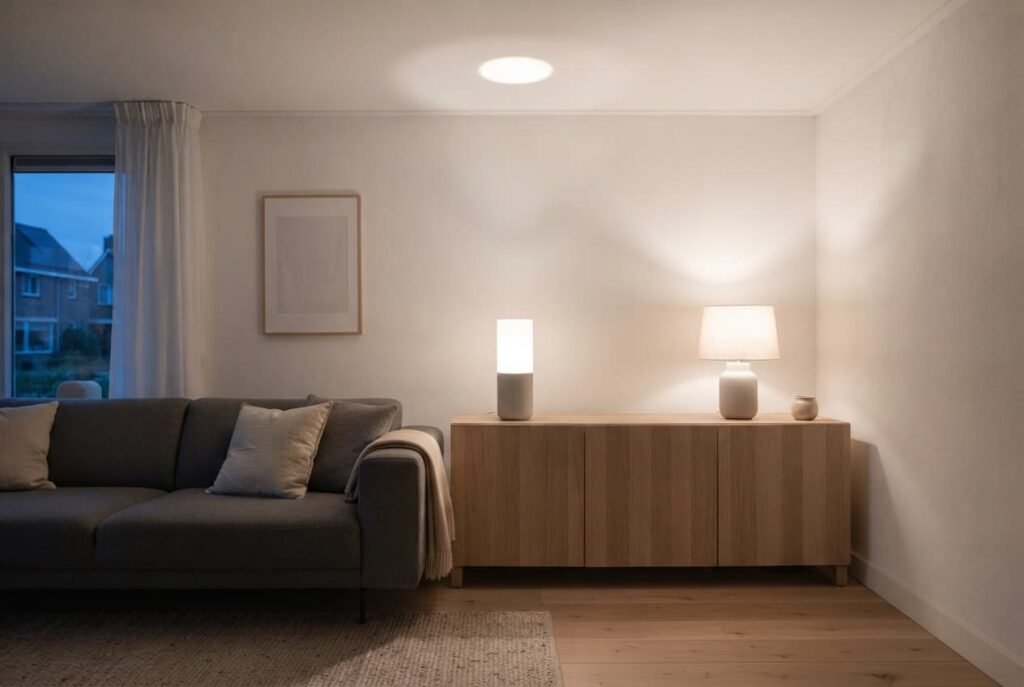
The Bright Ceiling Ring: Which Version You Have
Switch the lamp on with the room dark, then study the ceiling while standing in the centre. Almost every bright ring on the ceiling matches one of three versions, and some lamps show two together.
Version one has a crisp border. The disc is evenly lit, and its edge is a clean line you could trace with a pencil. Seen from the sofa, the disc can look almost like a painted circle. A clear bulb with a thin glowing filament produces this most often, since a small source throws a crisp image of the rim.
Version two is a hot spot. The patch is under about a metre across, and its centre is much brighter than its border. A deep, narrow shade makes the cone tight, which crowds the light into a small area.
Version three is lopsided. The disc is oval or drifts sideways away from the lamp, because the shade leans on its fitting and the rim tilts with it. A bent finial can tilt the shade without anyone noticing.
Pick the version that fits your lamp before choosing a fix.
Four Fixes for a Lamp Ring, From Free to Workshop
Re-seat the shade lower and level. Nothing is spent, and it answers versions two and three. Loosen the finial or the clips, slide the shade down about 4 cm, and check the rim by eye from a few steps back until it appears level. The rim then sits 10 cm over the bulb, and the radius becomes 8 × 165 ÷ 10 = 132 cm. Roughly twice the area receives the same light, which looks about half as bright. The blur grows to 2 × 155 ÷ 10 = 31 cm as well. Light the lamp and see whether the border has widened and fuzzed. The limit is the bulb itself, since a glaring point shows from the sofa once its top rises above the rim.
Swap the clear bulb for a frosted globe. One bulb is the whole cost, and it answers version one. A globe with a 6 cm glowing surface produces a blur of 6 × 151 ÷ 14 = 65 cm, three times the 22 cm from the clear bulb. The hard line becomes a slow fade. Match the brightness rating printed on the old bulb. A small frosted candle shape keeps nearly the crispness of a clear one. Choose a wide, round shape instead. Make sure it sits inside the shade.
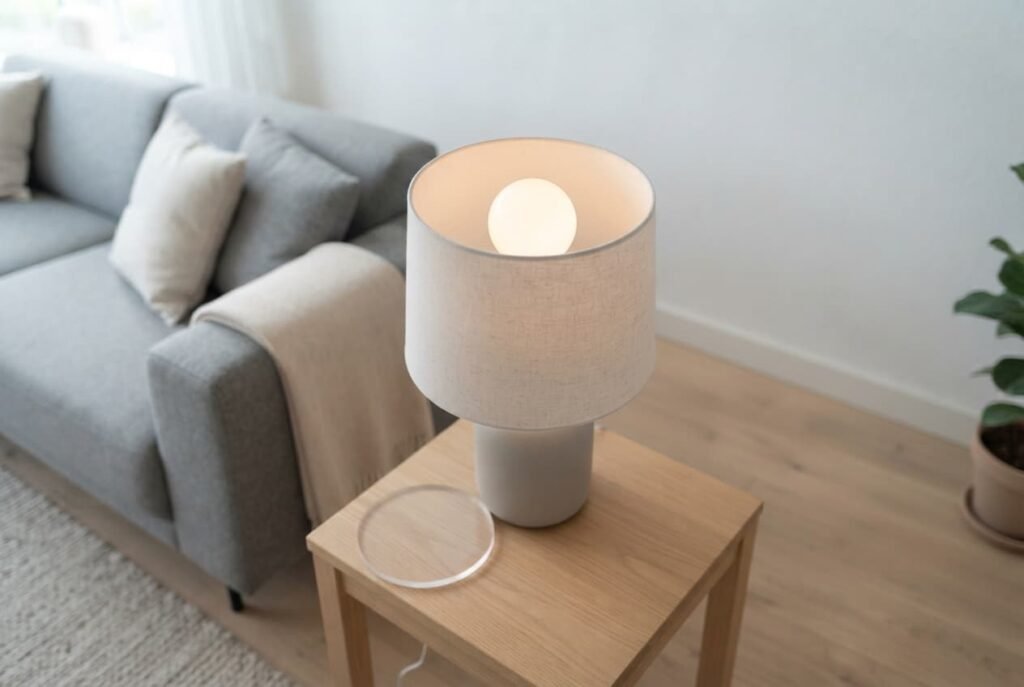
Stretch a diffuser disc across the opening. This is a small purchase again. A thin translucent disc makes the opening itself glow, and a glowing surface sends light out in every direction instead of in a cone. The border dissolves, and the bright ring on the ceiling turns into a soft pool. Brightness is the cost, because less light travels upward and the ceiling dims overall. Pick a disc a little wider than the opening. The shade needs a clip or a harp to hold it, and a loose disc sags onto the bulb.
Ask a shade workshop to close the top. A professional shade maker fits an opaque cap, which blocks the upward cone altogether. No other fix removes the ring entirely. You pay a workshop fee, and the bill rises if the shade has to be re-covered to match. The shade’s walls still glow and light the room sideways. With no uplight, though, the ceiling turns dark, which can make a low room feel lower.
What This Flat’s Ceiling and Socket Allow
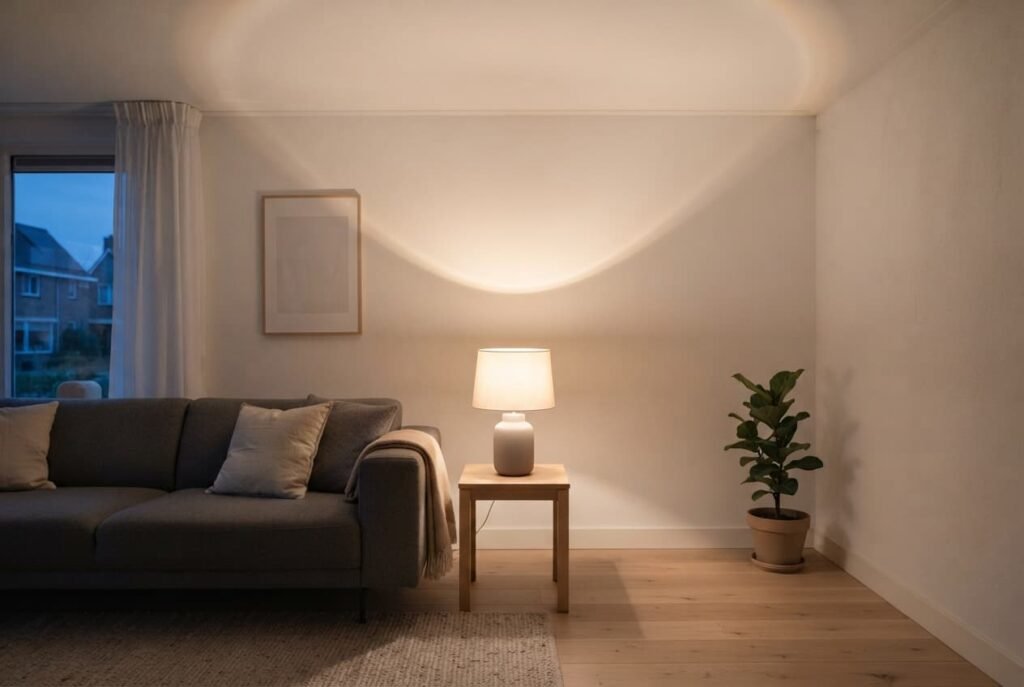
Sanne’s flat dates from the 1930s. The landlord’s satin paint covers a ceiling 2.5 m up, and a satin finish can make a ring’s edge look sharper than matt paint would. The only socket beside the sofa is 30 cm from the long wall.
That socket decides where the bright ring on the ceiling ends up. The cone meets the wall 30 cm away at the height where 8 × z ÷ 14 = 30, which gives z = 52.5 cm above the bulb, about 137 cm from the floor. From there the border climbs the wall as a curve and reaches the ceiling about 89 cm to each side of the lamp. Keeping the whole ring on the ceiling would need a gap of 94 cm to the wall, which the socket can’t give without an extension lead.
The landlord’s satin paint on the ceiling stays as it is.
The Fix That Changes Nothing
A dimmer or a weaker bulb is the usual reflex, and it leaves the ring just as hard. Suppose the ceiling inside the ring receives 20 lux from the lamp, while 2 lux of bounced light reaches the area outside it. That works out at ten to one. Halve the output and the figures become 10 and 1, and the ratio holds. The eye reads the ratio rather than the absolute lux. Brightness controls are for mood, not for edges. Turn a dimmer down and the border stays sharp until it fades out altogether.
Nothing about the geometry has altered. The same rim and bulb still draw the same edge on the same ceiling. The lamp’s real job of lighting the table suffers too, because the downward cone dims by the same factor.
Name your version from the list and try the free fix before spending anything. Measure the rim’s height above the bulb, then the ceiling’s height above it. Those two figures drive the sum. Look at the ceiling again after dark. A border that has gone from a pencil line to a gentle fade tells you the cause was found. Repeat the check in daylight with the curtains shut.
Questions and Answers
Can I fix this without buying anything?
Often yes. Lowering the shade a few centimetres and straightening it widens the cone and spreads the light over a bigger area. That helps hot spots and lopsided rings. A crisp, even border usually needs a different bulb, because the glowing part is too small to blur the edge.
What does the simplest lasting fix cost?
A single frosted bulb. It widens the glowing surface, and the border then fades over about 65 cm instead of 22 cm in our example. Match the brightness rating on the old bulb. Anything beyond that, such as a diffuser disc or a workshop cap, costs more. It also changes the room’s light.
Why do some lamps leave a sharper ring than others?
Two things set the sharpness: a small bulb and a high rim. A tiny glowing filament makes a crisp image of the rim’s edge, and a rim far above the bulb narrows the cone. A wide frosted bulb under a shade that sits low blurs that image and softens the ring.