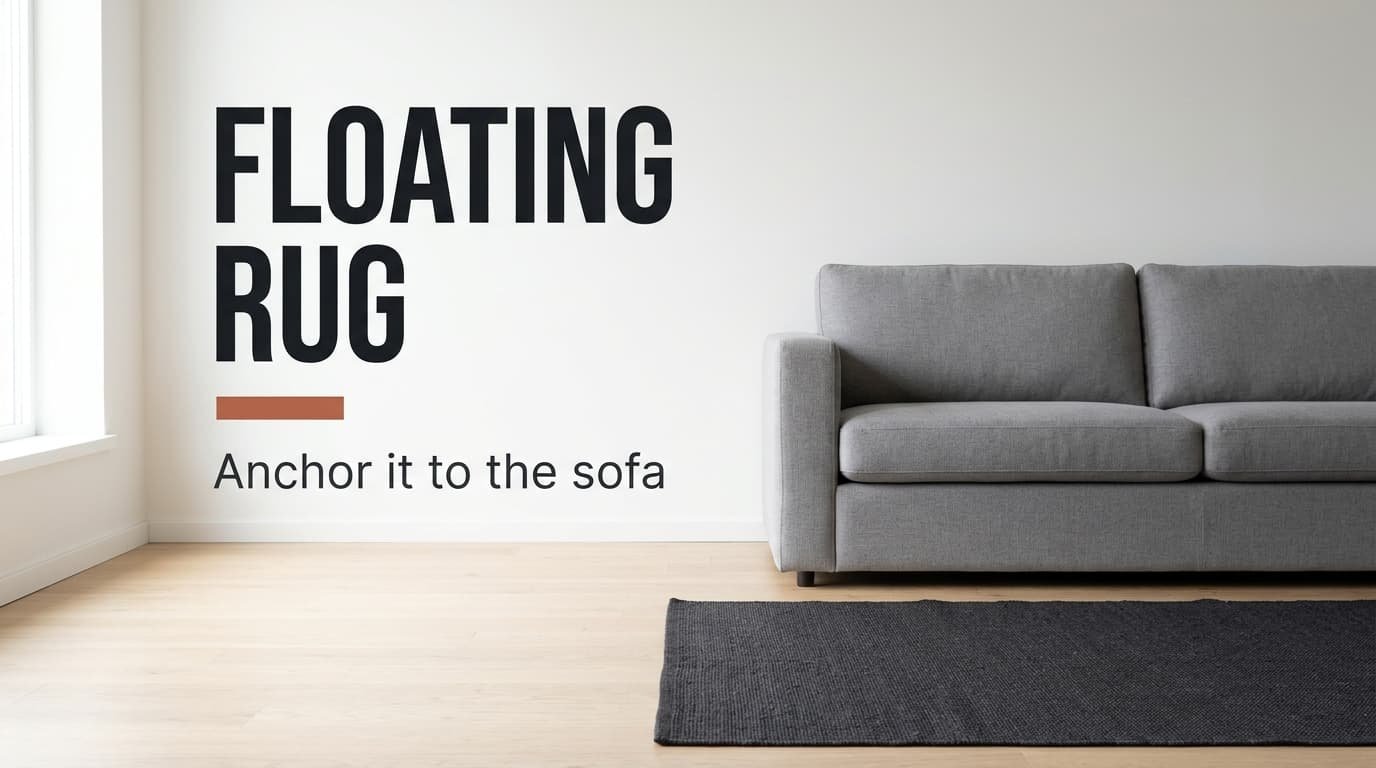
Each piece in the room is a sensible size, yet the rug looks as if it drifted onto the floor by itself. The sofa is pushed against the end wall while the rug lies somewhere beyond it. The two never read as a single arrangement. When a living room rug seems to float, the rug is seldom the culprit. The trouble sits in the gaps and edges around it, and those are easy to measure. Picture a Zwolle flat whose lounge runs 360 × 480 cm. Its sofa stretches to 210 cm, and the rug is 160 × 230 cm.
Why a Living Room Rug Seems to Float: the Mechanism
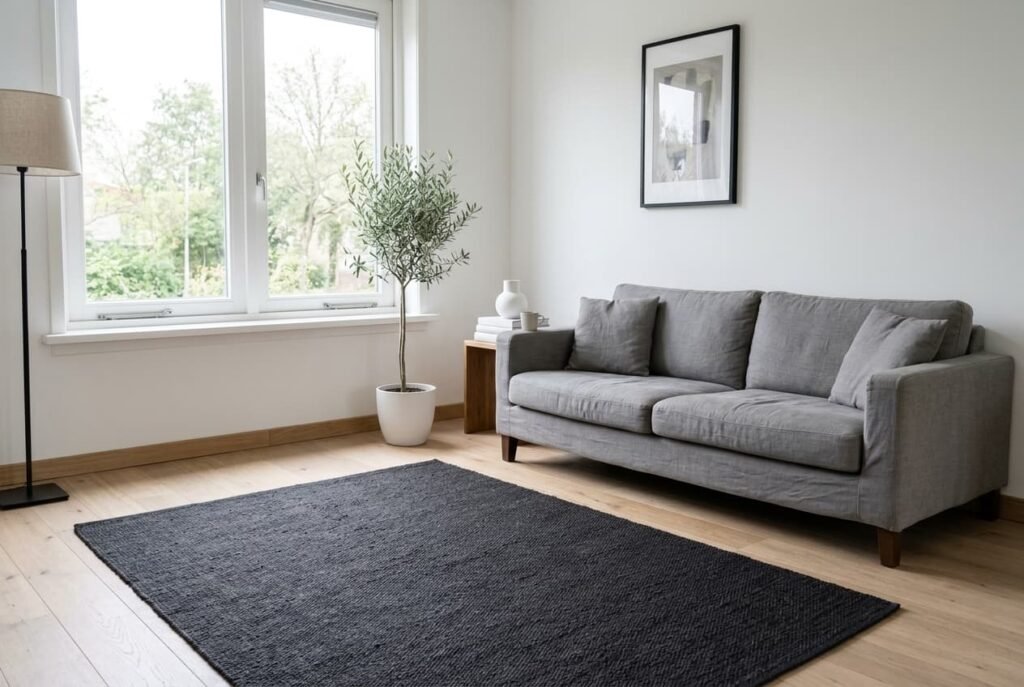
The eye groups objects that touch or sit close together, and it splits objects divided by open floor. A strip of bare boards between sofa and rug therefore acts as a boundary. Here the sofa is 95 cm deep, and the rug is centred in the room with its leading edge 125 cm away from the sofa wall. The same reasoning explains why a living room rug seems to float even when all of the furniture is sound. A strip 30 cm wide is the result.
The rug is also 160 cm across against a seat 210 cm long. Each end of the seat therefore overhangs it by 25 cm. Two edges that nearly line up and don’t look more unsettled than two that plainly differ, because the eye keeps trying to resolve them.
Owners tend to respond with the belief that the rug is too small, and a plan to swap it for a bigger one. That would waste a good rug, which covers 3.68 m², which is 21% of a floor of 17.3 m² and a fair share by any normal measure. A rug of the right size can still look adrift.
Size alone rarely explains a rug that drifts across a room.
Three Tests When a Living Room Rug Seems to Drift
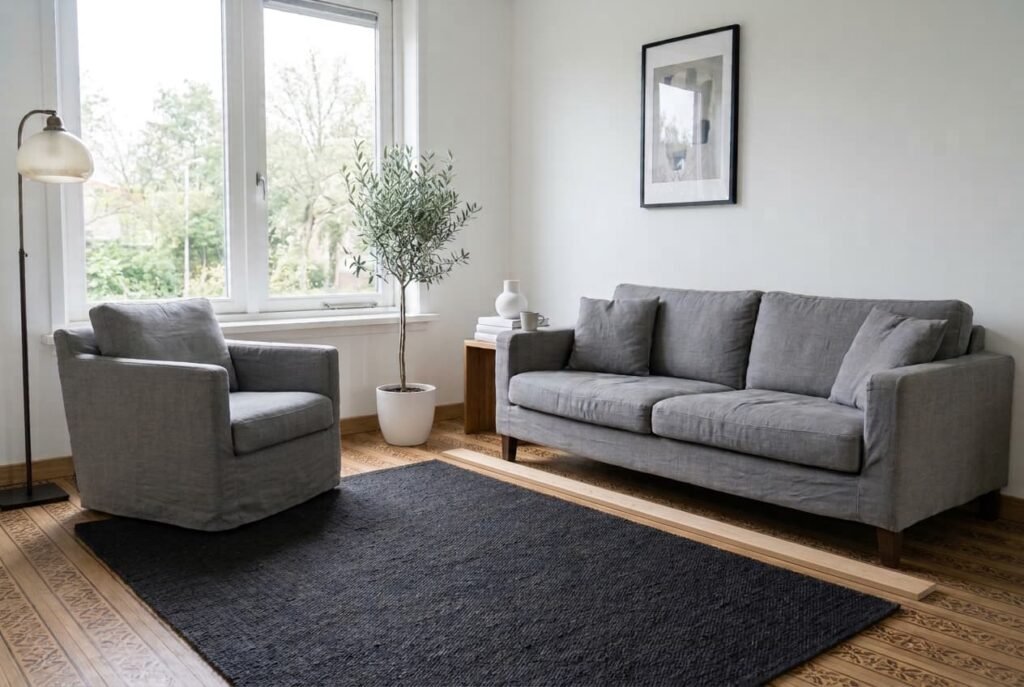
Shoot one picture from the doorway, holding the phone at about shoulder height, roughly 150 cm. Three checks follow, and they need ten minutes plus a tape measure.
The gap comes first. Gauge how far the sofa front sits from the rug edge, and give yourself a point for any strip wider than 15 cm. Next comes the overhang. Compare sofa width against rug width, and add a point if the sofa is the wider one.
The tone step comes last. Put the photo through a grey filter and study where the rug meets the boards. A rug that reads as a dark or pale cut-out earns a third point. Do this at the hour you use the room most, because evening light deepens the step.
Two or three points mean the arrangement itself causes the drift. A single point calls for one small change. Here the gap measures 30 cm and the overhang 50 cm. The rug also sits far darker than the boards, which makes a full three.
Three Faults Behind a Rug That Floats
Cures climb in cost. The first is free, and the last is a purchase. Each one works on a different link in that chain, and nobody notices why a living room rug seems to float until the links are separated.
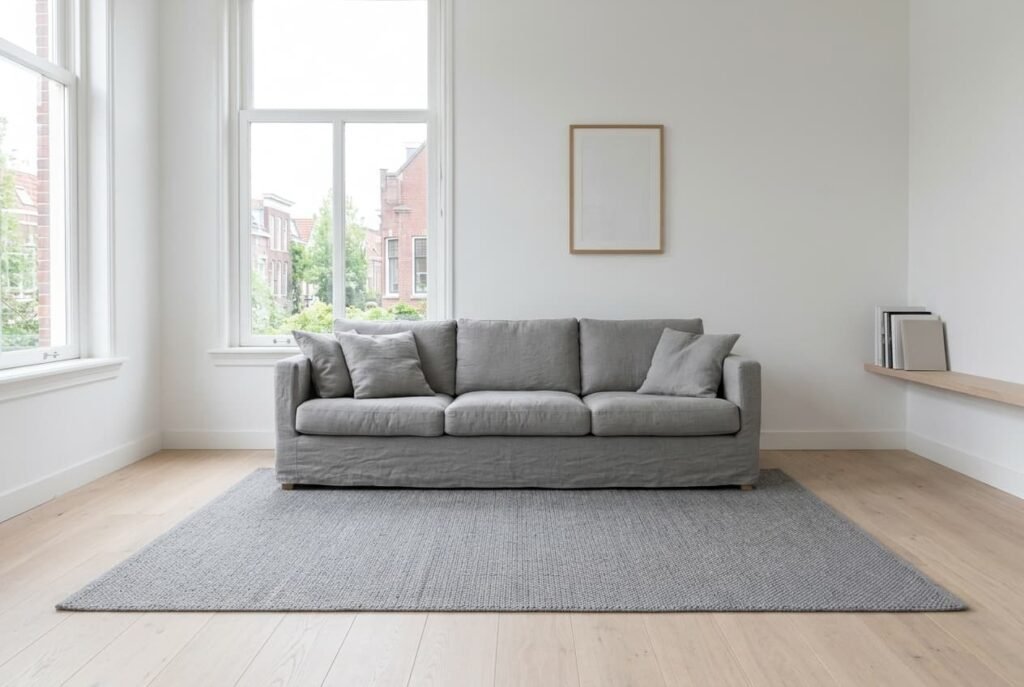
A strip of bare floor between sofa and rug, a fault of placement. It happens because the 30 cm gap breaks the eye’s grouping. Slide the rug 50 cm toward the sofa until its leading edge tucks about 20 cm under the front of the seat. No money is involved, and a minute does it. No other change touches the gap at all. Afterwards sofa and rug share one boundary instead of facing each other across a strip. Look along the floor from the side to confirm that no daylight shows between them, and press down the pile at the join with your hand.
A rug narrower than the sofa, a fault of scale. At 160 cm the rug is 76% of the seat’s width. The sofa looks heavier than the piece meant to anchor it. Rotate the rug through 90 degrees so that its 230 cm side runs along the seat and overhangs it by 10 cm at each end. Moving the coffee table across takes ten minutes. The cost is depth: the rug now reaches only 160 cm out from the sofa. Check that any door nearby still swings clear of the new edge, and that the coffee table now sits fully on the rug.
A dark rug on a pale floor, a fault of contrast. Assume the boards reflect about 45% of the incoming light and the rug about 12%, a step of 33 points. That step turns the rug into an island. Choosing a rug nearer 30% cuts the step to 15. This is the only item you’d pay for, and it carries the biggest bill. Pick the tone with a swatch before you buy. A 30 cm square sample held against the boards for a day is enough to judge it. In our room, a flat weave in mid grey is a sensible opening.
What to Measure Before the Next Rug Goes Down
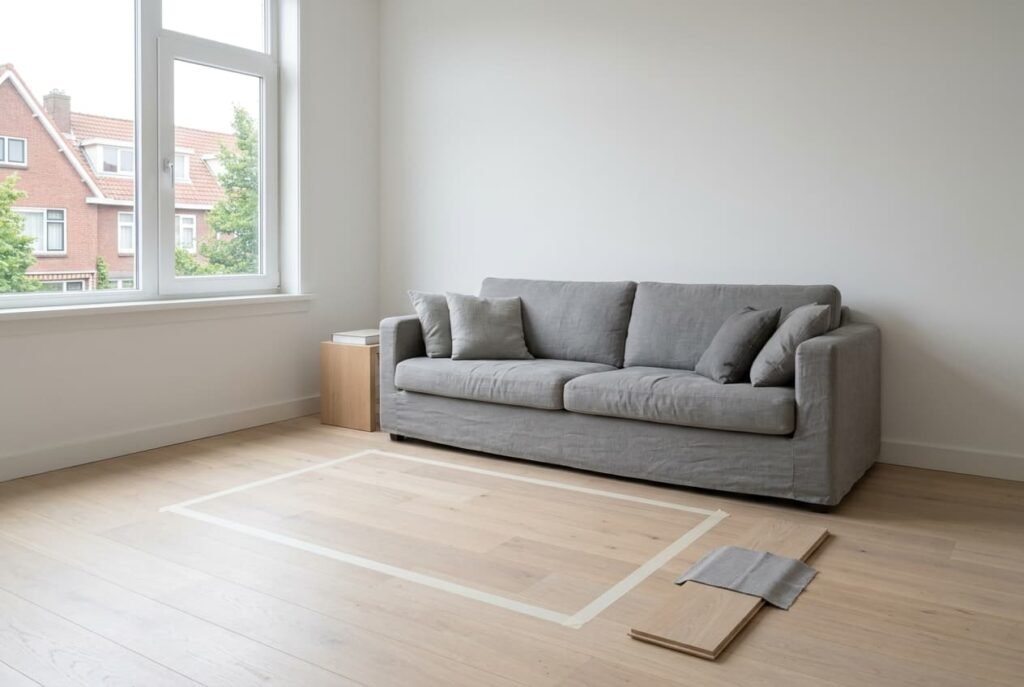
Work out the layout before anything is delivered. Outline the rug on the boards with low-tack tape. Leave the outline for a day. Check that the edge of the outline passes beneath the seat and that its width matches the sofa. Do this before you decide which of the three changes to make. If a living room rug seems to float on tape alone, a heavier rug won’t cure it, and you’ve saved the delivery.
Then lay a swatch beside a spare piece of floor and compare them in a grey-filtered photo. Aim for a step of about 15 points. A step far above that is where the island effect begins.
Walk around the tape a few times as you would on an ordinary evening. If you catch your feet on the edge, or step round it where you’d rather cross, the position needs another look.
The Fix That Isn’t Worth Doing
Buying a larger rug is the option that is dearest and gains least. A rug of 250 × 350 cm would cover 8.75 m², or 51% of the floor, which cures the overhang. Laid in the same position, it would leave the 30 cm strip and the tone step untouched. It would also squeeze the walking space, since only 130 cm of boards would remain beyond its far end.
A second small rug laid over the first is another tempting idea. It adds a third edge, and the eye now has three boundaries to resolve instead of two. The pile of the top rug also catches on the edge underneath. Treat it as an added complication rather than a cure.
A rug that is too large has its own way of looking wrong.
Try the free and cheap changes before spending anything. Slide the rug. Rotate it. Judge the tone afterwards. Retake the picture from the original spot and score the three tests again. Zero points means the rug can stay exactly as it is. A single point left over almost always comes from the tone step, because the other two faults respond to simple moves. At that stage you can decide whether a different rug is worth the bill, and the swatch test will have told you which tone to look for. Keep the photos from each round, since they show how far the room has moved.
Questions Readers Keep Asking
What makes a rug look like it floats?
Often several faults at once: a bare strip between rug and sofa, a rug narrower than the seat, and a strong tone step against the floor. Start by measuring the gap, then the overhang, then compare the tones in a grey-filtered photo. Each result points to a different cure.
Is there a quick fix for the same day?
Yes. Slide the rug 50 cm toward the sofa so that it tucks under the front of the seat, and rotate it if the sofa is wider than the rug. Neither change needs any spending, and each takes minutes. Try them before you shop.
Can I fix it without buying a new rug?
In most rooms, yes. Shifting and rotating the rug remove two of the problems. Only a strong tone step calls for a different rug, and a swatch held beside the floor tells you whether that is true before you spend anything. Skip the larger rug unless the overhang survives the turn.