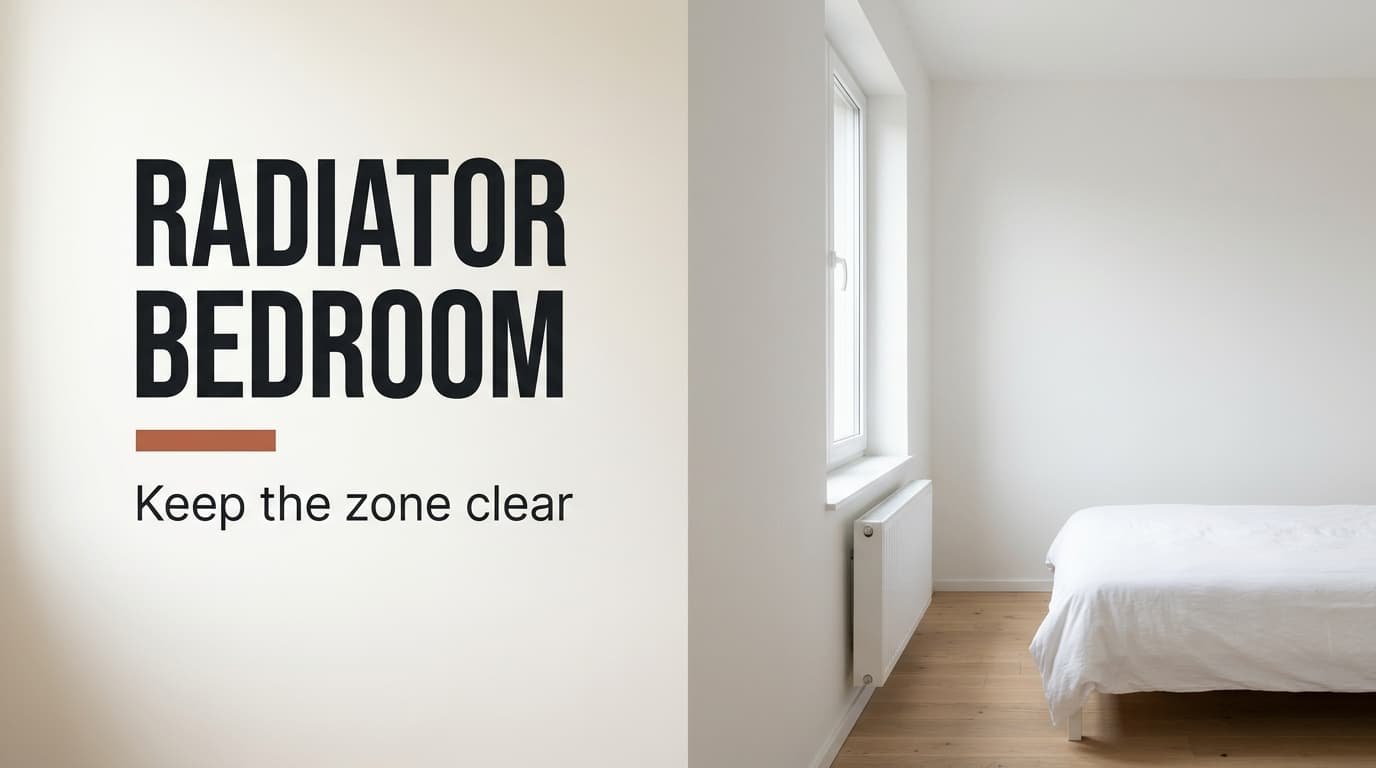
A radiator under the only window dictates the layout of a bedroom before any furnishing is chosen. Its heat climbs the glass, and whatever stands in the way sends that warmth straight back. Most plans place the bed beneath the window because it feels natural, and that is the one position to avoid. The room under study is a rented bedroom in Groningen measuring 340 × 410 cm. The 100 cm radiator sits centred below the 140 cm window, while the door stands in the far corner. These numbers are illustrations only. Tape out your own room.
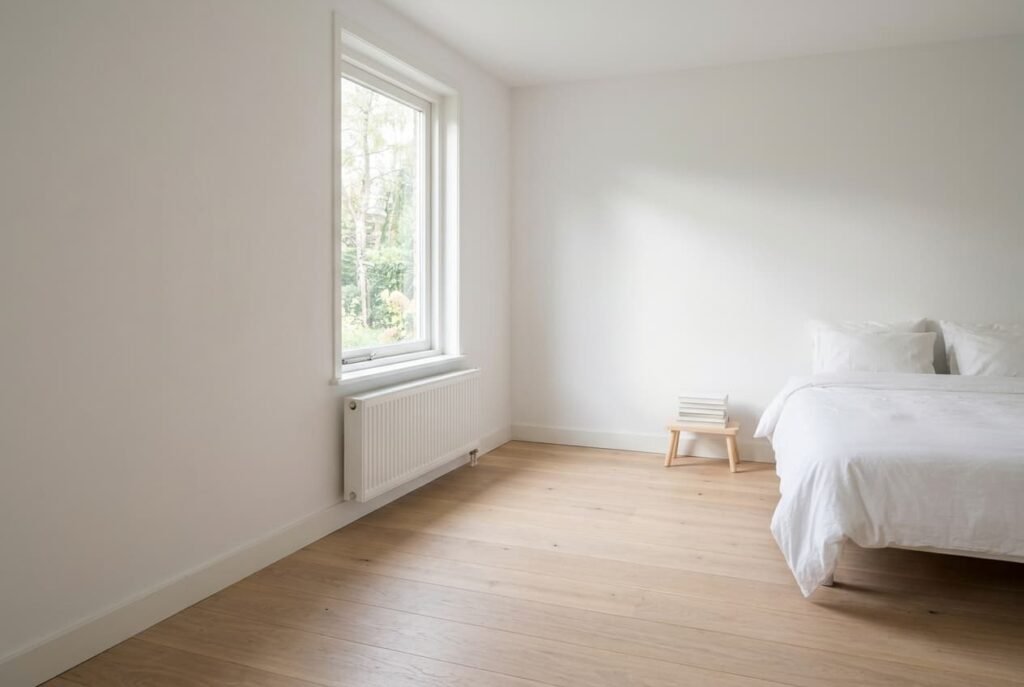
Why a Radiator Under the Only Window Decides Where the Bed Goes
A radiator warms a room by pushing air upward. The air beside its fins heats, climbs past the cold glass and spreads across the ceiling, then sinks on the far side as it cools. That loop is how the whole room gets warm. Block the first stage and the loop stalls, which is why a radiator under the only window needs more care than one on an inner wall. The heat then stays behind the obstacle and leaks out through the wall.
Many radiators also carry a valve with a sensor that reads the air next to it. If a bed or a curtain traps hot air in that spot, the sensor decides the room is warm and closes the valve. The bedroom then stays cold while the corner by the window turns hot.
Keep a warm-air zone in front of the radiator free of furniture, and build every layout around what remains. Ours stands 10 cm proud of the wall. The zone is therefore 120 cm wide, with 10 cm extra at each end, and it reaches 30 cm out. That’s 120 × 30 = 3,600 cm², or 0.36 m², which is only 2.6% of a floor of 13.94 m².
Protect the zone, because it costs almost nothing.
Treating the whole window wall as forbidden is the usual overreaction, and it isn’t needed. That wall is 340 cm long, and the zone claims barely a third of it. A chair or a low chest can still use the remaining 220 cm.
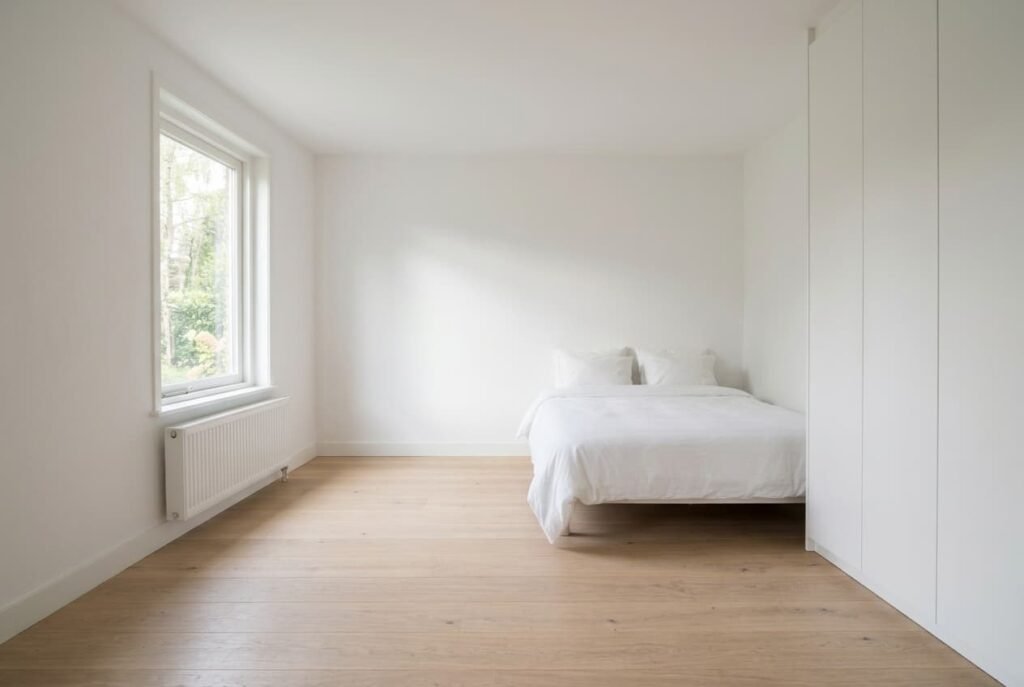
Three Layouts With a Radiator Under the Window
– Bed lengthways in the door corner, head against the door wall and one side against the right wall. A 160 × 200 mattress covers 3.2 m², or 23% of the floor. The 78 cm leaf of the door opens across that side, and the space left beside the bed measures 340 − 160 − 78 = 102 cm. At the foot, 210 cm remain before the window wall. The zone stays untouched. Daylight reaches the pillow from the side, and nothing stands in front of the radiator. A wardrobe measuring 100 × 60 cm stands along the left wall, opposite the foot.
– Bed crosswise on the right wall, head tight to it. The bed now spans 200 cm of the 340, which leaves a lane 140 cm wide on its left for crossing between doorway and glass. A two-door sliding wardrobe of 120 cm sits beside the door on the same wall, because sliding doors need no swing room.
– Bed lengthways with the head toward the window end, held back by 30 cm. The headboard stops exactly where the zone ends, which lets the radiator keep its airflow. The trade-off is 30 cm of lost floor behind the bed, which still suits a slim shelf for a phone charger and a book.
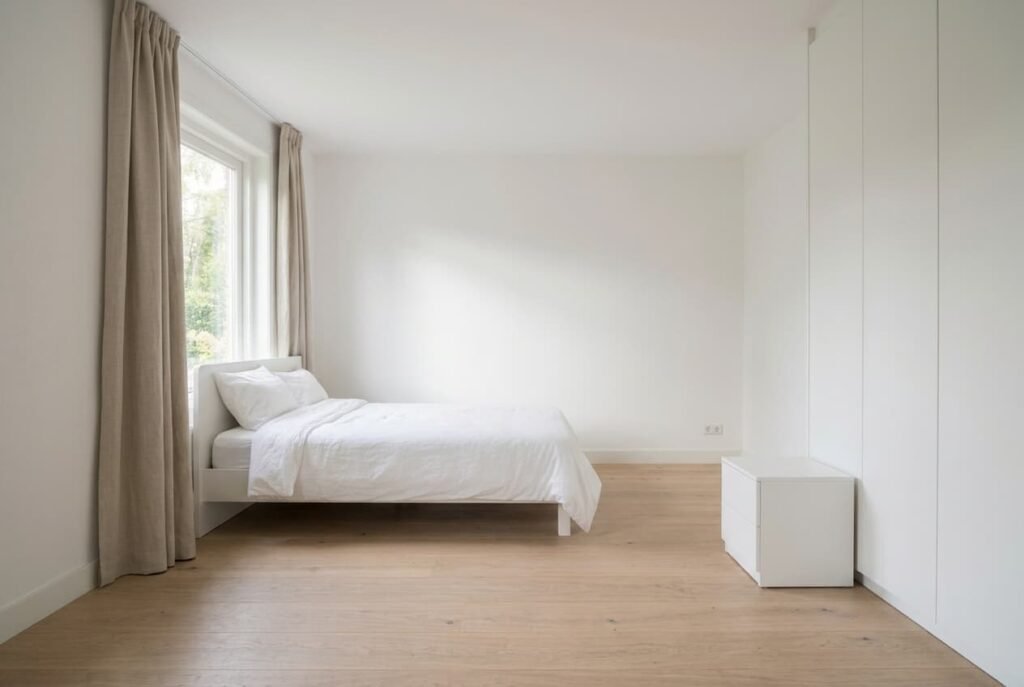
Mistakes That Smother the Radiator
Each of these errors starts with seeing a radiator under the only window as wall rather than as moving air.
Pushing the bed under the window. A headboard in the middle of that wall covers the full 100 cm of radiator face. The warm air rises behind the headboard instead of into the room, and everything beyond it gets less heat. Beds are large and cause more harm than a lamp ever does. Pull the bed away or turn it, and the radiator reaches the room again.
Hanging floor-length curtains in front of it. Cloth that reaches the floor traps warm air between itself and the glass. The valve sensor then reads too high and shuts the radiator down early. Stop the curtains at the sill, which stands 85 cm up, or tie them back during the day. A blind that rolls up above the glass is another tidy answer.
Setting a bedside unit against its end. A unit of 40 cm touching the radiator leaves no gap for the air at that edge. Keep at least 10 cm between them, or move the unit to the opposite side of the bed, where nothing competes with the heat. A lamp on it is fine, since a lamp doesn’t block airflow.
Moving the radiator to suit the bed. In a rented flat this involves a plumber and permission from the landlord, and none of our layouts needs it. Change the furniture before you consider touching the pipework. It’s cheaper and quicker, and nothing becomes permanent.
When the Door-Corner Plan Is the Wrong One
Tucking the bed into the door corner suits most rooms where a radiator under the only window shapes the plan, but it relies on a margin that narrow rooms lack. The walking gap equals the room’s width minus the bed minus the door swing. A room 310 cm wide would therefore leave 310 − 160 − 78 = 72 cm, which is too tight to carry a laundry basket through.
Use the door-corner plan in rooms 330 cm wide or more, because 330 − 160 − 78 gives a gap of 92 cm. Our 340 cm bedroom clears that line by 12 cm. In a narrower room, switch to the crosswise plan or to a 140 cm bed, as a smaller bed isn’t a defeat.
A narrower bed returns 20 cm of floor and costs little comfort for one person. Try it before you give up the window side, and measure again with the tape in place. A bedroom whose single window has a radiator beneath it has less room for error. The extra 20 cm is worth having. Measure twice before moving any furniture.
Three Things to Try This Weekend
1. Mark the warm-air zone with tape, 120 × 30 cm, centred below the radiator that sits under the only window. Leave it for two days and notice each time you want to put something there. Move the item and decide if the room copes without it.
2. Mark the bed’s footprint in the door corner. Check the clearance between the swing of the leaf and the bed, using a tape measure along the floor. If it falls under 90 cm, move to the crosswise layout.
3. After an hour of heating, hold a hand 20 cm from the radiator face. Warm air reaching your hand means the loop is working, while a cold hand means something is blocking it. Try this at the corners of the zone too.
Taped outlines cost a roll of tape, whereas a wrongly placed bed costs a weekend. When the zone stays open, the radiator works as the room’s heater and not as a problem to hide. The room warms faster, because nothing fights its airflow any more, and you won’t need to turn the valve up. That saves a little energy too, though the amount varies with your boiler and your habits.
Questions Readers Keep Asking
How big a bed fits in this bedroom?
The 160 × 200 double fits well, using 3.2 m² of 13.94 m². A 180 cm bed would cut the door gap to 82 cm in the corner plan, below the 90 cm target. Stay with 160 cm, or use the crosswise layout for a wider mattress.
Should the bed go on the window wall?
Rarely. A headboard there covers most of the radiator and traps its heat. If that wall is the only place for the head, hold the bed back by 30 cm so the zone stays open, and fit curtains that end at the sill.
What colour suits the wall behind the bed?
A pale, warm tone helps, because the window side is bright and the far wall is not. Use a white with a touch of yellow behind the headboard. Keep darker colours for the bedding. Daylight from the window then still reaches the wall.