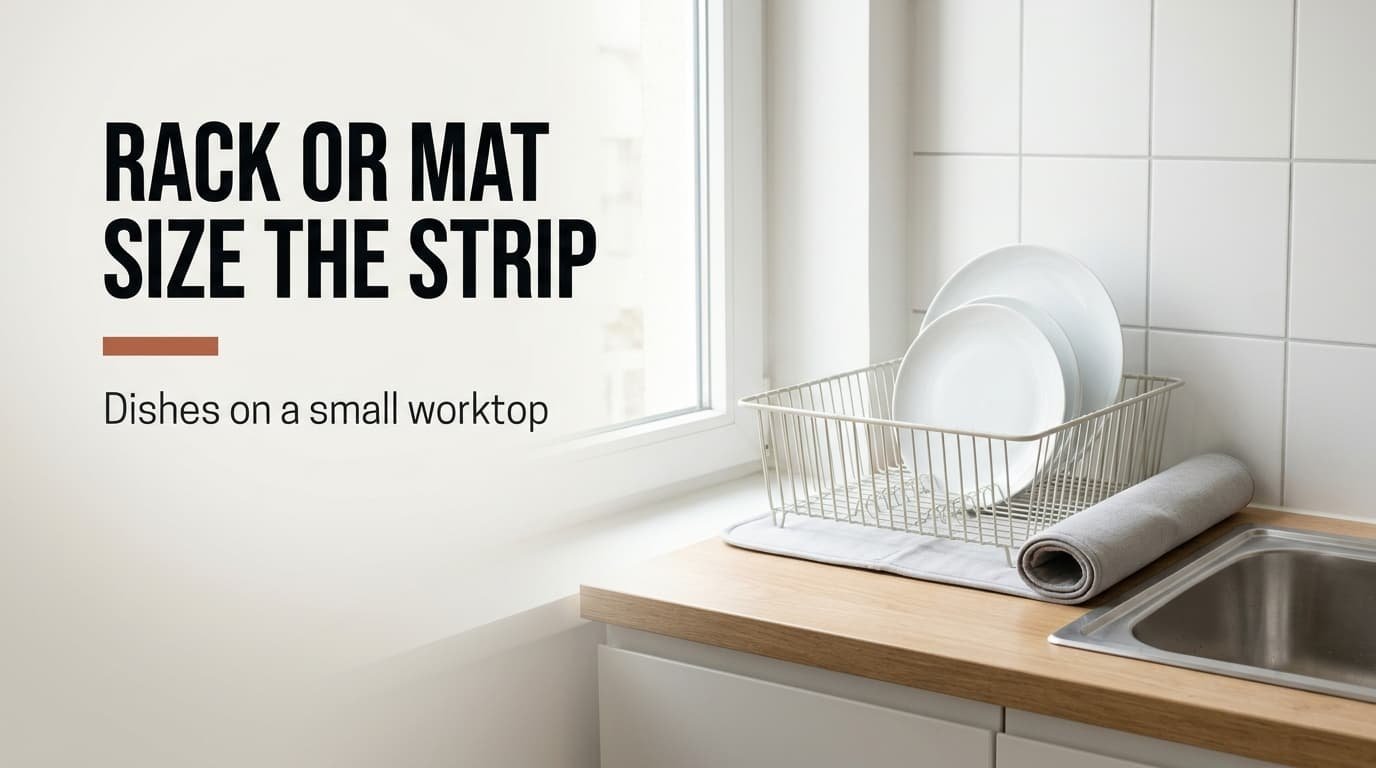
A dish rack or drying mat looks like a minor choice until it lands on the only free stretch of counter. In a Dutch kitchen with 70 cm of clear worktop beside the sink, every centimetre already has a job. This page weighs the two on footprint and capacity, then on where the water goes. A table comes next, followed by one section for each option. A free third route and a short rule close the page. All figures describe a single kitchen, so replace them with readings from yours before you decide anything. The comparison uses real measurements, which shows where each option wins and where it costs you.
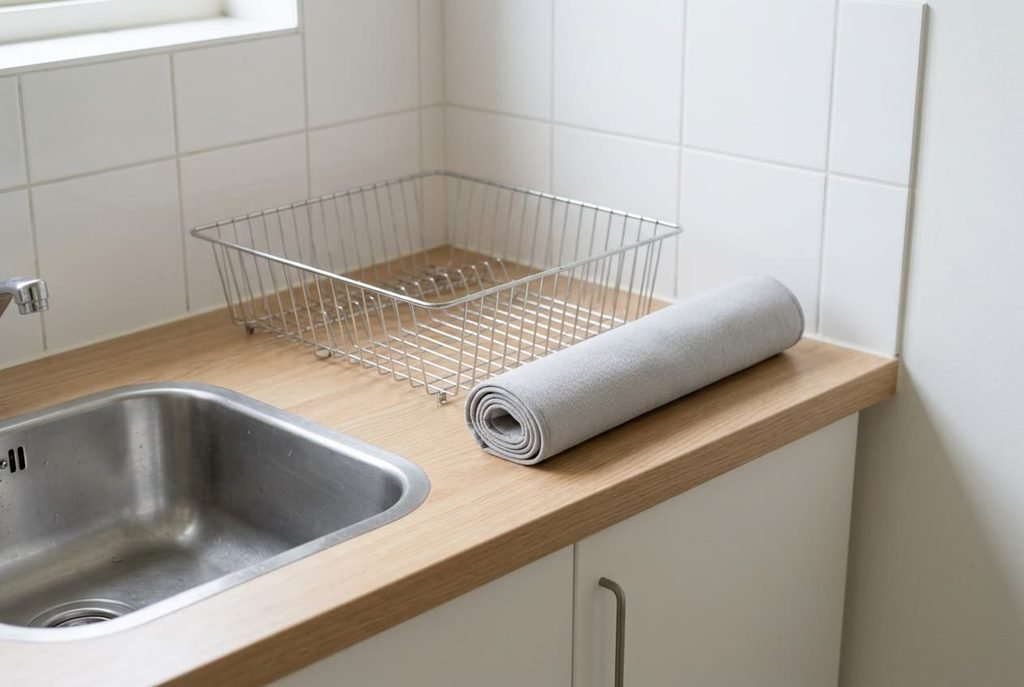
What a Dish Rack or Drying Mat Must Do on a Small Worktop
Whatever you buy has to hold one evening’s wash while it drips, and it has to clear the worktop afterwards. For three people that wash comes to 26 items. Twelve are crockery and glassware, three of each kind, with plates 26 cm across. A further twelve are pieces of cutlery, and a pan of 28 cm and a chopping board finish the list.
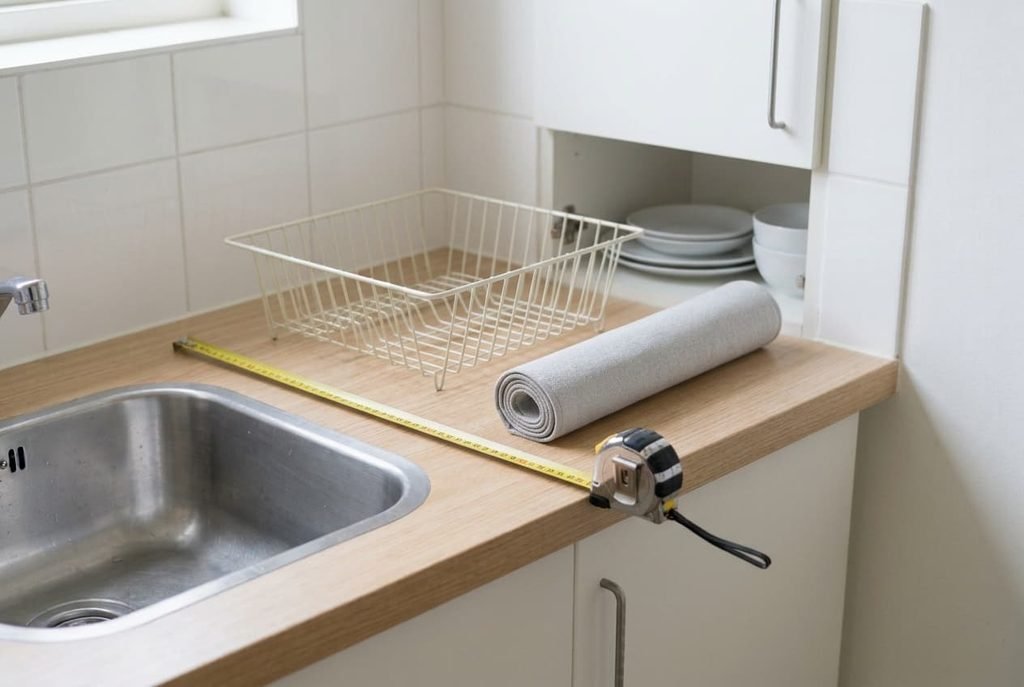
The deciding measure is how many of those items each option holds per square centimetre of worktop while the water runs the right way. The clear stretch beside our sink is 70 × 60 cm, which is 4,200 cm². A rack of 45 × 30 cm takes 1,350 cm² of it, or 32%. A mat of 50 × 40 cm takes 2,000 cm² when open, or 48%.
Water decides the second test. A rack drains through a sloped tray into the sink, so the worktop under it stays dry. A mat is a flat sheet that soaks up the first splash and then has to pass the rest on somewhere. It must also dry fully before it goes away.
Both options change what the counter does when no dishes are drying. A rack stays out at full size all day. A mat rolls to about 6 cm across and goes into a drawer.
Two Options Compared Row by Row
Everything in the table can be measured at home. The figures assume the 70 × 60 cm strip beside our sink and a wash for three people. Both columns describe the same evening’s dishes, so the rows compare like with like.
| Point | Dish rack | Drying mat |
|---|---|---|
| Footprint on the worktop | about 45 × 30 cm, 1,350 cm² | about 50 × 40 cm open, 2,000 cm² |
| Dinner plates held | 10, standing on edge about 2.5 cm apart | 3, lying flat at about 530 cm² each |
| Where the water goes | down a sloped tray into the sink bowl | into the fabric first, then out to the edge once it’s full |
| Glasses and mugs | upside down on prongs | on their sides, in a row |
| When the dishes are dry | stays out at full size | rolls up and goes in a drawer |
| Worktop underneath | stays dry beneath the tray | covered, and damp at the edges |
Each row is easy to test with a measuring tape and a jug of water, so none of it rests on taste. Choosing a dish rack or drying mat is a matter of finding the row where your kitchen is weakest. The column that fails it least is the one to choose.
Where a Dish Rack Beats the Drying Mat for a Family
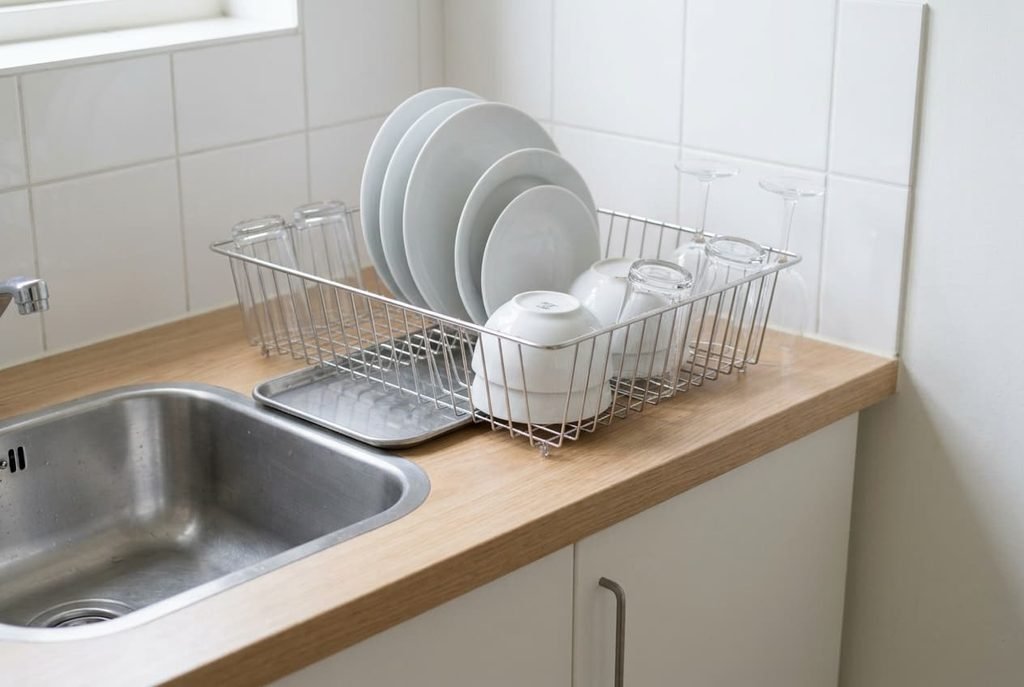
A rack suits a kitchen that washes up for three or more every evening. Standing plates and bowls take about 2.5 cm of width each. Six of them need only 15 cm of a rack that’s 45 cm long. The other 30 cm carries glasses on prongs and a cutlery cup, and a pan lies on its side. That’s how 26 items fit into 1,350 cm².
Gravity does the draining. The tray slopes towards the sink, so water runs off the plates and down the tray into the bowl, while the worktop beneath stays dry. Nothing has to be wrung out or moved to finish the job.
Two limits apply. The rack keeps its 1,350 cm² all day, and that’s 32% of a strip only 4,200 cm² in size. The tray also needs a spout that reaches the sink bowl, so a rack placed 30 cm away drips onto the counter. Check the distance before you settle on a spot.
Where a Mat Is Enough for One or Two People
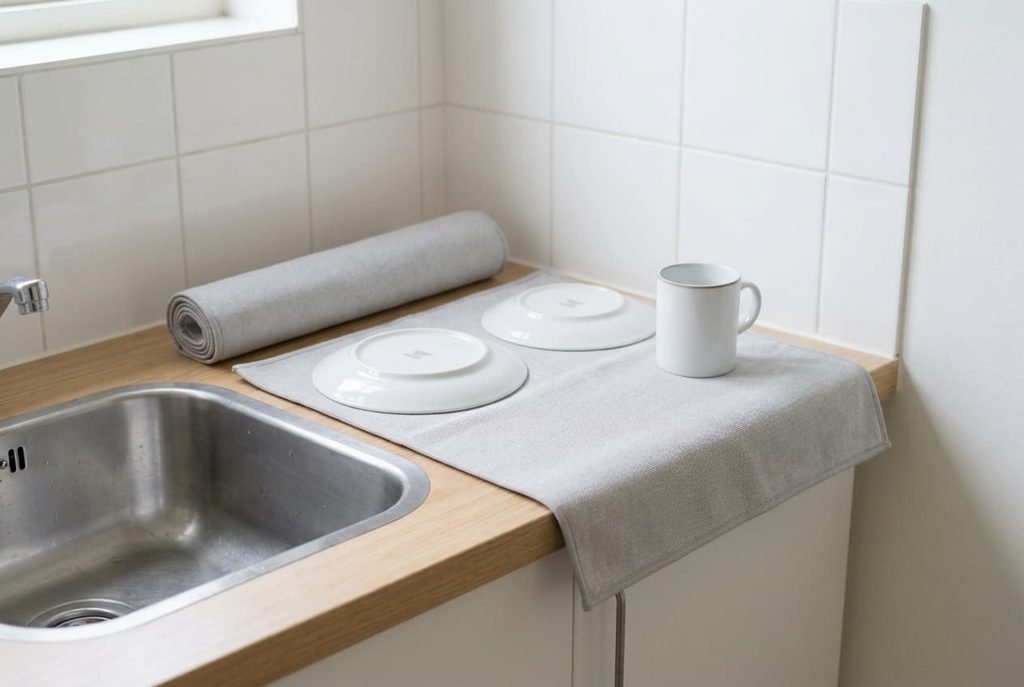
A mat suits a kitchen where the evening wash is small. Three dinner plates lying flat take about 1,590 cm², each covering roughly 530 cm², which is about four fifths of a 2,000 cm² mat. Three people would fill it with plates alone. One or two people with a wash of 9 to 14 items find it roomy.
The big gain comes after the drying. A mat rolls to 6 cm across and a drawer swallows it, giving the 4,200 cm² strip back until the next wash. If the wash dries in three hours, the mat holds the worktop for 3 of 24 hours, and a rack holds it for all 24.
Water is the price. A mat takes the first splash, and what it can’t hold runs to its edge. Let one edge overhang the sink, and raise the far edge a little with a folded cloth. Dry the mat fully before rolling it. A mat fits too where the sink shares its counter with the hob. It rolls away before the pans come out.
The Third Option Is the Tea Towel You Already Own
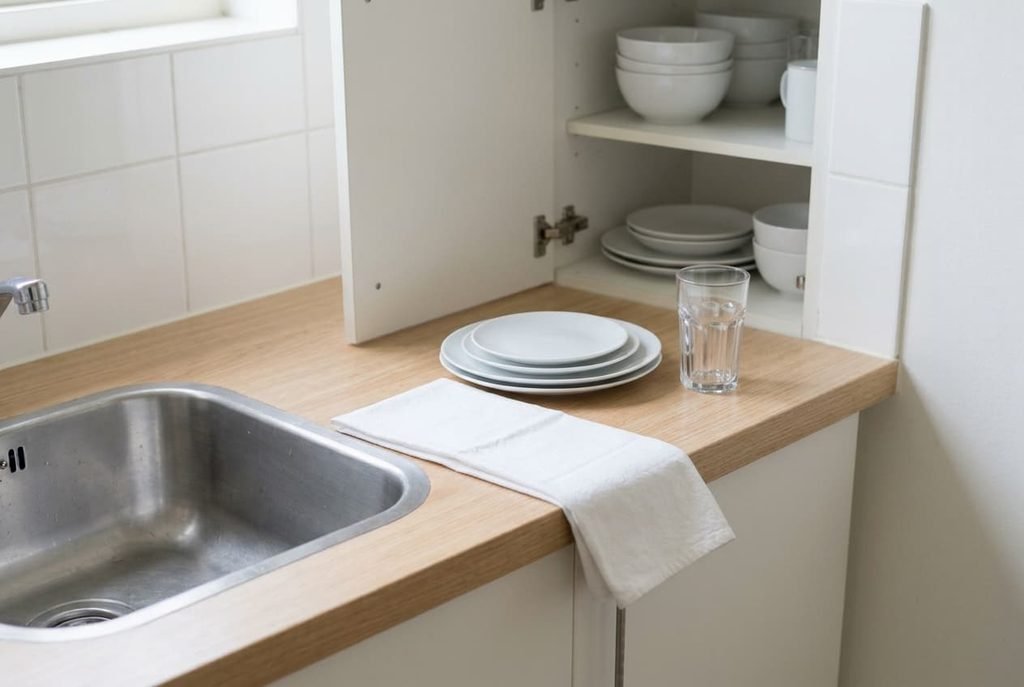
Before you buy either, count the items you wash. Drying each one by hand with a tea towel takes about 20 seconds, so 9 items cost 180 seconds, or 3 minutes. Everything goes straight back into the cupboard, nothing sits on the worktop and nothing needs a tray.
A tea towel beats both purchases whenever the evening wash is under about 10 items. At that size a dish rack or drying mat only adds an object to clean. One pan takes under a minute, so even a single pan doesn’t call for a mat. Keep one towel for glasses and another for the pan so neither picks up grease. A towel does get damp after a dozen items, so hang a spare on the oven door.
The catch is time, since at 26 items the same method takes about 9 minutes every evening, and that’s the point where a rack pays for itself.
Which One to Pick
Two branches cover nearly every kitchen.
If you wash more than about 15 items an evening and a strip of 45 × 30 cm stays free beside the sink, choose the rack. It holds the whole wash standing up and drains straight into the bowl, provided the spout reaches the sink bowl.
If you wash 10 to 15 items and the worktop has to clear once the dishes are done, choose the mat. It handles a small wash and then rolls into a drawer or stands in a cupboard. Check that the drawer is at least 6 cm deep before you count on it. Under 10 items, use the tea towel from the section above.
Whichever way you lean, measure the free strip first and count one real evening’s wash before ordering anything. A dish rack or drying mat earns its place by getting out of the way when cooking starts. Give the choice two weeks, and move it if you catch yourself reaching round it. The kitchen will tell you quickly whether it fits. Measure again whenever an appliance changes place.
Questions Readers Keep Asking
Which one lasts longer?
A rack with a coated wire frame lasts until the coating wears at the cutlery cup and the tray corners. A mat’s fabric loses some of its absorbency as the fibres wear. Both give years of daily use when they’re dried fully between washes.
How do I keep either one clean?
Empty and rinse a rack’s tray every week, then wipe the wires with a cloth and a drop of washing-up liquid. A mat goes in the washing machine at a low heat and dries flat. Both need drying completely, because standing water leaves a chalky ring where the tap water is hard.
Which suits a small rented kitchen with three people?
A rack, because three people produce about 26 items an evening and a mat fills up with the plates alone. Place it within reach of the sink so the tray spout drains into the bowl. One person living alone can manage with a mat.